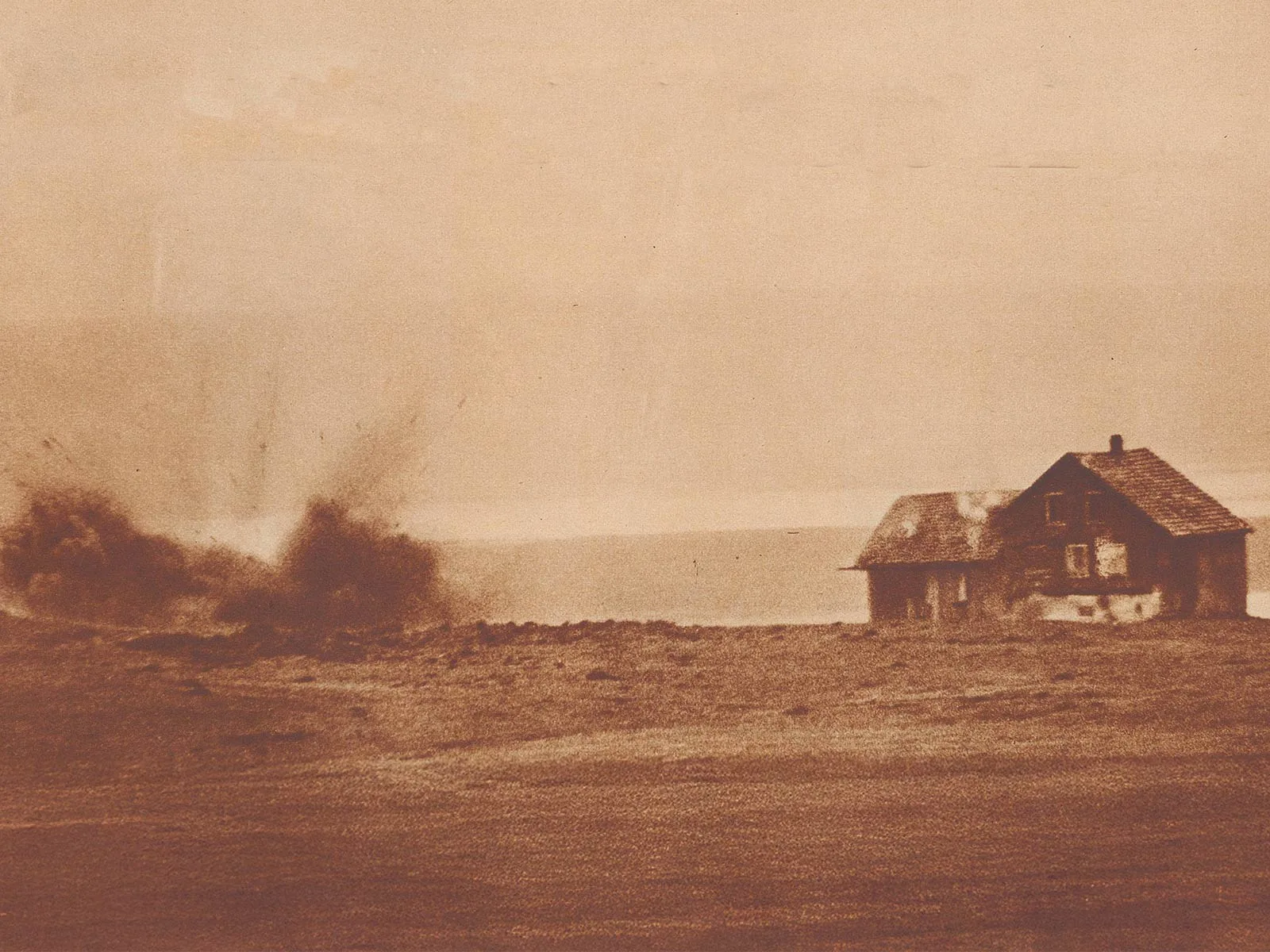
The first attempts involved buried bombs before dropping the high-explosive and finally firebombs. An illustrated report in weekly newspaper Zürcher Illustrierte contained a number of striking photographs demonstrating the effect of a high-explosive bomb, which fell about a metre from the building. The article said: “The detonation could be heard over 10 km away. It left an 8-metre wide and 2.5-metre deep crater. Stones, clods of earth, roof tiles, boards and other parts of the house were sent flying up to 80 metres in the air. Part of the building collapsed sideways and almost entirely disappeared into the crater.” One of the pictures is very blurred. That was due to the ground shaking from the bombs as apologetically explained in the article. The photographer was 500 metres from the house, which was how far the bomb fragments reached. One of the fragments, about eight centimetres long, is shown in the report.
Next up was the second house in the direction of the hamlet ‘Birchli’. The slopes were “full of spectators” by then according to a report in the Neue Zürcher Nachrichten (NZN). The people followed the dive and dropping of the bombs “with bated breath”. “Aerial bombardment in the Lake Sihl basin” was the headline in Der Sonntag magazine. The NZN concluded its report thus: “The people experienced a sensation and a rare, remorselessly destructive spectacle. Something we hope never to see for real.”
Just under seven years after the bombing, Einsiedeln was to receive a taste of real war. An English bomber that had been involved in the RAF’s disastrous raid on Augsburg had been so hard hit by German anti-aircraft fire that it diverted to Switzerland and exploded in a big fireball over Lake Sihl. The Einsiedler Anzeiger reported that the explosion had been so powerful that “people were thrown around in their beds while the furniture shook and entire houses vibrated.” The aircrew had managed to vacate the airplane shortly before the explosion, only one crew member who had already been injured died after his parachute jump. The frozen Lake Sihl, however, resembled a giant field of debris; only the heaviest pieces of debris penetrated the ice.
These days, Lake Sihl looks like it’s been there forever. No trace remains of the natural and cultivated landscape from the 1930s, which now lies almost 20 metres under the water.
Category: OLd Hist