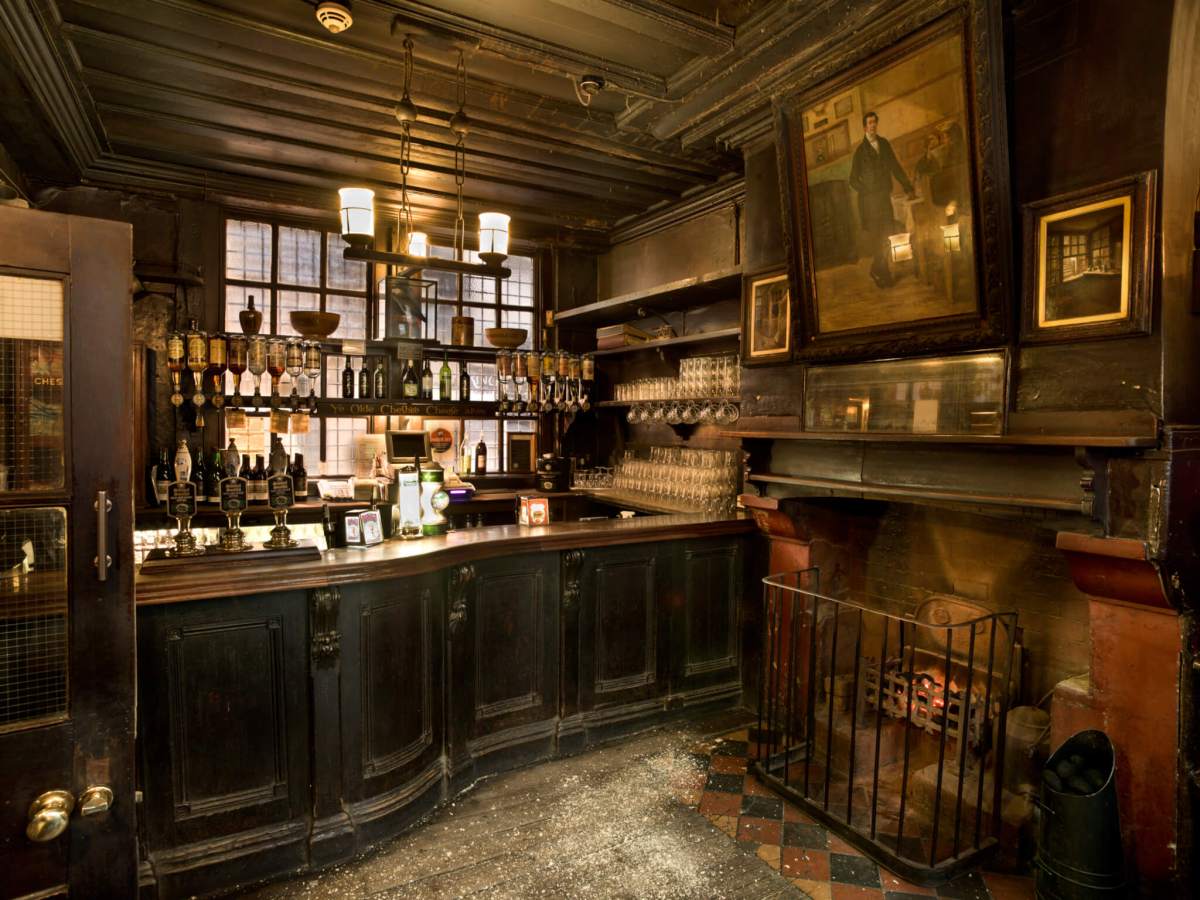
There are many claimants for London’s oldest public house, with several names repeatedly cropping up.
The earliest pubs were medieval alehouses, taverns, and inns. The term ‘public house’ was in use by the early 17th century and included these early types of buildings.
No historic pubs survived the Great Fire of London in 1666, and 21st-century Greater London is much larger than the historic core mapped during the late 17th century.
Therefore, our search for the oldest pub concentrates on Westminster, Southwark, Temple (the historic area around the Inns of Court) and the suburbs including Shoreditch, Whitechapel, Wapping, and Rotherhithe.
To start, let’s look at some of the popular contenders:
The Prospect of Whitby, Wapping
Claim: 1520
It’s claimed that the Prospect of Whitby is the oldest riverside tavern in England, and some say that the writer and politician Samuel Pepys was once a local. However, it’s unlikely that Pepys saw the building that stands today, as it appears to date from the 18th and 19th centuries.
The first references to the pub’s foundation in 1520 did not appear until the 1950s and may have been related to a marketing campaign rather than historical research.
Ye Olde Mitre, Holborn
Claim: around 1546
Supposedly founded in 1546 as a drinking den for the servants of the Bishop of Ely, the origins of Ye Old Mitre are much later. The site of the bishop’s London estate was taken over by the Crown in 1772 and completely redeveloped.
The Mitre was established during the 1770s, and the names of some of the early licensees, including William Dash (1791) and James Parker (1794), are known through fire insurance records.
The Mayflower, Rotherhithe
Claim: around 1550
Although not a listed building, it’s often claimed that the Mayflower first opened its doors for trade as a pub called The Ship around 1550.
The earliest parts of the standing building date to the 1780s, when it was a pub called the Spread Eagle and Crown. However, the building was severely damaged during the Second World War, leaving only the ground floor standing.
The building was rebuilt during the late 1950s and renamed the Mayflower in memory of the nearby mooring of the Pilgrim settlers’ famous ship that set off for the Americas in 1620.
Hoop and Grapes, Whitechapel
Claim: 1593
Some suggest that the Hoop and Grapes is London’s oldest licensed pub and that it survived the Great Fire of 1666. However, the building is more likely to be from the late 17th century.
It’s also recorded in trade directories and fire insurance records that the property was used by wine and brandy merchants throughout the latter 18th and the 19th centuries. It was eventually converted into a pub in 1920.
The Seven Stars, Holborn
Claim: 1602
It has sometimes been thought that the carpentry details of the staircase and roof structure at the Seven Stars are characteristic of the late Elizabethan period (1558 to 1603). It also claims the specific date of 1602 as its origin.
Instead, pub historians Geoff Brandwood and Jane Jephcote have pointed to a more likely date of construction in the 1680s. This structure was then significantly remodelled when a new façade was added in the 19th century.
What is the oldest pub in London?
The dates painted on pub signs can be inaccurate. Some pubs are on old sites, but their structures were rebuilt later. Others were built for a different purpose and were later converted into pubs.
However, based on archival research, archaeology and tree-ring dating, it’s possible to identify 2 genuinely old pubs surviving in London:
Ye Olde Cheshire Cheese, Fleet Street
Established by 1680
Despite claims that the cellars of Ye Olde Cheshire Cheese were built in the 13th century for a Carmelite monastery or that there was a pub on the site in 1538, the origins of this pub are a little later.
Stylistically, the earliest parts of the building, including the brick-vaulted cellar, date back to the late 17th century. It seems likely that the building was constructed after the Great Fire of 1666, although it was then significantly remodelled around a century later.
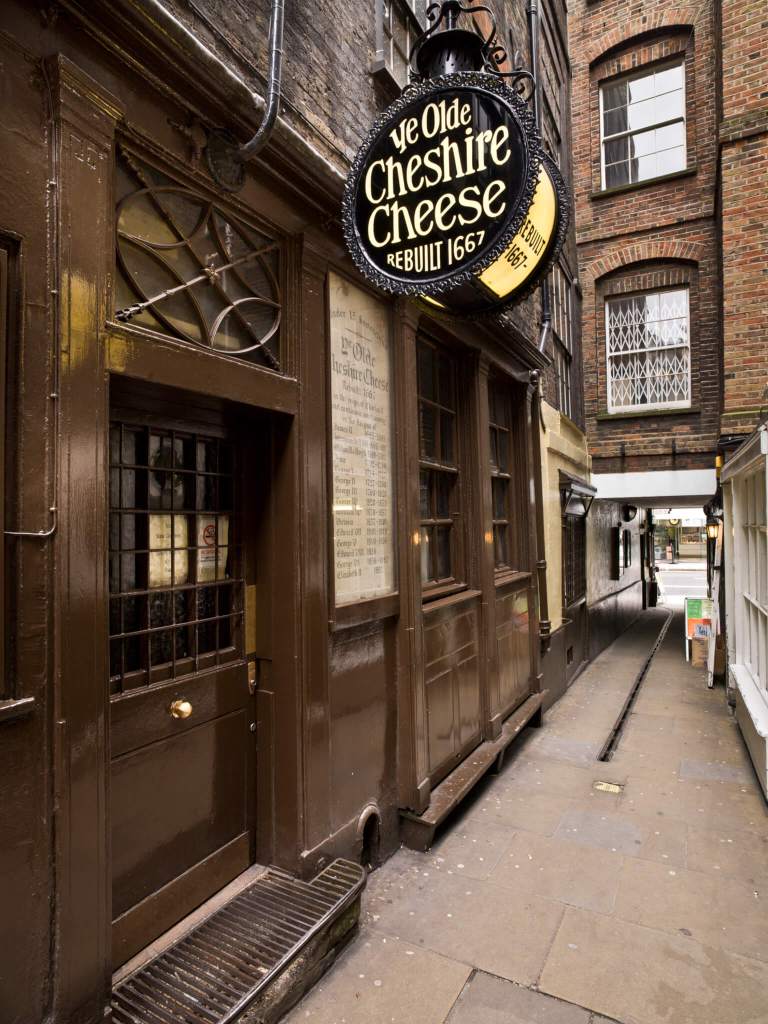
The earliest reference to the Cheshire Cheese comes from a broadside ballad, ‘The Midwives’ Ghost’, which was published in 1680. This marked the beginning of a strong literary association for the pub, which was later patronised by figures including Charles Dickens, W. B. Yeats, and P. G. Wodehouse.
The George Inn, Southwark
Established by around 1542 and rebuilt in 1677
Borough High Street was once thick with public houses serving travellers approaching or leaving the City via London Bridge. The George Inn is the only one to have historic fabric which has survived to the present day, giving it the best claim to be London’s oldest pub.
The earliest known reference to an inn on the site comes from a map of Southwark made around 1542. Later in the 16th century, it was referred to by the topographer John Stow in a list of ‘many fair inns’.
The building was rebuilt entirely during the 1620s, partly rebuilt in 1670, but was then consumed by the 1676 great fire of Southwark. In 1677, the tenant, Mark Weyland, began the reconstruction of the George.
The only surviving part of Weyland’s 1677 rebuild is the western part of the south range. This part of the inn probably had services on the ground floor below 2 storeys of bedchambers accessed from galleries. This makes it London’s only surviving galleried inn, once a common sight during the medieval and early modern periods.
The significance of pubs
Much blood, ink and beer have been spilt during discussions about London’s oldest pub. Given the tricky nature of the available information, it’s easy to see why. At a time when public houses are under increasing threat of closure, we should celebrate their value to the communities that they serve. Whether it’s a 17th-century galleried inn or a 19th-century beerhouse, let’s enjoy the warm welcome offered by London pubs. Cheers!
Written by Dr James Wright FSA
Further reading:
Leave a Reply