
Rose Sidgwick may have died of Spanish Influenza at just 41 years old, but she made pioneering contributions to the fields of history and international feminism. Here, we unpick her legacy.
Nestled in a picturesque garden behind the University of Birmingham Business School, there’s an ornate birdbath carved from stone. Look closely, and you’ll find a memorial inscription dedicated to a forgotten feminist pioneer, Rose Sidgwick.
When Mo Moulton, a Professor of History at the university, first learned about Rose Sidgwick through their research on detective novelist Dorothy L Sayers, the birdbath was hidden away in storage.
Now, it’s an essential stop on Moulton’s tour – “a walk through queer history” – which offers more insight into Sidgwick’s life, work and close relationship with fellow trailblazer Margery Fry.
Rose was born to a family of scholars. Her father, Arthur Sidgwick, an acclaimed researcher of Greek history, used his findings to draw modern conclusions on gender.
He was an early advocate for women’s rights, particularly in education. When Rose was born in 1877, she wasted no time following in his footsteps, first attending Oxford High School for Girls and later reading history as an Oxford Home student.
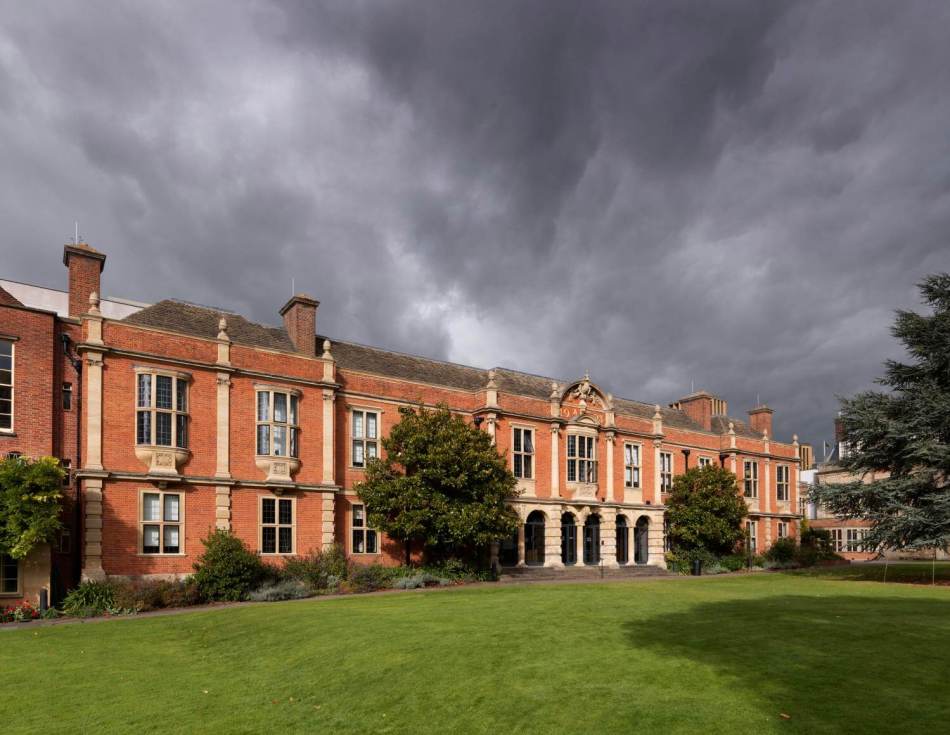
In 1904, at Somerville College, Rose first crossed paths with Margery Fry, a mathematics student and librarian. Both women held socialist values and a desire to champion marginalised communities.
In ‘Writings’, a 1908 pamphlet of Rose’s work available at Birmingham’s Cadbury Research Library, there’s a brief poem named ‘Tongues in the Tree’, a moral allegory which nods to the values of empathy and solidarity:
Don’t judge the folk in whose wood you walk
Till you perfectly understand their talk‘Tongues in the Tree’, from Rose Sidgwick’s 1908 pamphlet ‘Writings’

When Fry moved to the University of Birmingham in 1904 to take on a role as Warden of the women’s residence, Sidgwick decided to go with her.
Before long, Sidgwick earned her place as the first woman to lecture on history at the hallowed institution, and she moved into the women’s residence as a result.

This was a fascinating period in feminist history, the era of the so-called ‘New Woman.’ Higher education was gradually opening up to women, but many had to make sacrifices to succeed, and these opportunities were contingent on factors like race and class.
According to scholar Carol Dyhouse, “79 to 85% of women academics at the turn of the century ‘remained lifelong spinsters’,” essentially feeling forced to choose between their careers and a life of domesticity. Moulton explains that Fry in particular expressed regret over never having had children.
Yet, especially in women’s history, the term ‘spinster’ rarely tells a complete story. In the Margery Fry archive at Somerville College, there are huge stacks of letters and poems written by Rose Sidgwick, some of which make playful requests for confidentiality.
Moulton recalls one particular letter. There’s a message on the envelope: “For heaven’s sake, don’t leave this lying around!
“There’s a concern around who will see the letters, whether they should be burned,” says Moulton.

There’s more than a decade’s worth of letters exchanged between them, which nod towards a loving, intimate and sensual relationship. In one letter, Sidgwick writes about swimming naked in the sea, teasing Fry by saying, “Wouldn’t you have liked to see?”
Reframing histories through a queer lens is always challenging; after all, there’s no guarantee that past pioneers would have welcomed or embraced terms like ‘lesbian’, ‘bisexual’ or ‘gender non-conforming’ even if they’d had them. Yet Fry and Sidgwick worked tirelessly to create a sense of community for the university’s female students, creating intimate networks of outsiders.
Moulton recalls being moved by the words of scholar Sam Rutherford, a speaker at one of the queer history walks, who described the women’s residence as a queer kinship, a family setting or a way of life.
“We don’t have to reduce queerness to what people did in bed,“ says Moulton. “It’s a whole alternative way of building communities and relationships; I really like that as a reframing of what we’re looking for when we’re trying to recover queer histories.”
Mo Moulton, Professor of History at Birmingham University

During the First World War, Fry travelled to France as part of her involvement with the Friends’ War Victims Relief, where she played a crucial role in nursing war victims to health and aiding vital relief efforts. Sidgwick’s letters become understandably melancholy during the war, fraught with a sense of longing and panic that Fry wouldn’t survive.
In late 1918, Sidgwick undertook a mission of her own. As part of an international feminist network, she travelled to New York, where she gave a memorable speech at the Women’s University Club.
Not only did she advocate for the inclusion of women in higher education, she cited a desire to see “the easy access of college to those who cannot afford to pay for it.”
During this visit to the United States, Sidgwick held discussions with British and North American academics to establish the International Federation of University Women (now named the Graduate Women International), which advocates women’s rights and access to secondary and tertiary education.
Tragically, Sidgwick contracted influenza on her travels. On 28 December 1918, she succumbed to the lethal virus.

Another remaining trace of Sidgwick at the university is her inclusion on a First World War memorial dedicated to “the sons of the university who gave their lives during the Great War.”
Upon closer inspection, a small handful of women are listed on the memorial. “I think it ties into how different roles and actions were gendered by society,” theorises Moulton.
“In going to the US and representing Britain on this educational mission, [Sidgwick] was serving her country. To die in that effort meant that she had died for her country, just like the soldiers.”
One heartbreaking detail revealed in the Margery Fry archives is that she was never notified of Sidgwick’s illness. In Fry’s words, she never had the chance to send a last telegram, to write of her great love for Sidgwick once more before her death.

Margery Fry commissioned the memorial birdbath, a sentimental decision made to honour Sidgwick’s love of nature, of birds in particular. Fry moved to London after returning from France, leaving Birmingham and the university behind to focus on prison reform.
In the early 1920s, she became one of the country’s first female magistrates, spoke out against the death penalty and took a role as an educational advisor at Holloway Prison.
Yet, as her life in Birmingham faded to a distant memory, she continued to send annual cheques for the upkeep of the memorial birdbath. “It feels like an alternate burial site,” says Moulton, who continues the queer walking tour in hopes of preserving Sidgwick’s distinctly feminist legacy.
About the author
Jake Hall is a freelance journalist and author living in Sheffield, England. Jake’s first book, ‘The Art of Drag’, was an illustrated deep dive into the history of drag, published by NoBrow Press in 2020. Their upcoming book, ‘Shoulder to Shoulder’, is a history of queer solidarity movements over the last six decades; it’s scheduled to be published in May 2024 by Trapeze Books.
For years, Jake has been fascinated by everything from queer culture and histories to fashion, film and climate activism, and they’ve written for publications ranging from Dazed Digital and The Independent to Refinery29 and Cosmopolitan. They’re also a keen book fan and reviewer, publishing regular reviews on their Instagram.
Further reading
Leave a Reply