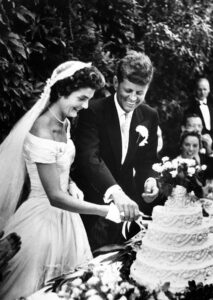
“The secret to happily-ever-after,” Janet Auchincloss had been preaching to Jackie and Lee ever since they were little girls, “is money and power.” She always believed she was entitled to affluence and security. Rose Kennedy felt the same way. Many women of that time, in fact, felt similarly even if, like Rose, they didn’t come right out and say it. While they dated and married with money and power in mind, to verbalize it would’ve been considered gauche, and certainly to explicitly pass it on to your daughters as a mandate, vulgar. They should learn by example, as Rose’s daughters did. With the exception of Rosie, all of them would marry men who had the potential to make a lot of money and be very powerful. The Kennedy girls would go into their marriages with their own wealth, unlike Jackie and Lee, who had no money of their own. Jack Kennedy met both of Janet’s standards, money and power. Her daughter could do a lot worse, and with John Husted, she would have. Therefore, JFK had Mummy’s approval, though she did have some reservations.
Janet knew her former husband, Jack Bouvier, and her father, Jim Lee, had strong feelings about Jack’s father, Joe. Jackie’s cousin John Davis explained: “In 1945, Jackie’s grandfather, Jim Lee, confided in Joe that he was about to invest in the Merchandise Mart in Chicago. That was prime real estate. Joe acted quickly and bought it for himself, thereby double- crossing Jim. Earlier, when Joe was chairman of the Securities and Exchange Commission, his crackdown on the way certain stocks could be traded had decimated Jack Bouvier’s portfolio. ‘My father and ex-husband hate Jack’s father,’ Janet told Mrs. [Martha] Bartlett. ‘So?’ Mrs. Bartlett countered. ‘What’s that got to do with Jackie?’ Janet couldn’t disagree with that, I guess.”
Joe Kennedy had been impressed with Jackie when he first met her in Palm Beach in December 1951. Once he realized she might be a factor in their lives, he took it upon himself to look into her background. “He’d heard she was an heiress, but when he checked it out, he found it wasn’t true,” said his nephew Joey Gargan. “He also assumed she was mostly French, given her surname. In fact, he learned she was only about one-eighth French, no matter what her mother, who was mostly Irish, might claim. She had also said the Bouviers were descended from French aristocracy, which also wasn’t true.”
Joe Kennedy’s secretary, Janet DesRosiers, recalled, “Joe used to say, ‘It doesn’t matter who you are. It matters who people think you are.’ That was politics, after all. He decided to keep an eye on Jackie while also giving Jack the freedom to pursue her. After all, she was, by any measure, the perfect political wife on paper. We all saw that. She looked good on Jack’s arm. That mattered.”
At this same time, Jackie was given a promotion at the Times-Herald. Her “Inquiring Photographer” column would be known as the “Inquiring Camera Girl” and would carry her byline. While she was determined to continue working, she felt there was no reason she couldn’t also date Jack. However, their budding romance would be complicated by his workload as he traveled about and laid the groundwork for his Senate campaign. “It was a very spasmodic courtship,” she later said, “conducted mainly at long distance with a great clanking of coins in dozens of phone booths.”
On April 6, after assembling a crackerjack team to help him get to the finish line, Jack officially announced his Senate run. His team included Dave Powers from Boston, a loyal friend who’d been in charge of his congressional campaign. There was also Larry O’Brien, an experienced politico from Springfield, and Kenny O’Donnell, Bobby’s old college roommate, a fellow Irishman who had served in the Army Air Corps.
A big part of Kenny O’Donnell’s job would be taming Jack’s father, who was financing the whole operation but who everyone agreed had a damaged reputation and weak political instincts. Joe could be a bully, unreasonable, contentious, and prone to spreading conspiracy theories. On the plus side, he was a great media strategist, knew how to plant just the right stories at just the right times, and was able to secure the important endorsement of top newspapers, even if he had to pay for them. In a couple months’ time, he’d write a check for half a million dollars to get the support of the conservative Boston Post. Jack would say his father had to “buy the newspaper” to get such great backing. Joe had plenty of money and would spend as much as he needed to in order to see his son win. “Kennedys must win” was his philosophy, always. There had to be a way around him, however, in building the kind of statewide campaign necessary for Jack to win. Kenny had the smarts to figure it out, and a big part of how he did that was to pass the buck on to someone who had real influence over the patriarch: his son Bobby.
Twenty-six-year-old RFK knew that to control his father he needed to act as if he was seeking his approval when, actually, he was strategizing ways around it. Jack too often vehemently disagreed with their father, which always caused havoc, and Teddy, of course, was too young to be a factor. Bobby had turned pacifying the old man into a fine art; he’d been doing it all his life. When his two older brothers were off finding themselves, he was home sparring with Joe. Now, he would be used to tame him. Bobby would end up being a titanic force on Jack’s team, from this point forward . . . and all the way to the White House.
JFK: Public, Private, Secret © 2025 by J. Randy Taraborrelli. All rights reserved.
The post Featured Excerpt: JFK: Public, Private, Secret appeared first on The History Reader.
Leave a Reply