by Veronica Lazăr
Intellectual history’s recent global turn signaled the need for both an epistemic renewal of the field and its strong repoliticization. Global intellectual history is at least partially a result of the critical forces that, for decades, had denounced the blatant Eurocentrism of hegemonic Western systems of knowledge. The global turn strives to update the critical and self-critical dimensions of Western academic practices. Overall, there has probably never been so much excellent and long-awaited discussion of empire, coloniality, epistemic injustice, the construction of race, and related issues—concerning both the intellectual practices that supported such ideas and the mechanisms and power structures that sustained these systems of thought for so long.
Nevertheless, the global turn that emerges from this arborescent genealogy reveals a paradox. At the level of its content, the discipline grows increasingly disgruntled with the authoritarian hierarchies of its traditional topics and epistemic categories. It repeatedly rewrites and re-questions its canon, rules of accumulation, and geographies of knowledge. Yet with each academic practice, with each book and article, it deepens the asymmetries between an active (and again Western) core of knowledge production and an ever more extended plurality of native objects of study.
At first glance, it seems surprising how recent the field appears—or at least presents itselfto be. Its now-authoritative journal Global Intellectual History was established in 2016. According to the rhetoric of disciplinary renewal of its editors, Samuel Moyn and Andrew Sartori, the earlier eponymous volume (2013) was intended as “a foundational work that seeks to act as a theoretical manifesto” (López 2015, 155). In Rethinking Modern European Intellectual History, a collective work he co-edited with Darrin McMahon, Moyn (2014, 112–130) seeks to trace the state of the art and to suggest a renewal program. In so doing, he denounces the persistent idealism in the practices of intellectual historians. Of course, what became known as the Cambridge School model of contextualism had already sought to brush aside what Quentin Skinner perceived as the intrinsic idealism of the Lovejoy-esque, Whiggish, and even Marxist histories of ideas. Moyn, however, argues that the essential move is to pay attention to the difference between theories and actual practices of writing. Authors from the North American tradition represented in the Moyn and McMahon volume seem rather indifferent to the Cambridge School’s agenda and restrictions. As the editors note in their introduction, the reasons are both institutionally contingent and polemical: British intellectual historians associated with Skinner had reduced the meaning of context to text and, according to Moyn (114), had essentially ignored social theory’s basic impulse “to anchor representations in practices.” For intellectual history to develop a more substantial contextualism true to its intentions and critical edge, Moyn argues, it should return to the intuitions of Marxism—with its great questions, if not great answers—about what shapes and gives stakes to doctrines and concepts.[1]
For Moyn and Sartori, the improvement of intellectual history also requires turning the mirror toward the discursive apparatus itself and reflecting on the polysemy of the term “global”—the plurality of its possible objects and lenses, as well its fractures—in an attempt to create a terminology of the global that is both empirically valid and politically non-oppressive. Including non-Western theoretical contributions is the minimum, but as Vanessa Smith (2013, 83) points out in her contribution to their volume, a truly global intellectual history must also “confront… the implicit bias toward written contributions in the production of knowledge.” So it demands the inclusion, too, of “the contributions of participants from cultures in which writing is a belated mode of communication (a move that, in turn, foregrounds the politicized dimensions of written production).” Historians should reflect on the geographical distribution of the still-centralized production of theory, in which the rest of the world, indispensable for knowledge, remains a resource for data mining processed in Western academic laboratories: “Bruno Latour’s identification of metropolitan ‘centers of calculation,’ epicenters at which knowledge was gradually gathered and archived in the service of projects of empire… The operations of an imperial will to know that sought to render alterity portable, abstractable, and translatable for accumulation at imperial centers” (87). Therefore, to correct this traditional hierarchy, non-Western academics should become integral to the process of developing theories and concepts, and their work should be recognized and integrated.
Yet this work of rebalancing global knowledge production and integrating diverse intellectual traditions has already been underway for some time, and it raises its own problems. Frederick Cooper (2013) notes in his excellent concluding essay in Global Intellectual History that the uses of the word “global” in intellectual history oscillate between “soft” and “hard” meanings. In its “softer” meaning, global intellectual history seeks to correct certain insufficiencies by extending its objects of research and including what the narrow, peripheral view of the Western intellect has left aside. As Cooper writes, “the key questions are how far the range should extend and the extent to which we can do more than throw more cases from more parts of the world into the intellectual stew” (Cooper 284). The “hard” version challenges the paradigm of globality and questions its reality, as well as its geography and history. It asks whether “global” isa native term, an operative concept historians use today, or perhaps a meta-category, like “universal history”? The great risk here, according to Cooper, is ceding to the modernist reflex, which constitutes another form of Eurocentrism: believing that the global is a creation merely of Western modernity, one made possible by the spread of capitalism and its very specific instantiation of the knowledge-power apparatus of political economy. Such a perspective risks reenacting, in the negative and with guilt, the very Western exceptionalism that scholars of the global turn strive to overcome.
To ensure disciplinary self-reflection, intellectual history should, according to Moyn and Sartori, focus on the way that ideas are anchored in practices and on how they may function as ideologies (a term the first generation of Cambridge scholars ostensibly bypassed). As they put it, “In this way, a global intellectual history would be realized not at the level of the object of study but at the level of the profession itself, in which the inequitable distribution of institutional power and authority stands as the single biggest obstacle to overcoming Eurocentrism” (Sartori and Moyn, 19). But which practices reveal how knowledge is produced in the field of intellectual history? Here, we get to the real problem.
The practice that Moyn and Sartori advocate seems confined to what happens within theories. Though they set for themselves the goal of avoiding the trap of merely focusing on contextual languages when recovering contexts, they suggest that “the problem is far more one of theory than one of practice.” Their goal is to build better theories, not necessarily to reconfigure power relations in the field, because “posing the difficulty (evidentiary, linguistic, professional, and so forth) of enacting a global history depends, first, on developing plausible models of what the subject matter of such a historiography ought to be” (Moyn and Sartori 2013, 4). Dominant models should be corrected and supplemented, but not disrupted: “Shruti Kapila considers how this move in European intellectual history might be regarded—and corrected—by those whose expertise lies outside of Europe in places where ‘European’ ideas are often presented as descending upon and traveling within” (10). It may not be a coincidence that almost every review or summary of recent developments in intellectual history that I have read in the past few years cites only sources written originally in, or translated into, English (and occasionally German or French). To take a more blunt example, in Danielle Charette and Max Kjönsberg’s literature review from 2020, every current or movement in the history of political thought, whether of primary or secondary importance, appears to belong to the English or North American traditions. This selection is not reflected upon in the text. Similarly, Riccardo Bavaj’s synthesis “Intellectual History,” a study dedicated to the plurality of understandings of intellectual histories, omits theoretical sources in foreign languages other than German.
In spite of its intentions to provincialize itself, in Chakrabarty’s words, and even when its topics are generously diverse, the global meta-language largely relies on, or is substantially mediated by, academic literature published in English. Historians’ research networks, as reflected in these works, are now more transnational and more linguistically and thematically diverse than ever. Yet their center remains Anglo-Saxon academia (the term “Eurocentric” seems outdated), concentrated especially in a few universities, institutes, and publishers, whose (at least until now) enormous financial resources have reinforced this asymmetry. The existence of an international lingua franca is a substantial condition for a more democratic access to knowledge worldwide, but the persistence of a central pole of academic legitimation, which this same mode of circulation continually reinforces, is a far less democratic phenomenon. While figures such as Goody, Chakrabarty, Latour, and Fabian have already extensively expressed cultural criticisms of the imperial legacies in the academic world of historical theory, we must avoid reducing their powerful analyses into repetitions of the age-old resentment against the hegemony of English (or French, German, or Latin). What is important to emphasize is that the dominance of one language merely obscures the deeper power relations that define where academic authority resides today. To further question its own conditions of possibility and asymmetries of power, global intellectual history should examine its present-day centrality and hegemony, beyond the legacies of the Western political and epistemic empires.
The sociology of knowledge had promised to do so: Pierre Bourdieu ([1990] 1999, 220–228) famously presented his reflexive sociological examinations of international intellectual exchanges as an extension of Kant’s questions regarding the conditions of knowledge. He was particularly interested in the strategic construction of criteria that define legitimate intellectual activity, namely those criteria that emerge from power struggles within and between fields, both intellectual and non-intellectual, national and international.
Just as humanity’s self-image has been shaken by the Copernican, Darwinian, and Freudian revolutions, the self-image of any intellectual discipline may be destabilized by the sociological examination of its own institutional distribution of power and resources, and by the ways these external forces shape ideas themselves or establish and contest the principles for evaluating ideas and intellectual work. Of course, Bourdieu was writing within a still hugely influential French editorial culture. His focus was not on academic publishing in today’s narrow sense of peer review, whose importance has since increased enormously. Bourdieu’s purpose was to understand the internationalization of academic life, a process far from spontaneous, relying on radical operations of decontextualization and re-rooting and shaped by circumstances specific to each national cultural field: “I mean by this the imposing of a particular definition of the legitimate exercise of intellectual activity, for example, Germany’s valorization of ideas of Kultur, depth, philosophical content, etc., over what they saw as the French stress on Civilisation, clarity, literature, etc.” (227).[2]
Bourdieu’s declared objective was the denationalization of categories of thought—the emancipation from national fields. The work of another well-known sociologist of ideas, particularly philosophical ideas, Randall Collins (2000, 15), focuses on networks and could be very useful, were it not for its determinism, rigidity, and overly generalizing method, limitations which lead him to proclaim “the social predictability of intellectuals’ thinking”:
I am arguing that if one can understand the principles that determine intellectual networks, one has a causal explanation of ideas and their changes. In a very strong sense, networks are the actors on the intellectual stage. Networks are the pattern of linkage among the micro-situations in which we live; the sociology of networks penetrates deeply into the very shapes of our thought. The network dynamics of intellectual communities provides an internal sociology of ideas, taking us beyond the reductionism of traditional externalist sociology. The historical dynamics of social identities in networks, too, casts the question of canonicity in another light.
What the sociologist would find, according to Collins, are “structured processes that are historically general.” This is because “there are universal patterns of formation of ideas across history and intellectual cultures” (xviii).
While the mainstream sociology of knowledge focuses largely on relations between actors in the field—negotiations for cultural power and symbolic capital, the economy of prestige, and individual career strategies—a genuinely materialist understanding of global intellectual history should also examine the specific political economy of its own model, especially as it has evolved over the past couple of decades with the takeover of academic presses by commercial publishers. Today, the rise of for-profit publishing is an essential part of the globalization of knowledge in a very specific way: as Valer Cosma (2024; 2025) has shown, much academic research is publicly funded yet privately published by academic entrepreneurs who offer no payment for the labor they extract, thereby fueling an increasingly financialized publishing system whose results are eventually resold to universities and libraries. Outside the Western world, as these libraries and universities sometimes lack resources, accessing academic journals and books is prohibitively expensive for both institutions and individual users. As a result, access to research often depends on piracy, a providential means of democratizing at least the reception, if not yet the production, of knowledge. Even open-access research publishing as it is practiced now, where the authors pay for readers’ unrestricted use, favors those researchers who already have grants or institutional financial support.
Beyond the inequalities in researchers’ material means, which this situation does nothing to correct, the publication system grows increasingly financialized and centralized, even when its content may be radically anti-capitalist. The consequences affect not just the academic community, but society as a whole. The profits of the Big Five major players— Elsevier, Springer Nature, Wiley, Taylor & Francis, and SAGE—have been steadily increasing. Substantial portions of their stock are held by hedge funds, their operations require minor investments, and their returns ultimately function as an epistemic rent. Moreover, “these corporations manage not only the scientific journals, but also the infrastructure of academic evaluation, through platforms like Scopus (Elsevier) or Web of Science (Clarivate). These instruments decide which research is worthwhile and which is not, who gets the funding, who is promoted, and which ideas are disseminated. Science is not only commercialized, but also filtered through private interests… These rates of profit can be higher than those of companies like Hyundai, Amazon, or even Google,” while the production costs are minimal (Cosma 2025). In addition, companies like Taylor & Francis appear willing to sell data from their journals to other companies that use them for AI training, as this controversial deal might suggest.
The most lucrative publishing sectors are probably in the natural sciences, but the same constraints, restrictions, and profit-driven tendencies already affect the social sciences and humanities—or are likely to do so soon. Journals in these fields belong to the same conglomerates and reinforce the same external structures. Historians, philosophers, and political scientists face the same “publish or perish” pressures in shaping their careers. These pressures, in turn, encourage the pursuit of academic niches, which are sometimes artificially created, and the constant pretense of inventing new concepts, perspectives, or theories, often by ignoring or misrepresenting earlier ones. Therefore, a sociology of the present conditions of knowledge production, circulation, and promotion of ideas throughout global academia—one connected to a political economy of academic work and scientific publishing—might be essential for the correction of the remnant idealism and Eurocentrism of intellectual history.
Global history is politically progressive but remains largely insensitive to the financial and symbolic economy underlying its centralized production. Capitalist knowledge brokers have replaced the old imperial and colonial divisions on which earlier institutions of knowledge were built, while simultaneously deepening these historical gaps through new means. This knowledge industry shapes new forms of the “global.” However, as the developments of the second Trump administration suggest, the power of knowledge brokers may continue to rise, while the influence of universities and intellectuals themselves may begin to decline. This practical vulnerability could yet be transformed into an intellectual strength through active self-reflection.
This think piece is part of a JHI Blog forum: “The Return of Political Economy in Intellectual History.”
[1] The late Ellen Meiksins Wood, whose work and rich reflections on method are unjustly neglected even by Moyn, succeeded in writing a brilliant historico-materialist longue durée history of Western political ideas without falling into the determinist trap. She makes room for the intellectual creativity and originality of the individual authors she examines.
[2] Antoine Lilti relativizes, as well, the fluidity and homogeneity of the internationalization of the historical profession today by stressing that “history remains an academic discipline that functions largely within national contexts, not only because of institutional regulations governing the recruitment of scholars and the evaluation of their research, but also because of the distinct ways that students are trained, publications are reviewed, and research priorities are set” (68).
Veronica Lazăr is a philosopher and historian of political ideas. She has lived and studied in Cluj, Paris, Berlin, Vienna, and Stanford. She currently teaches in the Department of Philosophy at the University of Bucharest. Her research focuses on philosophies of history, aesthetics, cinema, the history of political thought, and the history of academic disciplines. She is the author of Luminile revoluționează istoria, Vol. I: Erudiții și teologii [The Enlightenment Revolutionizes History, Volume One: The Érudits and the Theologians] (Tact, 2024), which examines the transformation of historical thought in the early French Enlightenment. This volume constitutes the first part of a broader investigation into the origins of Western historical consciousness. Together with film critic Andrei Gorzo, she co-authored Beyond the New Romanian Cinema: Romanian Culture, History, and the Films of Radu Jude (ULBS, 2023), a study of the Romanian director Radu Jude and his artistic reflections on cinema, history, and society.
Edited by Rose Facchini.
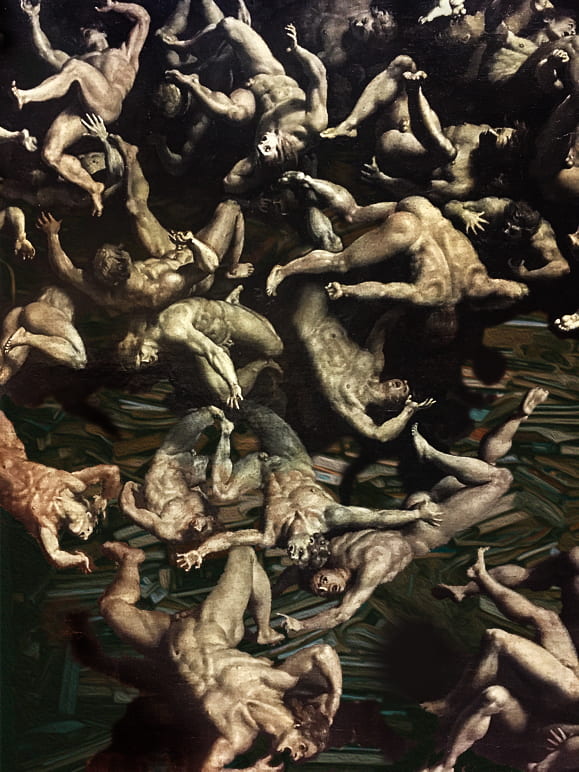
Featured image: Digital montage of detail of Andrea Commodi, Caduta degli angeli ribelli (The Fall of the Rebel Angels), 1614–17 and A pile of books sitting on top of a wooden floor by Gustavo Reyes via Unsplash.
Leave a Reply