Intricately linked to postcolonial realities, this essay delves into the visual-cultural connections between the establishment and challenging of white-centric perspectives, with a special focus on resistance to, as well as (re-)appropriations of, visual coloniality by non-white communities.[1] As I show, these (re-)appropriations were partly ambiguous, and cannot be fully explained by exclusively applying Eurocentric theories of collective memory. Instead, I argue that an approach through the lens of transimperiality, which considers the circulation of visual coloniality, counter-narratives, and complex appropriation processes across space and time, better grasps the complexity of (post-)colonial visual memory and its various media of expression.
Regarding the visual coloniality, I argue that there are links between the visual glorification of colonialism across empires, eras and different public spheres. This is done by scrutinizing “seeing traditions” that have spilled over into public spheres of colonial visualisations like museums, statues and monuments. Transimperial visualisations were not limited to colonial photographs. Instead, they reflected a colonial mind-set that was not limited to the mobile camera of any time but found in most public displays of colonial projects.
Within this essay, I present parts of my research project, where I focus on unveiling the long-term effects of colonial stereotyping and othering across centuries, and break down how they lead to identity-finding processes and collective memories in the 21st century. The regional focus is on photographs and events related to South Africa and Namibia. Facilitated by a transimperial circulation of racialised southern-African visual stereotypes created by European photographers, a visual heritage travelled the world that is being challenged increasingly and especially in the last decade.[2]
In recent years, there have been impassioned public discussions about identity and race across Europe, Africa and beyond that. Unlike earlier manifestations of this debate, they had a pronounced visual dimension. This essay highlights the connectors spanning from colonial photography to 21st century attempts to disrupt the above-mentioned visual traditions by challenging colonial stereotypes, changing the language[3] connected to them and addressing public spaces with strong colonial pasts.
These attempts include endeavours by affected communities to reclaim agency over their visual heritage and – as I call them – create counter-colonial visualisations[4] Counter-colonial visualisations seek to challenge and redefine racial stereotypes from a decolonised or postcolonial standpoint.[5]
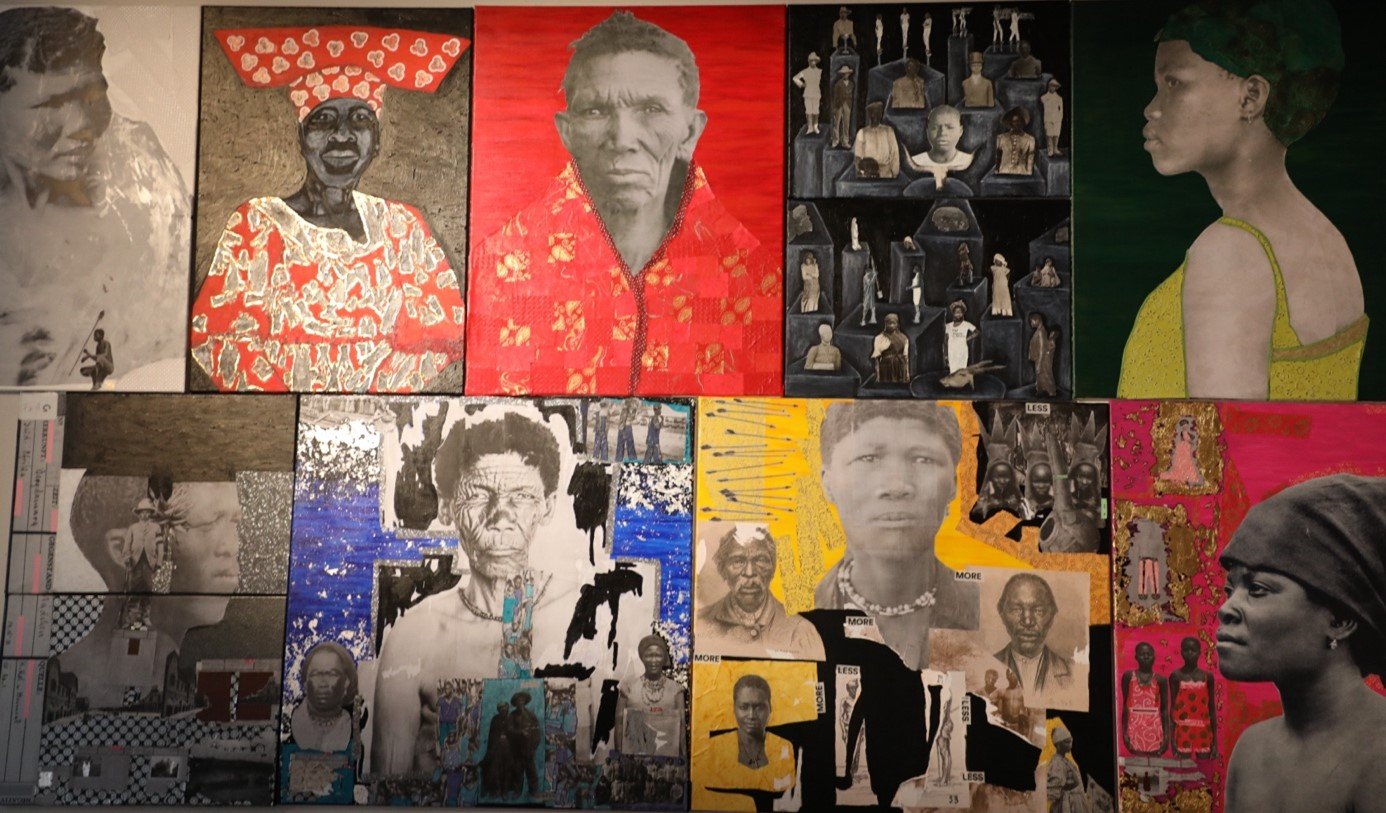
As a first example of how to counter-narrate the colonial gaze (a tool that enforced racial power hierarchies across empires), I suggest engaging with the works by contemporary artist Vitjitua Ndjiharine. Her decolonizing work is based on colonial photographs that originate from the time of Germany’s colonisation of Namibia. The objects have since been and still are stored in Hamburg in the archives of the MARKK – Museum am Rothenbaum. World Cultures and Arts. As a Namibian with Herero heritage, Vitjitua Ndjiharine took it upon herself to (re-)clothe the individuals displayed in the various images as well as re-assigning them agency. By doing so, she too took agency and in her own way decolonized those visual objects across continents. In her words, Vitjitua investigated “historical narratives in an effort to infuse photographic subjects, who are often stripped of any sense of self, with a sense of humanity, empathy and relatability.“[6] Thereby also linking the past with the present. The final results of the research and artistic collaboration between Hamburg University and MARKK were curated as part of the Ovizire×Somgu exhibition and presented at M.Bassy in Hamburg in 2018.[7]

Finally, going beyond the colonizer-colonized dichotomy, I add a more complex dimension, based on research trips to Windhoek, where I visited the National Museum of Namibia and witnessed an unexpected twist of visualities. What I encountered there was yet another layer of seeing traditions from former empires: cross-continental Cold War designs with a Communist note and a 21st century visual celebration of the Namibian liberation movement. After addressing the lacunae of collective memory studies to grasp such transimperial connectivity across time and space, the following blog post will discuss three briefly presented case studies: (i) colonial photography from Omhedi region, northern Namibia, (ii) the toppling of a colonial statue in Cape Town and (iii) a Namibian Independence Memorial Museum in Windhoek. To do justice to this multifaceted visualisation of colonial, counter-colonial, post-colonial and transimperial connections,[8] I combine analytical theorems from art history, whiteness studies, microhistory, global history, oral history and collective memory studies.
Collective Memory and Counter-Colonial Visualisations
Today, global societies rely more than ever on visual stimulation and entertainment, making a reality without reproducible visuals nearly unimaginable. Moreover, the pictorial turn has led to increased recognition of visual sources as historically relevant within academia. Scholars like W.J.T. Mitchell advocated for a pictorial turn in the humanities since the 1990s, emphasising the need to acknowledge the significance of visual sources alongside written or verbal ones.[9] This shift coincided with the rise of postcolonial studies, necessitating more diverse sources and perspectives. In my case, and based on prior research,[10] this involves analysing the long-term impacts of colonial photography and stereotyping on visual collective memories and identity debates in 21st century Europe and Southern Africa.[11]
Maurice Halbwachs’ definition of collective memories emphasises their dependence on a collective context. Therefore, the past is a social construction passed down through generations, subject to change based on societal factors. Different groups may form varying understandings or memories of the same event, such as colonisation. When groups with divergent collective memories intersect, tensions arise, necessitating identity redefinition and narrative adjustments. What Halbwachs’ original research lacks, however, is the inclusion of non-white colonial experiences. In addition, Susan Sontag’s insight into seeing traditions underscores that individuals also grow up with pre-existing images that shape their perception of the world.[12] Combining a collective memory with a seeing tradition approach becomes imperative for a comprehensive understanding. While my research draws from Halbwachs’ collective memory approach, it introduces a racial dimension absent in the original application of his theoretical method. Acknowledging these “blank spots” is crucial for this essay, aiming to incorporate racial experiences into the analysis of collective memories.[13] In fact, Halbwachs’ theory, developed in the early 20th century, reflects a colonial mind-set influenced by a prevailing Eurocentric worldview and therefore does not reflect today’s postcolonial situation.
Before delving into case studies, it is essential to recognise that memories are not solely private but also public matters. In her work, Aleida Assmann highlights the politicisation of memory creation by heads of states, elites and influential institutions.[14] Public spaces like statues, monuments and memorial days are shaped by these influences, and with them group dynamics. Accordingly, I argue that statues and monuments with colonial contexts too are part of (post-)colonial seeing traditions as much as photographs are.
The following section discusses examples of past actions influencing collective memories from or with a colonial background and current movements that actively seek to change collective colonial seeing traditions. These examples encompass the re-interpretation of colonial photographs, the removal or retention of statues and monuments, debates on restitution and repatriation of colonial heritage and political protests. Unlike the often top-down creation of collective memories, counter movements tend to be driven by bottom-up initiatives.[15] Dating back to the 1920s and 1930s,[16] transimperial and anticolonial bottom-up movements like the League Against Imperialism, Pan-African conferences and especially the Bandung Conference of 1955 had spread globally. Rooted in those bottom-up movements and combined with 21st century debates, the following pages apply a US-dominated discourse as a baseline[17] by introducing a photographic collection, the remnants of a colonial memorial and a post-colonial museum.
Case Study 1: Reclaiming agency in colonial photography on northern Namibia
The anthropometric photographs captured in the Omhedi region of Northern Namibia exhibit certain resemblances to “usual” colonial photographs. They are black-and-white images that suggest academic neutrality yet simultaneously apply Western racial bias by means of a colonial gaze. Unsurprisingly, racial stereotypes influenced these images, many of which were meticulously staged to align with Western aesthetics and political objectives, particularly within the context of Namibia under South African indirect rule. As a result, white photographers like Alfred Duggan-Cronin[18] and C. H. L. Hahn too were not only subject to said colonial seeing traditions, but they further developed, professionalised and reinterpreted them in 20th century southern Africa.[19] Nonetheless, Namibian scholar Napandulwe Shiweda compellingly argues that colonial photographs, while reflecting the colonial gaze during their creation, can also function as a collective memory for a national group a century later. Shiweda illustrates this perspective by examining Duggan-Cronin’s photographic legacy in the Omhedi region, delving into the historical and political circumstances surrounding the images’ production and highlighting their relevance in 21st century Namibia.
When Duggan-Cronin undertook the task of photographing the Ovambo people in Namibia, he collaborated with Hahn, who provided local knowledge and introduced him to community leaders. At first glance, Duggan-Cronin’s images may not stand out stylistically from other African photography of the time, adhering to the “principles of physical anthropology.”[20] They focus on tribal attire, jewellery, architecture and polygamy. Nonetheless, despite Duggan-Cronin’s stated intention to capture the Ovambo people before Europeanisation eroded their original culture, he occasionally staged photographs and positioned his models according to Western seeing traditions and aesthetics.[21] Shiweda contends that concentrating solely on the photographer’s agenda and power dynamic neglects the agency of the Ovambo models. She argues that, although Duggan-Cronin’s photographs adhered to colonial stereotypes, the subjects engaged in new forms of self-fashioning, emphasising the complexity and agency within the images.[22]
As with other examples in this paper, seeing traditions based on colonial racist worldviews are now undergoing re-contextualisation and critical analysis. Due to colonial power structures in place until decolonisation, most Namibians and Ovambo people did not have access to the multitude of photographs taken of them until the early 21st century. Shiweda’s contemporary research reveals that today’s Ovambo descendants are reusing the same photographs to re-establish connections to their ancestors and cultural traditions. These images are no longer viewed as merely a colonial construction; instead, the descendants appreciate them, almost with pride.[23] In fact, current developments have extended to using the photographs in the reconstruction of an “Ovakwanyama cultural identity and its newly restored kingship at Omhedi” from 1996.[24]
Case Study 2: #RhodesMustFall, Cape Town
Like photographs, statues and monuments from colonial contexts also represent colonial seeing traditions. They have therefore become subject to discussions on their retention or removal across the globe. An internationally prominent instance of a contested and renowned case regarding the removal of a colonial heritage statue is the Rhodes Must Fall (RMF; #RhodesMustFall) movement in South Africa, which emerged in 2015. Originating at the University of Cape Town (UCT) and later extending to Oriel College in Oxford (UK), this movement served as a blueprint for similar initiatives globally due to its successful outcome.[25] UCT student protests had triggered the RMF movement, with the aim to remove a statue of Cecil John Rhodes (1853-1902)[26] from its central position on UCT’s Upper Campus. Today, he is primarily recognised as the founder of the Rhodes Scholarship Programme. However, in southern Africa, his legacy remains visible through memorials, schools, street names and landscapes bearing his name, with local sentiments often divided on the question of retaining or removing his name, as can be seen in select cases in Zimbabwe.[27]
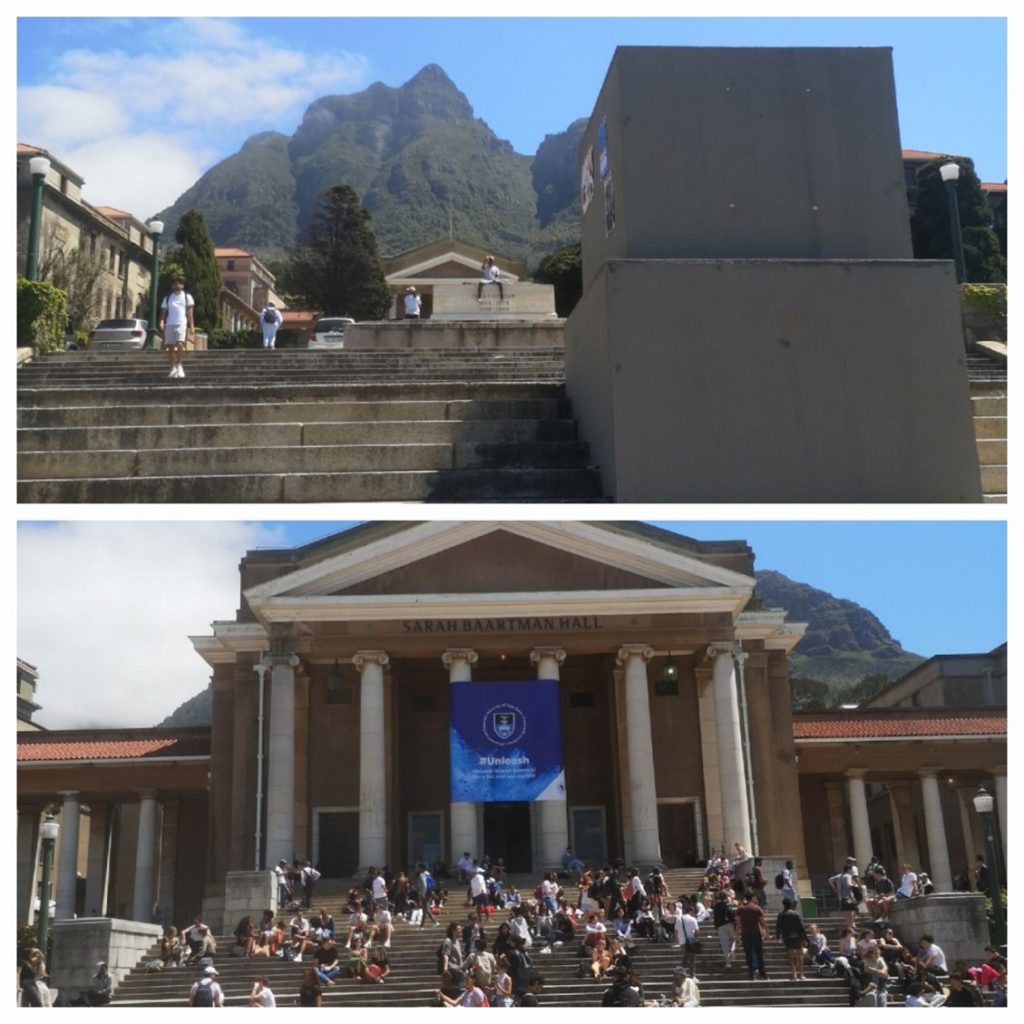
The RMF movement as such is a post-Apartheid, antiracist and decolonising movement addressing persistent racial inequality in former European colonised territories in South Africa. Moreover, according to Francis B. Nyamnjoh, the protests not only targeted global xenophobia but specifically afrophobia.[28] The movement reflected a quest for a self-determined national or ethnic identity free from white domination or supremacy, necessitating the removal of reminders of past repression and racial segregation, both internally and externally. Internally, universities like UCT, sought transformation as a means of internal shedding, acknowledging the need for change from within.[29] Another decolonising effort taken by UCT is the renaming of its main hall from Memorial Hall to Sarah Baartman Hall in 2018. Baartman was a Khoisan woman whom the British enslaved to present her at so-called freak shows in the UK. By renaming the hall, UCT hopes to take “a key step in the university’s commitment to transformation and inclusivity.”[30]
The success of the RMF movement sparked similar debates globally regarding the removal or re-contextualisation of public spaces with colonial associations. Examples include the toppling of the Edward Colston statue in Bristol (UK), the Leopold Must Fall Movement in Brussels (Belgium), the Piet Hein Monument in Rotterdam (Netherlands) and the Reiterdenkmal in Windhoek (Namibia).[31] These happenings underscore the ongoing identity debates occurring worldwide within diverse (post)colonial contexts, but responding to a shared transimperial experience of visual degradation. They share the common theme of supporters actively participating in the (re)shaping of identities in Africa and abroad, as well as the ongoing rewriting of certain frames of reference in the ongoing effort to decolonise collective national memories.
Case Study 3: Namibian Independence Memorial Museum, Windhoek
During a visit to Windhoek in October 2023, I had the opportunity to visit historical locations linked to Namibia’s efforts to find a post-independence narrative for its own people(s). For the sake of transimperial and global seeing traditions and the visualisation of collective memories, I wish to highlight Namibia’s Independence Memorial Museum (IMM), which opened its doors in 2014.
Then President Lucas Pohamba inaugurated the IMM 24 years after Namibia’s independence from South Africa. A curious fact about the IMM is that the entire museum was designed, built and financed by North Korea and its Mansudae Overseas Projects (MOP) company. Throughout the creation and building process, not a single Namibian voice was incorporated. Everything remained within and under North Korean control.[32] As a result, upon entering the museum, visitors are immediately immersed into a socialist modernist design and time bubble. According to MOP, the social modernist style represents the postcolonial Namibian struggles and thus adds to the IMM’s message of anticolonial movements and national liberation struggles.
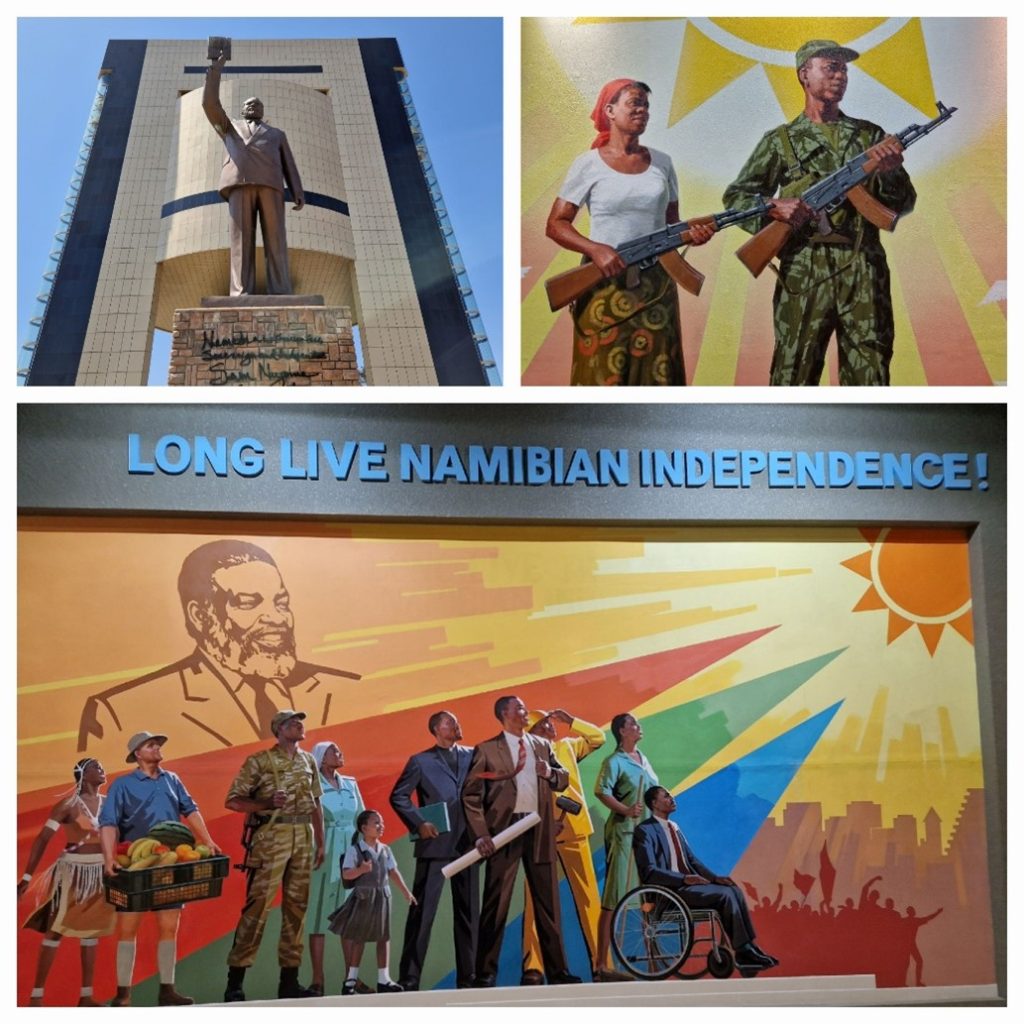
After speaking to Windhoek locals and colleagues at University of Namibia it became clear that none of them were aware of the strong visual history that is inherent to the North Korean style. When visiting the IMM, they do not think of the Cold War, Communism or Chinese-Russian artistic influences. But, for someone who was socialised in West Germany and South Korea like myself, and having travelled to East Berlin and Hungary in the 1980s, the visual heritage visible in the IMM is intricately linked to East-European and thus non-Western seeing traditions. What stands out is a 21st century adaptation of the social modernist style to postcolonial independence rhetoric whilst also showing remnants of European stereotypical imaginations of the African other in an Asian-African context. In this sense, in a postcolonial setting, the social modernist style travelled from Cold War Europe to North-East Asia and ultimately to South-West Africa.
Conclusion
Above examples share several commonalities that prompt an essential question: How do racialised visual stereotypes that circulated transimperially over space and time relate to contemporary identity debates? This paper argues that colonial photography was a new-born child of its time that thanks to modern mass publication methods could perpetuate and spread racial and colonial seeing traditions transimperially, ultimately influencing global perceptions until this day. This photographic medium thus enabled the widespread dissemination of colonial perspectives through books, posters and mobile slide shows. However, the visual Eurocentric mind-set was not limited to printed images but spilled over into public spaces as well. This essay aimed to highlight and scrutinise the transimperial origins, expansion and endurance of non-white stereotypes by starting with colonial seeing traditions and examining the long-term effects of colonial visualisations on numerous spheres.
Despite social and political changes since Africa’s decolonisation, a transimperial seeing tradition prevails that perpetuates stereotypical images of Africa reminiscent of colonial times. This visual world order narrative, marked by violence, exploitation, dehumanisation, infantilisation and victimisation, often delays – if not hinders – the creation of an updated and non-Western identity rooted in sub-Saharan Africa’s agency.[33]
However, Africans have developed ways of counter-visualizations, and launched processes of re-appropriation, inspired by the joint experience of a transimperial visual legacy that was similar in very different contexts. But photographs, statues, and museums that reproduced a coloniality became symbols of degradation for all the colonized peoples, no matter if they had a regional context.
To be sure, the visual anticolonialism of the communist tradition, as represented by North Korean anticolonial architecture in Namibia, shows that the shared “antiimperial” visual language has its own history, which might be ambiguous. But it equally shaped the collective memory and enabled it to reject the visual coloniality that had spread transimperially.
Further Reading
Patricia Hayes, Gary Minkley (eds.): Ambivalent. Photography and Visibility in African History, Columbus 2019.
Lucy Souter, Duncan Wolldridge (eds.): The Routledge Companion to Global Photographies, Abingdon 2024.
Mark Sealy: Decolonising the Camera: Photography in Racial Time, London 2019
Francis B. Nyamnjoh: #RhodesMustFall. Nibbling at Resilient Colonialism in South Africa, Bamenda 2016.
Marjo Kaartinen, Leila Koivunen, Leila, Napandulwe Shiweda (eds.): Intertwined Histories: 150 Years of Finnish-Namibian Relations, University of Turku 2019, URL: <https://www.utupub.fi/bitstream/handle/10024/148416/IntertwinedHistories.pdf?sequence=1&isAllowed=y> (accessed 6 November 2025).
E. Natalie Rothman: The Dragoman Renaissance: Diplomatic Interpreters and the Routes of Orientalism, Ithaca 2021.
[1] Gloria Wekker: Witte onschuld: Pradoxen van kolonialism en ras, Zutphen 2020.
[2] Mark Sealy: Decolonising the Camera: Photography in Racial Time, London 2019; Mark Knights: Historical Stereotypes and Histories of Stereotypes, in: Cristian Tileagă, Jovan Byford (eds.): Psychology and History: Interdisciplinary Explorations, Cambridge 2014, pp. 242–67; Jens Jäger, Fotografie und Geschichte, Frankfurt a. M. 2009.
[3] Ngũgĩ Wa Thiong’o: Decolonising the Mind. The Politics of Language in African Literature, Suffolk 2005.
[4] Patricia Hayes, Gary Minkley (eds.): Ambivalent. Photography and Visibility in African History, Columbus 2019.
[5] Mark Knights: Historical Stereotypes and Histories of Stereotypes, in: Cristian Tileagă, Jovan Byford (eds.): Psychology and History: Interdisciplinary Explorations, Cambridge 2014, pp. 242–67.
[6] Vitjitua Ndjiharine, Artist Statement, in: Ovizire×Somgu, Exhibition Catalogue, MARKK 2018, p. 26.
[7] Initially, I had the pleasure of being a member of the collaborative team and it was a great moment when the project came to such a powerful end.
[8] Patricia Hayes, Gary Minkley (eds.): Ambivalent. Photography and Visibility in African History, Columbus 2019.
[9] William John Thomas Mitchell: Picture Theory, Chicago 1995.
[10] Diana Miryong Natermann: Pursuing Whiteness in the Colonies. Private Memories from the Congo Free State and German East Africa (1884–1914), Münster 2018; Diana Miryong Natermann: Colonial Masculinity Through Time. One Man’s Story of Monarchy, the Military, Colonialism, Fascism, and Decolonisation, in: Laura Almagor, Haakon Ikonomou, Gunvor Simonsen (eds.): Global Biographies, Manchester 2022, pp. 62–81.
[11] Maurice Halbwachs: On Collective Memory, Chicago 1991.
[12] Susan Sontag: On Photography, London 2008.
[13] James V. Wertsch: Blank Spots in Collective Memory: A Case Study of Russia, in: Annals of the American Academy of Political and Social Science 617 (2008), pp. 58–71.
[14] Aleida Assmann: Das Unbehagen an der Erinnerungskultur. Eine Intervention, Frankfurt a. M. 2021.
[15] Mamadou Diawara, Bernard Lattegan, Jörn Rüsen (eds.): Historical Memory in Africa. Dealing with the Past, Reaching for the Future in an Intercultural Context, New York 2013.
[16] Eric Burton: Hubs of Decolonization: African Liberation Movements and “Eastern” Connections in Cairo, Accra, and Dar es Salaam, in: Lena Dallywater, Chris Saunders, Helder Adegar Fonseca (eds.): Southern African Liberation Movements and the Global Cold War “East”: Transnational Activism 1960–1990, Berlin 2019, pp. 25–56; Michael Goebel: Anti-Imperial Metropolis: Interwar Paris and the Seeds of Third World Nationalism, Cambridge 2015.
[17] Stacey Boldrick, Richard Clay, Michelle Duster, Keith Magee: Remembering and Forgetting Confederate Monuments: Taking the Bitter with the Sweet, in: The Sculpture Journal 31/1 (2022), pp. 1–15; Kirsten Treen: Unraveling Confederate Sentiment. The Unfinished Story of a Sock, in: Kathleen Diffley, Benjamin Faggan (eds.): Visions of Glory: The Civil War in Word and Image, Athens (GA) 2019, pp. 173–183.
[18] For some examples of Duggan-Cronin’s work related to the text, please follow this link: <https://museumsnc.co.za/new_site/satellites/duggan-cronin-gallery/> (Accessed: 6 November 2025). Alternatively, see Napandulwe Shiweda’s PhD thesis with exemplary photographs in chapter 3. Napandulwe Shiweda: Omhedi: Displacement and Legitimacy in Oukwanyama politics, Namibia, 1915-2010, Cape Town 2011, pp. 48–65, URL: <https://uwcscholar.uwc.ac.za/bitstreams/4378b85f-56d8-4c01-9342-39c975572a41/download> (accessed 6 November 2025).
[19] Napandulwe Shiweda: Images of Ambivalence. Photography in the Making of Omhedi, Northern Namibia, in: Patricia Hayes, George Minkley (eds.): Ambivalent. Photography and Visibility in African History, Columbus (OH) 2019, pp. 181–208.
[20] Shiweda: Images of Ambivalence, 191.
[21] Michael Godby: Alfred Duggan-Cronin’s Photographs for the The Bantu Tribes of South Africa (1928-1954): The Construction of an Ambiguous Idyll, in: Kronos 36/1 (2010), pp. 54–83.
[22] Shiweda: Images of Ambivalence, 186.
[23] Ibid, 202.
[24] Ibid, 204.
[25] Francis B. Nyamnjoh: #RhodesMustFall. Nibbling at Resilient Colonialism in South Africa, Bamenda 2016.
[26] Rhodes was known for supporting British colonialism, participating in the scramble for Africa and being associated with colonies like Rhodesia (now Zimbabwe) and institutions like Rhodes University in Grahamstown (South Africa). He was also a mining magnate and Prime Minister of the Cape Colony. Upon his death, Rhodes bequeathed parts of his estate around Table Mountain to South Africa, contributing to the UCT Upper Campus and the well-known Kirstenbosch National Botanical Gardens. Robert I. Rotberg: The Founder: Cecil Rhodes and the Pursuit of Power, Oxford 1988
[27] David Kenrick: Decolonisation, Identity and Nation in Rhodesia, 1964–1979: A Race Against Time. Berlin 2019.
[28] Nyamnjoh, #RhodesMustFall.
[29] Ibid, 100.
[30] Mamokgethi Phakeng, Sipho M Pityana, Renaming Memorial Hall Sarah Baartman Hall, in: News UCT, 13 December 2018, URL: <https://www.news.uct.ac.za/article/-2018-12-13-renaming-memorial-hall-sarah-baartman-hall> (accessed 6 November 2025).
[31] Heike Becker: Changing Urbanscapes: Colonial and Postcolonial Monuments in Windhoek, in: Nordic Journal of African Studies 27/1 (2018), pp. 1–21.
[32] Christian A. Williams, Tichaona Mazarire: The Namibian Independence Memorial Museum, Windhoek, Namibia, in: The American Historical Review, 124/5 (2019), pp. 1809-1811.
[33] Hayes and Minkley: Ambivalent; Elizabeth Baer: Genocidal Gaze. From German Southwest Africa to the Third Reich, Detroit 2017.

After graduating with honours (M.A.) from Goethe-University Frankfurt, Diana Miryong Natermann received a scholarship to do her PhD research at the European University Institute (EUI) in Florence, Italy. Since then she has done post-docs at University of Hamburg, worked as Assistant Professor at Leiden University and was a fellow at University of Cape Town, South Africa, at NIOD Dutch Institute for War and Genocide Studies, as well as a guest researcher at University of Namibia (UNAM) in Windhoek. Currently she is a Lecturer at Utrecht University at the Faculty of History and History of Art.
As an historian, her intellectual interests lie on the mid 19th to early 21st centuries with a focus on visual history and (post)colonial theories (esp. gender & whiteness studies), digitalisation, cultural and political history, genocide studies, and global orders. Therein, she focuses on modern European and African contexts, and her expertise also includes global history, research, memory and heritage studies as well as the interplay between culture and politics within Europe and decolonised states. The latter involves current debates on European identity/ies concerning restitution, museum and heritage-related policies. Her latest research combines several of the above foci with the study of cultural genocide and digital restitution. Furthermore, she enjoys being a member of the Scientific Advisory Board of the journal LawArt and part of the Afrikamuseum, Berg en Dal, reopening committee.
Leave a Reply