
Global Labour History
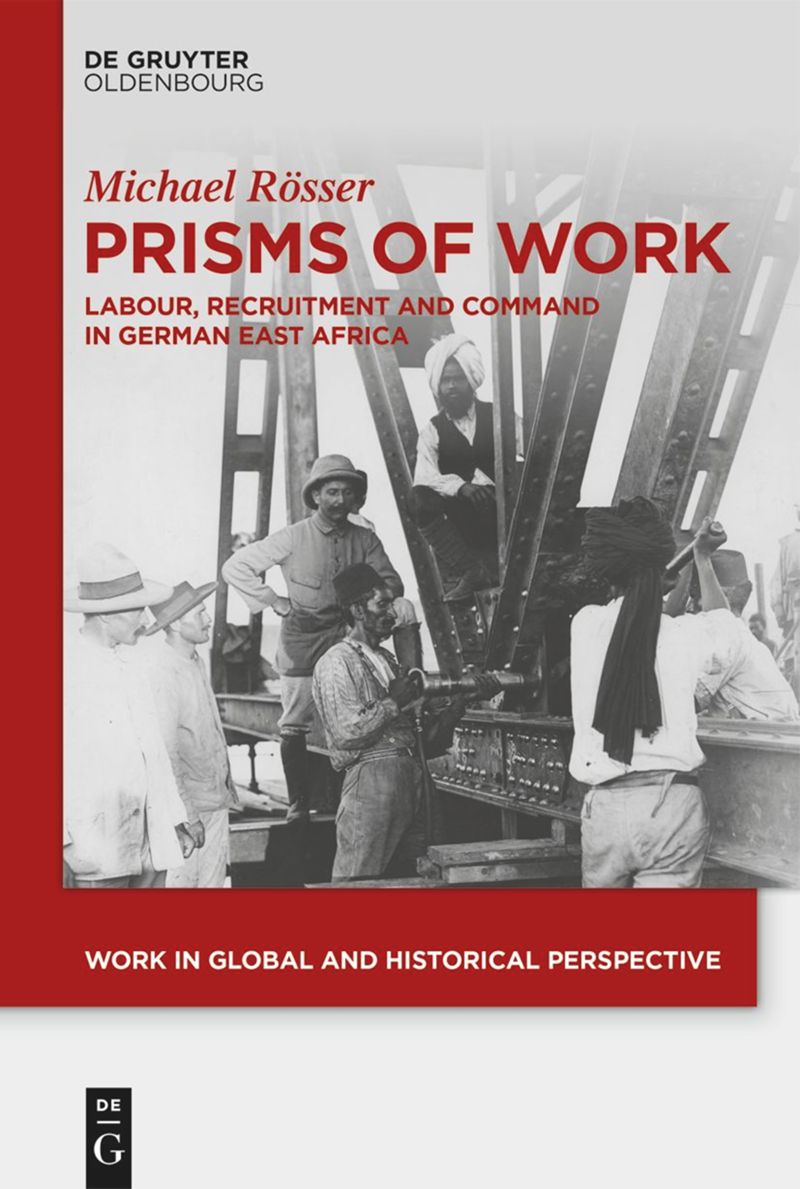
My book examines labour regimes in the colony of German East Africa (GEA) before World War I.[1] It uses three case studies: the construction of the Central Railway (1905–1916), the Otto Plantation in Kilossa (1907–1916), and the paleontological Tendaguru Expedition in the colony’s southern Lindi district (1909–1911). Combining global labour history with colonial and business history, the book examines how different (groups of) actors in East Africa and the Indian Ocean Area negotiated labour relations by investigating their scope for action within a specific discursive environment. While taking the coercive character of colonial labour regimes into account, the book explicitly looks at the agency of the respective (groups of) actors. In so doing, it goes beyond the prototypical understanding of work as wage labour in the “Global North”. It therefore includes the less visible forms of labour, such as reproductive labour and avoids dichotomies like “forced labour vs. free wage labour” or “work vs. leisure or non-work”.
The book highlights the interconnectedness between the three cases and puts them in a global context. For example, the Otto Cotton Plantation was only built in Kilossa because of the projected Central Railway. Work, and particularly workers, were at the origin of these connections as well. A plantation overseer had previously worked as a subcontractor for the colonial railway construction company. At Tendaguru, a geologist who had previously served the Otto Company assessed the sensational paleontological find in the south of the colony. Based on such interconnections, the book reveals that there were characteristics shared by all work regimes. For instance, the topography of all three places of labour resembled the racist topography of colonial towns; the more skilled a worker was the less coercion he or she faced. To be sure, forced labour intensified during economic upturns, because of increasing competition for (African) labour, but colonial labour relations were not necessarily coercive.
The dichotomy between colonised and coloniser is broken in each case study by focusing on actors neglected by historiography. These are mostly South (East) European, especially Greek, labour recruiters or railway construction subcontractors, (European) overseers and engineers, East African personal servants (cooks and so-called boys), Indian craftsmen and (qualified) East African workers, as well as women. The latter mostly performed reproductive labour and thus made (wage) labour possible in the first place. The fact that the recruitment of labour was one of the greatest challenges at all three places illustrates how colonial prestige projects were in fact extremely precarious. It is true that forced recruitment was always part of the arsenal of any place of labour. However, for entrepreneurial reasons, colonial actors ultimately depended on a wide variety of labour, ranging from skilled to unskilled labour as well as from convict and forced work to wage labour. Beyond hiring labour, employers also had to provide employees with incentives to stay.
The Transimperial Dimensions of German Colonial Labour Regimes
The Central Railway
Building the Central Railway, German colonisers always compared its construction progress to other imperial infrastructures like the neighbouring British Uganda Railway; they were constantly concerned with being at least as fast as their imperial competitors. Through their transimperial mobility, the protagonists of labour connected various empires. For instance, Greek subcontractors had mainly worked at the construction sites of the Berlin-Baghdad Railway in the Ottoman Empire before their employment in GEA at the Central Railway. Individual cases of Greek migration go beyond East Africa and South Eastern Europe. Like many of his fellow citizens, the Greek John Zavellas had lived in the USA for some years and then worked at GEA plantations around 1900. In 1911, he took up employment at the Central Railway. Most of his colleagues, however, reached the German colony via the global company networks of Philipp Holzmann, which was in charge of constructing both prestigious imperial railways in the Middle East and East Africa. In GEA, the subcontractors obtained a conflict-laden intermediate position between colonisers and colonised. Denigrated as “half-Orientals”; they were blamed for shortcomings in the construction of the Central Railway, although these white subalterns were generally more successful and better qualified than their German colleagues. Nevertheless, all railway construction subcontractors and employees of the company treated the East African workers equally badly, regardless of their origin. Moreover, skilled craftsmen like carpenters and literate workers were in high demand. This enabled them to improve their position in the colonial labour market. At the beginning of construction, the skilled labourers were recruited primarily among Indians in GEA but also from those in British East Africa who initially worked for the Uganda Railway. The sources suggest that German employers of the Central Railway attracted skilled workers from the Uganda Railway by paying higher wages. Furthermore, many Indians migrated from the subcontinent to GEA, because they hoped for job opportunities created by the railroad. Over time, East Africans who had previously attended missionary schools increasingly replaced Indians. Nevertheless, skilled workers from the subcontinent remained important employees at the Central Railway until the end of its construction.
The Otto Plantation in Kilossa
Similar to the Greeks, plantation manager Ranga Reinhardt Kaundinya in Kilossa migrated between empires. As a white subaltern, he also was racially defamed by the colonial government and by his own European employees. The son of an Indo-German couple in the service of the Pietist Basel Mission, he was socialised in the Swabian environment of the Otto Company near Stuttgart. The enterprise’s owners were Pietists themselves, whose business was well connected to the global centres of cotton trade and production, including England and the USA’s south. The Pietist owners of the Otto Company also maintained connections to the Basel Mission from nearby Switzerland. Their shared faith also brought Otto and Kaundinya closer together. After his education in the environment of Otto, Kaundinya moved to southern India where he worked on plantations for over twenty years. Despite this experience as a “planter in the tropics”, he failed in Kilossa, however. For one thing, the conditions for growing cotton were different from those in India. Secondly, management mistakes of his superiors and his position as a white subaltern in colonial society impeded his daily work. Despite these difficulties, Otto stood by Kaundinya, probably because of their shared faith.
The Tendaguru Expedition
In the early twentieth century, colonial powers such as Germany, France and Britain, but also the USA competed for the exploration of the largest dinosaur skeletons worldwide. This “dinomania”[2] was transimperial. In each empire, (natural history) museums displayed the genuine fossils to make famous and legitimise their (scientific) conquests overseas. With Germany extracting the largest skeletons the world had seen so far at Tendaguru, the sensational news of its discovery quickly spread across the globe. German authorities quickly excluded potential competitors, e.g. from Britain from investigating the finds. At Tendaguru, too, the mobility of central actors of labour opened up transimperial dimensions: Before working as a personal servant of a leading German palaeontologists at Tendaguru, a man the sources call Ali, had been employed on steamers in Africa and Asia. In contrast to his German boss at Tendaguru, he had also been to British colonies in Africa. Likewise, leading supervisor Boheti bin Amrani was not only crucial for the paleontological excavation under German colonial rule. After World War I, when GEA had become a Mandate under the League of Nations, Boheti resumed work for another paleontological expedition under British authority.
Travelling protagonists of labour made all three case studies transimperial. They reached GEA from many places ranging from neighbouring colonies like British East Africa, to the Ottoman Empire, India or (North) America. Likewise, the labour relationships of these protagonists were embedded in transimperial discourses about work and race as well as in general competition over global hegemony. As my book examines colonial labour regimes in both public and private endeavours, it can inspire a re-examination of both business history and the history of public (scientific) projects from a transimperial perspective.
[1] This is an open access book: https://www.degruyter.com/document/doi/10.1515/9783111218090/html (Accessed: 12 February 2025).
[2] Ilja Nieuwland: American Dinosaur Abroad. A Cultural History of Carnegie’s Plaster Diplodocus, Pittsburgh 2019.

Michael Rösser ist research assistant at the Otto-Friedrich University Bamberg (Germany). He specialised on the global history of labour and its transimperial dimensions at colonial infrastructures, cotton plantations and palaentological excavation seites particulary in East Africa. He is further interested in postcolonial topographies of memory, the global history of the interwar period.
He is Author of the book:
Prisms of Work – Labour, Recruitment and Command in German East Africa (Work in Global and Historical Perspective, vol. 21), Berlin/ Boston: De Gruyter Oldenbourg, 2024.
Open Access: https://www.degruyter.com/document/doi/10.1515/9783111218090/html
Website:
https://www.uni-bamberg.de/hist-wsg/team/michael-roesser/hist-wsg-team-michael-roesser-biographische-notiz/
Selected Publications:
„Die Firma Wilkins & Wiese in ‚Neu-Hornow‘. Ein Drahtseilakt zwischen Rhein/Ruhr, Weißer Elster und Ostafrika“. Marianne Beschhaus-Gerst et al. (Eds.). Nordrhein-Westfalen und der Imperialismus. Berlin: (expected 2022).
„Shenzi Ulaya. Deutsch griechische Verflechtungsgeschichte von der Bagdadbahn zum kolonialen Deutsch-Ostafrika“. Online-Compedium der deutsch-griechischen Verflechtungen. Zentrum Modernes Griechenland der Freien Universität Berlin: 02.03.2022. Web. comdeg.eu/compendium/essay/109893/ (21.04.22).
„Knotenpunkte des Kolonialen“. Vorstudie ‚Kolonialistisches Denken und Kolonialkultur in Stuttgart‘. Stadtarchiv Stuttgart (Hrsg.). Stuttgart: 19.07.2021. Web. archiv0711.hypotheses.org/files/2021/07/Stadtarchiv_Stuttgart_Kolonialistisches-Denken-Stuttgart.pdf (10.09.2021).
„Transimperiale Infrastruktur? Personal, Unternehmer und Arbeit beim Bau der Zentralbahn in Deutsch-Ostafrika“. Moderne Transimperialitäten: Rivalitäten, Kontakte, Wetteifer. 274-89. Laurent Dedryvère et al. (Hrsg.).Berlin: 2021.
Leave a Reply