Category: OLd Hist

  • Exploitation and Control of Transport Workers in Colonial Calcutta – JHI Blog

    Exploitation and Control of Transport Workers in Colonial Calcutta – JHI Blog

    by Amartyajyoti Basu

    The story of modern capitalism is often told through the lens of the factory whistle and the punch clock – symbols of progress and industrial modernity. Yet, in colonial Calcutta, between 1920 and 1960, these symbols represented something far more sinister: a system of exploitation that used time itself as an instrument of control. The transport workers of this era – tram operators, bus drivers, conductors, and support staff – experienced not the orderly benefits of industrial progress, but a regime designed to extract maximum labour while denying them security, dignity, or fair compensation.

    In the decade earlier to 1920s, Calcutta witnessed a rise of motorized transport, creation of new manufacturing industries causing massive labour migration from neighboring provinces and rise of the new class of workers—the transport workers. The transport workers were often migrant workers from neighboring provinces of UP and Bihar, rest of Bengal, and Punjab. The introduction of a new transport system went in tandem with the demand of the new industries created in the city and its suburbs.

    The Global Struggle and Colonial Betrayal

    The struggle over work-time has been one of the defining conflicts of modern labour history. Work-time serves us as a measure of abstract labour thar is sold to the employer. A struggle over work-time thereby is a struggle over the control of the workers of their own labour. The Haymarket incident in Chicago in the 1880s made the eight-hour workday a rallying cry for working-class movements worldwide. By the 1920s, the reduction of work hours had become recognized as a political right in capitalist states. The U.S. Congress enacted the eight-hour workday in 1886, and European nations gradually adopted similar standards, enshrining leisure time as a matter of political entitlement.

    The colonial world, however, presented a different picture entirely. While workers in the West secured these rights, colonial Calcutta’s transport workers in 1920 endured twelve-hour workdays with no provision for casual leave or any other form of paid time off[i]. This was not merely a lag in development – it was systematic exploitation enabled by colonial power structures.

    The workers were not silent receivers of this unjust treatment. There were multiple instances where they had organized demanding for better livelihood and working conditions. The strike of 1921 marked a turning point. For the first time in Bengal, transport workers demanded the fixation of an eight-hour workday, payment of allowances for overtime, and the introduction of casual and privilege leave[ii]. The workers were not simply asking for abstract rights – they were demanding control over their time and recognition of their humanity beyond their capacity to labour.

    The government’s response was to appoint the Calcutta Tramway Strikes Committee, which recommended reducing the workday from twelve to nine hours and introducing three weeks of annual leave at half pay. While this fell short of workers’ demands, it appeared to represent progress. However, implementation revealed the hollowness of colonial reform. Even by 1939, nearly two decades later, leave with full pay remained unknown to many workers, and payment for gazetted holidays was not guaranteed.

    The Report on Labour Conditions in Tram and Bus Services reveal that formal reduction of work hours masked continued exploitation through various mechanisms that revealed the ingenuity of colonial capitalism in extracting labour while minimizing costs. [pp. 33-63]

    The pro-rata system of wage payment exemplified this exploitation. Drivers and conductors employed on a daily rate basis were theoretically paid in full for their shift, even if their actual work period was less than the total spread-over due to bus breakdowns or other reasons. However, in practice, when a bus’s total income for a shift was low due to breakdown, workers were often paid only a portion of their wages ‘by mutual agreement’ – a euphemism for coercion.

    Some firms developed elaborate pro-rata systems. One firm paid its workers one rupee per trip in case of forced reduction in working hours. Another paid two rupees if a breakdown occurred before noon, with higher payments for afternoon breakdowns. These systems created uncertainty and insecurity, making it difficult for workers to plan their lives or budget their expenses. The risk of mechanical failure was transferred from employer to worker.

    Overtime presented another mechanism of exploitation. While not officially compulsory, it was often unavoidable due to the rotation of duties. The calculation of overtime differed from that laid down in the Factories Act, shortchanging workers. Workers received an overtime allowance equivalent to only quarter of a day’s pay for work up to two hours beyond the standard seven hours and fifteen minutes of ‘platform duty.’ An extra half-day’s pay was given for two to four hours beyond platform duty.

    Reports indicated that 60 to 70 percent of operatives in the traffic section regularly worked overtime for less than half an hour’s extra duty. This seemingly minor extension of the workday had significant cumulative effects on workers’ health, family life, and overall well-being. Moreover, the incentivization of overtime through additional pay meant that workers facing economic pressure – which was most of them – felt compelled to work longer hours, undermining the very purpose of work-hour limitations.

    One of the most significant features of exploitation in the transport sector was the sharp divide between permanent and daily-rated workers. This stratification was a deliberate strategy to prevent worker solidarity and maintain exploitative conditions.

    Permanent workers enjoyed relative security and access to benefits like privilege leave, medical leave, and paid holidays. Men with less than five years of service received fourteen days of privilege leave; those with five to fifteen years received twenty-one days; and those with more than fifteen years received thirty days. Medical leave of up to ten days per year was also granted. The engineering, overhead cable, and permanent way departments granted twelve paid holidays per year, coinciding with gazetted holidays for Hindu, Muslim, and Christian festivals.

    Daily-rated workers, by contrast, lived in a state of perpetual precarity. They faced what was termed ‘involuntary unemployment’– days when no work was available due to the grouping system introduced by the Bus Syndicate during the war, bus breakdowns, petrol shortages, or other reasons. This involuntary unemployment typically ranged from five to nine days per month, for which no compensatory allowance was paid. Some owners provided khoraki (a small allowance) to drivers and conductors required to attend the garage, but this was entirely at the proprietor’s discretion.

    This two-tiered system created radically different realities within the same sector. Permanent workers could be pacified with modest benefits while the majority remained vulnerable and desperate, unable to organize effectively for better conditions.

    Management also framed worker ‘absenteeism’ as a problem of discipline and backwardness, deflecting attention from the exploitative conditions that made such absences necessary. The Calcutta Tramway Company reported that the wartime labour shortage had forced them to maintain a reserve force far in excess of normal requirements. Between 1939 and 1944, the average number of conductors employed per month increased by 79 percent, while the number of drivers rose by 35 percent. In ordinary times, the company employed 18 percent extra drivers and 22 percent extra conductors; during the war emergency, they kept 40 percent extra drivers and 50 percent extra conductors in reserve.

    Management attributed high absenteeism to workers’ rural connections and lack of industrial discipline. Workers were said to be ‘normally absent’ after pay day, festivals, and Sundays. During the monsoon, absenteeism increased due to sickness. Newly appointed Bengali conductors were labeled ‘habitual absentees,’ with the principal cause attributed to ‘low standard of health and vitality and high incidence of malaria.’ The continuous nature of hard work was acknowledged as particularly exhausting and responsible for greater absenteeism.

    Drivers – who were predominantly from Northern India – showed lower rates of absenteeism, which management attributed to their ‘better physique.’ This racialized explanation obscured the real dynamics at play. Many workers maintained their connections to village life and agricultural work as a rational strategy for survival in an economy that offered neither security nor adequate wages. Workers were not backward – they were responding rationally to exploitation by maintaining alternative sources of survival.

    The system of fines imposed on transport workers reveals yet another extraordinary degree of control employers sought to exercise over every aspect of workers’ labour. Fines were imposed for breach of discipline, late attendance, and – most tellingly – refusal to work overtime. Workers had the right to appeal to higher authorities, but this was often more theoretical than practical. Significantly fines were imposed on conductors when they refused to work extra trips beyond eight hours, usually on the grounds that working on overcrowded trams produced considerable exhaustion.

    The Bus Syndicate and Route Committees imposed an elaborate system of fines for running behind or ahead of scheduled times. These fines varied by route and could be substantial – ranging from a few annas per minute to eight rupees per minute. The logic was that a bus running late picked up passengers who would otherwise have taken the next bus, while a bus running ahead picked up passengers meant for the bus it was scheduled to follow. Fines paid by one proprietor went to another, creating a system of mutual surveillance and enforcement.

    For daily-rated drivers and conductors, these fines did not directly affect their wages, but for those working on a commission basis, the late or early running of a bus had immediate financial consequences. This created pressure to maintain strict adherence to schedules, regardless of traffic conditions, passenger needs, or the physical state of the vehicle. Workers were punished for circumstances beyond their control, internalizing the discipline employers demanded.

    Wartime Opportunism and Post-War Retrenchment

    The Second World War brought significant changes that revealed the opportunistic nature of colonial labour exploitation. Labour scarcity during the war opened doors for new and casual workers, but the post-war period witnessed a process of separating formally and informally employed workforces, facilitated by large-scale retrenchments. Many wartime entrants were dismissed with legal backing. Measures aimed at casualizing employment relationships tended to target women first, suggesting a trend toward separating core and peripheral workforces along gender lines.

    The divide between ‘formal’ and ‘informal’ employment, which would become so central to discussions of labour in postcolonial India in the works of Ravi Ahuja and Hatice Yıldız, among others, was entrenched during this period. The wartime expansion had temporarily blurred these boundaries, but the post-war retrenchment re-established and even strengthened them. Formal workers gained increasing access to regulated work hours, paid leave, and other benefits. Informal workers remained subject to the vagaries of daily-rated employment and perpetual insecurity.

    Conclusion: The Architecture of Exploitation

    The analysis of work-time regimes in early to mid-twentieth-century Calcutta reveals a system deliberately designed to maximize exploitation. The formal trend towards reducing work hours, particularly after the 1920s, benefited primarily permanent workers in organized industries. A significant portion of the workforce – including daily-rated workers, seasonal workers, and those in unregulated sectors – remained outside the purview of these improvements.

    The sharp divide between permanent and daily-rated workers manifested in radically different experiences. While some workers enjoyed regulated hours, paid holidays, and leave provisions, others worked overtime including holidays and Sundays without legal protection. The ‘No Work, No Pay’ norm meant that paid holidays were often non-existent for daily-rated workers. In the transportation sector, while tram workers gained certain benefits through struggle, bus workers remained subject to pro-rata payment systems that encouraged longer working hours.

    Every mechanism examined – casualization, pro-rata wages, forced overtime, the permanent-daily divide, the fine system, unpaid ‘involuntary unemployment,’ and the racialized ‘absenteeism’ narrative – worked together to extract maximum labour while denying workers security or fair compensation. This was not an incomplete transition to industrial modernity but a fully realized system of colonial capitalist exploitation.

    The fractured clock of colonial Calcutta kept different times for different workers, and in that fracturing lay the architecture of exploitation. Colonial capitalism functioned – and extracted surplus value – precisely through maintaining these divisions. Workers were subjected to industrial time discipline when it suited employers but denied its benefits when those would cost money. They were blamed for maintaining rural connections that were survival strategies necessitated by inadequate wages and job insecurity.

    The story of transport workers in colonial Calcutta thus reveals how capitalism in the colonial context used time itself as an instrument of control and exploitation. The coexistence of different work regimes ultimately ensured a process of capital accumulation that produced more control than autonomy for workers, more profit for employers than dignity for laborers. In the fractured clock lay not the promise of modernity but the violence of exploitation.

    [i] The Statesman and the Friend of India, October 2, 1920.

    [ii] Calcutta Gazette (Supplementary), April 13, 1921, 695.


    Amartyajyoti Basu is a PhD candidate at Ambedkar University Delhi. His thesis revolves around the history of transport services in Calcutta in both colonial and post-colonial period. He is interested in looking into how the concept of work is framed in historiographical terrains and how looking into the history of service work such as transport can challenge it.

    Edited by Mayukh Chakrabarty

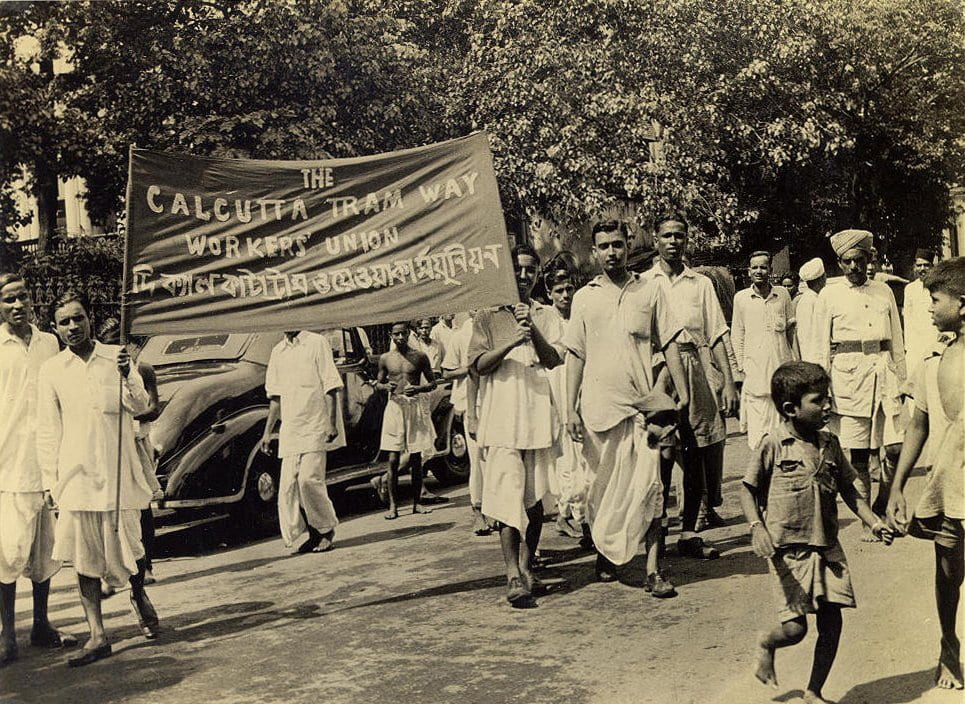
    Featured image: Calcutta Tram Way Workers’ Union strike in 1945, photo by Clyde Waddell, via Wikimedia Commons.

  • The Repressed Political Economy of Global Intellectual History – JHI Blog

    The Repressed Political Economy of Global Intellectual History – JHI Blog

    by Veronica Lazăr

    Intellectual history’s recent global turn signaled the need for both an epistemic renewal of the field and its strong repoliticization. Global intellectual history is at least partially a result of the critical forces that, for decades, had denounced the blatant Eurocentrism of hegemonic Western systems of knowledge. The global turn strives to update the critical and self-critical dimensions of Western academic practices. Overall, there has probably never been so much excellent and long-awaited discussion of empire, coloniality, epistemic injustice, the construction of race, and related issues—concerning both the intellectual practices that supported such ideas and the mechanisms and power structures that sustained these systems of thought for so long.

    Nevertheless, the global turn that emerges from this arborescent genealogy reveals a paradox. At the level of its content, the discipline grows increasingly disgruntled with the authoritarian hierarchies of its traditional topics and epistemic categories. It repeatedly rewrites and re-questions its canon, rules of accumulation, and geographies of knowledge. Yet with each academic practice, with each book and article, it deepens the asymmetries between an active (and again Western) core of knowledge production and an ever more extended plurality of native objects of study.

    At first glance, it seems surprising how recent the field appears—or at least presents itselfto be. Its now-authoritative journal Global Intellectual History was established in 2016. According to the rhetoric of disciplinary renewal of its editors, Samuel Moyn and Andrew Sartori, the earlier eponymous volume (2013) was intended as “a foundational work that seeks to act as a theoretical manifesto” (López 2015, 155). In Rethinking Modern European Intellectual History, a collective work he co-edited with Darrin McMahon, Moyn (2014, 112–130) seeks to trace the state of the art and to suggest a renewal program. In so doing, he denounces the persistent idealism in the practices of intellectual historians. Of course, what became known as the Cambridge School model of contextualism had already sought to brush aside what Quentin Skinner perceived as the intrinsic idealism of the Lovejoy-esque, Whiggish, and even Marxist histories of ideas. Moyn, however, argues that the essential move is to pay attention to the difference between theories and actual practices of writing. Authors from the North American tradition represented in the Moyn and McMahon volume seem rather indifferent to the Cambridge School’s agenda and restrictions. As the editors note in their introduction, the reasons are both institutionally contingent and polemical: British intellectual historians associated with Skinner had reduced the meaning of context to text and, according to Moyn (114), had essentially ignored social theory’s basic impulse “to anchor representations in practices.” For intellectual history to develop a more substantial contextualism true to its intentions and critical edge, Moyn argues, it should return to the intuitions of Marxism—with its great questions, if not great answers—about what shapes and gives stakes to doctrines and concepts.[1]

    For Moyn and Sartori, the improvement of intellectual history also requires turning the mirror toward the discursive apparatus itself and reflecting on the polysemy of the term “global”—the plurality of its possible objects and lenses, as well its fractures—in an attempt to create a terminology of the global that is both empirically valid and politically non-oppressive. Including non-Western theoretical contributions is the minimum, but as Vanessa Smith (2013, 83) points out in her contribution to their volume, a truly global intellectual history must also “confront… the implicit bias toward written contributions in the production of knowledge.” So it demands the inclusion, too, of “the contributions of participants from cultures in which writing is a belated mode of communication (a move that, in turn, foregrounds the politicized dimensions of written production).” Historians should reflect on the geographical distribution of the still-centralized production of theory, in which the rest of the world, indispensable for knowledge, remains a resource for data mining processed in Western academic laboratories: “Bruno Latour’s identification of metropolitan ‘centers of calculation,’ epicenters at which knowledge was gradually gathered and archived in the service of projects of empire… The operations of an imperial will to know that sought to render alterity portable, abstractable, and translatable for accumulation at imperial centers” (87). Therefore, to correct this traditional hierarchy, non-Western academics should become integral to the process of developing theories and concepts, and their work should be recognized and integrated.

    Yet this work of rebalancing global knowledge production and integrating diverse intellectual traditions has already been underway for some time, and it raises its own problems. Frederick Cooper (2013) notes in his excellent concluding essay in Global Intellectual History that the uses of the word “global” in intellectual history oscillate between “soft” and “hard” meanings. In its “softer” meaning, global intellectual history seeks to correct certain insufficiencies by extending its objects of research and including what the narrow, peripheral view of the Western intellect has left aside. As Cooper writes, “the key questions are how far the range should extend and the extent to which we can do more than throw more cases from more parts of the world into the intellectual stew” (Cooper 284). The “hard” version challenges the paradigm of globality and questions its reality, as well as its geography and history. It asks whether “global” isa native term, an operative concept historians use today, or perhaps a meta-category, like “universal history”? The great risk here, according to Cooper, is ceding to the modernist reflex, which constitutes another form of Eurocentrism: believing that the global is a creation merely of Western modernity, one made possible by the spread of capitalism and its very specific instantiation of the knowledge-power apparatus of political economy. Such a perspective risks reenacting, in the negative and with guilt, the very Western exceptionalism that scholars of the global turn strive to overcome.

    To ensure disciplinary self-reflection, intellectual history should, according to Moyn and Sartori, focus on the way that ideas are anchored in practices and on how they may function as ideologies (a term the first generation of Cambridge scholars ostensibly bypassed). As they put it, “In this way, a global intellectual history would be realized not at the level of the object of study but at the level of the profession itself, in which the inequitable distribution of institutional power and authority stands as the single biggest obstacle to overcoming Eurocentrism” (Sartori and Moyn, 19). But which practices reveal how knowledge is produced in the field of intellectual history? Here, we get to the real problem.

    The practice that Moyn and Sartori advocate seems confined to what happens within theories. Though they set for themselves the goal of avoiding the trap of merely focusing on contextual languages when recovering contexts, they suggest that “the problem is far more one of theory than one of practice.” Their goal is to build better theories, not necessarily to reconfigure power relations in the field, because “posing the difficulty (evidentiary, linguistic, professional, and so forth) of enacting a global history depends, first, on developing plausible models of what the subject matter of such a historiography ought to be” (Moyn and Sartori 2013, 4). Dominant models should be corrected and supplemented, but not disrupted: “Shruti Kapila considers how this move in European intellectual history might be regarded—and corrected—by those whose expertise lies outside of Europe in places where ‘European’ ideas are often presented as descending upon and traveling within” (10). It may not be a coincidence that almost every review or summary of recent developments in intellectual history that I have read in the past few years cites only sources written originally in, or translated into, English (and occasionally German or French). To take a more blunt example, in Danielle Charette and Max Kjönsberg’s literature review from 2020, every current or movement in the history of political thought, whether of primary or secondary importance, appears to belong to the English or North American traditions. This selection is not reflected upon in the text. Similarly, Riccardo Bavaj’s synthesis “Intellectual History,” a study dedicated to the plurality of understandings of intellectual histories, omits theoretical sources in foreign languages other than German.

    In spite of its intentions to provincialize itself, in Chakrabarty’s words, and even when its topics are generously diverse, the global meta-language largely relies on, or is substantially mediated by, academic literature published in English. Historians’ research networks, as reflected in these works, are now more transnational and more linguistically and thematically diverse than ever. Yet their center remains Anglo-Saxon academia (the term “Eurocentric” seems outdated), concentrated especially in a few universities, institutes, and publishers, whose (at least until now) enormous financial resources have reinforced this asymmetry. The existence of an international lingua franca is a substantial condition for a more democratic access to knowledge worldwide, but the persistence of a central pole of academic legitimation, which this same mode of circulation continually reinforces, is a far less democratic phenomenon. While figures such as Goody, Chakrabarty, Latour, and Fabian have already extensively expressed cultural criticisms of the imperial legacies in the academic world of historical theory, we must avoid reducing their powerful analyses into repetitions of the age-old resentment against the hegemony of English (or French, German, or Latin). What is important to emphasize is that the dominance of one language merely obscures the deeper power relations that define where academic authority resides today. To further question its own conditions of possibility and asymmetries of power, global intellectual history should examine its present-day centrality and hegemony, beyond the legacies of the Western political and epistemic empires.

    The sociology of knowledge had promised to do so: Pierre Bourdieu ([1990] 1999, 220–228) famously presented his reflexive sociological examinations of international intellectual exchanges as an extension of Kant’s questions regarding the conditions of knowledge. He was particularly interested in the strategic construction of criteria that define legitimate intellectual activity, namely those criteria that emerge from power struggles within and between fields, both intellectual and non-intellectual, national and international.

    Just as humanity’s self-image has been shaken by the Copernican, Darwinian, and Freudian revolutions, the self-image of any intellectual discipline may be destabilized by the sociological examination of its own institutional distribution of power and resources, and by the ways these external forces shape ideas themselves or establish and contest the principles for evaluating ideas and intellectual work. Of course, Bourdieu was writing within a still hugely influential French editorial culture. His focus was not on academic publishing in today’s narrow sense of peer review, whose importance has since increased enormously. Bourdieu’s purpose was to understand the internationalization of academic life, a process far from spontaneous, relying on radical operations of decontextualization and re-rooting and shaped by circumstances specific to each national cultural field: “I mean by this the imposing of a particular definition of the legitimate exercise of intellectual activity, for example, Germany’s valorization of ideas of Kultur, depth, philosophical content, etc., over what they saw as the French stress on Civilisation, clarity, literature, etc.” (227).[2]

    Bourdieu’s declared objective was the denationalization of categories of thought—the emancipation from national fields. The work of another well-known sociologist of ideas, particularly philosophical ideas, Randall Collins (2000, 15), focuses on networks and could be very useful, were it not for its determinism, rigidity, and overly generalizing method, limitations which lead him to proclaim “the social predictability of intellectuals’ thinking”:

    I am arguing that if one can understand the principles that determine intellectual networks, one has a causal explanation of ideas and their changes. In a very strong sense, networks are the actors on the intellectual stage. Networks are the pattern of linkage among the micro-situations in which we live; the sociology of networks penetrates deeply into the very shapes of our thought. The network dynamics of intellectual communities provides an internal sociology of ideas, taking us beyond the reductionism of traditional externalist sociology. The historical dynamics of social identities in networks, too, casts the question of canonicity in another light.

    What the sociologist would find, according to Collins, are “structured processes that are historically general.” This is because “there are universal patterns of formation of ideas across history and intellectual cultures” (xviii).

    While the mainstream sociology of knowledge focuses largely on relations between actors in the field—negotiations for cultural power and symbolic capital, the economy of prestige, and individual career strategies—a genuinely materialist understanding of global intellectual history should also examine the specific political economy of its own model, especially as it has evolved over the past couple of decades with the takeover of academic presses by commercial publishers. Today, the rise of for-profit publishing is an essential part of the globalization of knowledge in a very specific way: as Valer Cosma (2024; 2025) has shown, much academic research is publicly funded yet privately published by academic entrepreneurs who offer no payment for the labor they extract, thereby fueling an increasingly financialized publishing system whose results are eventually resold to universities and libraries. Outside the Western world, as these libraries and universities sometimes lack resources, accessing academic journals and books is prohibitively expensive for both institutions and individual users. As a result, access to research often depends on piracy, a providential means of democratizing at least the reception, if not yet the production, of knowledge. Even open-access research publishing as it is practiced now, where the authors pay for readers’ unrestricted use, favors those researchers who already have grants or institutional financial support.

    Beyond the inequalities in researchers’ material means, which this situation does nothing to correct, the publication system grows increasingly financialized and centralized, even when its content may be radically anti-capitalist. The consequences affect not just the academic community, but society as a whole. The profits of the Big Five major players— Elsevier, Springer Nature, Wiley, Taylor & Francis, and SAGE—have been steadily increasing. Substantial portions of their stock are held by hedge funds, their operations require minor investments, and their returns ultimately function as an epistemic rent. Moreover, “these corporations manage not only the scientific journals, but also the infrastructure of academic evaluation, through platforms like Scopus (Elsevier) or Web of Science (Clarivate). These instruments decide which research is worthwhile and which is not, who gets the funding, who is promoted, and which ideas are disseminated. Science is not only commercialized, but also filtered through private interests… These rates of profit can be higher than those of companies like Hyundai, Amazon, or even Google,” while the production costs are minimal (Cosma 2025). In addition, companies like Taylor & Francis appear willing to sell data from their journals to other companies that use them for AI training, as this controversial deal might suggest.

    The most lucrative publishing sectors are probably in the natural sciences, but the same constraints, restrictions, and profit-driven tendencies already affect the social sciences and humanities—or are likely to do so soon. Journals in these fields belong to the same conglomerates and reinforce the same external structures. Historians, philosophers, and political scientists face the same “publish or perish” pressures in shaping their careers. These pressures, in turn, encourage the pursuit of academic niches, which are sometimes artificially created, and the constant pretense of inventing new concepts, perspectives, or theories, often by ignoring or misrepresenting earlier ones. Therefore, a sociology of the present conditions of knowledge production, circulation, and promotion of ideas throughout global academia—one connected to a political economy of academic work and scientific publishing—might be essential for the correction of the remnant idealism and Eurocentrism of intellectual history.

    Global history is politically progressive but remains largely insensitive to the financial and symbolic economy underlying its centralized production. Capitalist knowledge brokers have replaced the old imperial and colonial divisions on which earlier institutions of knowledge were built, while simultaneously deepening these historical gaps through new means. This knowledge industry shapes new forms of the “global.” However, as the developments of the second Trump administration suggest, the power of knowledge brokers may continue to rise, while the influence of universities and intellectuals themselves may begin to decline. This practical vulnerability could yet be transformed into an intellectual strength through active self-reflection.

    This think piece is part of a JHI Blog forum: “The Return of Political Economy in Intellectual History.”

    [1] The late Ellen Meiksins Wood, whose work and rich reflections on method are unjustly neglected even by Moyn, succeeded in writing a brilliant historico-materialist longue durée history of Western political ideas without falling into the determinist trap. She makes room for the intellectual creativity and originality of the individual authors she examines.

    [2] Antoine Lilti relativizes, as well, the fluidity and homogeneity of the internationalization of the historical profession today by stressing that “history remains an academic discipline that functions largely within national contexts, not only because of institutional regulations governing the recruitment of scholars and the evaluation of their research, but also because of the distinct ways that students are trained, publications are reviewed, and research priorities are set” (68).


    Veronica Lazăr is a philosopher and historian of political ideas. She has lived and studied in Cluj, Paris, Berlin, Vienna, and Stanford. She currently teaches in the Department of Philosophy at the University of Bucharest. Her research focuses on philosophies of history, aesthetics, cinema, the history of political thought, and the history of academic disciplines. She is the author of Luminile revoluționează istoria, Vol. I: Erudiții și teologii [The Enlightenment Revolutionizes History, Volume One: The Érudits and the Theologians] (Tact, 2024), which examines the transformation of historical thought in the early French Enlightenment. This volume constitutes the first part of a broader investigation into the origins of Western historical consciousness. Together with film critic Andrei Gorzo, she co-authored Beyond the New Romanian Cinema: Romanian Culture, History, and the Films of Radu Jude (ULBS, 2023), a study of the Romanian director Radu Jude and his artistic reflections on cinema, history, and society.

    Edited by Rose Facchini.

    Featured image: Digital montage of detail of Andrea Commodi, Caduta degli angeli ribelli (The Fall of the Rebel Angels), 1614–17 and A pile of books sitting on top of a wooden floor by Gustavo Reyes via Unsplash.

  • An Interview with Federico Marcon (Part II) – JHI Blog

    An Interview with Federico Marcon (Part II) – JHI Blog

    by Jonathon Catlin

    This is Part II of Jonathon Catlin’s interview with Federico Marcon about his latest book, Fascism: History of a Word (University of Chicago Press, 2025). Following their discussion in Part I about the semantic origins and transformations of the term, Marcon’s semiotics-inspired methodology, and the importance of examining this concept on a global scale, this part explores the book’s relation to the “Fascism Debate” of recent years, its debts to Frankfurt School critical theory and other forms of historical semantics, and ultimately the role of conceptual historians in furnishing their readers with a conceptual and epistemological toolkit to historicize and clarify contemporary discourse for themselves.


    Jonathon Catlin: I appreciated the way you position your book vis-a-vis the so-called “fascism debate” that engaged many historians following the resurgence of global far-right populism in the last decade. As I explored on this blog and elsewhere years ago, shortly after Donald Trump’s rise in American politics, liberals like Timothy Snyder, Ruth Ben-Ghiat, and Federico Finchelstein readily employed a generic concept of fascism while intellectuals on the left like Corey Robin, Samuel Moyn, and Daniel Bessner criticized this usage because it served to exoticize Trump and distract from the continuities his movement represented with America’s domestic radical right. You stay out of this normative dispute, instead clarifying what is at stake in such contestations of the term. You ultimately sympathize with Theodor W. Adorno, who claimed in 1959, “I consider the survival of National Socialism within democracy to be potentially more menacing than the survival of fascist tendencies against democracy” (90). As he put it elsewhere, “one might refer to the fascist movements as the wounds, the scars of a democracy that, to this day, has not yet lived up to its own concept” (9). You similarly argue that across all these historical eras the term’s “usage as an ideal type, widespread since the postwar era, hides the parasitic dependency that its historical forms had on the institutions of liberal democracy” (22). After all, both Mussolini and Hitler did not seize power in violent coups but rather were handed it by elites and parliamentary maneuvers; and both claimed to be enacting “true” democracy by doing away with ineffective parliamentarism (see Müller, Contesting Democracy, 116–17). I’d like to push you a bit to elaborate on your stance in the fascism debate. How would you describe this inherent potential for fascism within democracy?

    Federico Marcon: In a sense, this book is my response to the “Fascism debate.” As I said before, what bothered me the most from that debate was its rushed nature, suggesting that the situation was perceived to be so urgent that it could not afford any rigorous, self-reflexive analysis of the terms of the debate itself. So, even though I found some of the interventions quite compelling—Bessner in particular, but also Herzog and Geroulanos, Robin, your own, and many others—the use of “fascism” in that debate was in its most generic fashion. The debate, that is, was conceptually regulated by the adequacy of the given definition of “fascism” (or of the checklist of features that “fascism” was conceived of containing) with the resurgence of authoritarian postures today. I saw at least two problems in that reasoning. The first is that the adoption of “fascism” as an appropriate interpretant of the present political situation aimed less at developing a sharp analysis of the causes and dynamics of authoritarianism within today’s socioeconomic circumstances than at emphasizing the crisis of democratic institutions and ideals. That is, its illocutionary use aimed at signaling an impending danger, so that “fascism” operated largely as a “scare word” in the Orwellian sense of simply pointing to anything that liberal democracy is not. Second, in most interventions “fascism” operated as an abstraction, as an ideal type, largely following the definitions given by Griffith, Payne and other proponents of the “fascist minimum” mentioned before. So, the political, cultural, ideological or institutional aspects of Italian Fascism and German National Socialism were mentioned more as illustrations of what the abstract political form “fascism” was assumed to be, rather than as straightforward comparisons, which would imply more thorough examinations of the similarities and dissimilarities of the societies and circumstances that favored the emergence of those regimes.

    What I think is the risk of this application of “fascism” as an abstract political type, even if not necessarily in the reductive mode of the “fascist minimum,” is its hypostatization as a discrete and recognizable political form that is distinct from and antagonistic to the liberal institutions it confronts. What a proper comparative analysis would show, however, is that Italian Fascism and German National Socialism grew within and developed into regimes that remained largely parasitical upon the preexisting institutions of liberal democracy; they never dismantled the mode of capitalist production, market economy, and private property; and they utilized, by refunctioning them, even the terminology and legal apparatuses of previous liberal regimes. In the book I borrow (and modify) Benedetto Croce’s metaphor of fascism as disease (an unfortunate metaphor) to insist that Mussolini’s and Hitler’s regimes were not invading pathogens (as the hypostatization of the ideal-type “fascism” suggests) but rather neoplastic diseases. We cannot legitimately say that there wasn’t the time to create their own institutions, since Mussolini had uncontested power for twenty years! The revolution Mussolini advocated was a mere simulacrum, as its regime strengthened the preexisting hierarchical divisions of Italian society and the unequal distribution of wealth. That is why for me the Adorno’s quote that you mentioned above is so important in drawing our attention to the always present potential for the institutions of liberal, capitalist democracies to become authoritarian and illiberal. The use of “fascism” as a distinct political form, to me, hides and hinders the recognition of the authoritarian potential inherent in liberal capitalist democracies, which can become authoritarian in many different ways, some of which completely distinct from the historical precedent of Fascism and Nazism because responding to different historical, cultural, and social circumstances.

    Adolf Hitler and Benito Mussolini in Munich, 18 June 1940. Courtesy of the National Archives.

    JC: Staying with our friend Teddie Adorno, your book takes an oblique approach to one of the central social and political questions of the twentieth century: “people’s voluntary abdication of the modern emancipatory ideals of freedom, equality, and solidarity” (6). But rather than addressing this problem through social theory, like Adorno, your “book conceives of a political dilemma of twentieth-century history in epistemological terms” (7). Can you say more about how your aim of breaking what Adorno called the “spell” (Bann) of fascism relates to the general social dilemmas that preoccupied antifascist thinkers like the Frankfurt School and Antonio Gramsci?

    FM: The book never directly tackles this issue, but it truly is the core question behind all research on interwar authoritarianism and its revamp today. Still, it remains on the horizon throughout the entire book, which rather investigates the heuristic affordances of the term “fascism,” which is the name conventionally given to that befuddling phenomenon of modernity. In a sense, the model reader that the book painstakingly builds step by step is one that takes upon themselves the burden of answering that dilemma. The book provides the reader with an analytical toolkit and with a thorough understanding of the semiosic and epistemological effects of the conceptual apparatus of that toolkit. I make this strategy of the book clear in the Preface, when I write that “I avoid the rhetoric of persuasion” (xiii).

    This is the real utopian, untimely, and, if you want, naïve move of the entire project: i.e., its pedagogical approach. It intends, perhaps too subtly, to invite a framing of the entire project that places at its center a pedagogical goal: the accretion of the reader’s competence on how the system of signification works (the encyclopedia, as Eco called it, the structure and modifications of which are always and necessarily social) in mediating the mutual making of the mind, society, and the world. The history of the formation and consolidation of the semantic markers of “fascism” and the reconstruction of the historical circumstances that accompanied that semantic process aim at furnishing the reader with a conceptual and epistemological toolkit for them to tackle that question. That is what I learned from Adorno regarding breaking the “spell” (Bann) of concepts, and it is also a way to remain faithful to the Enlightenment project and its emancipatory mission, a common feature in Adorno’s philosophy, Umberto Eco’s semiotics, and Pablo Freire’s political pedagogy.

    The book is certainly difficult in the sense that it demands a lot of its readers, yet it does not require any prior knowledge: all the technical jargon it uses and the philosophical conceptions it refers to are explained in the main text or in the footnotes. As a consequence of this approach, I imply what I think is the social condition of scholars today, and the relatively marginal role we play in today’s world. I address this only in the Conclusions chapter, when I propose “a new semiotic guerrilla” where the role of intellectuals is simply to help “take care of semiosis—of meaning making—and its proper functioning (…): to care for its capacity for truth-telling as well as its polysemic potential, universal accessibility, and effects in society and the world” (306).

    JC: As someone working in the tradition of conceptual history inspired by Reinhart Koselleck, I want to ask you about two contrary impulses in your book that similarly shape my own work: critical dismantling, but also semantic reconstruction—in other words, disassembling and reassembling a given concept. On the one hand, you acknowledge the claim that through overuse, especially as a pejorative “‘boo’ word,” fascism has been “emptied by its semantic uses, which have consumed and exhausted it” (3). As a corrective, you write, “This book wants to regenerate the significance of ‘fascism’ by tearing apart the history of its usages and meanings and putting it back together with renewed analytical cogency” (3). Relatedly, you claim that fascism “operated as a historical agent” insofar as it mobilized fascists and antifascists (5), but you also warn of “the hypostatizing effect of concepts,” in which by positing fascism as an object of study the Cold War historians pursuing a generic concept of fascism succumbed to the “reifying effect” of assuming the existence of their object of inquiry (17). How do you balance these competing impulses, in order to recognize the agency of concepts but avoid the “spell”-like fallacy of hypostatizing them? Can one perhaps speak of a dialecticin your method of critique combined with semantic reconstruction?

    FM: The history of ideas more semiotico that I propose in this book is not incompatible with conceptual history, but it wants to complement and expand some of its heuristic reach by placing at the center of its theoretical explorations the processes of consolidation (conventionalization) of the interpretants of words (Begriffe,in semiotics “sign-vehicles”) through acts of sign production and interpretation. These interpretants, the cultural units that sign-vehicles conventionally signify, are not natural, universal, or primitive in a Chomskian sense. Rather, the structured ensemble of denotative and connotative markers that constitutes them results from processes of conventionalization within a historical society. The organized system of signification of a culture, what Eco called “encyclopedia,” appears to be fixed and stable, but in truth it is given stability by communicative acts that repeat and reiterate the registered meanings (denotative and connotative) of the terms. That said, these markers are historically subjected to transformation and modification, resulting from changing social, political, and cultural circumstances that render the referential utilization of some key concepts less felicitous. Initially, new semantic markers form through new, unconventional, reformist, antagonistic, or aberrant semiosic use of terms. Most of these aberrant uses are lost and forgotten, but a few succeed in becoming conventionalized, and thus enter the encyclopedia, expanding the semantic structure of the cultural unit with new denotations and/or connotations.

    In the case of new terms like “fascism” or of modification of others that in particular historical moments have played a pivotal role in social, intellectual, and cultural transformations (e.g., “revolution,” “subjective/objective,” “liberty,” “nature,” etc.), the consolidation of the new semantic markers takes time, during which denotations and connotations are unstable, they can quickly transform, they circulate only within small social groups, and they can be subjected to erasures, censorship, hybridizations, etc. Most new usages of terms are destined to disappear, but some succeed in entering the encyclopedia in virtue of their repetition and recurrence, or the acknowledgement of their referential usefulness. This is a very superficial and vague description of a complex mechanism, so I invite readers to go back to Fascism: A History of the Word or, even better, to Eco’s A Theory of Semiotics (1976). What in the book I call the disassembling or breaking apart of words is precisely the reconstruction of the historical processes of consolidation or disappearance of particular semantic markers; the aim is to prevent these meanings from becoming naturalized, taken as universal, and thus determining our knowledge of past phenomena and events. Begriffsgeschichte does this only partially. A conceptual history more semiotico like the one I try to do in my book offers clear analytical advantages (I list these on page 19): among these, it avoids the hypostatization of semantic structures (a sort of referential fallacy, Adorno’s “spell”) and does not rely on the naturalization of the semantic system (the question of universals or primitives), nor on the “intentional intervention of semantic demiurges (be they God, ‘great historical figures,’ or white male philosophers)” (ibid.), as I put it, tongue in cheek, in the book.

    In the long run, what conventionalizes the semantic structure of our words is the total sum of semiosic acts within a historical community (that historically can be as small as a village or as large as the entire world, especially for those words, like “fascism,” that travelled globally), and conventionalization is simply the result of repetition, adhering to interpretive habits which that community perceived as having referential advantages. If I can again quote from the introduction, I’d only add that “in producing signs, communicating, producing and interpreting texts of various kind, we all contribute to reinforcing” the received semantic markers of terms and to “setting up the conditions for transforming the systems of signification” behind ideas or concepts that are deemed to have transformative potential in a particular historical moment. This is what I mean by the eventual reassembling of words (in this case, “fascism”) in order to have potentially felicitous effects in the world. And this is why I decided to end the book with the somewhat naïve expression that “the means of linguistic production must ultimately be collectively owned by all.” Our social duty as scholars, I believe, is to take good care of the proper, precise use of language, because it is through it that knowledge of and potential transformation of the world, the mind, and society occur.

    JC: You write that your ultimate goal is semantic clarity about our world: “In a sense, the fight against fascism really begins with our emancipation from the spell of its language” (xiv). You do not see yourself as an interpretive judge, but rather as playing a small part in “the shared ownership of the means of linguistic production.” Because meanings “derive from the total sum of the collective interventions in communicative acts,” you “do not believe that one scholar can impose restrictions, limits, or legitimation on the way we use words.” Rather than prescribe or proscribe correct or incorrect uses of fascism, you more modestly lay out “the heuristic advantages and disadvantages as well as the political consequences of its use.” By contrast, I am sometimes frustrated by arguments like Jan-Werner Müller’s that “there can’t be such a thing as left-wing populism by definition” (93) because “populists are always antipluralist: populists claim that they, and only they, represent the people” (20) and similarly that there’s no such thing as “illiberal democracy” despite many people using these phrases in these ways. You suggest that we scholars don’t possess the authority to serve as normative language police in this way. What kind of interventions can and should we historians be making in our discursive contexts?

    FM: I don’t think I can speak for “we historians,” but I can tell you what I believe our social responsibility is. Let me premise that with two methodological qualifications. First, what scholars can expect to achieve through their interventions depends on the sort of historical context they operate in. We are historical beings, and as historians I think we have the duty to historicize first and foremost us, our methodologies, our convictions, and our place within our society. Accordingly, it seems to me that we live in a historical moment where scholars’ voices are increasingly marginal, and where our work is constantly delegitimated. This is a huge question I can’t afford to tackle here in a few words. We must, at least, begin by acknowledging that, as intellectuals, we live in a dramatically different world from the one in which scholars that interrogated the social role of intellectuals like Antonio Gramsci, Theodor Adorno, Michel Foucault, even Pierre Bourdieu and probably Umberto Eco lived, and that our work has far less social traction than it used to have in the past. This is by no means an invitation to write like Dan Brown or like political agitators, or to abandon all and become a hermit or a cynical hedonist. Scholarly and agitational texts are semiotically different: they follow different scripts and different rhetorical strategies, and they are bound to different notions of truth-procedure. My book explicitly defends the right and duty of scholarly research. Second, whatever we think our role in society is (or should be), this must be congruent and coherent with the sort of society we would like to contribute to build: e.g., one cannot really criticize capitalism and then act as scholar only to maximize one’s marginal utility or one’s social and cultural capitals. There is no scholarly work, no matter how disinterested, that doesn’t have a surplus of political meaning. In the way we talk and describe social events of the past there are inevitably traces of what we believe society to be, simply because there is no natural way of organizing a society. This is why in chapter 12 I insist on the interpretive nature of historical knowledge, which can be contradictory while pursuing truth-procedures. And this is why I insist that we need to always disclose the theoretical guidelines we have followed in our argumentations.

    Moving from these two premises, I believe that as a historian of ideas my responsibility is to help students and readers to acquire and understand the conceptual and theoretical means that guide my own research, so that they can follow, reconstruct, qualify, analyze, criticize, correct, or falsify the reasoning, evidential apparatus, and the claims I make. I have always loved José Ortega y Gasset’s maxim that “every time you teach, also teach to doubt what you teach.” My commitment to this idea of scholars’ role is congruent and coherent with my ideal of an emancipated society organized around the principles of freedom, equality, and solidarity. Intellectuals, as educators, should offer the toolkits and language for students and readers to understand the very process of knowledge production and its effect on us, on society, and on the world, so that they can use that understanding to become actively engaged in their own emancipation. I learned this from Freire and Gramsci, and Adorno and Eco gave me the theoretical instruments that have helped me at least try to live up to that ideal. I certainly tried to do it in this book.


    Jonathon Catlin holds a Ph.D. from Princeton University and is a Postdoctoral Associate in the Humanities Center at the University of Rochester. He is currently writing a history of the concept of catastrophe in twentieth-century European thought. He has contributed to and edited for the JHI Blog since 2016. He is on X at @planetdenken and Bluesky at @joncatlin.bsky.social.

    Edited by Jacob Saliba.

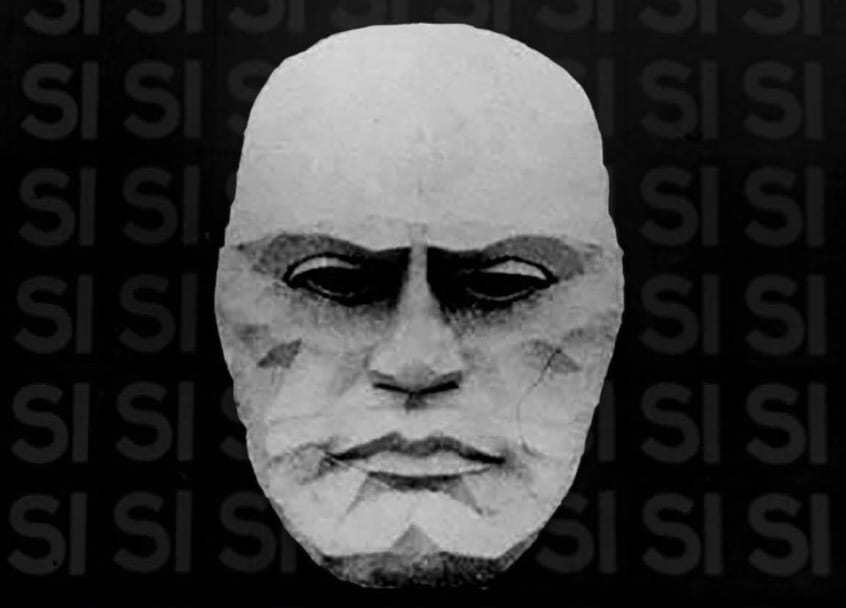
    Featured image: Detail from the cover of Fascism: History of a Word, which shows Mussolini’s face on the facade of Palazzo Braschi in Rome, 1934.

  • An Interview with Julien Stout – JHI Blog

    An Interview with Julien Stout – JHI Blog

    By Carolina Iribarren

    It was not terribly recently (1967) that Roland Barthes’s field-shaking essay “La mort de l’auteur” (“The Death of the Author”) first appeared. In it, Barthes argued that, in the late nineteenth century, the “empire” of the author—that “modern” figure peddled by “classical criticism” and bolstered by the rise of individualism, positivism, and “capitalist ideology” itself—began to cave and crack under the pressure of such figures as Mallarmé, Proust, and Breton, who, in depersonalizing, hypostatizing, and collectivizing language, gave the lie to authorship as a useful critical category. Ultimately, Barthes’s argument was a panegyric on interpretative freedom: on the reader’s right to engage with literary texts independently, on their own terms, sans the “theological,” if not authoritarian, mediation of the critic. As revolutionizing as Barthes’s intervention was for the study of literature, it carried with it another important implication: by equating authorship with modernity, it further entrenched in a generation of literary scholars the historiographical prejudice—rooted back in post-Enlightenment thought and Romantic aesthetics—that authorship qua concept was a modern (post-1500) formation. “The author is a modern character, no doubt produced by our society as it emerged from the Middle Ages,” the French writer asseverated.

    But was the notion of authorship truly alien to the medieval period? What, then, to make of a Chrétien de Troyes, known and venerated by name from the twelfth century on? What happens when assumptions like Barthes’s about the modern birth of the author are bracketed and medieval texts (many of them recognizably authored) are examined anew? Those are the questions guiding Julien Stout. An Assistant Professor of French at Princeton University, Stout has recently published L’auteur retrouvé : l’avènement des premiers recueils à collections auctoriales de langue française au Moyen Âge central (Droz, 2025). Centered on a group of Old-French authorial collections from the High Middle Ages (ca. 1100-1340), Stout’s study leaves behind the tendency prevalent in medieval studies today that takes for granted the anonymity—generalized and defining, as Burckhardt claimed in his seminal history of the Renaissance—of medieval culture. The book shifts the conversation away from the over-studied anonymous, oral song to the authored manuscript tradition. In doing so, it not only challenges established assumptions about vernacular authorship in medieval French literature but also invites us to reconsider our own triumphalist narratives of modernity, subjectivity, and individualism. Carolina Iribarren interviewed Stout about his book.


    Carolina Iribarren: I would characterize your book as having two sides. On the one hand, there is a conceptual engagement with the question of authorship. This question is itself transhistorical—it spans many centuries—and animates much literary discussion to this day. On the other hand, there is a sustained engagement with historically specific, geographically rooted cultural artifacts. Indeed, I would say that the bulk of the book is a painstaking examination of those 25 manuscripts by 17 authors active in France from 1100 to 1340 that you single out for their inclusion of authorial markers (e.g., proper names). To start, could you talk about the experience of researching and writing such a vast, multifarious project?

    Julien Stout: It was absolutely daunting, as reflected in the size of the book. Overall, the project participates in the historiography around the birth of authorship and the medieval author in particular. I respond to many different pre-existing opinions, both on the theoretical level and in terms of material evidence, while also trying to assert my own original approach. On the theoretical side, I was heavily inspired by Alain de Libera, his Archéologie du sujet. I really liked what he had to say about the absence of subjectivity in the Middle Ages; I used that as an anchoring principle, in a negative sense: rather than adopting that point of view, I felt galvanized by it to reevaluate the place and significance of this question of subjectivity in the entire corpus of late medieval theory, even its most anti-humanist corners. As for the material, the archives provided the grounding force. For me, it was a question of how exactly one tests the limits of modernist theory by grounding your analysis in concrete examples—by looking through the Dictionnaire des lettres françaises and going through every single author’s manuscript tradition, however time consuming and exhausting. In the end, I wanted to bring something new to the conversation, by pivoting both theoretically and with examples, even well-known ones, like Rutebeuf and Adam de la Halle. I wanted to locate a methodology capable of reframing the narrative.

    CI: You mention Alain de Libera and his thesis concerning the absence of subjectivity in the medieval period as a major influence, however negative. It seems like your point of departure was to acknowledge the predominance of that view of the Middle Ages—as a pre- or anti-modern period marked by anonymity and amorphous collectivity and therefore fundamentally inimical to the subject and the individual auteur—only to better relativize it, complement it, or altogether debunk it. How did this intuition first come to you that the Romantic/anti-humanist perspective may not be the whole story? How did you begin to suspect that a distortion regarding the Middle Ages’ relationship to subjectivity (and hence to authorship) might have taken place?

    JS: I was trained by scholars who really leaned into this poststructuralist, Freudian, anti-humanist tradition that is reader-centric and for which the author is merely a construction. At the same time, I met others who used the vocabulary of subjectivity, if only to conflate it with authorship—it was always author-subject, author-subject. As I was starting my dissertation, Alain de Libera published his Archéologie, wherein was the provocative claim that the medieval subject is essentially blasphemous; that, as Aristotelianism and even Augustinian thought have it, human beings cannot be subjects. Yet Michel Zink, one of the most influential scholars of medieval authorship, uses Hegelian terms in his book La Subjectivité littéraire (The Invention of Literary Subjectivity) to argue that there were medieval authors. So, I started to wonder, what do we miss when we deny subjectivity or apply that author-subject conflation to the medieval period? And I began to reassess both the anti-humanist and the subjectivist accounts: those who say that the medieval ages are an anti-subjective moment and those who say it is a proto-subjective one. My book aims to rediscover and assess the medieval theories and practices of authorship that have been obfuscated by such modern theories of subjectivity.

    CI: Foucault is central to this reassessment. You turn to his famous chiasmus, from “Qu’est-ce qu’un auteur ?” (“What Is an Author?”), to frame your argument. In that essay, he argues in favor of that view of the Middle Ages as a period of anonymity and posits a turn, in the early eighteenth century, when works of literature begin to be associated with proper names, such that a cult of the author can be said to have properly emerged. Obviously, you push against that teleological reconstruction of the birth of the modern subject-author, but you also keep part of the Foucauldian framework. In particular, you borrow from Foucault the distinction between author-subject and author-function. Because for you there’s something valuable methodologically in the latter. Could you spell out what is at stake in that distinction and why it’s important to your intervention?

    JS: Foucault’s chiasmus is genre oriented. He says that in the Middle Ages texts that were seen as scientific did bear proper names, and that that connection between scientific work and the author actually gets lost in the late seventeenth century. This is the exact inverse of what happens, according to him, to literary texts, which truly begin to have authors and be subjected to copyright at the end of the eighteenth century. It’s a very impressive argument. Heidegger and Nietzsche also make similar moves, where it’s not about historical evolution but instead about these moments of reversal—those points de bascule—and the first moment is the opposite of what comes next… It’s catchy on a philosophical level. But it’s not really accurate on a historiographical, evidentiary level. That said, I’m very appreciative of this distinction Foucault makes, because it isolates the authorial function. That’s what I’m interested in: “author” as a manuscript feature, an editorial category, and a category of reception. What I do in my work is locate the moments when it’s absolutely certain that authorship is a function in a text, meant to be noticed by medieval readers, and look at it closely.

    My primary criterion, then, was to identify manuscripts that assembled a series of texts one after another—forming an oeuvre clearly marked, through the recurrent appearance of the author’s name in both text and paratext, as an authorial collection. This approach required me to consider only tangentially certain figures revered by modern readers, such as Marie de France, since no extant manuscript actually preserves her “complete works” or explicitly celebrates her name. Instead, I concentrated on cases like that of Adam de la Halle, whose name appears over one hundred times in his collected works! Because part of my audience is so skeptical of the very notion of medieval authorship, it was crucial to focus on these extreme examples.

    CI: It caught my eye that, in your presentation of the corpus, you put emphasis on the fact that you’re bringing highly recognized figures and minor ones together. Could you talk more about your bibliographical choices and your selection process? What constitutes a minor figure in this period? What constitutes a major one?

    JS: My colleague Ariane Bottex-Ferragne, from NYU, published a book on the medieval bestselling author Le Reclus de Molliens. He’s a bestseller in the sense that he has fifty-five copies or so. Jean de Meun, author of Le Roman de la rose, has about two hundred copies starting in the fourteenth century. That can be seen as major in medieval contexts. What counts as major is modern terms is whoever is taught in the curriculum and is overanalyzed—for instance, Marie de France and Chrétien de Troyes. Then there are figures like Baudouin de Condé—now relatively obscure but once central to the tradition of single-author manuscript collections.

    When I say “minor,” I refer to three overlapping criteria: modern scholarly reception, the number of surviving authorial copies, and historical influence. Chrétien de Troyes, for example, was immensely respected as the initiator of the Grail legend and was cited by his contemporaries as a model of eloquent French. The fact that we have only one surviving single-author collection of his romances does not diminish his importance, though it does put it into perspective. To modern eyes, authors such as Angier and Jacques de Baisieux—the least studied and least copied in my corpus—appear extremely minor. Jacques’s single-author collection was even destroyed in the 1904 fire. They seem to have left little trace in their literary world beyond their own authorial collections. The term “minor,” then, remains flexible—but it works.

    CI: So, going back to Foucault’s questionably neat genealogical reconstructions, would it be correct to say that the Romantic-poststructuralist view of medieval literary production as fundamentally a-subjective and authorless is not wrong so much as incomplete: it leaves out the essential fact that the author as an editorial category or a category of reception did exist in the Middle Ages and remains operative in some key (if now “minor”) texts?

    JS: Yes, it’s both. When you look at Latin authorship theories of the moment, you find established literary and scientific authors—e.g., Ovid and Virgil—and they are revered. Even vernacular authors like the troubadours could be monumentalized. In the French case that I examine, you have both a culture of anonymity and a few established authors. Anonymity, you know, can be complimentary to authorship; they coexist. You see this in the pseudo authorship tradition that goes all the way back to pseudo–Saint Paul, pseudo-Aristotle… There is a whole series of in-between practices that put pressure on the assumption that the Middle Ages were a time when everything was anonymous, a period where everybody seemed to be in a dreamy, semi-conscious state. However, I focus on twenty-five manuscripts and seventeen authors, and that’s nothing compared to the countless writers who do not have authorial collections. These authors range from twelfth-century Anglo-Norman didactic writers such as Philippe de Thaon and Angier to thirteenth-century “autobiographical” authors like Rutebeuf, Adam de la Halle, and Watriquet de Couvin. I also include lesser-known translators and hagiographers such as Pierre de Beauvais and Guillaume le Clerc de Normandie, as well as authors of fabliaux like Gautier le Leu, Jean de Condé, and Jacques de Baisieux. I make it very clear that French authorship is a very marginal and very fuzzy phenomenon outside of the corpus.

    CI: Still, I can’t help feeling that your argument, your spotlighting of authorship in varying forms and degrees in the Middle Ages, invites us to revise a certain philosophy of history premised on a progressivist understanding of the development of subjectivity—from formless anonymity and collectivism in the Middle Ages to full-fledged individuality and selfhood in the modern period. Do you think that enriching our understanding of authorship in the medieval period, as you purport to do, in any way destabilizes the teleological presuppositions that shape our notions of self and subject today? You show that the story actually included authors, names, and editorial practices anchored in authorship from the beginning. What are the implications of that recognition for contemporary philosophical models of the subject or the self?

    JS: Pierre de Jean Olivi, a thirteenth-century minor theologian, actually uses a concept—that of the reflexive, agential soul—that is quite close to that of the subject. There’s also a great article by Jacob Schmutz (“L’existence de l’ego comme premier principe métaphysique avant Descartes”) which shows that the certainty of the self as a primary metaphysical principle, associated with Descartes and then Kant, can be traced back to thirteenth-century debates—even Augustine has an equivalent of “I think, therefore I am”; he says, “I doubt, therefore I am.” It’s not at the center of the epistemological system of the Middle Ages, but there are genealogical traces. The thirteenth century is also a moment when private confession becomes mandatory. All these elements are part of a redefinition of the self or the individual that will have an impact later. However, I myself really enjoy not thinking about what comes later, instead focusing on how a twelfth-century, a thirteenth-century reader might have perceived the shifting definition of authorship. For example, all of my authors, but especially Rutebeuf, Adam de la Halle, Guillaume le Clerc de Normandie, describe themselves as individual sinners, and their poetry as personal sins, and this in turn leads to a more individualized—let’s call it subjective—approach to literature. How was that change perceived at the time? I focus on texts that say they have an author, not because I’m trying to use the past to deconstruct the present, but in order to reconnect with questions, theories, and practices that have largely been forgotten but that in reality participated in the production of pivotal literary and cultural categories. My aim is to render the medieval experience of authorship in its complexity. That’s my hope.

    CI: It must be challenging, I imagine, to position your study as an intervention. There’s a polemical edge to it. From your theoretical framing to your archival choices, you’re definitely pushing back against the grain of recent medieval scholarship. You offer your study as a kind of corrective to this old yet unresolved debate in literary history that revolves around authorship. What do you think is the state of the conversation concerning the medieval author, after an intervention like yours?

    JS: Well, I presented this book two weeks ago and still got a very common question, which is, why do you, French people, always focus on this question of the death of the author? Which indicates that the presentation wasn’t really heard because the book is basically not about the death of the author. Rather, it examines how the questions of the author’s death and resurrection are deeply entangled with theories of the subject—an enduring obsession not only among French thinkers, but among humanists more broadly. The humanities have, after all, placed subjectivity and the “self” at the very center of academic inquiry. Even the most critically innovative scholarship remains steeped in these notions of the self and the subject, often equated with the figure of the author. This is why it can be so difficult to make myself heard when I insist that I am writing about the author before the era of the self, before the era of the subject, which are anything but universal and atemporal. So, I think there will be a multilayered reception: some people will look at the book and say, “yet another book on medieval French authorship” and dismiss it; and then there will be another audience, probably the new generation of grad students, who will be open enough to engage with it.

    CI: You’re trying to move the field beyond the poststructuralist doxa.

    JS: That would be the greatest honor—to influence readers, even slightly, to be more cautious about the constant impulse to privilege modernity, or to justify the Middle Ages only through a dialogue with the modern period. Too often, this takes the form of seeing the medieval either as its “other”—the absolute opposite of what we define as “modern,” in the Burckhardtian sense—or as its prelude, what Zink, following Hegel, calls the “infancy” of modern literature: a body of work valued chiefly for the greater things it is thought to have made possible. Though I am not naïve enough to believe that I can access it directly, I work under the assumption that the primary interest of medieval literature is medieval literature itself.

    CI: One of the first things that struck me about your book was the impersonal, “anonymizing” use of the pronoun nous, “we.” As the first sentence reads, “Pourquoi se risquer à proposer, comme nous nous apprêtons à le faire, une étude de plus sur l’auteur au Moyen Âge ?” (“Why risk proposing, as we intend to do, yet another study of the author in the Middle Ages?”). Of course this is largely a rhetorical convention, especially in French academic writing: to bolster the impartiality of one’s scholarship by concealing or denying one’s own subject position. Still, I couldn’t help but wonder if, after having meditated so profoundly on the issue of authorship and, to some degree, subjectivity, you have noticed that your own relationship to writing and the act of creating under a proper name has changed?

    JS: The fact that it is a convention doesn’t mean that it’s not significant. There are all sorts of ways that the self is annihilated during the writing of a book. There’s this idea of crushing the self in order to be able to produce something in one’s name. When you study subjectivity in particular, there’s also a fear of developing a double personality—of becoming, like that book by Ricœur, Soi-même comme un autre (Oneself as Another). There were many instances when I thought I was being written just as much as I was writing. There’s this beautiful image by the twelfth-century mystic Hugh of Saint Victor, who says that we moderns are like little people standing on the shoulders of ancient giants. That’s very much how I feel. As a writer, you are humbled by the past and the generations of thinkers who came before you and are speaking at the same time, even though it’s only your name on the book cover.


    Julien Stout is Assistant Professor of French at Princeton University. His research focuses on literature, music, and material culture from the Middle Ages, with a special interest in questions of authorship, multilingualism, and modernity’s relationships to the medieval past. He has published on Chrétien de Troye’s Conte du Graal, the paratextual phenomenology of late-medieval booklists, and the poetics of youth in medieval literature. His next book project, Sounding Foreign: The Poetics of Multilingualism in Christian and Jewish Vernacular Song, brings together sound studies and codicology in the first joint study of Christian and Jewish vernacular multilingual songs in Old French, Occitan, Latin, Hebrew, and Arabic.

    Carolina Iribarren is a Ph.D. candidate in the Department of French at Princeton University, where she specializes in twentieth-century literature and thought, with an emphasis on aesthetics, ethics, and ecology. Her articles on Simone Weil, Simone de Beauvoir, the history of literary criticism, and related topics have appeared in French Studies, the Journal of Modern Literature, and The Cambridge Companion to the American Essay, among other venues. She is currently working on a monograph on Weil’s philosophy of art, notably her ideas on beauty and their social, decolonial, and environmental implications.

    Edited by Jacob Saliba.

    Featured image: Illumination from manuscript collection Recueil d’anciennes poésies françaises, ca. 1275-1300, via Bibliothèque de l’Arsenal.

  • On Adam Smith’s Alleged Sobriety – JHI Blog

    On Adam Smith’s Alleged Sobriety – JHI Blog

    by Lotte List

    “The expression ‘Sattelzeit,’” Reinhart Koselleck once quipped, “is obviously a trick concept [Kunstbegriff] which I used to get money!” (195). Nevertheless, since then, the notion of a “saddle period” in European history from the mid-eighteenth to the mid-nineteenth centuries has gained popularity as a methodological concept. It has spilled over from intellectual history to the “real world” of social history, and it has now come to constitute a link between that historical period and the instability and transformations of our present moment.

    For Koselleck, the Sattelzeit resembled a mountain saddle, a valley in a pass, from which Europe could look simultaneously to the two plains of past and future, early and late modernity. It was a time of conceptual change, where concepts became “Janus-faced,” in that they were torn between outdated and not yet established semantic contents. Ideological struggles were waged over the right to define such concepts, which Koselleck and his co-editors conceived as “basic historical concepts” in their major dictionary project of the same name, the Geschichtliche Grundbegriffe (1972–1997). These concepts, again, were historical in a double sense: on the one hand, they constituted the content of the period as its ideological signature, and, on the other, they had as a central function the reinterpretation of history itself. To use Koselleck’s term, they came to “temporalize” history, whereby modernity came to understand itself as the first properly historical epoch.

    This idea of an in-between period in which the modern European mind took shape through historical self-reflection remains influential today, not least because of Koselleck’s own treatment of such concepts as crisis and progress. His specific reconstruction of the character and consequences of the Sattelzeit, however, is deeply ideologically saturated. His project was essentially anti-Marxist and anti-socialist. For example, in his 1987 preface to the English edition of his first book, Critique and Crisis, he conceded that it was a product of the post-war era and motivated by the wish to “examine the historical preconditions” of both National Socialism and the Cold War divide between East and West, specifically their “Utopian roots” in the Enlightenment (1). It was the “loss of reality and Utopian self-exaltation” of the German National Socialists “which had resulted in hitherto unprecedented crimes.” That is, both the Third Reich and the Soviet Union sprung from the same source in intellectual history, namely the Utopianism of the revolutionary tradition. Although his 1959 book was more openly ideological, the GG remained motivated by the same project: to trace a genealogical lineage of Utopianism from the French and German Enlightenment to the civilizational breakdown of the twentieth century. Thus, in his own entries, Koselleck repeatedly argues that Enlightenment Utopianism culminates in Marx and Engels’s political appropriation of Hegelian philosophy of history (e.g. the entries on progress, history, and crisis).

    To consolidate this narrative about a revolutionary tradition lying at the roots of the modern catastrophe, it was apparently important to Koselleck to exclude the British thinkers: “The Utopian ideas of the continental Enlightenment […] never gained a foothold across the Channel. There it was the Scottish moral philosophers with their sober theories rooted in social history who set the tone and who began to respond to the economic lead gained by Britain” (2–3). Continental Enlightenment politics, it would seem, was intoxicated with historico-philosophical fantasies of a Utopian future, whereas British Enlightenment economics was solidly grounded in the real world of empirics and material concerns. Koselleck’s genealogy of modern philosophy of history relies on this distinction: It was the secularized eschatology of revolutionary political thought which brought about the extremes of twentieth century ideologies—not the transition to capitalist production and the emergence of its ideological equivalent, liberal political economy; the French Revolution, not the Industrial.

    The British political economists, however, were not as “sober” as Koselleck claimed. Philosophy of history played just as great of a role in economic thought as it did in political thought (if such a distinction can even be maintained). Here too, notions of universal history, progress, and crisis were abundant and formed the metaphysical foundation of moral and political arguments. This is true not least of that great godfather of liberal economics, Adam Smith. According to his first biographer, Dugald Stewart, the unifying feature of Smith’s thought was his method of inquiry, which Stewart defines as “conjectural history.” Similar to Hume’s notion of “natural history,” Stewart claims, conjectural history fills in the holes in documented history by deducing from the “principles of human nature” the most plausible cause of events (293–95). Where we have no written record of what actually happened, we are forced to speculate.

    Yet conjectural history is more than just a solution to a practical problem in Smith. As Stewart’s remarks about the principles of human nature suggest, it includes a philosophy of the natural laws of historical development as rooted in Smith’s philosophical anthropology. In the words of Stewart: “When, in such a period of society as that in which we live, we compare our intellectual acquirements, our opinions, manners, and institutions, with those which prevail among rude tribes, it cannot fail to occur to us as an interesting question, by what gradual steps the transition has been made from the first simple efforts of uncultivated nature, to a state of things so wonderfully artificial and complicated” (292). These lines capture neatly the stakes of Smith’s philosophy of history: first, the idea of a natural progress of history, second, that this progress proceeds through a series of stages, third, that society advances from a natural state to the modern civilization, and fourth, that this diachronic development maps onto a synchronic differentiation of societies into degrees of “rudeness” and sophistication according to their level of progress, the most advanced among them of course being Britain. Smith believed in universal progress, not just regarding productive forces but also the perfection of humankind. Moreover, he believed that this progress led each society through four stages of development: from a primitive society of hunters and gatherers, over pasture, then agrarian, and finally commercial society (Skinner, 8 ff).

    Smith’s theory of the stages of history has been interpreted as his version of historical materialism, an early inspiration for Marx. Yet it is important to note that Smith does not limit his characterization of the different stages to their mode of production, but sees their succession as a progression of human freedom. While the first stage, the age of hunters, is characterized by unlimited freedom, this freedom is checked by a lack of opulence and security, much like the state of nature in natural right theory. The following stages introduce property rights, thus increasing opulence, but these rights also lead to hierarchy, domination, and slavery. Only in commercial society is freedom united with opulence and security, so that humanistic progress can catch up with technological progress. In this way, Smith’s theory of historical stages is not purely material, but also includes a moral vision of the universal progress of humankind realizing its potential for freedom.

    Natural history also was a standard for evaluating factual history. Thus, Smith’s primary argument against mercantilism, his rival economic theory, is that it inhibits natural progress: By establishing monopolies and tariff barriers, mercantilism limits the freedom of trade and impedes the civilizing and peacemaking force of the market (Smith, sec. IV.vii.c.44, henceforth WN). Mercantilist regimes thus constitute a deviance from the natural course of history, although they can never break away from this course entirely. In the same vein, according to Smith, the brutality of colonialists towards Native Americans and indigenous communities of British India arose “rather from accident than from any thing in the nature of those events in themselves” (WN: IV.vii.c.80); what ought to have been a peaceful and mutually beneficial exchange between two societies according to natural history must have in some way been derailed from this path by unnatural policies.

    As Stewart emphasized, Smith’s progressive philosophy of history was no revolutionary theory; it posited no end-goal of history or eschatological emancipation (311). Rather, commercial society was itself the final stage of history, in which the perfect conditions for progress could ultimately be realized. Such progress was itself the telos of human nature: “It is hard in the stationary, and miserable in the declining state. The progressive state is in reality the cheerful and the hearty state to all the different members of the society. The stationary is dull; the declining, melancholy” (WN: I.viii.43). While not a revolutionary, Smith was just as much a believer in the natural and universal progress of mankind as the French enlightenment thinkers. Yet as many readers of Smith have observed, despite the structural role that his belief in progress plays in the architecture of The Wealth of Nations, it stands in a curious tension with an undercurrent of pessimism resurfacing now and again throughout the text. When natural and factual history diverge, natural progress gives way to an “unnatural and retrograde order” (WN: III.i.9).

    This tension cannot entirely be ascribed to the vices of mercantilism, nor to those “human institutions” which have “disturbed the natural course of things” and inhibited progress (WN: III.i.4). Indeed, there are inherent contradictions within Smith’s own system. Heilbroner, for instance, has emphasized the inherent tendency of the progressive division of labor to deskill and mentally impoverish the working class, as well as the tendency of profit-seeking to impoverish them materially, both of which were already recognized by Smith himself. Others like Ince understand the tension between Smith’s vehement critique of mercantilist imperialism and his approval of settler-colonialism in North America as an instance of that deeper contradiction between liberal ideals (pre-dating the notion of “liberalism”) and capitalist historical reality central to what he calls “colonial capitalism.” I concur with both that we should not try to gloss over such tensions in Smith but rather see them as symptoms of something not adding up in the way he tries to extrapolate a “natural system of perfect liberty and justice” (WN: IV.iii.c.44) from the violent reality of capitalism’s historical emergence.

    To return to our initial dispute with Koselleck, there is nothing sober about Smith’s thought, if “sober” means devoid of political ideology and speculative metaphysics. While Smith was indeed no utopian revolutionary, he contributed just as much as the French and German Enlightenment thinkers to the temporalization of history characteristic of the Sattelzeit: the emerging self-conception of a “modern” Europe which was understood to be uniquely historical in the sense that it was perceived as a time of deep and continuous transformation. Central to this temporalization of history were ideas of progress, natural history, and historical universalism—features which were not accidental to Smith’s system but structurally defining for the argumentative foundation for the superiority of commercial society.

    If we keep in mind that the concept of Sattelzeit was meant to describe a specific transformative period in European consciousness—not a universal event in global social history—then Koselleck’s argument about temporalization appears convincing and useful. However, by limiting his focus to revolutionary Utopian thought and drawing a direct line from there to the political extremism and unrest of the twentieth century, he both ascribes to intellectual history the power to determine social history (a reductive inference he himself warned against) and places the responsibility for ideological excesses on emancipatory revolutionary ideals. However, non-revolutionary liberal economic thinkers such as Smith were just as ideological, in the sense that their metaphysical and moral convictions shaped their empirical claims, and in the long run arguably more influential. Ideals about progress and historical necessity were the vehicle, not just of Utopian politics, but of the ideological justification for the inescapability of capitalism as the final and ultimate stage of history.

    While the Sattelzeit denotes a specifically intellectual shift in the self-conception of European elites, this does not mean that it happened in isolation from social history, as Koselleck takes care to point out in his essay “Social History and Conceptual History,” nor that its socio-historical context was limited to Western Europe. The Sattelzeit was a time of conflict and contention precisely because the concepts being fought over were politically invested and not only of purely philosophical interest. Thus, if we expand our concept of Sattelzeit to include economic thought, then we also need to revise our understanding of its historical context, its reactions to, conditions in, and influences on social history.

    Writing before the historiographic tectonic shift of post-colonial studies, and in the shadow of such staunch thinkers of the jus publicum Europaeum as Carl Schmitt and Karl Löwith, in the late 1950s Koselleck could still claim that “European history has expanded into world history and there, it reaches its completion, having led the whole world into a state of permanent crisis. As was the case when bourgeois society initially captured the entire globe, so too the present crisis stands on the horizon of a historico-philosophical, mainly Utopian self-conception” (5, translation modified). However, the social transformation that Smith sought to systematize in The Wealth of Nations was not limited to Europe, nor to the condition of the bourgeoisie. On the contrary, as several scholars have pointed out, it was the emerging world-market, trade wars, and the conditions in the colonies, conflicts between natives and colonizers, as well as between colonizers and their home countries that formed his understanding of world-history. In this sense, modern world history does not emanate from Europe; rather, the Sattelzeit period’s Eurocentric idea of world history arose in part as a reaction to the new reality of a global economy. And although Koselleck was perhaps the most astute observer of this idea, he also remained trapped within it, because he did not acknowledge the material-economic origins of this transformational period. To understand the transformation of historical time in the Sattelzeit, it would be necessary to place it in its proper context: not merely the political transformation of Europe, but also the economic transformation of a world being shaped in the image of capital.

    This think piece is part of the forum “The Return of Political Economy in Intellectual History.”


    Lotte List is a Danish researcher in philosophy with a background in Marxism and critical theory. She is currently a Carlsberg Foundation international postdoc fellow at Bologna University. Her research focuses on the intersections between political and economic thought and philosophy of history.

    Edited by Jonathon Catlin.

    Featured image: The Montagu House, the first seat of the British Museum, which opened to the public in 1759 as a “universal museum” of “human history” and owes its unique collection to colonial conquest. CC BY-NC-SA 4.0, the British Museum.

  • Mau Mau and/as Conspiracy: A Reconsideration

    Mau Mau and/as Conspiracy: A Reconsideration

    by Christian Alvarado       

    The Mau Mau conspiracy will fail. There is no doubt about that. It started too soon and was on too small a scale. The forces on the side of law and order are being constantly strengthened in numbers and by training. But it is not enough to crush the Mau Mau: How are we to deal with the evil ideas which, largely through fear, are dominating a tribe of more than a million Africans?

    —Stephen Foot, “The Ideological Struggle in Africa”

    Published in The Star (Johannesburg) on October 21, 1953, the above passage is emblematic of a genre of writing about the Mau Mau Uprising in late-colonial Kenya (1952–1960), which positions the movement as the result of “evil ideas” spread through the work of a conspiracy. From the first rumors of attacks on settler plantations in Central Province, the composite factions of freedom fighters generally glossed as “Mau Mau” became known throughout the world as an icon of violent, African revolution. Stephen Foot, a British businessman, writer, and author of the article in The Star, rehearsed a formulaic set of elements that have conditioned pro-Western rhetoric about the Uprising since its outbreak in the fall of 1952—framings anchored in a much broader, and older, colonial tropology but further influenced by the particularities of his own politics. Most pertinently, prior to penning articles on his travels in Africa, Foot became a member and staunch advocate of the anti-communist Moral Re-Armament (MRA) movement. Founded in 1938, the MRA had its roots in American evangelical and revivalist traditions and sought to remake a fallen world through individual transformation and spiritual renewal.

    The establishment of relationships with many figures who would come to serve in high-ranking capacities across the African continent during and after the decolonization era—including Egypt’s Gamal Abdel Nasser, Nigeria’s Nnamdi Azikiwe, and Kenya’s Tom Mboya—became central to the MRA’s aspirations during the Cold War. The connections forged with such figures, however, obscure the extent to which the MRA was rooted in reactionary politics, most notoriously distilled in founder Frank Buchman’s assertion of pro-Nazi positions and statements. “Human problems aren’t economic,” Buchman proclaimed, “They’re moral, and they can’t be solved by immoral measures. They could be solved within a God-controlled democracy, or perhaps I should say a theocracy, and they could be solved through a God-controlled Fascist dictatorship.”

    It was this vision of a global order populated by patchworks of theocracies and “God-controlled Fascist dictatorships” that the MRA worked to establish as a bastion against the diffusion of international communism, anti-colonial race-consciousness, and atheism. Whatever its theological pretensions, the MRA was part of a mycelial network of reactionary crusaders that have traversed continents and spanned oceans since the Russian Revolution and the First World War. These entangled events speak to two of the most consistent elements of conspiracy theories regarding political violence over the last century: anti-communism and the malevolent machinations of inordinately powerful “outsiders within.” And it is as a part of this interpretive community of reactionary conspiracists that Foot’s comments on the “Mau Mau conspiracy” must be read. Doing so centers our attention on how this conspiracy was read outward from its origin in Central Kenya and why it was framed as a battlefront in the emergent “ideological age” of the global Cold War.

    Undoubtedly, digital culture has radically changed how people across the world interface with conspiracies and other speculative narratives like them. Today’s “post-truth” discursive landscape, however, looks far less unprecedented than it might first appear when situated as a continuation of distinct colonial and post-colonial discursive tendencies shaped over centuries of imperial paranoia and politicking. In what follows, I want to suggest that one can best understand conspiracism in the present as a re-casting of a genre of thought that has been part and parcel of Western discourses about change, the Other, and civilizational decline for as long as the self-conscious idea of “the West” has existed itself. Decades before internet conspiracists posted their way into the mainstream of Western European and American societies, the same rhetoric and violence enabled by conspiracies remade the political economy of the world by shaping the processes of colonization and decolonization in Africa, Asia, and Latin America—including through the circulation of what I call here the “Mau Mau conspiracy.”

    Constructing Conspiracy, Narrating Mau Mau

    In its narrative proliferation, “the Mau Mau conspiracy” served as a way to sidestep the ethical charge raised by the waging of revolutionary violence (most famously by Kĩama Gĩa Ĩthaka na Wĩyathi or the “Land and Freedom Army”) in a settler-colonial state in three intertwined ways: One, the conspiracy dismissed the political claims of those who participated in the Uprising through delegitimizing its status as an organic movement; two, it avoided engaging with the critiques elevated by the armed struggle through positioning its political thought as the result of brainwashing; and three, it located the agency of the anti-colonial movement outside of its rank-and-file participants. What this very phrase “Mau Mau” designated in its heyday was an anti-systemic militancy in Kenya orchestrated by the string-pulling machinations of a shadowy cabal (variously composed of leading African nationalists, Reds, and/or the “international Jew”). Whatever its particular constitution, according to those like Foot, this nefarious group worked to destabilize the Western order of things by stoking dissent in places where it had not existed before under benevolent colonial governance. The growth in militancy and rejection of prescribed political channels that took shape as Kenya’s anti-colonial sentiment swelled was, thus, taken as evidence of the manufactured nature of the movement; a feature that incentivized narrative structures positioning the Uprising as both an inorganic result of outside agitators exploiting some of the most common organic deficiencies of African subjectivity as constructed in colonial thought (its gullibility, irrationality, and plasticity). As pointed out in an episode on the Mau Mau Uprising by the QAnon Anonymous (QAA) podcast, these ideas were central to articulating how participants in Mau Mau were positioned as having taken to quasi-Satanic practices by being co-opted into a cultish structure dictated by charismatic leadership.

    As broached by Caroline Elkins, this framing proved central to producing the rationale for exercising extreme forms of judicial and extrajudicial violence in suppressing the anti-colonial movement in Kenya, resulting in the creation of an elaborate system of British concentration camps and what has been regarded as a genocidal campaign against the Kikuyu. Anchored in the well-trodden political utility of conspiracist argumentation, the “Mau Mau conspiracy” pulled from a common set of elements in this idiosyncratic but remarkably consistent genre—triangulating the stock figures of string-pulling masterminds, their established collaborators within a given mass movement, and the vast populations of “manipulable subjects” they co-direct to nefarious ends. If this triangulation is not endemic to all iterations of conspiracist narratology (and it is not), it remains one of the most common frameworks through which attempts to dismiss the ethical questions raised by anti-systemic movements of all sorts have been pursued. It has been, and remains, a rhetorical structure identifiable in conspiracy theories concerning a range of events throughout history, including the French and Haitian Revolutions, Irish Republicanism, anti-Soviet dissent, environmentalist groups, feminist agitation, and student movements the world over. In each of these conspiracist frameworks, challenges to hegemonic conceptions of Order and economic extractivism share a set of rhetorical figures located in a narrative wherein cabals of shadowy actors conscript easily-manipulated populations and turn them toward nefarious ends. Whether surfacing as slave, “rabble,” political dissident, anti-colonialist, or nationalist, the “manipulable subject” is always only partially an agent of historical action; behind them lurks “the Hidden Hand.” In the case of Mau Mau, the threat of this articulation was relevant not only to dynamics inside the colony, but also to the metropole from which it was ruled.

    If the “manipulable subject” was a concrete feature of governance in the colony, the appearance in Britain of colonial conspiracism about Mau Mau also played a key role in justifying British attitudes and actions within the metropole, even in spaces with little direct connection to events in Kenya. Just two months before Foot’s article on Mau Mau appeared in The Star (Johannesburg), residents of the city of Luton in eastern England who picked up their daily newspaper encountered the following headline on its front page: “Africans as Easy Prey: Mau Mau and Communism.”[1] Set alongside advertisements for industrial-grade overalls, reportage on local model train enthusiasts, and investigatory information into the mysterious death of a local woman, the day’s Luton News detailed nothing short of an impending doomsday scenario unfolding in the faraway colony. The August 27th, 1953, article recounts the visit of a Reverend H.G. Rolls to the local Rotary Club three days prior, where he addressed its membership regarding the Uprising in Kenya. According to Rolls (who left no record of ever having travelled to Kenya), African populations, destabilized by the “advent of modernity” on the continent, presented a situation in which: “Easily exploited, the native was prey to those who advocated nationalism of the wrong kind such as Mau Mau, and Communism.” These dual, characteristically-ambiguous threats—Mau Mau and Communism—are co-productive elements in the “Mau Mau conspiracy.” The former delineates examples of African political consciousness untethered from the specific model of constitutional reform acceptable to the British during the 1950s, while the latter serves as a vague shorthand for Cold War-era preoccupations with the nefarious designs of forces behind the Iron Curtain.

    This article’s appearance in Luton is not incidental. In the wake of the Second World War, Luton’s proximity to London and relative affordability drew a moderately large influx of African, Caribbean, and South Asian migrants seeking opportunity in the United Kingdom. Those who made their way to Luton landed in a hostile environment. As speculation about immigration being driven by internationalist plots became a normative part of political discourse across the country, conspiracism appeared as a routine and endemic aspect of daily life. Among other things, it is for this reason that towns like Luton featured conspiracy theories about Mau Mau alongside advertisements for sandwich spread and coveralls aimed at a historically white working-class population. The harsh realities of post-war global capitalism and the phenomenon of de-industrialization that reshaped the economic landscape of England made it a place ripe for nativist speculation about who, exactly, was responsible for the reduction in standards of living and job losses. In such a context, it became possible for an uprising in Kenya that sought the overthrow of colonial rule and the assertion of the fundamental rights of African people to feel suddenly much closer to home. In conjunction with the ever-present threat represented by populations of “manipulable subjects,” conspiracist myths of Mau Mau worked to link the collapse of the British empire to apocalyptic visions of life under Communism and, as such, expresses the destabilizing anxieties surrounding decolonization and the possibility of Soviet victory in the developing Cold War.

    Here, we see how the “manipulable subject” catalyzes a demos that generates the gravity of “the Cabal’s” threat to dismantling the status quo. This rhetorical strategy is linked to the purported existence of an affective environment alleged to produce psycho-socially destabilized and, thus, easily exploited populations who are perpetually susceptible to radicalization. Put otherwise: What enables the conspiracy to establish successful control over manipulable populations is the psycho-anthropological turmoil they experience as populations who live, as claimed by Foot, “largely through fear,” despair, anxiety, desperation, and illogic. Positioned contra objectivism, the “manipulable subject” is always in some manner insufficiently right-thinking and exceedingly detached from reason. It is a rhetorical effect, as Frida Beckman writes, of the Western subject’s drive to reify itself by “constructing borders against the potentially ‘engulfing otherness’ of growing masses of poor people, against colonial subjects, against the nonhuman.” While the bloodthirsty Mau Mau feared by mid-twentieth-century colonial apologists and the unthinking sheeple lambasted by contemporary conspiracists might harbor different (and often racialized) roles in specific conspiracy theories, they are both alleged to share an imputed condition of gullibility and a general capacity to be bent toward the destruction of the West. Conspiracism in this vein takes shape in what Charisse Burden-Stelly identifies as the “Black Scare/Red Scare Longue Durée” problem-space in Western capitalism that articulates the twin threats of race and progressivism in the past and present.

    ***

    It has now been more than seventy years since the phrase “Mau Mau” began circulating across the world as an icon of violent African rebellion against colonialism. The threat to the racial order that it represented—one that struck at the foundation of the post-war global political economy—generated concerns with the Uprising that traversed political orientations, visions of African futurity, and forms of cultural production. Alongside the assertion of Black freedom from white domination that characterized solidaristic or even quasi-messianic readings of Mau Mau, sat reactionary attempts to dismiss the rebellion as the unleashing of latent savage impulses and the absence of a coherent political program on the part of those who formed the grassroots movement. The impulse to “demystify” Mau Mau in much of the historical literature on Mau Mau (that is, to disprove colonial renderings of its demonic nature and lack of political vision) has tended to obscure the work done by its global embeddedness in conspiracist narratives and understandings of African decolonization. If (pace Foot’s prediction that opens this essay) the “Mau Mau conspiracy” failed as a project of militant decolonization in Kenya, it succeeded as a composite of existing conspiracist and racist tropes assembled to discredit anticolonial resistance, offer scapegoats for the economic disarray brought about by the failure of empire, and entrench colonial paranoia in the postcolonial metropole.

    [1] “Africans as Easy Prey: Mau Mau and Communism,” The Luton News, 27 August 1953. Accessed via the British Newspaper Archive.


    Dr. Christian Alvarado is a Lecturer in Humanities at San José State University. He earned his PhD in the History of Consciousness at the University of California, Santa Cruz. An interdisciplinary scholar of African Studies, Alvarado’s work has been published in History in Africa, the Cambridge Journal of Postcolonial Literary Inquiry, and Kritika Kultura (among other venues).

    Edited by Tomi Onabanjo.

    Featured image: Digital montage of the photograph “Troops of the King’s African Rifles carry supplies while on watch for Mau Mau fighters” (Wikimedia Commons) taken between 1952 and 1956 by the British Ministry of Defense, overlaid with the headline of an article (“Who’s Behind the Mau Mau?”) written by Fenner Brockway and published in the February 27th, 1953 issue of the Tribune

  • Rediscovering Agricultural Economists for the History of Ideas – JHI Blog

    Rediscovering Agricultural Economists for the History of Ideas – JHI Blog

    by Federico D’Onofrio

    In 1920, the agricultural economist and Social-Revolutionary politician, Aleksandr Chayanov published, under the pseudonym Ivan Kremnev, The Journey of My Brother Aleksei into the Land of Peasant Utopia. In this science fiction novella, the protagonist falls asleep in Bolshevik Moscow in 1921, later awakening in the fictionally iconic year of 1984. He quickly realizes that the Socialist Revolutionaries, rather than the Bolsheviks, have come to power: under peasant rule, the population of cities has been restricted, science has been harnessed to control the weather, and heavy industry has been dispersed as widely as possible across the countryside. In this narrative fantasy, filled with peasant costumes and futuristic old muzhiki, Chayanov imagined an alternative future in which all the levers of power were held by peasants. For him, peasants were a distinct class, united not only by common interests but also by similar values and ideals, including a shared aesthetic sensibility, reminiscent of the art styles of Breugel the Elder and Russian populist painter Aleksej Venecianov (Brass, 2022; Raskov, 2014).

    Chayanov’s works, suppressed by the Soviet regime that ultimately killed their author (executed at Alma-Ata in 1937 after years in Stalin’s camps), were rediscovered in the 1960s through the efforts of historian Basile Kerblay and sociologist Theodore Shanin. This rediscovery became a foundation of critical peasant studies, an anthropological and historical approach—emerging in the context of the Vietnam War—that highlighted the problematic character of rural societies based on a vision of the peasantry as a group, an awkward class, that was not destined to disappear: “They did not have to follow either a capitalist or socialist ‘road’, but could forge a distinct ‘peasant path’ building on family small holdings” (Friedmann, 2018, p. 18). Yet, the post-colonial focus of critical peasant studies and Chayanov’s posthumous prominence within it has, ironically, only obscured how much he actually shared in broader visions of a European agrarian modernity. In particular, the historiography has generally failed to grasp the ideological unity of the kind of agrarianism spearheaded by agricultural economists across continental Europe in the twentieth century. Unlike economic historians, who identified family farms as an engine of rural modernization already in the 1990s, most notably Jan Luiten van Zanden (1991), intellectual historians of agrarian society have long pitted visions of modernity as fully industrialized agriculture—the “Campbell-farm-approach” described by Deborah Fitzgerald (2003)—against inward-looking traditionalism. Only recently, the real significance of European agrarianism as a strategy of conservative modernization extending from the Belle Époque into the 1980s has emerged as a focus in works by Jonathan Harwood (2013) as well as Juri Auderset and Peter Moser (2018).

    With the exception of Soviet collectivism, which embraced the industrialization of agriculture, visions of a distinctively rural modernism cut across political regimes and ideologies in the first half of the twentieth century, from German social-democracy to Italian fascism. They originated in a broader historical phenomenon: the rise of agricultural economists as policy experts in Europe and the United States. This form of expertise was a bit similar to, though ultimately distinct from, that of economists and management theorists. Within agricultural studies, beginning already in the late nineteenth century, new professional figures emerged, capable of combining technical-scientific knowledge, mastery of information, and significant political influence.

    Agricultural economists, in continental Europe, from Spain to the Baltics, from Scandinavia to Sicily, were part of a broad development of career paths and ideals similar to those of Taylorist engineers (Merkle, 1980). Many of the categories used to analyze the nature of economists’ intervention in politics work equally well for agricultural economists (Eyal and Levy, 2013; Berman and Hirschman, 2018). However, certain characteristics set them apart from similar professional groups. First and foremost is the role that the most prominent agricultural economists assumed as direct representatives of agricultural interests. Ernst Laur, the Bauernkoenig of Switzerland, is a strong example of this. Laur was not only professor of agricultural economics at Zurich’s Federal Polytechnic, which trained generations of Swiss agricultural economists, but also, for over 40 years, he was the leader of the Swiss Farmers’ Union. Additionally, Laur was one of the key inspirers behind the Farmers’ and Citizens’ Party, at the roots of the current Swiss majority far-right party (Baumann, 1993). Laur, that is, combined together international scientific expertise with leadership of a trade organization and decisive political influence on Swiss customs policy. Laur’s case is exceptional for his ability to influence political and scientific life while at the same time representing a paradigmatic case of what other agricultural economists managed to do in neighboring European countries.

    The significance of figures such as Laur, and his counterparts in other countries, has not escaped national historiographies. However, historians have so far failed to grasp the international dimension of this phenomenon: the simultaneous emergence in multiple countries of personalities who were both scientific and political actors, capable of harnessing their economic expertise in the service of transforming the countryside. There was a common reason for these similarities: the widespread need to reconfigure agricultural dynamics—markets and enterprises—without provoking social upheaval, avoiding both rural depopulation and challenges to consolidated property structures. Agricultural economists were well suited to envision a new role for agriculture and identify the necessary steps to implement this transformation as concrete policies (Auderset and Moser, 2018; Baumann and Moser, 1999; Di Sandro and Monti, 2020; Schuurman, 2013). In this regard, social science and political action were inextricably linked. The ambiguities underlying ideology—technological progressivism but also social conservativism, praise of entrepreneurship combined with paeans to the idyllic life of the countryside —stemmed from the search for a compromise between industrialization and agriculture, with the latter often conceived as inherently distinct from, and even superior to, industry.

    Technically, these agricultural experts sought to recognize the advantages of economies of scale while maintaining a decentralized agricultural production structure: farmers in a world of industry. Scale was necessary for farmers to profit from technological innovations (e.g., hybrid seeds, fertilizers, machines, etc.), but a decentralized structure characterized by a large number of small enterprises and the direct involvement of agricultural entrepreneurs in manual labor. This was seen not only as socially ideal—preventing urban migration and related social concerns—but also as essential for the functioning of a European agrarian economy. Environmental and economic factors rendered neither plantation-style agriculture nor truly industrial agriculture, as developed in the United States or Soviet Union, feasible or desirable.

    In order to combine family farming and scale economies, cooperatives and associations played a fundamental role. Through self-organization, farmers could develop their marketing boards for standardized products and buy increasingly costly industrial inputs at lower prices. Cooperatives and associations were meant to level the field with highly concentrated industrial groups (historically, railways, first, and, later, chemical industries, large-scale equipment, food industries, and large-scale retailers), but also to exert an influence on politics comparable to financial and industrial groups or labor unions. This was the essence of continental European agrarianism that the main schools of agricultural economics (not without internal disagreements) theorized in the first half of the twentieth century.

    To be sure, this associative dimension extended to the international level (Mignemi, 2017; Graevenitz, 2017). Agricultural economists, like the Scientific Management Movement, maintained intense scientific exchanges and occupied central roles in governmental and non-governmental international organizations that brought together national groups. Again, no better example of this exists than Laur. His Agricultural Accounting Office in Brugg was visited by numerous, leading agricultural economists, including Chayanov, to update their research methodologies and assess the Swiss data collection system (Haumann and Baumann, 1997).[i]

    At the same time, Laur was a tireless traveler. From 1896 onward, he participated in the International Congresses of Agriculture—the closest entity to an international agrarian lobby—and represented Switzerland at the General Assemblies of the International Institute of Agriculture, an intergovernmental organization. After World War I, he helped establish a new international agrarian organization that would become the European Confederation of Agriculture in 1948. During the Great Depression, Laur understood, both technically and politically, that agricultural problems could only be resolved through international restructuring of production, that is, eliminating surpluses to safeguard farmers’ incomes without challenging the strategic objectives of European states (D’Onofrio, 2026).

    However, in contrast with experts from the British Empire like Frank McDougall, who emphasized complementarities between the different regions of the world (Way, 2013), continental agricultural economists and lobby groups insisted that Europe should not only increase its specialization in high-end products such as meat, dairy, fruits, and wine, but also guarantee a solid base of nationally produced staples (especially cereals). As a result, in anticipation of the protectionist policies of the European Economic Community, little room was left to accommodate the demand of exporting countries from outside Europe or from the European periphery.

    Laur and the agrarian movement presented a vision that was radically different—but no less ambitious—than that of the Geneva school of Neoliberalism recently studied by Quinn Slobodian (2018) and others: not globalist—attached to public economic intervention and protectionism—yet not anti-globalist like those figures examined by Tara Zahra (2023). Rather, they sought a conservative reconciliation—an alternative modernity—epitomized by the new rural houses that Laur’s ilk praised in Switzerland: traditional in external appearance, but equipped internally with all the comforts of modern life, such as electricity, washing machines and new cooking technology.

    Unlike Chayanov, the majority of agricultural economists of the interwar period were not neo-populists, and had little in common with postwar theorists of peasant life. Behind social-democratic plans for internal colonization, as well as beneath the fascist ruralismo, the true objective of agricultural economists was not really to save old-fashioned peasant life. Rather, their far less romantic task was to enable the dignified integration of agricultural entrepreneurs into industrial society, and to find “happiness in a modernity”—as Sylvain Brunier (2018) notes—guided by technical experts and consultants.

    After the Second World War, Europe underwent dramatic social transformation. Agrarian economics itself was confronted with methodological innovations coming from the United States. The sense of a defeat of agrarianism was further intensified by the complete disappearance of one of the most potent contexts of the movement, the Soviet occupation of Central and Eastern Europe. In Soviet-controlled Europe, there was no place for the ideologues of modernized family farming. Yet the legacy of interwar agricultural economics was still visible in the policies of the European Economic Community and strongly resonated in the funding document of the European Common Agricultural Policy.

    Today, Europeans still live in a world where meat and dairy products are seemingly abundant, sugar is ubiquitous, white bread is the norm, and fruits and vegetables are available year-round. Yet, Western European farmers have been, for most of the twentieth century, small independent entrepreneurs tightly knit within a network of cooperatives rather than industrial conglomerates. This agricultural system, and its consequences on the environment, was not (only) the result of anonymous market forces, of a seemingly “natural” selection operated by profit, but also of the conscious action of agricultural economists and agrarian leaders. Rediscovering the lasting contribution of agricultural economists to Western European social and political life in the second half of the twentieth century, therefore, is no less important than studying the ideas of Keynesian planners or the roots of Neoliberalism that would eventually submerge that world.

    [i] See Werner Baumann and Heiko Haumann, “‘…um die Organisation des typischen Arbeitsbetriebes kennenzulernen.’ : Zu Aleksandr Čajanovs Schrift ‘Bäuerliche Wirtschaft in der Schweiz,’” Schweizerische Zeitschrift für Geschichte = Revue Suisse d’histoire = Rivista storica svizzera 47 (1997).

    This think piece is part of the forum “The Return of Political Economy in Intellectual History.”


    Federico D’Onofrio is Associate Professor of Agricultural History at the University of Vienna and the PI of the ERC project DATAREV: “Leading the first data revolution in European agriculture” (grant number 949722).

    Edited By Jacob Saliba.

    Featured Image: Aleksej Venecjanov, In the Ploughed Field: Spring (1820s): a seductive image of a truly peasant agriculture, via Wikimedia Commons.

  • Latin American Perspectives on Intellectual History and Political Economy – JHI Blog

    Latin American Perspectives on Intellectual History and Political Economy – JHI Blog

    by David Vertty

    Though the return of political economy in historical studies is now widely acknowledged, intellectual historians have only begun to assess one of its most promising fields of inquiry: the central role that Latin America has played in building innovative approaches for both of those disciplines. Whether as a point of encounter for global connections or as a space of intellectual production, Latin America offers a fundamental geography to reflect about the intersection between intellectual discourses and the worlds of political economies which make them. And yet, within literature on the global turn of the discipline, most intellectual historians from the Global North have remained inattentive to this region, either due to disciplinary boundaries, language barriers, or even persisting hierarchies of knowledge. As approaches of going beyond the paradigm of “misplaced ideas” have shown, this omission seems no longer tenable.

    In what follows, I offer a sketch of how the intersection between intellectual history and political economy has developed in and around Latin America, focusing on prospective avenues of research and methodological lessons we can draw while navigating the challenges posed by the intertwining of both fields. Specifically, this historiographic essay suggests that Latin America has often anticipated and, at times, revolutionized key concerns at the heart of global intellectual history and histories of political economy. My aim is not only to place Latin America as an unexplored case of study that might present substantial innovations regarding canonical histories of ideas and of political economy, but also to show how historians who study the region have produced original approaches—mainly by addressing the structural conditions that have made political economy central to Latin American history and its historiography. As intellectual history continues to broaden its scope, aiming at a truly global perspective, Latin America becomes an increasingly necessary point of reference.

    From the early nineteenth century to the neoliberal turn and the end of the Cold War, Latin American thinkers have engaged directly with questions of development, modernity, inequality, and social transformation—often with rich and thought-provoking insights tied to the region’s uneven position in the global system. Latin America’s structural place in global economic flows only further demonstrates its intricated history in developmentalist and modernizing projects, the imbrication of the state, and the official and intellectual shaping of economic life. The consequences produced by these changes are particularly relevant for intellectual historians. The study of economic categories and debates, for instance, sheds light on wider political and philosophical discourses. This also explains why Latin America offers fertile terrain to develop interdisciplinary approaches that draw on different historiographical traditions—from the history of economic thought to the social history of ideas, or even conceptual history. By adopting historical processes of creative transformation in the region, these perspectives invite historians to innovate traditional interpretations of regional archives and debates, as well as classical methods and theories.

    One significant example appears in the adaptation of Reinhart Koselleck’s Begriffsgeschichte to the study of political-economic discourses in the Ibero-American world. While Koselleck’s original framework was rooted in specific European, mainly German, historical transformations, scholars across Spain and Latin America —particularly the Iberconceptos network—expanded this novel framework of conceptual history to accommodate more diverse categories and temporalities. These networks, which operate through Padua, Paris, Buenos Aires, and Mexico City specifically exemplifies how conceptual history can generate original political-economic studies grounded in both regional specificity and global theoretical dialogue. Most recently, Iberconceptos promoted the creation of a research group focused on economic concepts, the scope of which opens multiple scholarly avenues, including: the study of epistemic communities articulated through economics departments, the role of economists as intellectuals, or the historicization of fundamental economic concepts—such as debt and labor—within longue durée and transnational frameworks.

    More contemporary work—including that of Matias X. Gonzalez—has further enriched this approach by situating Latin America within broader international histories of labor, the social, and the communal. Notably, this literature often draws on the Italian reception of Begriffsgeschichte, combining sources like Otto Brunner’s work on premodern social and economic structures with the thought of French sociologists such as Marcel Mauss. These projects not only offer a more complex view of nineteenth century political economies but also open up the possibility to rethink categories such as “community” or “nation,” as well as historical forms of solidarity and crisis—including the contemporary reconfigurations of welfare regimes. Additionally, scholars like Javier Fernández Sebastián—a leading figure in the reception of conceptual history in the Ibero-American region—have advocated for the compatibility of Begriffsgeschichte with the work of Quentin Skinner or J.G.A. Pocock. Although some scholars have raised pertinent questions regarding this proposal, it is true that the work of Pocock or Richard Whatmore––who deals with issues like commerce or markets—has received less attention than more widely known debates on republicanism associated with the so-called Cambridge School. As intellectual history turns to political economy and units of analysis transcending national boundaries, perspectives from these different “traditions” may prove extremely useful.

    Figures like Domingo Sarmiento or Andrés Bello, usually framed as Latin American nation-builders, are now seen as participants in a global conversation, producing texts directly embedded in relationship to discussions on Enlightenment political economy and debates on natural law or sovereignty. A redefined version of contextualism may be deployed to explore the region’s political-economic discourses, the meaning of texts such as Principios de derecho de gentes or Facundo, and their transnational interlocutors. This creative transformation of conceptual histories becomes all the more evident in a Latin American context layered with different temporalities, only further prompting renewed historical horizons of intellectual histories of population, migration, administration, and territorial control emerging in nineteenth century Latin America. This, in turn, even sheds light on Pocock’s own concerns with these phenomena in the Atlantic world.

    Moving into the twentieth century, following the interwar crisis and the postwar developmentalist moment, Latin American thinkers took center stage on international debates––ranging from political economy to cultural identity––as an effect of the region’s increased importance in global interactions. While the work of Raúl Prebisch and the UN Economic Commission for Latin America and the Caribbean (ECLAC / CEPAL) has received growing attention, an intellectual history of Latin American interventions in the making of the international economic order of the past century is still absent. In the few cases in which research has been pursued, scholars have developed frames of analysis that help us to navigate the interrelation between political economy and intellectual history in Latin American intellectuals. Beyond “dependentist” or cepalino circles, figures such as Gilberto Freyre and Celso Furtado have articulated visions of national development blending cultural, political, and economic discourses. Freyre, a Brazilian social scientist of the 1900 generation—like Prebisch—provides an illustrative case: early in his career, he subscribed a celebratory discourse on racial heterogeneity reminiscent of intellectuals like the Mexican José Vasconcelos, and closely tied to Latin American responses to the “decadence” discourse in interwar Europe. As Melissa Teixeira has shown, Freyre’s historical revisionism would become the cornerstone to some of the ideological foundations of Brazil’s corporatist model. The trajectory of these intellectuals is hard to understand without considering transnational dialogues and imbrications of cultural or philosophical debates with political and economic projects.

    Hybrid approaches that mix intellectual biographies with histories of institutional practices, state-building projects, and sociopolitical imaginaries have become central to understand the development of twentieth century Latin American political economy. As the Cold War further intensified the fusion of intellectual and institutional histories, scholars like Christy Thornton or Margarita Fajardo have pursued interdisciplinary approaches to explore how Latin American diplomats, economists, and social scientists helped to shape global institutions like the IMF, the United Nations, or the World Bank—not just as recipients of their policies but as active theorists and architects. Conceived as future-oriented theory, their work has called for a broader conceptualization of the Latin American “intellectual,” one that should encompass the actions of bureaucrats, technocrats, and experts within historiographical analysis.

    These future-oriented insights also contribute to redefining the study of a more recent period marked by the rise of social scientists as intellectuals within multilateral or hemispheric agencies. Indeed, the recent historical turn toward the so-called “Third World” in political economy, for instance, has echoed historiographical displacements within Cold War studies. Incipient as that movement is, crucial aspects of this history have barely been explored using the methodological insights mentioned above. Topics like the Mexican substitution of importations policy await a deeper analysis to account for its intellectual foundations, institutional axis, and how their figures negotiated it locally and globally. More broadly, recent attention to failed proposals of reform of the International Economic Order indicates that the global intellectual history of the 1970s awaits contemporary reconstruction.

    Today’s historiographic pivot to liberalism has also prompted scholars to reconsider the end of the twentieth century’s historical complexity beyond a mere dramatic shift from Keynesian consensus to neoliberal hegemony. Some are now debating the extent to which neoliberal reforms may have reflected pre-existing logics of technocracy, state-led modernization, or populist appeals in Latin American. Indeed, Latin American political economy has become not only a peculiar case in point but also a valuable site for critical reflection, insofar as neoliberal and modernization reforms—which, as in the case of the “Baker Plan,” imposed fiscal reforms on Latin American countries to address the IMF’s debt crisis—may have been built on the foundation of developmentalism. Such questions challenge typical periodization to shift toward more fine-grained histories of this transition.

    Recent work on welfare states in the US and Latin America has, thus, set the stage for a more accurate examination of the contemporary world. Intellectual history might benefit especially from approaches that analyze the seemingly inconsistent intellectual evolutions of economists and government officials who once championed state-led industrialization or protectionism, only to later embrace most of the repertoire inherent to neoliberal reforms. Read against broader recalibrations due to debt crises, inflation, and changing international norms, the history of political economy no longer appears as a struggle simply between ideologies but as a complex—often transnational—movement of actors across academic, bureaucratic, and political worlds.

    Only an interdisciplinary approach would really capture the intellectual histories of the shifting roles of debt, austerity, or international financial institutions. In doing so, we may better locate the re-signification of local and global vocabularies. Borrowing from a long durée analysis, for example, we can see how the political and economic languages associated with the Mexican Revolution were reframed to align with the neoliberal and modernization reforms of the 1980s and 1990s. Far from writing a history of ideas detached from this world, engaging with such topics only highlights the deep connection between intellectual production and its material contexts of government coalitions, academic discourses, print media, and labor movements. 

    It seems increasingly evident that mixed approaches drawing on both political economy and intellectual history can help us grasp the historical nuances behind global transitions by the end of the twentieth century. For historians working on contemporary issues, this interdisciplinarity may even prove necessary. In the twenty-first century, the rise of nationalist and far-right platforms, ecological crises, and renewed cycles of commodity extraction have rekindled older debates about sovereignty, development, and dependency. Issued from complex sociopolitical realities, these debates are irreducible to policymaking because they are laden with competing conceptions of political devices along with a diverse array of actors and conditions.

    Ultimately, Latin America’s relationship with political economy offers more than just a mere collection of case studies. From the early modern emergence of political-economic vocabularies to twentieth-century “dependentist” and technocratic visions, from Cold War governance to contemporary analyses of extractivism or informal labor networks, Latin America calls for a reinvigorated interrogation of Eurocentric assumptions as well as a simultaneous reexamination of intellectual history’s own methods and disciplinary boundaries. Latin America is not a passive recipient of ideas from the Global North—whether in political economy or other realms. Studying this region—and integrating it into broader global frameworks—does not simply show how “misplaced ideas” work outside their contexts of production but also reveals the internal contradictions of an older approach still locked in a global history of the Global North. In following these new threads of intellectual and conceptual history, Latin America offers a productive site of reflection for the history of political economy. Nurtured by growing networks of international academies and institutions, Latin American intellectual history promises a novel set of theoretical approaches and methods while offering the means by which to creatively challenge those methodological tropes inherited by the classical histories of ideas.

    This think piece is part of a forum “The Return of Political Economy in Intellectual History.”


    David Vertty is a PhD student at the Department of History at the University of Pennsylvania. His research focuses on modern European and Latin American intellectual history, with particular attention to the cultural and theoretical exchanges between the two regions. He has worked primarily on France and Mexico, exploring the reception of surrealism in Latin America and the development of postwar French intellectual currents.

    Edited by Matias X. Gonzalez.

    Featured Image: ECLAC Building in Chile, Orly Winer, 2013. CC BY-SA 4.0, via Wikimedia Commons.

  • Mind, Matter, and the Question of Materialist Intellectual History – JHI Blog

    Mind, Matter, and the Question of Materialist Intellectual History – JHI Blog

    by Alec Israeli

    In the debate between Samuel Moyn and Peter Gordon in Rethinking Modern European Intellectual History on “contextualism” in the history of ideas, there are a few key points of convergence: they each reject notions both of ideas’ absolute transcendence of material conditions and ideas’ absolute debt to material conditions. For both, that is, the reified distinction between the two is spurious. For Gordon: “To present the possible options of intellectual history as a stark choice between social immanence and intellectual transcendence misses the dialectical entanglement by which immanence and transcendence cannot confront one another merely in a stance of abstract negation” (50). For Moyn: “representations help constitute the social order, to the point that there is no choosing between the study of one and the other” (118). Though their essays have different subject matters and aims—Gordon speaking to a kind of “high” intellectual history of prominent thinkers, Moyn bringing readers toward a “proper social history of ideas” that takes society itself as “ideationally founded”—both develop a dialectical compromise between the ideal/intellectual and the material/social.

    This is to say that there seems to be some consensus that these dualisms in intellectual history are unhelpful. Even if one were to take Gordon’s position that an idea’s “conditions for meaning” allow it to travel “beyond its initial context of articulation” into our present as a position defending ideas’ transcendence above the unfolding of history, that still does not permit an ignorance of the social-material realm of reception. As Mikkel Flohr’s piece in this JHI Blog forum reminds us: “Any interpretation of historical texts involves translating them across temporal and conceptual divides and thereby transferring and transforming them so that they can be understood within contemporary frameworks of meaning.” What we may perceive as ideas’ transcendence is merely our own present cognition of recorded and transmitted thought.

    Here the distinction of the intellectual historian’s work from other fields of historical inquiry is most visible: our objects of study—ideas of the past—are by their very constitution receivable as such in the present. “Equality” or “value” can seem to exist for their historians in the present in a way that the precise commodity flows of a seventeenth-century trade route do not. Further, if one understands themselves to be a materialist intellectual historian, there is difficulty in having one’s primary object of study—ideas—simultaneously not serve as the prime mover in one’s theory of historical causality. How to write a history of something that in its disembodied form, which we so often take for granted in the very nature of the idea of an idea, seems able to move beyond history? The key is seems:ideas merely appear transcendent, to move forward and backward of their own accord (and they do, per Gordon, move forward), but they are not reducible to this appearance. Intellectual historians must be able to demystify this appearance, and so account for the conditions in which people produce and apprehend ideas, even in their reified status. At the same time, intellectual historians must recognize the significance of that appearance: the mode in which ideas are so commonly received.

    Political economy’s reentry into the history of ideas, then, may involve a rejection of neither transcendence nor material context as such, but rather an attempt to articulate the very conditions that made such conceptual cleavage possible. Thus, this methodological debate over context in the history of ideas seems to recapitulate longer-standing philosophical debates over the relative primacy of the ideal and the material in understanding the world. And that world today is almost necessarily shaped by capitalist production, the development of which posed all kinds of curiosities that added new layers to, but also sharpened, older questions about the mind/matter distinction. Such questions indeed preoccupied intelligent observers of and participants in the capitalist incubator of Europe and the Americas in the nineteenth century.

    The figure of Karl Marx, of course, looms large here. The first volume of Capital famously begins with an analysis of the commodities—existing in a then-historically-unprecedented quantity—produced under capitalism. This system made, en masse, a world of things, of endlessly rearranged matter coming at consumers and workers nonstop. Marx is obvious and direct on this point: “The commodity is, first of all, an external object” (Capital, 125). Soon enough, though, wrinkles appear. Marx informs us: the commodity, upon further analysis, “is abounding in metaphysical subtleties and theological niceties.” And so we are in a doubled world, surrounded by more things than ever before but also by their conceptual mysteries—a world of odd idea-positing matter, matter even shrouded by those ideas. In the following pages Marx proceeds to describe the fetishism of commodities, wherein the material history of social labor undergirding the commodity’s existence is obscured by the exchange relation between individual producers and the assumption of the value form. In this process of mystification—by which the commodity “transcends sensuousness,” operating in an ideational realm disconnected from its objective attributes—commodities thus appear “endowed with a life of their own” (163–64). They seem to move through the market, through a present history, without the humans who are responsible for their existence.

    Commodities, in a word, appeared transcendental—floating in an ahistorical realm of the ideal. And, crucially, Marx was not merely trying to prove that this transcendence was “false,” but rather to demystify it, while hardly discounting the important fact that people perceive commodities in this way. It may be said, then, that the epistemology of the commodity form manifests itself in intellectual historians’ perception of ideas, whose supposed ahistorical transcendence and even apparent self-movement tends to mask their concrete embeddedness in social systems. But as with demystifying the commodity, to demystify ideas, neither of these aspects of appearance and being (or, in Moyn’s terms, “representation” and “practice”) should be neglected.

    ***

    Beyond this methodological parallel, there is also something to be gleaned from the historical intertwining of ideas and commodities in context. It is not only the case that the world of ideas seems to have become perceived like the world of commodities, but also that in the world of commodities, ideas take on a particular kind of explanatory importance: movement in the world is assumed to be governed by disembodied ideas. Analyzed alongside Marx’s writing on commodity fetishism in the 1850s and 1860s, a case study of some of his contemporaries in the United States illustrates this historical development.

    Consider the iron industry—a most material and matter-ful industry if there ever was one. In the 1850s United States, iron was central to every sector of the industrializing economy: from resource extraction itself to the machine parts of Northern factories to cotton gins on Southern plantations to agricultural equipment in the Midwest to the railroads (the Iron Horse!) that connected them all. Yet there was not much of a coherent iron industry to speak of beyond the largescale ironworks of the Mid-Atlantic and Northeast; in most of the country, production proceeded at small, local scales without the use of the latest modern metallurgical methods. Worried about British competition, northern iron capitalists in 1856 thus formed the American Iron Association (AIA) with the aim of bringing disparate hinterland producers into their fold.  

    Above all, this group saw knowledge production as a prerequisite for consolidating a national iron industry. The very concept of a “national iron industry” could only be manifested through the collection and distribution of data about it; otherwise, iron producers had no identity beyond their local market. The association’s secretary, Pennsylvania geologist J. Peter Lesley, was given the daunting task of traveling and collecting information on the location, production methods, and output statistics of every iron production facility in the US. This survey took him and his assistants years to complete and culminated in an 1859 tome, The Iron Manufacturer’s Guide.

    Lesley himself was a consummate bourgeois polymath. He was a surveyor and geologist variously employed by the state of Pennsylvania and private railroads; he was also an amateur philologist and trained theologian. His own personal writings indicate his affinity for Transcendentalism and contemporary idealism. As he wrote in an 1858 letter to his brother during his iron survey, he held that “The progress of the world… is not by physical force, but by mental and spiritual struggles—the crash of ideas,” that the “almightiness of the human will is the standing miracle of all time.” Lesley believed that the mind’s exercise could control the uncertainty of a material world subject to market vicissitudes.

    Lesley’s analysis, spread across the Guide and bulletins to AIA members, combined statistical tables and the “science of political economy” with extensive writing on the chemistry and geology of iron in all the different ores in which it is found. In attempting to contain the risks of matter through the power of mind, Lesley thus engaged in a telescoping of iron’s scale beyond its immediate appearance to ironworkers—down to the molecular and up (through and past the economic) to the geologic, neither graspable by the eye, one too small and the other too large to be something other than a concept abstracted from general observations and principles. Lesley told ironmasters how to conquer production by focusing on the invisible, as against the experiential productive knowledge of craftworkers. Indeed, in the coming decades, control over the shop floor in the metal trades was partially wrested from workers by replacing their somatic judgements with proclamations from the company chemist sent from above.

    A system built on a combination of a priori knowledge and inert matter, mediated by mental abstraction rather than by the labor process, could render a vision of a factory as something that moved without human aid. Observing a massive ironworks in Lehigh, Pennsylvania, Lesley looked past its workers and instead fixated on the appearance of self-motion: the furnace had a “life and force given by the jilts of steam”; working with “the regularity of a corporate animated being,” it was “grand and self-sustained.” Labor’s presence was mystified by a system powered, in Lesley’s eyes, by scientific laws. Despite the extensive data that Lesley collected for his Guide, the book provided no information on iron labor. As with all commodities, the iron he described appears as self-generating.

    In Lesley’s writings, then, we can see how the fetish form—manifest in this uncritical primacy of the ideational—informed a distorted view of the broader economy of production. A philosophical privileging of the mind expressed and justified different industrial-scale labor regimes, obscuring the exploitation they involved. The conditions of industrialized labor had indeed already produced an emergent distinction between “mental” and “manual” laborers, with the former naturally dominating the latter—an idea also present among contemporary slaveholders in their theorization of racial slavery, with the white mind directing the black body. Lesley and the AIA took things a step further: less a self-conscious division between mental and manual labor, and more a notion that industrial value would proceed from the abstracted planning of the bourgeois mind and the application of general scientific knowledge to specific instances of production. Lesley’s was a notion of production without producers.

    Marx, of course, made much of the growing role of knowledge in capitalism, especially in a reified form severed from the material conditions of production. In Capital he observed,“large-scale industry makes science a potentiality for production which is distinct from labor and presses it into the service of capital” (482). Earlier, working through these ideas in the Grundrisse, he further considered the apparent primacy of the ideational. General social knowledge itself materialized in the fixed capital of machinery: the “accumulation of knowledge […] of the general productive forces of the social brain, is thus absorbed into capital, as opposed to labour, and hence appears as an attribute of capital” (694). Thus follows a remarkable passage:

    Nature builds no machines, no locomotives, railways, electric telegraphs, self-acting mules etc. […] They are organs of the human brain, created by the human hand; the power of knowledge, objectified. The development of fixed capital indicates to what degree general social knowledge has become a direct force of production, and to what degree, hence, the conditions of the process of social life itself have come under the control of the general intellect and been transformed in accordance with it. (706)

    Knowledge becomes a productive input. A “general intellect”—a phrase that scholars have since made much use of in explorations of both the postindustrial “knowledge economy” and, more recently, the capitalist deployment of artificial intelligence—comes to control social life itself.

    The ideational thus rules over the capitalist world in a fetish form, crystallized in a self-appointed ruling class of brainworkers that sees the world in its own ideal image (think of Lesley and the AIA’s project of industrial reorganization through knowledge). At the same time, as Marx notes, the ideational permeates this world at the deepest level of material production to the point of indistinguishability, enabling capitalism’s leaps and bounds while simultaneously drawing attention away from its own diffuse material history.

    Let us now return to and conclude on that rare point of agreement between Gordon and Moyn: intellectual historians can afford to reject neither ideas’ appearance of autonomy nor their social and material imbrications, precisely because the relations of production which have calcified this dualism depend on its simultaneous maintenance and negation. To own up to our own historicity as intellectual historians, we must be able to account for this simultaneity head-on. Here we might take direction from Lesley and Marx’s contemporary Henry David Thoreau, himself a sharp observer of American capitalist development: “There are various tough problems yet to solve, and we must make shift to live, betwixt spirit and matter, such a human life as we can.”

    This think piece is part of the forum “The Return of Political Economy in Intellectual History.”

    This text has been partially adapted from talks presented by the author at the 2025 meetings of Historical Materialism in Athens, Greece and the Society of Historians of the Early American Republic in Providence, Rhode Island.


    Alec Israeli is a PhD student at the University of Chicago in the Department of History and the Committee on Social Thought, and serves as a contributing editor for the JHI Blog. His research focuses on overlaps of intellectual history, the history of capitalism, and labor history in the nineteenth-century United States. You can read his work in Modern Intellectual History, Jacobin, and the JHI Blog, among other venues.

    Edited by Jonathon Catlin.

    Featured image: Lithograph of Crane Iron Works, Catasauqua, Pennsylvania, ca. 1857. Source: P.S. Duval & Sons. Courtesy of the Library of Congress.

  • Featured Excerpt: Family of Spies

    It began with a mysterious letter from a screenwriter, asking about a story. Your family. World War II. Nazi spies. It evolved into a thirty-year quest to discover the truth behind a horrendous family secret. Christine Kuehn’s Family of Spies is the never-before-told story of one family’s shocking involvement as Nazi and Japanese spies during WWII and the pivotal role they played in the bombing of Pearl Harbor. Read an excerpt below.


    “DON’T SAY ANYTHING”

    When you’re young, you believe the stories your father tells you. And my father—lovable but imposing, a strapping six feet three inches tall with a thick, bristly mustache and a rumbling Sergeant Schultz accent that frightened my friends half to death—loved to tell stories. His family had moved to Hawaii from Germany when he was a child, but his strange way of pronouncing words never quite disappeared. Our family dogs, Nase and Scheu, were anointed with German names, a nod to his heritage, but there wasn’t much else he divulged that would give us a feel for his formative years.

    When talking about his past, my dad described his parents—his whole childhood, really—in vague, whitewashed snippets, offering little detail. The stories, as they came down to me, reminded me of old-timey telegrams: I lived on Oahu, in Hawaii, until I graduated from Punahou High School in 1944. Stop. I joined the army and fought in World War II. Stop. I was sent to Okinawa and earned a Bronze Star. Stop. It was the same when describing his family: My father served as a naval officer before dying in a car crash. Stop. End of discussion.

    Occasionally, tiny details slipped out, but they were mostly about other people or the larger historical forces that sent him to war. “I went to the South Pacific,” my father told me once. “Because if American soldiers with German names were captured by the Nazis, they suffered mightily for betraying the homeland. They told me if a U.S. soldier with German blood was captured by the Reich,” he said, his face blank, “they were badly tortured.”

    But then it was back to his telegrams. I served again in Korea, then moved to New Jersey and married my first wife. Stop. We had two sons, but eventually divorced. Stop. I married your mom and we settled in Jacksonville. Stop. She had three children from an earlier marriage. Stop. You were born in 1963. Stop.

    It had all led him to a quiet, normal life.

    * * * * *

    My father kept us away from his first family. He spoke very little about his wife and kids from the earlier marriage, and they had no contact. A picture of his two sons, framed in his office, was all we knew of them.

    Life tumbled forward. In our family we rarely spoke about my dad’s past. But on a sultry and dull June evening in the summer of 1976, his past arrived at our door. I was eating dinner with my mom and dad when the doorbell rang.

    I jumped up to answer it, hoping, I’m sure, it was a friend from the neighborhood wanting to hang out. Instead, it was a man, tall and wiry, much like my dad.

    “Can I help you?” I asked, a little sheepishly.

    “Is your dad home?” he responded.

    I had no idea who this tall stranger with a bristly mustache was, so I ran back to the kitchen.

    “Hey, Dad, there’s a man at the front door, he’s looking for you. Says you know him.”

    Dad got up quickly and disappeared down the hallway. When he got to the door, he recognized the man immediately. It was almost like looking in a mirror.

    On the other side of the screen door was a man in his twenties, fair-skinned, tall like my father, his face obscured by the cross-hatching of the metal.

    “Don’t say anything about my family—they don’t know!” were the first words out of my dad’s mouth as he stepped outside and closed the door behind him. He was talking about his parents, brothers, and sister. Then he hugged the man he hadn’t seen in more than ten years. It was his eldest son, my half brother, who years later would tell me the details of their reunion.

    I didn’t piece it together at the time, but in retrospect, that moment was the first glimpse that my dad had secrets.

    I later learned he hadn’t always been so guarded and cryptic about his past. He had married relatively young, at age twenty-three. He told his new bride everything—his tragic upbringing, the sins of the family. He was young and in love. There was nothing to hide.

    They had two sons and led a quiet, happy life in the suburbs, the tragedies of his past finally vanquished to a place in the recesses of his memory. But as the years rolled by, things began to slowly unravel. By the time the boys were out of diapers the screaming fights between my dad and his first wife were becoming commonplace.

    The arguments were ugly and heated, both sides hurling insults like bombs. Toward the end, when they’d burned through whatever love they had left for each other, his wife took to hitting him where it hurt most, invoking the past.

    “Nazi!” she would yell at him. “Go back to Germany, where you belong!”

    It had to be a crushing insult. A painful legacy he confided to a person he loved had been turned against him, dredging up the agonizing memories of his past. He wouldn’t make that mistake again.

    KENSINGTON, MARYLAND

    Eighteen years after that unexpected visit from my estranged half brother, on a Friday afternoon in the summer of 1994, I snagged a handful of mail and sifted through it as I made my way toward the kitchen. Mostly junk and a couple of bills. One letter, though, looked different. It was addressed to Christine Kuehn, my maiden name, typed in a formal bold, black print. The return address was from California, and the sender wasn’t familiar to me.

    I slid my finger into the corner of the envelope and opened it. When Mark came down twenty minutes later, I was staring into the distance. Mark dropped onto the couch next to me. He could see something was wrong.

    “I got a weird letter,” I said. “Some guy writing a movie about World War II.”

    The mysterious screenwriter was asking about my grandfather on my father’s side. Dad had always told me his father was a naval officer who’d had an unexceptional career and died suddenly in a traffic accident. But the letter said something different: that Otto Kuehn had been involved with the Nazis.

    The word Nazi seemed to burn itself into the stationery. Mark stared at me, thoroughly puzzled. I handed him the note. The screenwriter was researching the Japanese attack on Pearl Harbor and the role of German spies in the tragedy. He was trying to contact my father.

    “Seems crazy,” Mark said, after reading the letter. “Your dad would have told you something if this were true, wouldn’t he?”

    I started to say something but stopped. Actually, I thought, my dad never really said much about his family. Or the past.

    “There are lots of Kuehns in the phone book,” Mark said. “He must have the wrong ones. Or maybe he’s just a crackpot.”

    I pushed up from the couch to head to bed. Has to be the wrong Kuehns, I thought.

    I considered calling my father and asking him to dismiss the whole thing, but it seemed so far-fetched that I didn’t want to bother him with some wild speculation about Hitler and the war and all that horror. He had always been vague and evasive about his father’s naval career and his death. Besides, we were true-blue patriotic Americans; my father had served in two wars and hung an American flag outside the house every Fourth of July.

    I went to bed that night thinking I would write the screenwriter back and tell him he had the wrong family.


    From Family of Spies: A World War II Story of Nazi Espionage, Betrayal, and the Secret History Behind Pearl Harbor by Christine Kuehn. Copyright (c) 2025 by the author and reprinted with permission of Celadon Books, a division of Macmillan Publishing Group, LLC.


    Photo Credit: Emily Burkhard

    Christine Kuehn was cocooned in the sanctity of a quiet suburban life when a mysterious letter in 1994 pierced that bubble, sending her on a thirty-year quest to discover the truth behind a horrendous family secret kept hidden for half a century. Following a career in journalism, public relations, and nonprofits, Christine now lives in Maryland with her husband, close to their three grown children.

    The post Featured Excerpt: Family of Spies appeared first on The History Reader.