Category: OLd Hist

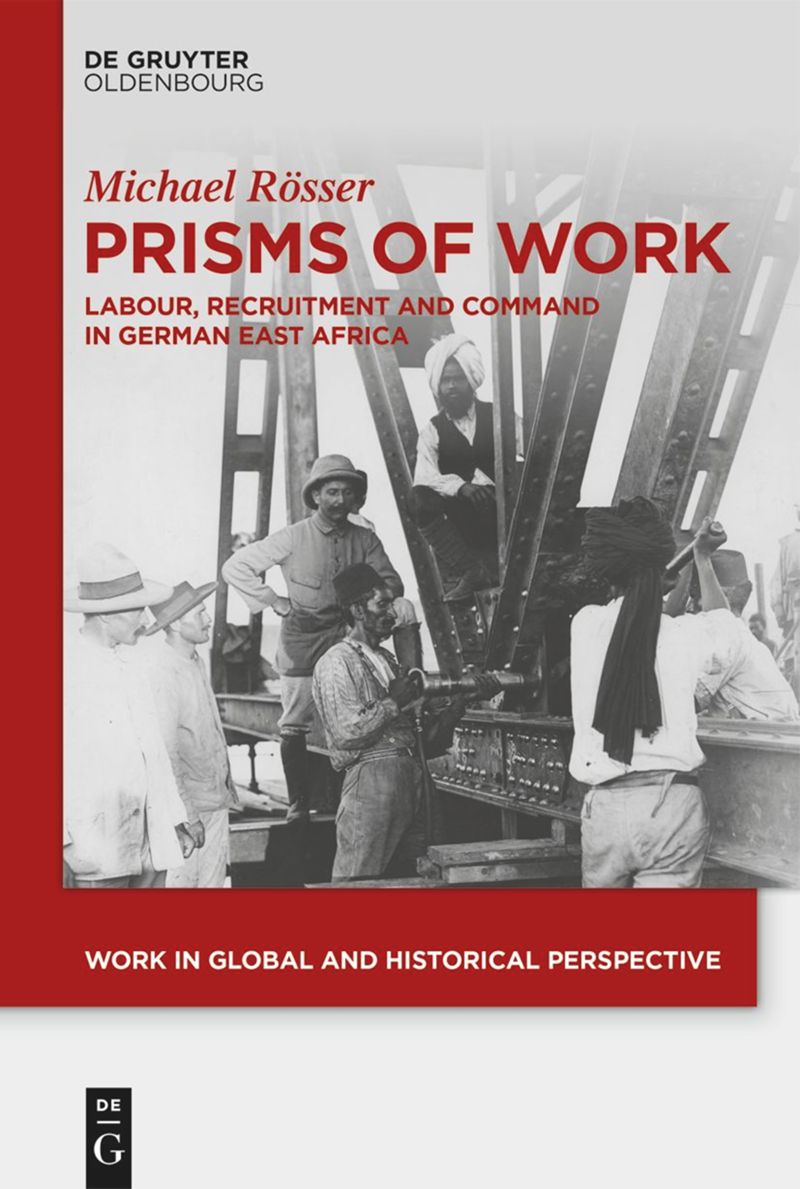
  • Book Spotlight “Prisms of Work: Labour, Recruitment and Command in German East Africa, Berlin 2024”

    Book Spotlight “Prisms of Work: Labour, Recruitment and Command in German East Africa, Berlin 2024”

    Global Labour History

    My book examines labour regimes in the colony of German East Africa (GEA) before World War I.[1] It uses three case studies: the construction of the Central Railway (1905–1916), the Otto Plantation in Kilossa (1907–1916), and the paleontological Tendaguru Expedition in the colony’s southern Lindi district (1909–1911). Combining global labour history with colonial and business history, the book examines how different (groups of) actors in East Africa and the Indian Ocean Area negotiated labour relations by investigating their scope for action within a specific discursive environment. While taking the coercive character of colonial labour regimes into account, the book explicitly looks at the agency of the respective (groups of) actors. In so doing, it goes beyond the prototypical understanding of work as wage labour in the “Global North”. It therefore includes the less visible forms of labour, such as reproductive labour and avoids dichotomies like “forced labour vs. free wage labour” or “work vs. leisure or non-work”.

    The book highlights the interconnectedness between the three cases and puts them in a global context. For example, the Otto Cotton Plantation was only built in Kilossa because of the projected Central Railway. Work, and particularly workers, were at the origin of these connections as well. A plantation overseer had previously worked as a subcontractor for the colonial railway construction company. At Tendaguru, a geologist who had previously served the Otto Company assessed the sensational paleontological find in the south of the colony. Based on such interconnections, the book reveals that there were characteristics shared by all work regimes. For instance, the topography of all three places of labour resembled the racist topography of colonial towns; the more skilled a worker was the less coercion he or she faced. To be sure, forced labour intensified during economic upturns, because of increasing competition for (African) labour, but colonial labour relations were not necessarily coercive.

    The dichotomy between colonised and coloniser is broken in each case study by focusing on actors neglected by historiography. These are mostly South (East) European, especially Greek, labour recruiters or railway construction subcontractors, (European) overseers and engineers, East African personal servants (cooks and so-called boys), Indian craftsmen and (qualified) East African workers, as well as women. The latter mostly performed reproductive labour and thus made (wage) labour possible in the first place. The fact that the recruitment of labour was one of the greatest challenges at all three places illustrates how colonial prestige projects were in fact extremely precarious. It is true that forced recruitment was always part of the arsenal of any place of labour. However, for entrepreneurial reasons, colonial actors ultimately depended on a wide variety of labour, ranging from skilled to unskilled labour as well as from convict and forced work to wage labour. Beyond hiring labour, employers also had to provide employees with incentives to stay.

    The Transimperial Dimensions of German Colonial Labour Regimes

    The Central Railway

    Building the Central Railway, German colonisers always compared its construction progress to other imperial infrastructures like the neighbouring British Uganda Railway; they were constantly concerned with being at least as fast as their imperial competitors. Through their transimperial mobility, the protagonists of labour connected various empires. For instance, Greek subcontractors had mainly worked at the construction sites of the Berlin-Baghdad Railway in the Ottoman Empire before their employment in GEA at the Central Railway. Individual cases of Greek migration go beyond East Africa and South Eastern Europe. Like many of his fellow citizens, the Greek John Zavellas had lived in the USA for some years and then worked at GEA plantations around 1900. In 1911, he took up employment at the Central Railway. Most of his colleagues, however, reached the German colony via the global company networks of Philipp Holzmann, which was in charge of constructing both prestigious imperial railways in the Middle East and East Africa. In GEA, the subcontractors obtained a conflict-laden intermediate position between colonisers and colonised. Denigrated as “half-Orientals”; they were blamed for shortcomings in the construction of the Central Railway, although these white subalterns were generally more successful and better qualified than their German colleagues. Nevertheless, all railway construction subcontractors and employees of the company treated the East African workers equally badly, regardless of their origin. Moreover, skilled craftsmen like carpenters and literate workers were in high demand. This enabled them to improve their position in the colonial labour market. At the beginning of construction, the skilled labourers were recruited primarily among Indians in GEA but also from those in British East Africa who initially worked for the Uganda Railway. The sources suggest that German employers of the Central Railway attracted skilled workers from the Uganda Railway by paying higher wages. Furthermore, many Indians migrated from the subcontinent to GEA, because they hoped for job opportunities created by the railroad. Over time, East Africans who had previously attended missionary schools increasingly replaced Indians. Nevertheless, skilled workers from the subcontinent remained important employees at the Central Railway until the end of its construction.

    The Otto Plantation in Kilossa

    Similar to the Greeks, plantation manager Ranga Reinhardt Kaundinya in Kilossa migrated between empires. As a white subaltern, he also was racially defamed by the colonial government and by his own European employees. The son of an Indo-German couple in the service of the Pietist Basel Mission, he was socialised in the Swabian environment of the Otto Company near Stuttgart. The enterprise’s owners were Pietists themselves, whose business was well connected to the global centres of cotton trade and production, including England and the USA’s south. The Pietist owners of the Otto Company also maintained connections to the Basel Mission from nearby Switzerland. Their shared faith also brought Otto and Kaundinya closer together. After his education in the environment of Otto, Kaundinya moved to southern India where he worked on plantations for over twenty years. Despite this experience as a “planter in the tropics”, he failed in Kilossa, however. For one thing, the conditions for growing cotton were different from those in India. Secondly, management mistakes of his superiors and his position as a white subaltern in colonial society impeded his daily work. Despite these difficulties, Otto stood by Kaundinya, probably because of their shared faith.

    The Tendaguru Expedition

    In the early twentieth century, colonial powers such as Germany, France and Britain, but also the USA competed for the exploration of the largest dinosaur skeletons worldwide. This “dinomania”[2] was transimperial. In each empire, (natural history) museums displayed the genuine fossils to make famous and legitimise their (scientific) conquests overseas. With Germany extracting the largest skeletons the world had seen so far at Tendaguru, the sensational news of its discovery quickly spread across the globe. German authorities quickly excluded potential competitors, e.g. from Britain from investigating the finds. At Tendaguru, too, the mobility of central actors of labour opened up transimperial dimensions: Before working as a personal servant of a leading German palaeontologists at Tendaguru, a man the sources call Ali, had been employed on steamers in Africa and Asia. In contrast to his German boss at Tendaguru, he had also been to British colonies in Africa. Likewise, leading supervisor Boheti bin Amrani was not only crucial for the paleontological excavation under German colonial rule. After World War I, when GEA had become a Mandate under the League of Nations, Boheti resumed work for another paleontological expedition under British authority.

    Travelling protagonists of labour made all three case studies transimperial. They reached GEA from many places ranging from neighbouring colonies like British East Africa, to the Ottoman Empire, India or (North) America. Likewise, the labour relationships of these protagonists were embedded in transimperial discourses about work and race as well as in general competition over global hegemony. As my book examines colonial labour regimes in both public and private endeavours, it can inspire a re-examination of both business history and the history of public (scientific) projects from a transimperial perspective.


    [1] This is an open access book: https://www.degruyter.com/document/doi/10.1515/9783111218090/html (Accessed: 12 February 2025).

    [2] Ilja Nieuwland: American Dinosaur Abroad. A Cultural History of Carnegie’s Plaster Diplodocus, Pittsburgh 2019.

    Michael Rösser

    Michael Rösser ist research assistant at the Otto-Friedrich University Bamberg (Germany). He specialised on the global history of labour and its transimperial dimensions at colonial infrastructures, cotton plantations and palaentological excavation seites particulary in East Africa. He is further interested in postcolonial topographies of memory, the global history of the interwar period.

    He is Author of the book:
    Prisms of Work – Labour, Recruitment and Command in German East Africa (Work in Global and Historical Perspective, vol. 21), Berlin/ Boston: De Gruyter Oldenbourg, 2024.
    Open Access: https://www.degruyter.com/document/doi/10.1515/9783111218090/html

    Website:
    https://www.uni-bamberg.de/hist-wsg/team/michael-roesser/hist-wsg-team-michael-roesser-biographische-notiz/

    Selected Publications:
    „Die Firma Wilkins & Wiese in ‚Neu-Hornow‘. Ein Drahtseilakt zwischen Rhein/Ruhr, Weißer Elster und Ostafrika“. Marianne Beschhaus-Gerst et al. (Eds.). Nordrhein-Westfalen und der Imperialismus. Berlin: (expected 2022).
    „Shenzi Ulaya. Deutsch griechische Verflechtungsgeschichte von der Bagdadbahn zum kolonialen Deutsch-Ostafrika“. Online-Compedium der deutsch-griechischen Verflechtungen. Zentrum Modernes Griechenland der Freien Universität Berlin: 02.03.2022. Web. comdeg.eu/compendium/essay/109893/ (21.04.22).

    „Knotenpunkte des Kolonialen“. Vorstudie ‚Kolonialistisches Denken und Kolonialkultur in Stuttgart‘. Stadtarchiv Stuttgart (Hrsg.). Stuttgart: 19.07.2021. Web. archiv0711.hypotheses.org/files/2021/07/Stadtarchiv_Stuttgart_Kolonialistisches-Denken-Stuttgart.pdf (10.09.2021).
    „Transimperiale Infrastruktur? Personal, Unternehmer und Arbeit beim Bau der Zentralbahn in Deutsch-Ostafrika“. Moderne Transimperialitäten: Rivalitäten, Kontakte, Wetteifer. 274-89. Laurent Dedryvère et al. (Hrsg.).Berlin: 2021.

  • Colonial Visualities and Their Influences Across Empires from the Late 19th to the 21st Century

    Colonial Visualities and Their Influences Across Empires from the Late 19th to the 21st Century

    Intricately linked to postcolonial realities, this essay delves into the visual-cultural connections between the establishment and challenging of white-centric perspectives, with a special focus on resistance to, as well as (re-)appropriations of, visual coloniality by non-white communities.[1] As I show, these (re-)appropriations were partly ambiguous, and cannot be fully explained by exclusively applying Eurocentric theories of collective memory. Instead, I argue that an approach through the lens of transimperiality, which considers the circulation of visual coloniality, counter-narratives, and complex appropriation processes across space and time, better grasps the complexity of (post-)colonial visual memory and its various media of expression.

    Regarding the visual coloniality, I argue that there are links between the visual glorification of colonialism across empires, eras and different public spheres. This is done by scrutinizing “seeing traditions” that have spilled over into public spheres of colonial visualisations like museums, statues and monuments. Transimperial visualisations were not limited to colonial photographs. Instead, they reflected a colonial mind-set that was not limited to the mobile camera of any time but found in most public displays of colonial projects.

    Within this essay, I present parts of my research project, where I focus on unveiling the long-term effects of colonial stereotyping and othering across centuries, and break down how they lead to identity-finding processes and collective memories in the 21st century. The regional focus is on photographs and events related to South Africa and Namibia. Facilitated by a transimperial circulation of racialised southern-African visual stereotypes created by European photographers, a visual heritage travelled the world that is being challenged increasingly and especially in the last decade.[2]

    In recent years, there have been impassioned public discussions about identity and race across Europe, Africa and beyond that. Unlike earlier manifestations of this debate, they had a pronounced visual dimension. This essay highlights the connectors spanning from colonial photography to 21st century attempts to disrupt the above-mentioned visual traditions by challenging colonial stereotypes, changing the language[3] connected to them and addressing public spaces with strong colonial pasts.

    These attempts include endeavours by affected communities to reclaim agency over their visual heritage and – as I call them – create counter-colonial visualisations[4] Counter-colonial visualisations seek to challenge and redefine racial stereotypes from a decolonised or postcolonial standpoint.[5]

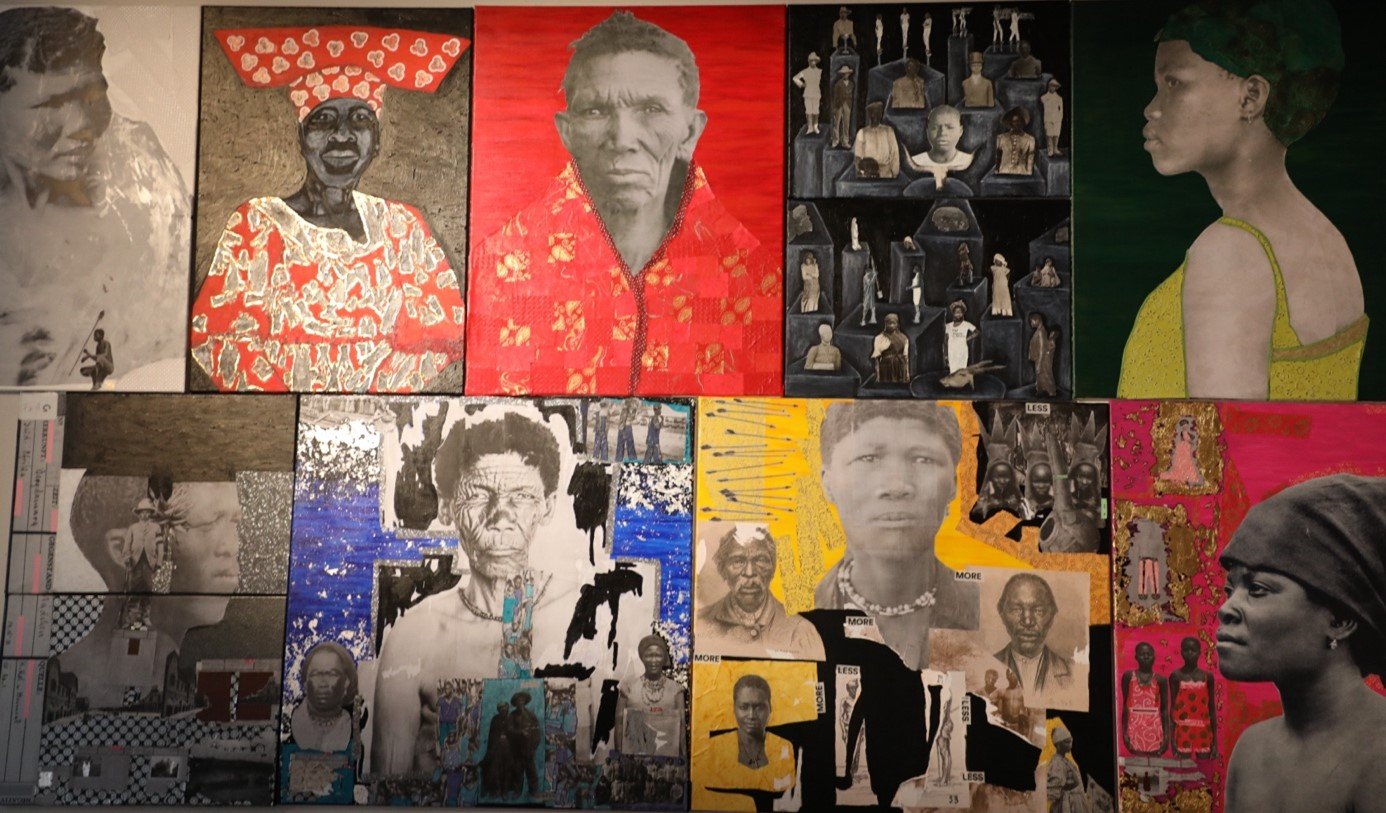
    As a first example of how to counter-narrate the colonial gaze (a tool that enforced racial power hierarchies across empires), I suggest engaging with the works by contemporary artist Vitjitua Ndjiharine. Her decolonizing work is based on colonial photographs that originate from the time of Germany’s colonisation of Namibia. The objects have since been and still are stored in Hamburg in the archives of the MARKK – Museum am Rothenbaum. World Cultures and Arts. As a Namibian with Herero heritage, Vitjitua Ndjiharine took it upon herself to (re-)clothe the individuals displayed in the various images as well as re-assigning them agency. By doing so, she too took agency and in her own way decolonized those visual objects across continents. In her words, Vitjitua investigated “historical narratives in an effort to infuse photographic subjects, who are often stripped of any sense of self, with a sense of humanity, empathy and relatability.“[6] Thereby also linking the past with the present. The final results of the research and artistic collaboration between Hamburg University and MARKK were curated as part of the Ovizire×Somgu exhibition and presented at M.Bassy in Hamburg in 2018.[7]

    (Figure 1: ©Vitjitua Ndjharine)

    Finally, going beyond the colonizer-colonized dichotomy, I add a more complex dimension, based on research trips to Windhoek, where I visited the National Museum of Namibia and witnessed an unexpected twist of visualities. What I encountered there was yet another layer of seeing traditions from former empires: cross-continental Cold War designs with a Communist note and a 21st century visual celebration of the Namibian liberation movement. After addressing the lacunae of collective memory studies to grasp such transimperial connectivity across time and space, the following blog post will discuss three briefly presented case studies: (i) colonial photography from Omhedi region, northern Namibia, (ii) the toppling of a colonial statue in Cape Town and (iii) a Namibian Independence Memorial Museum in Windhoek. To do justice to this multifaceted visualisation of colonial, counter-colonial, post-colonial and transimperial connections,[8] I combine analytical theorems from art history, whiteness studies, microhistory, global history, oral history and collective memory studies.

    Collective Memory and Counter-Colonial Visualisations

    Today, global societies rely more than ever on visual stimulation and entertainment, making a reality without reproducible visuals nearly unimaginable. Moreover, the pictorial turn has led to increased recognition of visual sources as historically relevant within academia. Scholars like W.J.T. Mitchell advocated for a pictorial turn in the humanities since the 1990s, emphasising the need to acknowledge the significance of visual sources alongside written or verbal ones.[9] This shift coincided with the rise of postcolonial studies, necessitating more diverse sources and perspectives. In my case, and based on prior research,[10] this involves analysing the long-term impacts of colonial photography and stereotyping on visual collective memories and identity debates in 21st century Europe and Southern Africa.[11]

    Maurice Halbwachs’ definition of collective memories emphasises their dependence on a collective context. Therefore, the past is a social construction passed down through generations, subject to change based on societal factors. Different groups may form varying understandings or memories of the same event, such as colonisation. When groups with divergent collective memories intersect, tensions arise, necessitating identity redefinition and narrative adjustments. What Halbwachs’ original research lacks, however, is the inclusion of non-white colonial experiences. In addition, Susan Sontag’s insight into seeing traditions underscores that individuals also grow up with pre-existing images that shape their perception of the world.[12] Combining a collective memory with a seeing tradition approach becomes imperative for a comprehensive understanding. While my research draws from Halbwachs’ collective memory approach, it introduces a racial dimension absent in the original application of his theoretical method. Acknowledging these “blank spots” is crucial for this essay, aiming to incorporate racial experiences into the analysis of collective memories.[13] In fact, Halbwachs’ theory, developed in the early 20th century, reflects a colonial mind-set influenced by a prevailing Eurocentric worldview and therefore does not reflect today’s postcolonial situation.

    Before delving into case studies, it is essential to recognise that memories are not solely private but also public matters. In her work, Aleida Assmann highlights the politicisation of memory creation by heads of states, elites and influential institutions.[14] Public spaces like statues, monuments and memorial days are shaped by these influences, and with them group dynamics. Accordingly, I argue that statues and monuments with colonial contexts too are part of (post-)colonial seeing traditions as much as photographs are.

    The following section discusses examples of past actions influencing collective memories from or with a colonial background and current movements that actively seek to change collective colonial seeing traditions. These examples encompass the re-interpretation of colonial photographs, the removal or retention of statues and monuments, debates on restitution and repatriation of colonial heritage and political protests. Unlike the often top-down creation of collective memories, counter movements tend to be driven by bottom-up initiatives.[15] Dating back to the 1920s and 1930s,[16] transimperial and anticolonial bottom-up movements like the League Against Imperialism, Pan-African conferences and especially the Bandung Conference of 1955 had spread globally. Rooted in those bottom-up movements and combined with 21st century debates, the following pages apply a US-dominated discourse as a baseline[17] by introducing a photographic collection, the remnants of a colonial memorial and a post-colonial museum.

    Case Study 1: Reclaiming agency in colonial photography on northern Namibia

    The anthropometric photographs captured in the Omhedi region of Northern Namibia exhibit certain resemblances to “usual” colonial photographs. They are black-and-white images that suggest academic neutrality yet simultaneously apply Western racial bias by means of a colonial gaze. Unsurprisingly, racial stereotypes influenced these images, many of which were meticulously staged to align with Western aesthetics and political objectives, particularly within the context of Namibia under South African indirect rule. As a result, white photographers like Alfred Duggan-Cronin[18] and C. H. L. Hahn too were not only subject to said colonial seeing traditions, but they further developed, professionalised and reinterpreted them in 20th century southern Africa.[19] Nonetheless, Namibian scholar Napandulwe Shiweda compellingly argues that colonial photographs, while reflecting the colonial gaze during their creation, can also function as a collective memory for a national group a century later. Shiweda illustrates this perspective by examining Duggan-Cronin’s photographic legacy in the Omhedi region, delving into the historical and political circumstances surrounding the images’ production and highlighting their relevance in 21st century Namibia.

    When Duggan-Cronin undertook the task of photographing the Ovambo people in Namibia, he collaborated with Hahn, who provided local knowledge and introduced him to community leaders. At first glance, Duggan-Cronin’s images may not stand out stylistically from other African photography of the time, adhering to the “principles of physical anthropology.”[20] They focus on tribal attire, jewellery, architecture and polygamy. Nonetheless, despite Duggan-Cronin’s stated intention to capture the Ovambo people before Europeanisation eroded their original culture, he occasionally staged photographs and positioned his models according to Western seeing traditions and aesthetics.[21] Shiweda contends that concentrating solely on the photographer’s agenda and power dynamic neglects the agency of the Ovambo models. She argues that, although Duggan-Cronin’s photographs adhered to colonial stereotypes, the subjects engaged in new forms of self-fashioning, emphasising the complexity and agency within the images.[22]

    As with other examples in this paper, seeing traditions based on colonial racist worldviews are now undergoing re-contextualisation and critical analysis. Due to colonial power structures in place until decolonisation, most Namibians and Ovambo people did not have access to the multitude of photographs taken of them until the early 21st century. Shiweda’s contemporary research reveals that today’s Ovambo descendants are reusing the same photographs to re-establish connections to their ancestors and cultural traditions. These images are no longer viewed as merely a colonial construction; instead, the descendants appreciate them, almost with pride.[23] In fact, current developments have extended to using the photographs in the reconstruction of an “Ovakwanyama cultural identity and its newly restored kingship at Omhedi” from 1996.[24]

    Case Study 2: #RhodesMustFall, Cape Town

    Like photographs, statues and monuments from colonial contexts also represent colonial seeing traditions. They have therefore become subject to discussions on their retention or removal across the globe. An internationally prominent instance of a contested and renowned case regarding the removal of a colonial heritage statue is the Rhodes Must Fall (RMF; #RhodesMustFall) movement in South Africa, which emerged in 2015. Originating at the University of Cape Town (UCT) and later extending to Oriel College in Oxford (UK), this movement served as a blueprint for similar initiatives globally due to its successful outcome.[25] UCT student protests had triggered the RMF movement, with the aim to remove a statue of Cecil John Rhodes (1853-1902)[26] from its central position on UCT’s Upper Campus. Today, he is primarily recognised as the founder of the Rhodes Scholarship Programme. However, in southern Africa, his legacy remains visible through memorials, schools, street names and landscapes bearing his name, with local sentiments often divided on the question of retaining or removing his name, as can be seen in select cases in Zimbabwe.[27]

    (Above: Old pedestal without Cecil Rhodes statue at UCT Upper Campus ©D.M. Natermann; below: Sarah Baartman Hall ©D.M. Natermann)

    The RMF movement as such is a post-Apartheid, antiracist and decolonising movement addressing persistent racial inequality in former European colonised territories in South Africa. Moreover, according to Francis B. Nyamnjoh, the protests not only targeted global xenophobia but specifically afrophobia.[28] The movement reflected a quest for a self-determined national or ethnic identity free from white domination or supremacy, necessitating the removal of reminders of past repression and racial segregation, both internally and externally. Internally, universities like UCT, sought transformation as a means of internal shedding, acknowledging the need for change from within.[29] Another decolonising effort taken by UCT is the renaming of its main hall from Memorial Hall to Sarah Baartman Hall in 2018. Baartman was a Khoisan woman whom the British enslaved to present her at so-called freak shows in the UK. By renaming the hall, UCT hopes to take “a key step in the university’s commitment to transformation and inclusivity.”[30]

    The success of the RMF movement sparked similar debates globally regarding the removal or re-contextualisation of public spaces with colonial associations. Examples include the toppling of the Edward Colston statue in Bristol (UK), the Leopold Must Fall Movement in Brussels (Belgium), the Piet Hein Monument in Rotterdam (Netherlands) and the Reiterdenkmal in Windhoek (Namibia).[31] These happenings underscore the ongoing identity debates occurring worldwide within diverse (post)colonial contexts, but responding to a shared transimperial experience of visual degradation. They share the common theme of supporters actively participating in the (re)shaping of identities in Africa and abroad, as well as the ongoing rewriting of certain frames of reference in the ongoing effort to decolonise collective national memories.

    Case Study 3: Namibian Independence Memorial Museum, Windhoek

    During a visit to Windhoek in October 2023, I had the opportunity to visit historical locations linked to Namibia’s efforts to find a post-independence narrative for its own people(s). For the sake of transimperial and global seeing traditions and the visualisation of collective memories, I wish to highlight Namibia’s Independence Memorial Museum (IMM), which opened its doors in 2014.

    Then President Lucas Pohamba inaugurated the IMM 24 years after Namibia’s independence from South Africa. A curious fact about the IMM is that the entire museum was designed, built and financed by North Korea and its Mansudae Overseas Projects (MOP) company. Throughout the creation and building process, not a single Namibian voice was incorporated. Everything remained within and under North Korean control.[32] As a result, upon entering the museum, visitors are immediately immersed into a socialist modernist design and time bubble. According to MOP, the social modernist style represents the postcolonial Namibian struggles and thus adds to the IMM’s message of anticolonial movements and national liberation struggles.

    (Above left: IMM from outside including view of statue of President Sam Nujoma ©D. M. Natermann; above right: Male and female freedom fighters ©D. M. Natermann; below: Namibia’s diverse population post-independence – working towards a better future ©D. M. Natermann)

    After speaking to Windhoek locals and colleagues at University of Namibia  it became clear that none of them were aware of the strong visual history that is inherent to the North Korean style. When visiting the IMM, they do not think of the Cold War, Communism or Chinese-Russian artistic influences. But, for someone who was socialised in West Germany and South Korea like myself, and having travelled to East Berlin and Hungary in the 1980s, the visual heritage visible in the IMM is intricately linked to East-European and thus non-Western seeing traditions. What stands out is a 21st century adaptation of the social modernist style to postcolonial independence rhetoric whilst also showing remnants of European stereotypical imaginations of the African other in an Asian-African context. In this sense, in a postcolonial setting, the social modernist style travelled from Cold War Europe to North-East Asia and ultimately to South-West Africa.

    Conclusion

    Above examples share several commonalities that prompt an essential question: How do racialised visual stereotypes that circulated transimperially over space and time relate to contemporary identity debates? This paper argues that colonial photography was a new-born child of its time that thanks to modern mass publication methods could perpetuate and spread racial and colonial seeing traditions transimperially, ultimately influencing global perceptions until this day. This photographic medium thus enabled the widespread dissemination of colonial perspectives through books, posters and mobile slide shows. However, the visual Eurocentric mind-set was not limited to printed images but spilled over into public spaces as well. This essay aimed to highlight and scrutinise the transimperial origins, expansion and endurance of non-white stereotypes by starting with colonial seeing traditions and examining the long-term effects of colonial visualisations on numerous spheres.

    Despite social and political changes since Africa’s decolonisation, a transimperial seeing tradition prevails that perpetuates stereotypical images of Africa reminiscent of colonial times. This visual world order narrative, marked by violence, exploitation, dehumanisation, infantilisation and victimisation, often delays – if not hinders – the creation of an updated and non-Western identity rooted in sub-Saharan Africa’s agency.[33]

    However, Africans have developed ways of counter-visualizations, and launched processes of re-appropriation, inspired by the joint experience of a transimperial visual legacy that was similar in very different contexts. But photographs, statues, and museums that reproduced a coloniality became symbols of degradation for all the colonized peoples, no matter if they had a regional context.

    To be sure, the visual anticolonialism of the communist tradition, as represented by North Korean anticolonial architecture in Namibia, shows that the shared “antiimperial” visual language has its own history, which might be ambiguous. But it equally shaped the collective memory and enabled it to reject the visual coloniality that had spread transimperially.

    Further Reading

    Patricia Hayes, Gary Minkley (eds.): Ambivalent. Photography and Visibility in African History, Columbus 2019.

    Lucy Souter, Duncan Wolldridge (eds.): The Routledge Companion to Global Photographies, Abingdon 2024.

    Mark Sealy: Decolonising the Camera: Photography in Racial Time, London 2019

    Francis B. Nyamnjoh: #RhodesMustFall. Nibbling at Resilient Colonialism in South Africa, Bamenda 2016.

    Marjo Kaartinen, Leila Koivunen, Leila, Napandulwe Shiweda (eds.): Intertwined Histories: 150 Years of Finnish-Namibian Relations, University of Turku 2019, URL: <https://www.utupub.fi/bitstream/handle/10024/148416/IntertwinedHistories.pdf?sequence=1&isAllowed=y> (accessed 6 November 2025).

    E. Natalie Rothman: The Dragoman Renaissance: Diplomatic Interpreters and the Routes of Orientalism, Ithaca 2021.


    [1] Gloria Wekker: Witte onschuld: Pradoxen van kolonialism en ras, Zutphen 2020.

    [2] Mark Sealy: Decolonising the Camera: Photography in Racial Time, London 2019; Mark Knights: Historical Stereotypes and Histories of Stereotypes, in: Cristian Tileagă, Jovan Byford (eds.): Psychology and History: Interdisciplinary Explorations, Cambridge 2014, pp. 242–67; Jens Jäger, Fotografie und Geschichte, Frankfurt a. M. 2009.

    [3] Ngũgĩ Wa Thiong’o: Decolonising the Mind. The Politics of Language in African Literature, Suffolk 2005.

    [4] Patricia Hayes, Gary Minkley (eds.): Ambivalent. Photography and Visibility in African History, Columbus 2019.

    [5] Mark Knights: Historical Stereotypes and Histories of Stereotypes, in: Cristian Tileagă, Jovan Byford (eds.): Psychology and History: Interdisciplinary Explorations, Cambridge 2014, pp. 242–67.

    [6] Vitjitua Ndjiharine, Artist Statement, in: Ovizire×Somgu, Exhibition Catalogue, MARKK 2018, p. 26.

    [7] Initially, I had the pleasure of being a member of the collaborative team and it was a great moment when the project came to such a powerful end.

    [8] Patricia Hayes, Gary Minkley (eds.): Ambivalent. Photography and Visibility in African History, Columbus 2019.

    [9] William John Thomas Mitchell: Picture Theory, Chicago 1995.

    [10] Diana Miryong Natermann: Pursuing Whiteness in the Colonies. Private Memories from the Congo Free State and German East Africa (1884–1914), Münster 2018; Diana Miryong Natermann: Colonial Masculinity Through Time. One Man’s Story of Monarchy, the Military, Colonialism, Fascism, and Decolonisation, in: Laura Almagor, Haakon Ikonomou, Gunvor Simonsen (eds.): Global Biographies, Manchester 2022, pp. 62–81.

    [11] Maurice Halbwachs: On Collective Memory, Chicago 1991.

    [12] Susan Sontag: On Photography, London 2008.

    [13] James V. Wertsch: Blank Spots in Collective Memory: A Case Study of Russia, in: Annals of the American Academy of Political and Social Science 617 (2008), pp. 58–71.

    [14] Aleida Assmann: Das Unbehagen an der Erinnerungskultur. Eine Intervention, Frankfurt a. M. 2021.

    [15] Mamadou Diawara, Bernard Lattegan, Jörn Rüsen (eds.): Historical Memory in Africa. Dealing with the Past, Reaching for the Future in an Intercultural Context, New York 2013.

    [16] Eric Burton: Hubs of Decolonization: African Liberation Movements and “Eastern” Connections in Cairo, Accra, and Dar es Salaam, in: Lena Dallywater, Chris Saunders, Helder Adegar Fonseca (eds.): Southern African Liberation Movements and the Global Cold War “East”: Transnational Activism 1960–1990, Berlin 2019, pp. 25–56; Michael Goebel: Anti-Imperial Metropolis: Interwar Paris and the Seeds of Third World Nationalism, Cambridge 2015.

    [17] Stacey Boldrick, Richard Clay, Michelle Duster, Keith Magee: Remembering and Forgetting Confederate Monuments: Taking the Bitter with the Sweet, in: The Sculpture Journal 31/1 (2022), pp. 1–15; Kirsten Treen: Unraveling Confederate Sentiment. The Unfinished Story of a Sock, in: Kathleen Diffley, Benjamin Faggan (eds.): Visions of Glory: The Civil War in Word and Image, Athens (GA) 2019, pp. 173–183.

    [18] For some examples of Duggan-Cronin’s work related to the text, please follow this link: <https://museumsnc.co.za/new_site/satellites/duggan-cronin-gallery/> (Accessed: 6 November 2025). Alternatively, see Napandulwe Shiweda’s PhD thesis with exemplary photographs in chapter 3. Napandulwe Shiweda: Omhedi: Displacement and Legitimacy in Oukwanyama politics, Namibia, 1915-2010, Cape Town 2011, pp. 48–65, URL: <https://uwcscholar.uwc.ac.za/bitstreams/4378b85f-56d8-4c01-9342-39c975572a41/download> (accessed 6 November 2025).

    [19] Napandulwe Shiweda: Images of Ambivalence. Photography in the Making of Omhedi, Northern Namibia, in: Patricia Hayes, George Minkley (eds.): Ambivalent. Photography and Visibility in African History, Columbus (OH) 2019, pp. 181–208.

    [20] Shiweda: Images of Ambivalence, 191.

    [21] Michael Godby: Alfred Duggan-Cronin’s Photographs for the The Bantu Tribes of South Africa (1928-1954): The Construction of an Ambiguous Idyll, in: Kronos 36/1 (2010), pp. 54–83.

    [22] Shiweda: Images of Ambivalence, 186.

    [23] Ibid, 202.

    [24] Ibid, 204.

    [25] Francis B. Nyamnjoh: #RhodesMustFall. Nibbling at Resilient Colonialism in South Africa, Bamenda 2016.

    [26] Rhodes was known for supporting British colonialism, participating in the scramble for Africa and being associated with colonies like Rhodesia (now Zimbabwe) and institutions like Rhodes University in Grahamstown (South Africa). He was also a mining magnate and Prime Minister of the Cape Colony. Upon his death, Rhodes bequeathed parts of his estate around Table Mountain to South Africa, contributing to the UCT Upper Campus and the well-known Kirstenbosch National Botanical Gardens. Robert I. Rotberg: The Founder: Cecil Rhodes and the Pursuit of Power, Oxford 1988

    [27] David Kenrick: Decolonisation, Identity and Nation in Rhodesia, 1964–1979: A Race Against Time. Berlin 2019.

    [28] Nyamnjoh, #RhodesMustFall.

    [29] Ibid, 100.

    [30] Mamokgethi Phakeng, Sipho M Pityana, Renaming Memorial Hall Sarah Baartman Hall, in: News UCT, 13 December 2018, URL: <https://www.news.uct.ac.za/article/-2018-12-13-renaming-memorial-hall-sarah-baartman-hall> (accessed 6 November 2025).

    [31] Heike Becker: Changing Urbanscapes: Colonial and Postcolonial Monuments in Windhoek, in: Nordic Journal of African Studies 27/1 (2018), pp. 1–21.

    [32] Christian A. Williams, Tichaona Mazarire: The Namibian Independence Memorial Museum, Windhoek, Namibia, in: The American Historical Review, 124/5 (2019), pp. 1809-1811.

    [33] Hayes and Minkley: Ambivalent; Elizabeth Baer: Genocidal Gaze. From German Southwest Africa to the Third Reich, Detroit 2017.

    Diana M. Natermann

    After graduating with honours (M.A.) from Goethe-University Frankfurt, Diana Miryong Natermann received a scholarship to do her PhD research at the European University Institute (EUI) in Florence, Italy. Since then she has done post-docs at University of Hamburg, worked as Assistant Professor at Leiden University and was a fellow at University of Cape Town, South Africa, at NIOD Dutch Institute for War and Genocide Studies, as well as a guest researcher at University of Namibia (UNAM) in Windhoek. Currently she is a Lecturer at Utrecht University at the Faculty of History and History of Art.

    As an historian, her intellectual interests lie on the mid 19th to early 21st centuries with a focus on visual history and (post)colonial theories (esp. gender & whiteness studies), digitalisation, cultural and political history, genocide studies, and global orders. Therein, she focuses on modern European and African contexts, and her expertise also includes global history, research, memory and heritage studies as well as the interplay between culture and politics within Europe and decolonised states. The latter involves current debates on European identity/ies concerning restitution, museum and heritage-related policies. Her latest research combines several of the above foci with the study of cultural genocide and digital restitution. Furthermore, she enjoys being a member of the Scientific Advisory Board of the journal LawArt and part of the Afrikamuseum, Berg en Dal, reopening committee.

  • Human Ancestors Created Tools Continuously for 300,000 Years

    Goodness gracious, Friends, do I love the science of tree-ring dating!

    My dissertation research, which I published in 1997 as Time, Trees, and Prehistory, explored the 15-year-long effort, from 1914 to 1929, in which Andrew Ellicott Douglass, an astronomer at the University of Arizona (UA) here in Tucson, along with his rag-tag team of associated archaeologists, developed and first applied tree-ring dating at archaeological sites in the American Southwest.

    Since 1929, tree-ring dating has been used to date thousands of archaeological sites in the American Southwest, the American Southeast, the greater Mediterranean region, northern Europe, and a host of other places around the world. It has been used to date famous musical instruments, oak panel paintings, and even shipwrecks in Europe. It has been used to reconstruct precipitation, temperature, and a host of other climatic phenomena around the world. It has been used to reconstruct wildfire histories around the world, as well.

    The Laboratory of Tree-Ring Research (LTRR) at UA is the world’s best tree-ring laboratory and home to an astonishing array of scholars who pursue entrepreneurial research. Although I don’t have much time to be physically present at LTRR, where I am a research associate, I do try to keep up with what my colleagues are doing, particularly on the archaeological side of things.

    Earlier this week I was thrilled to see that Nick Kessler and colleagues just published some amazing new research—they dated a marker post from the Mitchell Mound in the ancient urban center of Cahokia, just outside of modern-day St. Louis, Missouri.

    Kessler and his team used a combination of methods from tree-ring dating, radiocarbon dating, and isotopic analysis to determine that people harvested a massive bald cypress tree sometime between 1122 and 1126 CE from a forest at least 100 miles distant from Cahokia. That beam was probably floated along a river or two and then ultimately carried to its final location at Mitchell Mound, where it was erected and used for about two human generations.

    Making all of this even more impressive, Kessler’s analysis suggests that the beam was about 18 meters (60 feet) long and weighed more than four metric tons when it was originally being moved. (For a summary overview of Kessler’s research, go here; for the full scholarly paper, go here.)

    Archaeologists and Indigenous descendant communities have long known that Cahokia was a major urban center in the 11th and 12th centuries (1000s through 1100s) of the Common Era calendar. Population estimates indicate that Cahokia probably had more residents at that time than either London or what is now Mexico City!

    Archaeological evidence suggests that its inhabitants had trade relationships with people all over North America and into Mesoamerica. Ecological evidence suggests that folks living in the area took advantage of a wide array of plant and animal species to gather and hunt and were productive farmers, as well.

    I love it when tree-ring dating allow us specific insights into human behavior, and by extension what it meant to be alive at a point in history. Certainly, not all people who lived in and around Cahokia at that time knew or even cared about the effort to erect that marker post, but a lot probably did—it was a massive, coordinated undertaking that required a lot of support. I can only imagine the celebrations at the end of that project!

    Thanks, and congratulations, Nick and colleagues, for a really cool analysis!

    Until next time,

    Steve Nash
    President & CEO, Archaeology Southwest

    Banner image: Lake Turkana, Kenya, by AdamPG, CC BY-SA 3.0, via Wikimedia Commons

    Human Ancestors Created Tools Continuously for 300,000 Years

    So when did our human ancestors start making tools? Well, the earliest artifacts that we know of date back more than 3 million years, but early finds had been scattered and inconsistent until new findings from modern-day Kenya. Researchers had studied a site there for 15 years and uncovered more than a thousand artifacts—tools made and used by early humans continuously for 300,000 years. Ailsa Chang interview with David Braun on All Things Considered (NPR) | Listen now »

    Read the scholarly article in Nature Communications 16 (2025). Download now (open access) »

    Archaeology in Action: Inspiring the Next Generation Through LEGO

    This year, the FIRST LEGO League introduced the UNEARTHED theme, challenging students to find solutions to real-world problems in archaeology. At Save History, we were eager to support several schools in exploring current issues in archaeology, including Skyline Gila River School here in Arizona and schools as far-flung as Illinois, Iowa, New York, Oklahoma, Oregon, Wisconsin, and Washington. SaveHistory.org | Read more »

    Commentary: As Copper Is Declared Critical, What Are Implications for Oak Flat and Other Heritage Places? For Resource Governance in the US?

    In this political climate, the designation of copper as a “critical mineral” assumes a significance that far exceeds its technical rationale. … In practice, these designations can recast tribal consultation, water protection, and sacred site preservation as potential impediments to U.S. strategic interests. …

    What does it mean for a place to carry deep cultural meaning while also containing resources the modern world depends on? Len Necefer’s All at Once Newsletter (opens at Substack) | Read more »

    The Fight to Protect Chaco Continues

    Earlier this month, the administration announced that the Bureau of Land Management will seek to reduce protections for Chaco Canyon, an area many Indigenous tribes hold sacred. Those protections included a 20-year moratorium on new oil and gas leasing on around 336,400 acres of public land within a 10-mile radius of the park, designed to protect cultural sites, wildlife and the environment from consequences of drilling. Now, the administration wants to allow drilling. …

    It’s clear Trump wants to move fast, since the administration only is allowing a 14-day comment period — when it starts and ends is still unclear. But the comment period apparently will take place during a time most Pueblo people, for example, are busy with the winter ceremonial season. Opposition will be fierce, but the government is making it as difficult as possible for individuals, governments and tribal nations to speak up. That’s on purpose. Santa Fe New Mexican editorial board | Read more »

    Commentary: The Damage to National Parks Is Just Beginning

    National Park staff are returning to work today following the longest government shutdown in American history. One in which national parks were kept open, despite furloughs that impacted 60 percent or more of the staff who remain, following the administration’s attempts to gut the department. What will they find? Wes Siler’s Newsletter (opens at Substack) | Read more »

    The Impacts of Federal Grant Cancellations on US Museums

    In the years since the pandemic, American museums have been working hard to restore their attendance and financial health. But a new survey of museum directors reveals that the glimmer of progress is reversing, in part due to targeted executive orders and federal cutbacks for the arts. …

    [T]he report paints the clearest picture yet of the widespread impact of grant cancellations from federal organizations, including the Institute of Museum and Library Services (I.M.L.S.), the National Endowment for the Humanities (N.E.H.), and the National Endowment for the Arts (N.E.A.). …

    Around half of the 511 directors who responded to the survey lead art and history museums; the rest oversee science museums, children’s museums, and other kinds of museums. Julia Halperin for the New York Times | Read more »

    Inside Today’s NEH: Acting Chair Handpicks Recipients

    Since its creation in 1965, the National Endowment for the Humanities has distributed more than $6.5 billion to support more than 70,000 projects, from landmark works like Ken Burns’s documentary “The Civil War” to small local efforts in every corner of the country. …

    Many of its nearly 50 grant programs have been paused or ended, according to an examination of its website. About two thirds of the staff has been laid off and, last month, most members of the scholarly council that must review a majority of grants were abruptly fired by the White House.

    Still, the money has been flowing out the door. Jennifer Schuessler for the New York Times | Read more »

    Publication Announcement: Repatriation after the 2023 NAGPRA Rule

    Emily R. Holtzman, “ ‘My Museum’s Reluctant Undertakers’: Repatriation After the 2023 NAGPRA Rule,” Columbia Journal of Law and Social Problems 59:1, 2025. Download now (open access) »

    REMINDER: Nov. 20 Online Event: An Expedition Torn Asunder: O’odham Responses to the Coronado Expedition

    With Deni Seymour. Dr. Seymour’s research on the 1539–1542 Coronado expedition in southeastern Arizona has revealed how O’odham resistance helped bring an end to this episode of Spanish colonial exploration. Third Thursday Food for Thought series (Old Pueblo Archaeology Center) | Learn more and register (free) »

    REMINDER: Nov. 21 Online and In-Person Event (Phoenix AZ): Updates on Research of the Leupp Isolation Center

    With Davina Two Bears. Dr. Two Bears will give an update on the Leupp Isolation Center Community Accountable Archaeological Project. Old Leupp is a site of entwined histories of both the Navajo people and Japanese Americans. Our community accountable archaeological project seeks to understand and share these histories of assimilation in federal Indian boarding schools and Japanese American incarceration on Indigenous lands by the US government in the early 20th century. Available in-person and online. Deer Valley Petroglyph Preserve (Arizona State University) | Learn more »

    Davina Two Bears is a member of Archaeology Southwest’s Board of Directors.

    December In-Person Lectures (Santa Fe NM)

    Dec. 1, Tierra Adentro Charter School Performance, Raíces (Roots): Flamenco’s Passion, Rhythm & Tradition (held at Santa Fe Women’s Club, 1616 Old Pecos Trail); Dec. 8, Thatcher Seltzer-Rogers, Ascendancy of Casas Grandes, Chihuahua, Mexico; Dec. 15, Sarah Oas, Foodways and Archaeology: What Histories of Flavor and Cuisine Tell us about the Past. 6:00 p.m., Hotel Santa Fe. $20 at the door or $55 for the series of 3 programs. Southwest Seminars | Learn more »

    Dec. 2 Online and In-Person (Tucson AZ) Event: Path of Light: Retracing the Expeditions of Charles L. Bernheimer

    With Morgan Sjogren. In 1929, explorer Charles L. Bernheimer dreamed up a National Park proposal that may have prevented Glen Canyon Dam and protected the surrounding landscape. Inspired by a decade of expeditions in the Four Corners region, Bernheimer wanted to “do more than be a sightseeing tourist.” To contextualize past and present efforts to protect Glen Canyon, author Morgan Sjogren retraced Bernheimer’s more than 300-day-long Glen Canyon expedition, guided by historic journals and photographs. Archaeology Café (Archaeology Southwest) | Register to attend in person (free) » | Register to attend online (free) »

    Dec. 4 Online Event: Sonic Landscapes: Sounds of Labor in Lowell

    With Sarah Buchmeier. Buchmeier’s project, The Measure of Work: Sounds of Labor in Lowell, uses sound and music to rethink dominant narratives of the American Industrial Revolution. It asks audiences to consider how, over more than two centuries, industrialization has transformed Lowell’s sonic landscapes— and what that can reveal about work, labor, and sense of place. Living Landscape Observer | Learn more and register (free) »

    Dec. 5 Online Event: Macaws for Metal?

    With Michael Mathiowetz. After AD 900, scarlet macaws from tropical Mesoamerica became significant in ritualism of Mogollon and Puebloan societies in the US Southwest and Mexican Northwest. A cross-continental “Aztatlán-Huasteca Network” may have connected Aztatlán societies in west Mexico to the Gulf Coast during the Postclassic period, thereby facilitating the eastward transmission of metals and metallurgy to the Huasteca with scarlet macaws moving along the Gulf Coast westward to Aztatlán societies and northward to the SW/NW. Mathiowetz will explore the evidence and logistics of these ritual economies in northern Mesoamerica. Pre-Columbian Society of Washington DC | Learn more and register (free) »

    Dec. 13 In-Person Workshop (Tucson AZ): Arrowhead-making and Flintknapping

    With Sam Greenleaf. Participants will learn how to make arrowheads, spear points, and other flaked stone artifacts from obsidian and other stone like ancient peoples did. The class is designed to foster understanding of how early peoples made essential tools, not to make artwork for sale. Reservation and $45 payment (which includes all materials and equipment) required by 5:00 p.m. December 11. Old Pueblo Archaeology Center | Learn more »

    Save the Date: Jan. 17 In-Person Event (Nogales AZ): Honoring Sheriff Estrada

    Join us to honor (retired) Sheriff Tony Estrada at our Annual Meeting. Come out to lovely Hacienda Monarca (formerly Ralph Wingfield Ranch) for a delicious lunch and be regaled with intriguing tales by this intrepid lawman. Stroll the historic grounds, see the John Wayne room, view the Corona Murals the famous bullfighter painted on the hacienda walls. Watch pimeriaaltamuseum.org for details and to purchase your ticket. (Available December 1.) Pimeria Alta Historical Society and Museum | Learn more »

    Video Channel Roundup

    In case you missed any presentations this past month! A simple click on any of the links to the YouTube channels of our Partners and Friends should catch you up. (And please do let us know if your channel isn’t in this list but should be.)

    Albuquerque Archaeological Society
    American Rock Art Research Association
    Amerind Foundation
    Archaeology Southwest
    Arizona Archaeological and Historical Society
    Arizona State Museum
    Aztlander
    Bears Ears Partnership
    Cotsen Institute of Archaeology at UCLA
    Crow Canyon Archaeological Center
    Grand Canyon Trust
    Grand Staircase Escalante Partners
    Mesa Prieta Petroglyphs Project
    Mission Garden (Friends of Tucson’s Birthplace)
    Museum of Indian Arts and Cultures
    Museum of Northern Arizona
    Old Pueblo Archaeology Center
    Pacific Coast Archaeological Society
    San Diego Archaeological Center
    School for Advanced Research
    SHUMLA Archaeological Center
    Southwest Seminars
    The Archaeological Conservancy
    Verde Valley Archaeology Center

    Remember to send us notice of upcoming events and webinars, tours and workshops, and anything else you’d like to share with the Friends. Thanks!


    The post Human Ancestors Created Tools Continuously for 300,000 Years appeared first on Archaeology Southwest.

  • Trail Memories

    Today’s post kicks off our Trails series, a companion to our year-end fundraising campaign. We’ll have weekly essays from now until the New Year. Thanks for your support!
    Skylar Begay (Diné, Mandan and Hidatsa), Director, Tribal Collaboration in Outreach & Advocacy

    New! Listen to the full blog here. Read by Skylar Begay.

    (November 20, 2025)—For many alumni of a conservation corps or a land-management agency, trails make up a large part of your life. At least for me they did—and in some ways, still do.

    Over the years, I have built trails from start to completion. I have performed maintenance and installed various structures on all types of trails. I have done this by hand tool, power tool, small explosives, various off-highway vehicles, and bulldozer. I’ve done this with 8-person crews, 2-person crews, and sometimes solo. I’ve done this with mules, donkeys, and horses.

    Sky and his first Ancestral Lands Crew on the steps just below the El Tovar Lodge at the South Rim of Grand Canyon National Park.
    Sky and his first Ancestral Lands Crew on the steps just below the El Tovar Lodge at the South Rim of Grand Canyon National Park.

    I’ve done this from the southern Sonoran Desert, the Mogollon Rim, the San Francisco Peaks, the Grand Canyon, the Kaibab National Forest, all the way up to the Grand Mesa, Uncompahgre, and Gunnison National Forests of Colorado’s Western Slope.

    A small bulldozer being used to install a drain on an off-highway vehicle (OHV) trail in Colorado.
    A small bulldozer being used to install a drain on an off-highway vehicle (OHV) trail in Colorado.

    I’ve done this in 115 degrees, in 30 degrees, in rain, sleet, hail, and snow. The exception is lightning storms (per policy).

    Snow was often what ended a trail season on the Western Slope of Colorado, but Sky and his crew pushed it as long as they could.
    Snow was often what ended a trail season on the Western Slope of Colorado, but Sky and his crew pushed it as long as they could.

    One thing I can say about building and taking care of trails: It is dirty, gritty, painful, dangerous work that will give you a sense of gratification in a way few other things can. There is a certain sense of accomplishment when you tool up at the end of the day, count paces on your way back to the start of the day, and look back at a section of trail that was in bad need of maintenance or didn’t exist that morning. You can say “I helped do that,” and you will have the best sleep possible on an inch-thick foam mat.

    Before and after the USFS trail crew partnered with the Thunder Mountain Riding club to repair a large mud hole in the trail.
    Before and after the USFS trail crew partnered with the Thunder Mountain Riding club to repair a large mud hole in the trail.

    A favorite trail memory of mine happened on the North Rim of the Grand Canyon on a trail that followed the rim. It hadn’t seen cyclical maintenance in at least a few years. There were sections where we couldn’t even see the tread (the part you walk on). Cyclical maintenance is things like removing overgrown vegetation, re-establishing tread to mineral soil, clearing out drains, removing fallen trees, removing rocks that a hiker could easily roll an ankle on, and opening the corridor (the space on either side and above the tread). Sometimes it also includes repairing structures like water bars or steps made from local rock or logs. Essentially, you want to make the trail safe for users, and you want the work to be of a quality that it doesn’t need to be done for another two years at least.

    This particular trail was a hiking and equestrian trail. With an equestrian trail, the corridor should be cleared at least 2 or 3 feet on either side of the trail and above such that “a tall man wearing a tall hat riding a tall horse” can ride under overhead vegetation. I usually took that to mean about 15 feet or so. And so, my crew and I started this task.

    The tread was completely overgrown with grass in some sections. Removing it felt like pulling up a carpet that was a mile long. The corridor was so crowded you couldn’t walk the trail without getting torn up by Catclaw Acacia. There wasn’t much need for rock work because it was a flat trail, and only here and there was there a water bar or drain to clear out or install. The work took a few hitches, which for us was 8 days working with 6 days off in-between.

    It was a real slog—tedious and monotonous. We played word games like “Contact” or “Man or Monster?” to pass the time. On days when morale was low, I would break out a “secret snack” which was usually something like chocolate chip cookies to lift spirits. Countless stories were told and sometimes an hour went by silently. I allowed my crew members to listen to music in one ear for a balance of sanity and safety. Eventually, we completed the trail. I cannot tell you how great it felt to drive away from the trailhead that day. I took my crew to the Grand Canyon Lodge to get some celebratory snacks and drinks.

    Some weeks later, lightning struck below the rim of the canyon and started a fire. The fire traveled up the canyon and started to spread on the rim toward the trail we had opened up. We didn’t know it at the time, but the fire came up to that trail and could not jump the corridor to the other side. Our project partner with the park came up to us one day and said you should drive out there and take a look at what happened. We drove out there and pulled into the trailhead. We got out and walked across the road to the trail. Towards the rim it was scorched earth, completely black and grey. Almost nothing hadn’t burned. And on the other side the forest was completely intact.

    I remember feeling a mix of emotions. On one hand a great deal of our work had literally gone up in flames, but on the other, who knows how many acres of forest had our work saved?

    Like I said, building and taking care of trails is hard work. It is either something you fall in love with or something you never want to do again. The first few weeks for a person new to it are a crucible. That’s when you figure out if you can sleep, work, cook, clean, go without a shower, and dig a cathole for 8 days at a time. For those who stick around, like me, you have to connect this work to something deeper.

    Before and after cyclical maintenance, mainly opening the corridor, on a OHV trail.
    Before and after cyclical maintenance, mainly opening the corridor, on a OHV trail.

    For me, trails are not just something to get you from here to there. To me, they represent stewardship of the land. To me trails mean callused hands, a strong back, a will to get it done, and the having the skills to do so safely. To me they represent 8 Indigenous youth spending a summer together on their ancestral homelands learning the reality of taking care of it. Trails to me mean not being able to walk one without thinking “I can fix that.” Trails mean walking in the footsteps of our Ancestors, and caring for trails means ensuring those to come can walk in ours.

    A final thought: If you ever find yourself struggling up a steep stone staircase, just think about the person who built it!

    DONATE TODAY

    Sky and his first Ancestral Lands Crew after completing some historic preservation work at the Tusayan “Ruins” on the South Rim of Grand Canyon National Park.
    Sky and his first Ancestral Lands Crew after completing some historic preservation work at the Tusayan “Ruins” on the South Rim of Grand Canyon National Park.

    The post Trail Memories appeared first on Archaeology Southwest.

  • Ndee Trails

    Today’s post is the second in our Trails series, a companion to our year-end fundraising campaign. We’ll have weekly essays from now until the New Year. Thanks for your support!
    John R. Welch, Vice President, Preservation & Collaboration

    Audio Version of “Ndee Trails.” Read by John Welch.

    (November 25, 2025)—I’ve been hot on the trail of Ndee (Western Apache) archaeology since the mid-1980s, dedicating many days and weeks to following documentary leads in the rugged uplands above the Salt River. The Ndee’s traditional “leave no trace” land-use ethic, coupled with container and shelter technologies using organic materials (for example, baskets and hide containers more so than pottery, and temporary structures rather than stone or adobe rooms), is a recipe for disappointment. Big finds have been few, far between, and often too sensitive for publication.

    In other words, there’s a big disconnect between the super-abundance of oral histories and military reports that confirm that there were hundreds of Apache families living on White Mountain Apache land, and the very meagre amount of physical evidence.

    Community-made trail sign near Cibecue, White Mountain Apache Tribal land. Image: John R. Welch
    Community-made trail sign near Cibecue, White Mountain Apache Tribal land. Image: John R. Welch

    I’m too often faster on my feet than between my ears, so it wasn’t until about 15 years ago that it occurred to me that the single most common Ndee “site” type is trail segments. Until just over a century ago, pedestrian-equestrian trails were the sole means of travel and transport throughout the rugged vastness of Ndee Territory. Ndee trails connect places, oral traditions, knowledge, and landscape-level learning.

    Left to right: John Welch, Gregg Henry, Wade Campbell, Chris Caseldine, and Mark Altaha on the Coyote Canyon Trail. Image (via drone): Wade Campbell
    Left to right: John Welch, Gregg Henry, Wade Campbell, Chris Caseldine, and Mark Altaha on the Coyote Canyon Trail. Image (via drone): Wade Campbell

    With help from White Mountain Apache Tribe Historic Preservation Officer Mark Altaha, his assistant Gregg Henry, ace photographer Bill Hatcher, and other colleagues, we’ve gotten busy following, mapping, and documenting trails. It’s a big kick to get together and see who can still shoulder a heavy pack and navigate the canyons and ridges, following the faint traces of the walkers and riders from days not so very long ago.

    These trail features are proving to be rich sources of information, and the work has prompted Gregg to seek information from older cowboys and others familiar with the outback. Gregg has added some really compelling place names and stories to the atlas we are building. “Mist blowing back up” is the translation of a place name on a trail in the Salt River Canyon where it crosses a vertical slot and the prevailing updrafts capture most of the trickle from a little seep.

    Gregg on the Pine Spring Trail. Image: John R. Welch
    Gregg on the Pine Spring Trail. Image: John R. Welch

    One thing I really appreciate is that there’s almost no objects to document or collect, so not much paperwork. Best of all, every trail so far leads to a seldom-visited place of inspiring beauty!

    Every day is a good day to count our blessings—Gozhóó Doleeł!

    DONATE TODAY

    The post Ndee Trails appeared first on Archaeology Southwest.

  • Finding My Way across Many Trails

    Today’s post is the third in our Trails series, a companion to our year-end fundraising campaign. We’ll have weekly essays from now until the New Year. Thanks for your support!
    Amy Gillaspie, BIA NAGPRA Assistance Program Coordinator

    Audio version of “Finding My Way across Many Trails.” Read by Amy Gillaspie.

    (December 4, 2025)—When I was in third grade, my teacher read a book to my class. One of the characters was an archaeologist, and while listening to those pages, I had what was the first epiphany of my life. Clarity hit out of nowhere. It felt like destiny in the most unexpected, unfamiliar, and monumental way. 

    I knew—in that deep, soul-level way—that I was going to be an archaeologist. I was already reading a lot of historical fiction, so from that moment on, I devoured everything I could about history and archaeology. The fire was lit, and the path was set.

    On the trail in Roxborough State Park, 2019. This is just 10 minutes from where I grew up!
    On the trail in Roxborough State Park, 2019. This is just 10 minutes from where I grew up!

    Of course, real life rarely follows the neat trail we imagine for ourselves at age eight. It would take almost thirty years before I officially stepped into my archaeology career—and even then, my walk was not a short path from point A to point B. I took many detours, and I’m grateful for them all.

    When I was asked to consider “Trails” as a theme for this post, my brain immediately splintered into two directions. First: I envisioned physical trails. The dirt paths and switchbacks I’ve walked either only once or again and again since growing up in the foothills of Denver, and later, trails all over the world as I began to travel and see new places. 

    Surveying in northern France in 2021. I had contracted with the Defense POW/MIA Accounting Agency on a mission to recover World War II pilot remains.
    Surveying in northern France in 2021. I had contracted with the Defense POW/MIA Accounting Agency on a mission to recover World War II pilot remains.

    Second: I then quickly thought of the esoteric, the metaphor. I thought of the path of my life that brought me into actualizing a career in archaeology and anthropology. I’ve been told that I’ve followed a non-traditional path, and I wear that like a badge of honor because it allows me to connect with those I see alongside me, pursuing their dreams in a way that society has told them they cannot or they should not. 

    So trails—the figurative and the literal—are deeply intertwined for me. We walk trails with our feet, yes, but also with our minds and souls. I have hiked for surveys or to reach archaeological sites for visits, education, or excavation, but I have also hiked through moments of growth, identity, grief, and healing.

    Hiking with my sister in Gunnison National Forest, 2023.
    Hiking with my sister in Gunnison National Forest, 2023.

    My path wasn’t smooth. I grew up in a tumultuous environment and left home at 15, becoming legally emancipated at 16. I dropped out of high school, got my GED at 17, and started community college while working full-time. School wasn’t the issue—life around me was. 

    And even when I started college, the system threw up its own barriers. When my advisor asked what I wanted to be and I answered “Archaeologist!” with enthusiasm, they replied, “No, you don’t want to do that. You’ll never make any money.” Just like that, I allowed myself to be nudged into the Biology track for my entire first year. Lucky for me, I learned much that year that I was able to build upon when I returned to Anthropology the next year.

    I worked full-time and took 10 years to earn two bachelors degrees, one in History and one in Anthropology. In my final year of undergrad, I attended my first archaeological field school at the age of 28, easily 5 to 10 years older than everyone else in my cohort. Regardless of our age differences, we became tight-knit immediately, and I learned that my age would be a barrier in some spaces, but not others—as long as I had the right outlook. 

    My close friend Dillon and I after lunch hiking Rainbow Lakes outside Nederland CO.
    My close friend Dillon and I after lunch hiking Rainbow Lakes outside Nederland CO.

    Following field school, in my final semester, my mom became abruptly ill and passed away weeks later. I graduated two months later. It was at this time in my life that I turned to the outdoors—hiking mile after mile to process grief, begin healing, and find who I was and who I am. 

    I took a break to process, had my son, and spent time in a career in real estate, where my path took me to conferences and led to publications, all skills that would lend toward my work in Anthropology in the future. I returned to academia to start my master’s degree at age 35. I started volunteering at Denver Museum of Nature and Science, and took internships and classes that would teach me a diverse array of skills to use in archaeology and anthropology. I graduated in 2020, at the height of the pandemic. 

    On an archaeological survey at Chancellor Ranch, 2022.
    On an archaeological survey at Chancellor Ranch, 2022.

    The job market was, simply put, a mess. CRM firms were doing socially distanced excavations, but not hiring. Museums and universities were virtual or closed, and not hiring. No one had space for me. So I did what I’ve always done: I followed the trails that opened up. I took term contracts anywhere I could find them. Because I had done a little bit of everything during grad school, I ended up getting experience in nearly all aspects of archaeological work—from technician to crew chief to collections assistant to research assistant to principal investigator. And through it all, I was hiking.

    Our team walking into site at Pañamarca, Peru, 2024.
    Our team walking into site at Pañamarca, Peru, 2024.

    Hiking helped me through my loss. It helped me through my growth. The trails I travelled led me to find myself, and reinvent myself, and evolve time and time again. I learned that I love the smells of nature. I bask in the sound of the wind in pine trees. I marvel at sunrises and cold temperatures at timberline in the height of summer. I saw my young son grow up on trails, and learned that he is the best hiking buddy I could ever ask for. Whenever I feel stuck or uneasy in life, I don’t seek answers. I seek a trail.

    With my son in Brainard Lake Recreation Area, 2020.
    With my son in Brainard Lake Recreation Area, 2020.

    Through it all, I owe so much to the people who walked alongside me. My mentor, Dr. Michele Koons, opened doors for me to join projects around the world. We’ve walked both our career paths together and physical trails in France and Peru. I’m additionally grateful for every colleague who took a chance on me, and for the people who encouraged me to branch out, try everything, and follow unconventional routes. I strive to do the same for those around me today. Because of them, I’ve excavated in places I never thought I’d see, taught students and the public, coordinated volunteers, and now I get to apply my experience to NAGPRA work—a path I’m truly grateful to be on.

    When I pulled up my Google Photos to find images for this post, I searched “trails.” I expected a handful of photos. Instead, hundreds popped up—trails I’ve walked alone, with family, with friends—stretching from 2011 to October of this year. I gave in to nostalgia and scrolled through more than a decade of my life documented in dirt paths, rock scrambles, mountain, desert and ocean views. Looking at those images, I felt an overwhelming sense of gratitude. Gratitude for the people who built and maintain these trails. Gratitude for our National, State, and County parks.

    Because I live in Colorado and hike the Rockies all the time, I’m grateful for ANY oceanside hike! San Francisco, July 2025.
    Because I live in Colorado and hike the Rockies all the time, I’m grateful for ANY oceanside hike! San Francisco, July 2025.

    And gratitude for those who’ve taught me to recognize that these landscapes—these places where I’ve healed, grown, and found direction—exist on stolen land. I wasn’t taught that truth as I was growing up. I had to unlearn, relearn, and understand the deeper history beneath my feet.

    My first time on the trail in Sabino Canyon, Tucson, January 2025.
    My first time on the trail in Sabino Canyon, Tucson, January 2025.

    My path into archaeology hasn’t been straight, smooth, or predictable. But it’s been mine—shaped by literal trails, spiritual paths, academic detours, global adventures, and countless people who helped clear the way. And as I continue on this new NAGPRA-focused trail, I’m grateful every day for where I’ve been and where I’m going. 

    Now who wants to go hit the trail together?

    DONATE TODAY

    Hello from Bald Mountain Scenic Area, Boulder!
    Hello from Bald Mountain Scenic Area, Boulder!

    The post Finding My Way across Many Trails appeared first on Archaeology Southwest.

  • Routes and Roots

    Today’s post is the fourth in our Trails series, a companion to our year-end fundraising campaign. We’ll have weekly essays from now until the New Year. Thanks for your support!
    Steve Nash, President & CEO

    Audio version of “Routes and Roots.” Written and read by Steve Nash.

    (December 12, 2025)—In 1946, Bobby Troupe wrote the memorable song “(Get Your Kicks On) Route 66,” which was popularized by Nat King Cole, Chuck Berry, the Rolling Stones, and many, many others over the years. Honestly, there’s not a ton of depth to the song—it just lists the cities and towns that you would drive through while making the journey west from Chicago to California. Notable among the towns listed, at least from a Southwestern archaeology perspective, are Gallup, New Mexico, and Flagstaff, Arizona.

    In 1971, Aliotta, Haynes, and Jeremiah released an addictive little ditty entitled “Lake Shore Drive.” It’s about the eponymous Chicago roadway that runs for 18 miles along Lake Michigan. It’s at once descriptive and judgmental (“from rats on up to riches”) and biased towards the northern half of Lake Shore Drive, which is particularly irksome for those of us (like Kate, our VP of Communications, and me!) from the South Side. From an archaeological perspective, that northern bias means that Aliotta, Haynes, and Jeremiah, would never have passed the Field Museum, which is located just south of downtown and used to be between (yes, between) the north- and southbound lanes of Lake Shore Drive.

    Chicago downtown lakefront, looking north. The Field Museum is at center, just north of Soldier Field.
    Chicago downtown lakefront, looking north. The Field Museum is at center, just north of Soldier Field.

    Three years ago, a musician named Dave Alvin released a wonderful new song about the Southwest Chief train, which runs from Chicago to Los Angeles, more or less paralleling Route 66.

    Why the musical interlude here?

    My trail has very much followed that of archaeologist Paul Sidney Martin (1898–1974), who worked at the Field Museum in Chicago from 1929 until 1972. Though I don’t know that I ever met Martin, my father worked at the Field Museum from 1962 to 1969, where he edited Martin’s book on the excavations at Carter Ranch Pueblo, as well as other Martin-related publications. I may have met him when I was simply too young to remember.

    My dad, Ed Nash, editing a manuscript at the Field Museum in 1965.
    My dad, Ed Nash, editing a manuscript at the Field Museum in 1965.

    But then I myself worked at the Field Museum, from 1997 to 2006. During that time, I cataloged the 600,000-piece archaeological collection amassed by Martin during his illustrious career.

    He earned his undergraduate and graduate degrees at the University of Chicago, where my mother worked for nearly four decades. A lifelong bachelor, Martin lived for many years at the Quadrangle Club at the University of Chicago (UofC), where he rubbed elbows with world-class scholars on a daily basis. While living in the Hyde Park neighborhood, where I grew up, Martin’s daily commute to the Field Museum took him north on Lake Shore Drive and then back again. He later moved back to his home town of Winnetka, Illinois, in the northern suburbs, on Lake Michigan. His commute from there was also on Lake Shore Drive, but on the stretch that Aliotta, Haynes, and Jeremiah sang about.

    From 1927 until 1972, when he moved to Tucson, Arizona, Martin took the Santa Fe Super Chief train (originally named The Chief until 1938; now the Amtrak Southwest Chief) or (occasionally) drove along Route 66 to and from the American Southwest to conduct archaeological research in southwestern Colorado, west-central New Mexico, and east-central Arizona. Although he was exceedingly partial to classical music, and indeed served as the organist at UofC’s Rockefeller Chapel for many years, he would have known the Route 66 song.

    The Super Chief in a 1951 ad.
    The Super Chief in a 1951 ad.

    Between 1939 and 1955, Martin got off the Super Chief in Gallup, where he rented cars and trucks from Gurley Motors, and obtained other provisions before heading to the mountain town of Reserve, New Mexico. From 1956 until 1972, he occasionally disembarked in Winslow, because it was closer to the town of Vernon, Arizona, where his next field project was based. The contacts Martin developed in Gallup over two decades were too deep to ignore—that was his preferred departure point.

    Since 2013, I have been working in the greater Reserve, New Mexico region, (re-)documenting the sites that Martin excavated for the Field Museum. In 2026, Preservation Archaeologist Karen Schollmeyer and I are going to spend two weeks there, preparing for our new archaeological field school that will begin accepting students in 2027. Our hope is that this new field school will include collections-based work in Chicago. Perhaps we can take the students on the Southwest Chief just for old time’s sake!

    Me screening backdirt in Reserve, New Mexico. Image: Rick Wicker, courtesy of the Denver Museum of Nature and Science
    Me screening backdirt in Reserve, New Mexico. Image: Rick Wicker, courtesy of the Denver Museum of Nature and Science

    Trails manifest themselves in many ways. Across space, through time, and between people that span multiple generations. Personally, I love my connection to the American Southwest, and I thank my elders and colleagues for ensuring that the routes I have followed are at once full of meaning and potential.

    DONATE TODAY

    The post Routes and Roots appeared first on Archaeology Southwest.

  • Researching the History of Emotions in the Bibliography of British and Irish History

    In this blog post, Dr Eloise Grey (University of Aberdeen) and Jenny Lelkes-Rarugal (editor of BBIH) discuss how the Bibliography of British and Irish History (BBIH) can be used to research and teach the History of Emotions.

    BBIH and the History of Emotions

    BBIH is one of the most accurate and comprehensive resources available for studying, teaching, and researching the domestic and global histories of Britain and Ireland, from 55 BCE to the present day. 

    An academic partnership between the Institute of Historical Research (IHR) and Brepols, it provides up-to-date information on over 670,000 history books, articles, chapters, edited collections (mainly published from the early 20th century to present), and history theses (submitted since the late 1990s). BBIH is updated three times a year, with c.10,000 new records annually.

    Due to its name and geographical focus, BBIH’s potential for studying, teaching, and researching interdisciplinary and emerging areas within history is not always obvious or intuitive to historians. To address this, Dr Eloise Grey has made a tutorial video about how BBIH can be used for studying, teaching, and researching the History of Emotions. Eloise’s tutorial video can be watched on the IHR’s website and YouTube channel.

    Dr Eloise Grey’s tutorial video

    Eloise’s tutorial video is supported by our free online reading list Researching the History of Emotions (521 items). When used together, historians have powerful ways of finding reliable, accurate, and trusted resources about emotions using BBIH.

    Approaching emotions in BBIH: Eloise’s process

    I often get a quizzical look from people when I say that I am a historian of emotions. One of the issues with the History of Emotions is that it seems common sense that emotions are somehow intrinsic to us as individuals, and that they either need to come out or be controlled in some way, and that we have them in response to things that happen to us.

    In fact, in my work, I look at how families teach their members emotions and how they are learned. I also look at them in the context of colonialism: they are used by historical actors to show civilisational difference and become implicated in the process of racialisation. My approach is based on the work of historians who have pioneered the field, such as Ute Frevert, Katie Barclay and William Reddy, who have shown that people had different feelings over the centuries and these changes reflected historical change. Not only that—historical change, it is argued, was enacted through emotional change in society. Some feelings emerged or mutated, and others declined, and these play a role in societal and political change.

    Writing this video tutorial, I wanted to show how researchers and students can use BBIH to find sources that work with the History of Emotions. I felt that we could use it, as some historians do, to bring the History of Emotions into other histories. In this way, we’re using emotions history as a methodology. In my own work, I use the History of Emotions as a methodology to study whiteness: how Scottish society came to see itself as white and ‘naturally’ different. I argue that Scots did this in several ways: they showed feelings that signified civilisation; they made strong affectionate bonds with the ‘right’ people, and they excluded racialised people from their communities of feeling. They used emotions for their own purposes—as critiques of slavery became mainstream, they made a point of showing empathy towards enslaved people. This was an emergent ‘civilised’ emotion. The enslaved people nevertheless still remain enslaved.

    When making the video, I applied this methodological approach to examples of Irish history. Whilst BBIH contains many resources related to political history, the marginalisation of Irish people over time came with its own set of emotional behaviours that could be researched in the same way. Other questions you could use BBIH to ask include: what emotions were used in the Irish Republican movement? Or, you could use emotions to study Irish Gender History, or the Irish diaspora.

    Another approach I wanted to take in the video was to look at particular emotions and examine how they have changed over time and in different geographies. This is more directly engaging with the History of Emotions as a field. Love is a subject of extensive research due to its seeming ubiquity and perception as a universal emotion. Therefore, it is useful to search for it in the Bibliography as it returns such a huge volume of results. Simply having a browse at some of the results is a good way to show that love has a history: it has had a range of meanings and has served varied social functions. For example, Claire Langhamer’s book, The English in Love, The Intimate Story of an Emotional Revolution (2013), is a great study of the changing meanings of love in relation to political and social forces in England in the 20th century.

    BBIH hitlist, showing the results for a search focusing on love

    In this way, whilst embarking on making the video threw up the same challenge that I experience when talking about the History of Emotions to those outside the field, BBIH is a useful tool to surface examples. It has many sources that show how the History of Emotions can be used as a methodology. Equally, the volume of books, chapters, and journal articles in BBIH means that you can use it for working with the History of Emotions as a field of study.

    Dr Eloise Grey is an Early Career Historian and Honorary Research Fellow at the University of Aberdeen. Her work on 18th and 19th century families uses methodologies from the History of Emotions to show how African-descended and Asian people were marginalised while British families came to embody whiteness in service to the colonial project.

    Jenny Lelkes-Rarugal joined the IHR in 2021 and is responsible for the BBIH.

    The post Researching the History of Emotions in the Bibliography of British and Irish History appeared first on On History.

  • Protected: The Ground Truth Gradient: When AI-Assisted Transcription Becomes Historical Record

    Password Protected

    To view this protected post, enter the password below:

    The post Protected: The Ground Truth Gradient: When AI-Assisted Transcription Becomes Historical Record appeared first on On History.

  • Christmas in the IHR Wohl Library

    This blog post was written by Sasha Pond and Sarah Snelling, the 2025-2026 Graduate Trainee Library Assistants at the IHR Wohl Library.

    This Christmas at the IHR Wohl Library we are highlighting four seasonal works from our collection. This includes an Edwardian work on a Kent Christmas tradition, a book on the Christmas Truce and Historical Memory, and meticulous transcription of Elizabethan Gift Exchanges. We are also featuring an article that can be discovered through one of the E-Resources available on-site through the IHR Library Catalogue. Whilst we have limited works at the IHR specifically on the festive season, these are long-held traditions and festivals that will be featured in many works in our collection even if not the explicit focus of the text.

    The Hooden Horse : an East Kent Christmas custom

    Percy Maylam’s 1909 book on this peculiar local Christmas Eve tradition is seen as the authoritative work the subject. Maylam was a solicitor and local Kent historian who gave enormous insight into this tradition. The Hooden Horse is a tradition that has undergone decline and revival many times throughout its life, both pre and post the initial publication of this book. This work would be of interest to historians who are keen to understand English folk traditions. The Hooden Horse, whilst a tradition specific to Kent, has similar equivalents found all over rural England. However, it also provides insight into the lives and priorities of the rural Kent residents who feature so prominently in this book. Many of those keeping the tradition of the Hooden Horse alive in the nineteenth-century and early twentieth-century were working class and rural, and this book highlights their connection to place and their own traditions. A charming feature is the numerous pictures of Hooden Horses from across the county.

    BC.6715/May – IHR Floor 1 Wohl

    The Christmas truce : myth, memory, and the First World War

    In this book, Terri Blom Crocker takes a critical look at the so-called ‘Christmas truce’ of 1914, revealing that the truth may be less festive than popular memory suggests. Rather than retelling a sentimental tale, she traces how the truce unfolded unevenly along the Western Front and examines why it became such a powerful symbol. Yet her research does unveil multiple instances where fighting was halted and festivities prevailed, as recorded in letters, diaries, and military reports. In some places, carols were sung and trenches were lit, with men from both sides “enjoying the Christmas lights and the quiet countryside”. In other places, football matches were played between the two sides (although not nearly as many as is commonly believed). Crocker unpacks how the truce has been remembered and how the romanticisation of the Christmas truce has shaped public understanding and memory of the First World War.  

    W.09/1914/Cro – IHR Floor LG

    The Elizabethan new year’s gift exchanges, 1559-1603

    The exchange of gifts around the New Year was a long-held tradition even before the Elizabethan period. They were part of a complex social structure and were to signal loyalty and fealty between those in the court. Jane Lawson’s transcription (and one reconstruction) of 25 New Year’s Gift Exchanges in the Elizabethan Court provides an illuminating insight into material culture in late Tudor England by documenting what was gifted to and by the Queen. The transcription is done in such a meticulous way with an ordering system that allows for use of the appendices and glossary at the back of the book. Some choice highlights of exchanged gifts include “By Mr Ewarde Heingwaye Appotticary One pott of Peaches preserved and a Box of Lozenges and manus Christe” and “By the Lady Cheeke a hawthorne flower of golde garnished with two smale Rubyes oone smale Emeraude/six smale Diamondes and five smale pearles”.

    B.651/Law – IHR Floor 1 Wohl

    The Modern Child’s Christmas, Western Gazette (Yeovil, England)

    For most members of the IHR access to e-resources is available on-site only, but there is still a wealth of insight and information to be accessed online. One of the most popular resources available through the IHR is the British Library Newspapers database. The article The Modern Child’s Christmas from the Western Gazette in Yeovil is available through this resource. Written by an author only identified as “an aunt” it laments the ungrateful and “LESS EASILY SATISFIED” nature of the modern (1927) child who needs wind-up toys and for whom a penny does not get many sweets – although it ends by professing the longevity of children’s taste for festive food. A fascinating insight into the constant but also changing nature of childhood, and adults’ attitudes towards it, it also makes for an amusing read and is just one example of the many stories from the past waiting to be discovered online.

    Online Resource – British Library Newspapers (onsite access only)

    The post Christmas in the IHR Wohl Library appeared first on On History.