Category: OLd Hist

  • The History of Reading, Berkshire in 6 places

    The History of Reading, Berkshire in 6 places

    Reading in Berkshire was founded around the 6th century AD by the Saxons, who had travelled up the rivers Thames and Kennett looking for a place to settle after travelling from areas of modern-day Germany, Denmark, and the Netherlands.

    Over time, Reading grew from a small village to a prosperous market town.

    A view of Broad Street in Reading, looking north-west from opposite the junction with Queen Victoria Street. © Historic England Archive. View image DP413828

    Reading was one of the 67 places which benefitted from our High Streets Heritage Action Zones programme from 2020 to 2024. We invested £1.6 million in Reading over 4 years, focusing on conserving and revitalising its historic heart.

    Here are 6 different sites, from Reading Abbey to the old Huntley and Palmers factory, that tell the story of Reading’s history and growth into one of the largest towns in the UK.

    Reading Abbey Ruins

    Reading rose to prominence as an important religious centre in medieval Europe with the construction of Reading Abbey, built in 1121 by King Henry I, who was also buried there following his death in 1135.

    A black and white photograph of the ruins of an entrance to a cloister covered in ivy.
    The ruins of the entrance to the east cloister of the Reading Abbey ruins looking south. Source: Historic England Archive. View image CC97/02829. View List entry 1113477. 

    The monastery became a major pilgrimage destination dedicated to the Virgin Mary and St John the Evangelist, and its strategic proximity to the river established Reading as a key location for trade.

    At the time of its closure, it was the fourth-largest church in Britain and a key venue for important events, such as royal weddings and Parliament meetings.

    A photograph of the ruins of an abbey surrounded by grass.
    Reading Abbey Ruins, Reading, Berkshire. Contributed to the Missing Pieces Project by Charles Watson. View List entry 1113477.

    The abbey was closed during King Henry VIII’s Dissolution of the Monasteries in 1539 and was further damaged in the English Civil War in the 17th century, leaving the ruins we see today.

    The ruins consist of the south transept, the treasury, the chapter house, the dormitory and the refectory. The Abbey Ruins are protected as a scheduled monument and a Grade I listed building.

    In 2018, the ruins were re-opened as part of the £3.15 million Reading Abbey Revealed project with support from Historic England, and celebrated its 900th anniversary in 2021.

    A black and white photograph of a 2-storey gateway arch over a small road.
    The Abbey Gateway overlooks Forbury Gardens and is part of the medieval Reading Abbey founded by King Henry I. After it collapsed in 1861, the gateway was rebuilt by architect Sir George Gilbert Scott. View image BL28598/005. View List entry 1155691.

    Market Place

    The abbey’s influence contributed to the growth of Reading’s trading influence during the medieval period, with the establishment of a new weekly market in front of the abbey gates.

    A black and white photograph a historic high street with a church tower in the background.
    A view of Reading Market Place in 1905, looking north towards St Laurence’s Church. Source: Historic England Archive. View image RBO01/03/OP11754.

    The medieval marketplace’s open space allowed for unrestricted trade, with Reading’s wool cloth and leather business being especially prominent.

    The marketplace was the heart of Reading and today showcases a range of architectural styles from medieval to Victorian and into the 20th century.

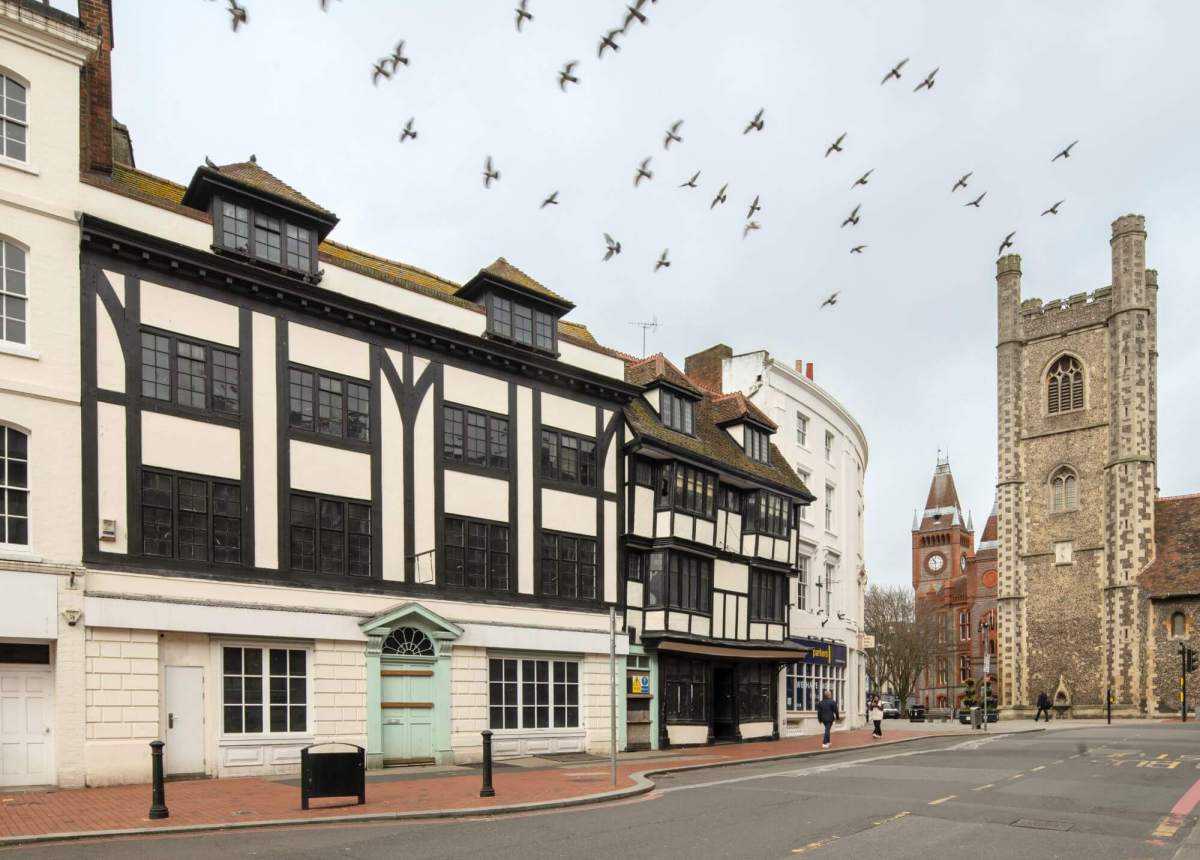
    A photograph of timber-framed buildings beside a road with a church tower in the background.
    A general view of the restored facades of 27 to 28 and 29 to 31 Market Place, Reading, with the tower of St Laurence’s Church on the right. © Historic England Archive. View image DP462599. View List entry 1302967.

    27 to 28 Market Place, which is Grade II listed, is perhaps Reading’s best surviving timber-framed building with features dating back to the 17th century. The buildings have recently been cleaned and restored as part of our High Streets Heritage Action Zones scheme.

    London Street

    In the 18th and 19th centuries, London Street became one of the busiest and most fashionable areas of town, and various businesses were established there.

    A black and white photograph of a high street with a person travelling in a small horse and carriage down the road.
    A view down London Street, Reading, in 1878. The street is lined with shops. Source: Historic England Archive. View image CC97/02809.

    Elegant buildings in a distinctly Georgian style sprang up in great numbers. Most of Reading’s Georgian buildings were built from locally produced brick, tile and terracotta.

    The terracotta ornaments on buildings, alongside patterns using red, cream and grey decorative bricks, formed the distinguishing features of Reading’s architecture. This led author Thomas Hardy to christen Reading as ‘Aldbrickham’, the old brick town, in his novel, ‘Jude the Obscure’ in 1895.

    A photograph of the exterior of a large town hall with a tall clock tower at the centre.
    Reading Town Hall, Reading, Berkshire. Contributed to the Missing Pieces Project by Charles Jennings. View List entry 1113400

    This characteristic red brick sprawled across Reading and its surrounding areas. Impressive examples include the Grade II* listed Town Hall, designed by architect Alfred Waterhouse, who was also responsible for the Natural History Museum in London.

    Reading Gaol

    Reading Gaol was first built over the site of the abbey infirmary in 1785 and was rebuilt in 1844 to designs by George Gilbert Scott and William Boynthon Moffatt, which is what still stands today and is Grade II listed.

    A photograph of the exterior of a wing of a red brick jail building.
    Exterior D Wing East Elevation, HMRC Reading, Berkshire. © Crown Copyright. Historic England Archive. View image AA95/03108.. View List entry 1321948.

    Its layout reflected the prison reform at the time, designed to enforce ‘the separate system’, a new penal technique that involved isolating inmates.

    It is famous for the imprisonment of poet and playwright Oscar Wilde, who served a 2-year sentence (1895 to 1897) with hard labour for ‘gross indecency’ with other men.

    He subsequently wrote ‘The Ballad of Reading Gaol’ in 1898 to immortalise his experiences, narrating an execution that he witnessed during his time in the prison. The Oscar Wilde Memorial Walk at the back of the old Reading Gaol, laid out in 2000, commemorates Wilde’s imprisonment.

    The prison became a Remand Centre and Young Offenders Institution in 1992 and was closed in 2014. It was sold to an educational foundation in January 2024, with plans for an educational centre to provide services to the local community.

    Huntley and Palmers

    Reading flourished as a manufacturing town for business and trade with the development of its famous ‘Three Bs’ industries: beer, bulbs and biscuits.

    The Huntley and Palmers biscuit factory was perhaps the most influential of the ‘Three Bs’, defining Reading’s growth in the 19th and 20th centuries.

    A black and white photograph of the exterior of a large factory building beside a road.
    Exterior view of Huntley and Palmer’s Biscuit Factory in Reading in the late 19th or early 20th century. Source: Historic England Archive. View image REA01/01/18

    Huntley and Palmers started as a small bakery on London Street by Joseph Huntley in 1822. Huntley partnered with George Palmer in 1841 and established a large factory on King’s Road in 1846.

    The company grew swiftly, and by the 20th century, it was the largest and most famous biscuit manufacturer in the world, employing over 5,000 people and producing over 400 different biscuit varieties.

    It is still a household name around the world.

    A black and white aerial photograph of an industrial town with a large factory building at its centre.
    Kennet and Avon Canal with Reading Gas Works, Huntley and Palmers Biscuit Factory and Simmonds Brewery, Reading, 1920. Source: Historic England Archive.

    Reading was even known as the ‘Biscuit Town’ from the 1870s to the 1970s, and during the world wars, Huntley and Palmers produced food rations for the British Army.

    However, biscuit production ended in 1976, and the only remaining building is the old factory social club, which was used as the factory employees’ social club premises. It has now been converted into social housing units.

    Queen Victoria statue

    A statue of Queen Victoria stands outside the Town Hall in Reading. It faces away from the modern town centre, leading to the urban myth that Queen Victoria disliked the town.

    A black and white photograph of a tall statue of Queen Victoria with a high street in the background.
    The statue of Queen Victoria looking down Friar Street from the town hall in Reading, photographed in 1885. Source: Historic England Archive. View image HT05122. View List entry 1113483.

    The statue was created by George Blackall Simonds in 1887 and unveiled that same year in commemoration of Queen Victoria’s Golden Jubilee. Simonds was not only a sculptor who created the Maiwand Lion in front of Forbury Gardens and the statue of George Palmer, but was also the director of H & G Simonds Brewery, comprising the ‘beer’ part of Reading’s ‘Three Bs’.

    Now, the statue is missing the index finger of its right hand, which was blown off by a bomb blast during the Second World War. As part of our High Streets Heritage Action Zones scheme, the statue was cleaned and restored in 2023.

    A photograph of a close-up of a statue of Queen Victoria holding an orb and sceptre.
    The Queen Victoria Jubilee Statue in Reading. Contributed to the Missing Pieces Project by Charles Watson. View List entry 1113483.

    Broad Steet

    Now a bustling street filled with shops and people, Broad Street became the main shopping street in Reading after the establishment of the railway in 1840.

    It was the first street in Reading to have the horse-drawn tramway system installed, with taverns and coaching inns a prominent feature.

    A photograph of the corner of a busy high street with shops on the ground floor and 3 storeys of ornate red brick building above.
    Shops on Broad Street, Reading. Contributed to the Missing Pieces Project by Jon Simons. View List entry 1113564.

    After being pedestrianised in 1970, Broad Street is now the main high street in the town centre and houses many major stores, with Reading’s main shopping centres, The Oracle and Broad Street Mall, situated on the east and west ends of the street, respectively.

    This busy high street is a testament to Reading’s growth as a town. It is a witness to Reading’s industrial past and thrives today at the centre of the town, the heart of one of England’s most populated and cosmopolitan neighbourhoods.

    Written by Steph Chan

    Hidden local histories are all around us. Find out more about Reading on the Local Heritage Hub.


    Further reading

  • Groundbreaking English Women of Science in History

    Groundbreaking English Women of Science in History

    Scientific discoveries and advancements have always shaped history, but many important contributions are still to be equally recognised.

    While people often talk about Sir Isaac Newton and Edward Jenner, the amazing work of many women in science over the centuries is less well-known.

    Here, we shine a light on their stories: women who made giant leaps in medicine, improved our understanding of nature, and played surprising roles during the Second World War.

    Their lasting impact lives on in the heritage around us, from historic buildings to blue plaques.

    Margaret Cavendish (1623 to 1673), The Abbeygate, Colchester, Essex

    Margaret Cavendish was a famous 17th-century writer and aristocrat. She was married to William Cavendish, Marquess of Newcastle.

    Despite her aristocratic position, she still faced many challenges throughout her life. After spending years in exile in Paris during the English Civil War (1642 to 1651), she began writing and published her first book, ‘Poems and Fancies’, in 1653.

    St John’s Abbey Gate in Colchester, Essex. Source: Colin Tucker / English Heritage. EH66597. View List entry 1337765.

    She shared her ideas about atoms and the natural world. Many people noticed her work because of her link to the Cavendish family, one of British history’s most prominent noble families.

    In 1666, she published ‘Observations on Experimental Philosophy’ and ‘The Blazing World’, which aimed to introduce science and philosophy to women through her writing.

    Though mainly a writer, Cavendish influenced the field of science. In 1667, she was the first woman to attend a Royal Society event, where the country’s top scientific minds met regularly.

    The Essex Women’s Commemoration Project honoured her with a blue plaque at her birthplace, The Abbeygate in Colchester, in 2021.

    Mary Anning (1799 to 1847), St Michael’s Church, Lyme Regis, Dorset

    Mary Anning collected, dealt, and studied fossils, gaining worldwide fame for discovering specimens from the Jurassic period in the 19th century.

    She was born in the seaside town of Lyme Regis in 1799.

    A photograph of the exterior of a church with grass in the foreground.
    The front of the Parish Church Of St Michael, Church Street, Lyme Regis, Dorset. © Historic England Archive. IOE01/10623/14. View List entry 1229389.

    When she was 12, Anning and her brother, Joseph, discovered the first fossilised Ichthyosaur (a large marine reptile).

    Her reputation grew in the 1820s and 1830s as people recognised her work along what is now known as the Jurassic Coast in Dorset.

    What did Mary Anning discover?

    Anning discovered many important fossils during her career, including a complete skeleton of a Plesiosaurus (a large marine reptile) in 1823.

    5 years later, Anning found the first remains attributed to a Dimorphodon (a medium-sized pterosaur). She was also a pioneer of studying coprolites (fossilised faeces of animals).

    Her discoveries challenged existing scientific views of Earth’s history and helped shape the early development of geology and palaeontology as disciplines.

    A photograph of a portrait of Mary Anning stood next to a dog.
    A portrait of Mary Anning with a dog. Source: Public Domain.

    Anning sold many of her finds put on displays across the country, which people flocked to. Lyme Regis became a popular tourist spot in the 19th century thanks to her discoveries; people still marvel at them today.

    She died in 1847 and was buried in the churchyard at St Michael’s Church in Lyme Regis. In 1850, the church installed a window to commemorate her remarkable contribution to palaeontology.

    Dorothy Hodgkin (1910 to 1994), University of Oxford’s Inorganic Chemistry Laboratory, Oxford, Oxfordshire

    As a young girl, Dorothy Hodgkin developed a passion for crystals and chemistry, even creating a laboratory in the attic of her home in Norfolk.

    A black and white photograph of a Gothic building.
    The University of Oxford building on South Parks Road, Oxford, Oxfordshire. © Historic England Archive. CC50/00380. View List entry 1369432.

    In 1928, Hodgkin entered Somerville College in Oxford to study chemistry. She graduated with first-class honours and became a research student at the crystallography laboratory in Cambridge.

    Afterwards, she returned to Somerville and set up an X-ray facility. She was appointed as the college’s first fellow and tutor in chemistry in 1936.

    What did Dorothy Hodgkin discover?

    Hodgkin made significant contributions to science by investigating the structure of penicillin and solving the structure of vitamin B12.

    In 1964, she received the Nobel Prize for Chemistry, at the time becoming only the fifth woman to win any scientific Nobel Prize.

    In 2014, the Royal Society of Chemistry installed a commemorative plaque at the University of Oxford’s Inorganic Chemistry Laboratory to honour Hodgkin. The building was listed at Grade I in 1954.

    Mary Somerville (1780 to 1872), Royal Astronomical Society, Burlington House, Piccadilly, London

    As a child, Mary Somerville secretly studied mathematics when growing up in Scotland, even though her father forbade it.

    After marrying her first husband, Samuel Greig, in 1804, she continued her studies despite his negative opinions of learned women. Following his death in 1807, Somerville dedicated herself to intellectual pursuits, and she married William Somerville in 1812, who encouraged her studies.

    A black and white photograph of a large ornate building.
    Burlington House, Piccadilly, London, where the Royal Astronomical Society moved to in 1874. © Historic England Archive. CC97/01478. View List entry 1389279.

    What did Mary Somerville contribute to maths?

    Somerville helped advance modern mathematics, mainly through her work on complex problems in celestial mechanics and physical sciences problems.

    One of Somerville’s biggest accomplishments was translating Pierre-Simon Laplace’s volumes on maths and astronomy, ‘Traité de mécanique céleste’. Under the title of ‘The Mechanism of the Heavens’, Somerville’s translation was published in 1831, and she expanded on the mathematical theory behind the workings of the solar system.

    This publication immediately hailed Somerville as an important scientific figure.  

    A black and white photograph of two women sitting outside of a large building.
    A view across the quad and tennis courts of Somerville College in Oxford, Oxfordshire, named after Mary Somerville. © Historic England Archive. CC50.00690. View List entry 1046619.

    Her educational books helped popularise science and maths, inspiring future generations. Her second book, ‘On the Connection of the Physical Sciences’ (1834), had 9 editions and sold over 15,000 copies, a remarkable feat at the time.

    Somerville and astronomer Caroline Herschel became the first women nominated as members of the Royal Astronomical Society in 1835. The Society, founded in 1820, moved to Burlington House in London in 1874.

    Somerville’s accolades didn’t end there. In 1869, the Royal Geographical Society awarded her the Patron’s Gold Medal, and Somerville College, Oxford, was named in her honour. 

    When she died in 1872, ‘The London Post’ hailed her as “The queen of 19th century science.”

    Elizabeth Garrett Anderson (1836 to 1917), Elizabeth Garrett Anderson Hospital, Camden, London

    Physician Elizabeth Garrett Anderson was the sister of suffrage leader Millicent Garrett Fawcett and the mother of Dr Louisa Garrett Anderson, a fellow medical pioneer and suffragette.

    A black and white photograph of women seated around a table.
    Nurses at the Elizabeth Garrett Anderson Hospital, Euston Road, Camden, Greater London. © Historic England Archive. MED01/01/3002. View List entry 1390775.

    Inspired by Dr Elizabeth Blackwell, the only woman on the General Medical Council’s register in 1859, Anderson took up the cause of promoting women in the medical profession throughout her career.

    When did Elizabeth Garrett Anderson qualify as a doctor?

    Despite prejudice at the time, Anderson received a licence from the Society of Apothecaries in 1865, becoming the first woman in Britain to enter the medical register and the first woman to earn an MD degree from the University of Paris in 1870.

    A photograph of a red brick hospital building.
    The exterior of the Elizabeth Garrett Anderson Hospital in London. Source: Contributed to The Missing Pieces Project by Charles Watson. View List entry 1390775.

    In 1872, she founded the New Hospital for Women and Children in London, which was staffed entirely by women and later renamed the Elizabeth Garrett Anderson Hospital. The hospital was listed at Grade II in 2003.

    Anderson was given membership of the British Medical Association in 1873 and elected as the East Anglian branch president in 1897.

    Marie Stopes (1880 to 1958), University of Manchester, Manchester, Greater Manchester

    Marie Stopes’ mother actively promoted women’s education. As a result, Marie excelled in her studies, earning a science degree from University College London and becoming the first woman to gain a PhD in botany from the Botanical Institute in Munich, Germany, in 1904.

    Stopes’ life was full of groundbreaking firsts.

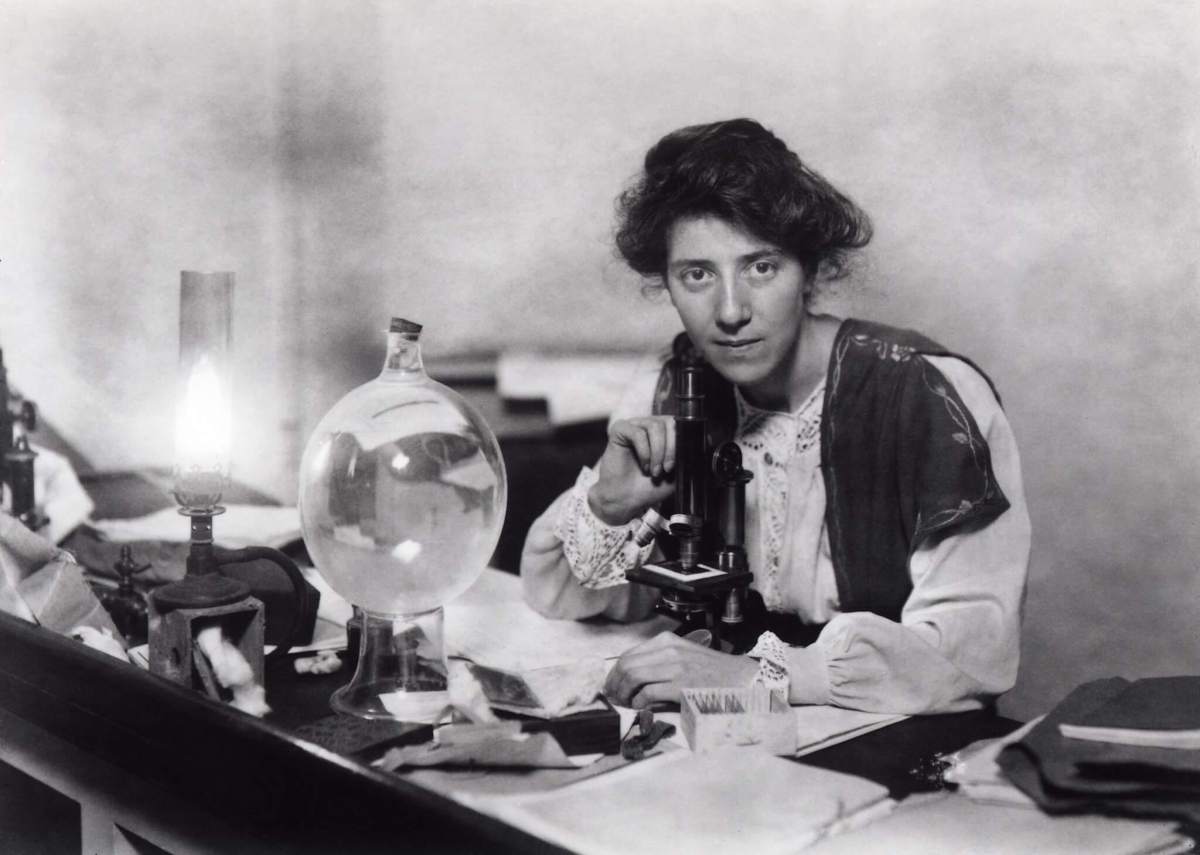
    A black and white photograph of a woman sat at a desk leaning over a microscope
    Marie Stopes in her laboratory at the Victoria University of Manchester in 1904. Source: Public Domain. View List entry 1271428.

    The same year she gained her PhD, she became the first female assistant lecturer in botany at the University of Manchester. In 1905, she became the youngest person in Britain to earn a Doctor of Science degree.

    Stopes joined the Women’s Freedom League in 1907, which campaigned for women’s suffrage.

    She started writing on marriage and birth control and published ‘Married Love’ in 1918, followed by ‘Wise Parenthood: A Treatise on Birth Control or Contraception’.

    In 1921, she and her second husband, Humphrey Verdon Roe, established the first birth control clinic in London.

    A photograph of the exterior of a large ornate brick building.
    University of Manchester’s Whitworth Hall, Manchester, Greater Manchester, where Marie Stopes was its first female academic. Source: Public Domain. View List entry 1271428.

    During this time, talking about contraception and seeking treatment or advice on the subject was largely taboo. Stopes’ clinic sought to change that, providing married women with information on reproductive health and birth control.

    The University of Manchester, where Stopes studied, was listed at Grade II in 1963. The university is also home to one of England’s most magnificent libraries. 

    Joan Clarke (1917 to 1996), Bletchley Park, Milton Keynes, Buckinghamshire

    Joan Clarke is one of the most essential English mathematicians in history.

    As a gifted student at Dulwich High School for Girls in London, Clarke won numerous academic prizes, including the Elsie Clarke prize for maths in 1934.

    She went on to study mathematics at Cambridge and became one of the first women to receive a degree from the institution when the rules changed in 1948. 

    Before 1948, women were permitted to study at Cambridge University but weren’t given degrees like men.

    The exterior of a grand house with grass in the foreground.
    A view of the front façade of Bletchley Park House, Bletchley, Milton Keynes, Buckinghamshire. © Historic England Archive. IOE01/00976/27. View List entry 1125409.

    What job did Joan Clarke perform at Bletchley Park, and why was it surprising?

    Clarke worked as a codebreaker at Bletchley Park during the Second World War. Her role was surprising because, at the time, it was rare to recruit women for such high-level intelligence work.

    A photograph of a green hut with the number 8 on it.
    Hut 8, constructed sometime late in 1939, Bletchley Park, Bletchley, Milton Keynes, Bedfordshire. © Historic England Archive. View image DP435671. View List entry 1391796.

    Clarke, Alan Turing and their team successfully deciphered German naval codes, mainly through their groundbreaking work on decoding the Enigma machines.

    Working in Hut 8, which focused on naval cryptography, they developed the ‘bombe’, an electromechanical device that significantly sped up the decryption process.

    They played a crucial role in saving countless sailors during the war.

    A photograph of a long green hut against a blue sky.
    Hut 8, Bletchley Park, Bletchley, Milton Keynes, Bedfordshire. © Historic England Archive. View image DP435673. View List entry 1391796.

    In January 1946, the British government awarded Clarke an MBE for her codebreaking services. In 2024, English Heritage honoured her with a blue plaque at her childhood home on Rosendale Road in West Dulwich, London.

    Beatrice Shilling (1909 to 1990), Waterlooville Library, Waterlooville, Hampshire 

    Beatrice ‘Tilly’ Shilling made significant contributions to science through her work in engineering.

    Shilling loved engines from an early age, and she soon turned her passion into a career by studying electrical engineering at the University of Manchester.

    A sepia photograph o a woman wearing motorcycle leathers sat on top of a motorcycle.
    Beatrice Shilling sitting on top of a motorcycle. Source: Public Domain.

    In 1936, the Royal Aircraft Establishment (RAE) noticed her talent, and she solved a critical problem with Second World War fighter planes, including Hurricanes and Spitfires.

    With a minor adjustment, Shilling stopped the Spitfire engine from conking out in negative g-force, making the planes much safer to fly and manoeuvre.

    Her groundbreaking work earned her an OBE in 1949, and she continued working at RAE until her retirement in 1969.

    In the town where she was born, Waterlooville Library honoured Shilling with a blue plaque in 2019, commemorating her important contribution to engineering. Several educational institutions have recognised her achievements, including Royal Holloway, University of London, which named its electronic engineering department after her in 2018.

    Hidden local histories are all around us. Find a place near you on the Local Heritage Hub.


    Further reading

  • 10 Historic Places to Explore in York

    10 Historic Places to Explore in York

    Founded by the Romans in AD 71 and later shaped by the Vikings and Normans, York’s cobbled streets, medieval architecture, brilliant museums, and ruined remains offer a unique glimpse into England’s past.

    A view looking north-east along Stonegate in York, Yorkshire, with York Minster in the background, taken around 1853. Source: Historic England. View image CC61/00025.

    1. York City Walls

    Walls have defended York since Roman times, and there are over 2.75 miles of surviving masonry.

    This scheduled ancient monument encircles the historic City of York and takes around 2 hours to walk. The wall is almost square-shaped around the city, and each side contains a grand medieval fortified gateway called a ‘bar’.

    A black and white photograph of a city wall with a grand medieval gateway.
     Walmgate Bar, Walmgate, York, Yorkshire. Source: Historic England Archive. View image CC78/00146.

    Earth ramparts were added to the city’s Roman walls in the 9th and 11th centuries, but the walls you see today were mainly built of magnesian limestone in the 13th century.

    2. Multangular Tower

    The Multangular Tower is the most substantial standing example of York’s Roman buildings and defences.

    A photograph of the interior of ruins of Roman fortifications and walls.
    Multangular Tower, York, Yorkshire. © Mr Chris Broadribb. Source: Historic England Archive. View image IOE01/03719/09. View List entry 1257120.

    The Romans chose the spot where the River Foss meets the River Ouse for a Yorkshire base. This strategic location allowed people, goods and supplies to be transported from the North Sea via the River Ouse.

    This fortress was originally made of timber but was later rebuilt with stone walls. The Multangular Tower stood at the west corner of the legionary fortress, now York Museum Gardens. The original Roman stones are still visible at the bottom of the tower.

    The tower gets its name from its 10-sided shape. These corner and interval towers were a Roman military innovation, allowing soldiers to fire along the walls at invaders trying to climb up. In reality, the Romans likely never expected an attack on Eboracum (the Roman name for York). The fortress served mainly as a base to control the surrounding region.

    A photograph of the interior of ruins of Roman fortifications and walls.
    Multangular Tower, York, Yorkshire. Contributed to the Missing Pieces Project by Deirdre Murray. View List entry 1257120.

    The tower’s upper half was rebuilt during medieval times. York’s fortifications played a role in the English Civil War, with cannonball damage visible north of the tower.

    3. St Mary’s Abbey

    In 1086, Count Alan Rufus granted St Olave’s Church to Benedictine monks. In 1088, King William II expanded the grant and laid the foundation stone for a new abbey church in York in 1089.

    St Mary’s Abbey thrived and expanded through the 12th century, establishing dependent cells (living quarters) across Cumbria, Yorkshire, and Lincolnshire.

    A photograph of church ruins surrounded by autumnal trees, with small column stumps surrounded by grass in the foreground
    The ruin remains of St Mary’s Abbey, York, Yorkshire. Contributed to the Missing Pieces Project by P Hampel. View List entry 1257128.

    After a fire in 1137, St Mary’s grew and rebuilt, including constructing a new abbey church between 1271 and 1294. By the Dissolution of the Monasteries in 1539, St Mary’s was the wealthiest abbey in the north of England with an income over £2,000, and it was one of the last to be dissolved.

    Following this, St Mary’s Abbey became King’s Manor, the headquarters for the Council of the North, governing northern England. Henry VIII stayed in the converted buildings during his visit to York in 1541. In the late 16th century, much of the abbey church was demolished.

    A photograph of the exterior of a museum within a park.
    The Yorkshire Museum, York, Yorkshire. Contributed to the Missing Pieces Project by Charles Watson. View List entry 1257100.

    In 1827, the Yorkshire Philosophical Society purchased the abbey ruins, conducted excavations, and opened The Yorkshire Museum in 1830. It was one of the first purpose-built museums in the country.

    It houses incredible artefacts from the abbey, including the St Mary’s Figure of Christ, possibly hidden during the Dissolution.

    4. York Minster

    York Minster (also known as the Cathedral Church of St Peter) was founded in AD 625 on the site of the Roman fortress. This wooden church was the setting for King Edwin’s baptism in AD 627.

    A black and white photograph of the exterior of a grand medieval minster.
    York Minster, Minster Yard, York, Yorkshire. © Crown Copyright. Historic England Archive. View image BB90/05963.

    The present Minster began to take shape around 1080, following the devastation of its predecessor during the Harrying of the North (a series of devastating military campaigns and pillaging by William the Conqueror between 1069 and 1070 to gain control of northern areas of England).

    The foundations laid during this time form the footprint of the cathedral as we know it.

    Construction of the Gothic Minster commenced between 1225 and 1255, with the vision of creating the largest cathedral in England. Over the next 250 years, the Minster became a masterpiece of medieval architecture.

    Among its many treasures, the Great East Window stands out as England’s largest expanse of medieval stained glass. But it is not alone in its magnificence.

    The Rose Window, created in 1515, may have been designed to bolster the legitimacy of the Tudor dynasty during Henry VIII’s reign. Its outer panels feature alternating Lancastrian red roses and the combined red and white roses of the House of Tudor.

    Today, York Minster remains a vital centre of worship.

    5. Shambles

    Shambles is one of York’s most iconic landmarks and one of Europe’s best-preserved medieval shopping streets.

    Originally lined with butchers’ shops and houses, each had a slaughterhouse at the rear. The name ‘Shambles’ likely derives from the Anglo-Saxon word ‘fleshammel’, referring to wooden shelves that display meat.

    A black and white photograph of a high street with medieval buildings. Animal carcases are hanging from the windows of butchers shops.
    Shambles, York, Yorkshire. Source: Historic England Archive. View image CC76/00555.

    Most of its timber-framed buildings are medieval, with several storeys of projecting jetties providing accommodation over the shops. The street was intentionally designed to be narrow, helping to keep meat out of direct sunlight. Although the original medieval shopfronts haven’t survived, some buildings still have external wooden shelves, a nod to when meat was sold from open windows.

    One of Shambles’ most notable historical figures was Margaret Clitherow, who lived on the street and was later canonised as a Catholic saint. She was tortured and executed in 1586 for harbouring a Catholic priest following the enforcement of The Jesuits Act of 1584 during Elizabeth I’s reign.

    6. Clifford’s Tower and York Castle

    William the Conqueror built 2 motte-and-bailey castles in York between 1068 and 1069, one on either side of the River Ouse. The abandoned motte on the south-western side of the river is now known as Baile Hill, while the northern one became the centre of government for the north of England.

    A photograph of a medieval castle ruins on a hill.
    Clifford’s Tower, York, Yorkshire. © Historic England Archive. View image DP290266. View List entry 1259325.

    William I’s timber tower on the hill was burned down in 1190 when York’s Jewish community of around 150 people was besieged there by a mob, and the majority took their own lives rather than fall into the hands of their persecutors. The castle was swiftly rebuilt.

    Henry III built the present 13th-century stone tower. Despite the city’s importance, its castle was not generally used as a royal residence. Instead, it was used for administrative purposes. Clifford’s Tower and its motte are the principal survivors of York’s castle today.

    An aerial photograph of a medieval castle ruins on a hill, surrounded by a car park.
    Clifford’s Tower, York, Yorkshire. © Historic England Archive. View image DP290288. View List entry 1259325.

    Since the 18th century, the castle’s bailey has been used as a prison and a court. The court still operates from here and the prisons form the York Castle Museum. You can still visit some of the original cells in the museum, which held famous prisoners such as notorious highwayman Dick Turpin.

    7. The Merchant Adventurers’ Hall

    Considered one of the finest of its kind worldwide, the Merchant Adventurers’ Hall on Fossgate was built between 1357 and 1368. It originally served as a meeting hall, chapel, and hospital for the Guild of Our Lord Jesus Christ and the Blessed Virgin Mary, a religious and charitable group.

    A photograph of a two storey yellow timbre framed building with a brick bottom storey.
    Merchant Adventurers’ Hall, York, Yorkshire. Contributed to the Missing Pieces Project by Millie Carroll. View List entry 1257828.

    By 1430, the mercers (a textile trading group) dominated what became known as the Guild of Merchant Adventurers. They used the hall for business, social gatherings, charitable work, and worship.

    A photograph of the interior of a medieval building with a blue panelled seating area.
    Merchant Adventurers’ Hall, York, Yorkshire. Contributed to the Missing Pieces Project by Brian Mawdsley. View List entry 1257828.

    A Merchant Adventurer was someone who risked their own money in overseas trade to bring back goods and wealth to York.

    8. Fairfax House

    Fairfax House on Castlegate, considered England’s finest Georgian townhouse, was built in the mid-18th century and remodelled as a dowry for Anne Fairfax, the daughter of Charles Gregory Fairfax, 9th Viscount of Emley (1700 to 1772).

    A photograph of a street with a Georgian 3 storey red brick house.
    Fairfax House, York, Yorkshire. Contributed to the Missing Pieces Project by Deirdre Murray. View List entry 1259337.

    Renowned architect John Carr designed its interior, including the impressive staircase with a Venetian window, the Siena marble library fireplace, and the dining room’s ornate stucco ceiling. The plasterwork was by the celebrated stuccoist Giuseppe Cortese.

    After serving as a private residence until 1865, it became a gentlemen’s club and later, in the early 20th century, converted into a cinema and dance hall called St George’s Hall.

    A photograph of the interior of a Georgian house with a grand staircase.
    Interior staircase in Fairfax House, York, Yorkshire. Contributed to the Missing Pieces Project by Millie Carroll. View List entry 1259337.

    York Civic Trust and the architect Francis Johnson restored the house between 1982 and 1984, returning it to its original splendour. It is now owned by the York Conservation Trust and open to the public.

    9. Coppergate

    A vast amount of evidence of York’s Viking history was unearthed between 1976 and 1981 when archaeologists excavated an area off Coppergate for a new shopping centre.

    After the end of Roman rule in England, the Angles settled the city after AD 400, but by the 9th century, it was home to Viking settlers.

    The extraordinary archaeological finds in the damp earth off Coppergate included the remains of timber buildings, pottery, textiles, leather, seeds and plants, which show how the inhabitants of Eoforwic or Jorvik (present-day York, according to the Angles and the Vikings, respectively) would have lived and worked.

    An illustration depicting craftsmen at work in a 10th century metalworking shop excavated at 16-22 Coppergate in York.
    Reconstruction drawing depicting artisans at work in a 10th-century metalworking shop excavated at 16 to 22 Coppergate in York. © Historic England Archive. View image IC128/001.

    The Coppergate excavation gathered information about the area’s entire history, but it was particularly revealing about the 9th to 11th centuries.

    Today, Coppergate is home to the Jorvik Viking Centre, where archaeological finds and reconstructions celebrate this part of the city’s history.

    10. Rowntree Park

    Like Terry’s, Rowntree’s were renowned York chocolate and confectionery manufacturers. One strand of the Rowntree story traces back to 1725 when Mary Tuke set up a grocery and chocolate business on Walmgate. She was a Quaker, a religious group favouring the cocoa industry as an alternative to alcohol.

    A black and white photograph of a city centre park with formal gardens.
    Rowntree Memorial Park, York, Yorkshire, photographed between 1910 to 1930. Source: Historic England Archive. View image PC10978. View List entry 1001439.

    Despite resistance from the Merchant Adventurers’ Company, which denied her a trading license, Mary persisted. In 1862, another Quaker, Henry Isaac Rowntree, bought the Tuke cocoa business at the back of Castlegate and Rowntree’s was born.

    Rowntree’s chocolate factory was among the largest in the world in the 19th and 20th centuries. At its height, over 14,000 people worked in York’s chocolate industry. Though the industry has declined, KitKat is still made in York.

    A photograph of a park scene featuring an arch-roof building, hedging, and a waterway and bridge in the foreground.
    The lych gate and dovecote, Rowntree Park, York, Yorkshire. Contributed to the Missing Pieces Project by the Historic England North listing team. View List entry 1452680.

    The Rowntree family was known for philanthropy. Rowntree Park opened on 16 July 1921 as a gift to the city of York in memory of Cocoa Works staff who suffered in the First World War. It was intended for rest and recuperation and contains a war memorial dovecote.

    A photograph of a war memorial plaque.
    Rowntree Park, York, Yorkshire. Contributed to the Missing Pieces Project by Historic England North listing team. View List entry 1452680.

    The Terry Avenue gates of about 1715, possibly made by ironworker Jean Tijou, were bought for the park by the family and installed in 1955 to commemorate those who died in the Second World War.

    The park remains a much-loved amenity for the city.

    Hidden local histories are all around us. Find out more about York on the Local Heritage Hub.


    Further reading

  • The Buildings of Architect Watson Fothergill

    The Buildings of Architect Watson Fothergill

    During the Victorian era (1837 to 1901), several architects, including Watson Fothergill, made their mark on England’s quickly changing landscape.

    From 1870 to 1912, Fothergill (1841 to 1928) worked tirelessly on plans for over 100 buildings across Nottinghamshire, bringing his grand designs for houses, warehouses, churches, and beyond to fruition.

    1 to 7 Castle Road, Nottingham, Nottinghamshire, designed by Watson Fothergill in 1883. © Historic England Archive. View image DP312860. View List entry 1246812.

    If you’ve ever visited Nottingham and been taken by a striking Gothic Revival or Old English vernacular style building, the chances are that Fothergill had a hand in it.

    But who was Fothergill, and how did he become such a leading local architect in the East Midlands?

    Who was Watson Fothergill?

    Watson Fothergill was born Fothergill Watson on 12 July 1841 in Mansfield. His unusual first name was his mother’s maiden name, but Fothergill later switched his names around so that the Fothergill name would continue down his lineage.

    Fothergill’s father, a prominent lace merchant, died when he was young, causing his mother to pull him out of the costly London boarding school he attended in favour of a less expensive one in Nottingham.

    A photograph of the exterior of a converted 5-storey red brick warehouse on the corner of a road.
    The Barker Gate Warehouse, a former lace warehouse, 1 Barker Gate, Nottingham, Nottinghamshire, designed by Watson Fothergill in 1897. © Historic England Archive. View image DP312843. View List entry 1271416.

    By the age of 15, Fothergill was already paving the way for his future as he became a trainee at the office of the architect Frederick Jackson, who was his late father’s friend.

    These early years were formative for Fothergill, who continued to work with Jackson for 4 years before moving on to work with another Nottingham-based architect, I. C. Gilbert. He then spent 2 years working in London under Arthur Blomfield.

    When did Watson Fothergill become a prominent architect in Nottingham?

    Though his years working with established architects served him well, Fothergill went out on his own in 1864 when he set up his Nottingham office.

    A photograph of a close-up of carved gables above trefoil-headed windows on the projecting turret on an ornate red brick building.
    The ornate carved details on Watson Fothergill’s office, 15 to 17 George Street, Nottingham, Nottinghamshire, where he worked from 1895. © Historic England Archive. View image DP279165. View List entry 1247548.

    3 years later, he married Anne Hage, the daughter of a Mansfield brewer, and they had 7 children together.

    Fothergill didn’t gain the recognition he deserved until he entered a competition to design Nottingham’s Albert Hall, a new conference and concert venue.

    His plans wowed judges thanks to its 2,500-seat capacity (quite a number at the time) and consideration for the acoustics. Built by Richard Stevenson and Field Weston, the impressive French-Gothic building opened in 1876.

    A black and white photograph of a tall music hall with a small cabmen's shelter on the road beside the building.
    The Albert Hall in Nottingham was Watson Fothergill’s first major commission. It was photographed in 1905, a year before it burned down. © Nottingham City Council / Picture Nottingham.

    Sadly, the hall burned down in 1906 before being rebuilt by architect Albert Edward Lambert and officially reopened in 1910.

    The late 1870s proved lucrative for Fothergill. Building on his designs for the Albert Hall, he went on to design multiple important buildings for the city during this period.

    What are the characteristics of Victorian architecture?

    Many buildings we know and love today were shaped by the characteristics of Victorian architecture.

    Throughout this period, architects like George Gilbert Scott were well-known for introducing elaborate Gothic Revival style elements, such as ornate detailing, grand arches, and spires.

    A black and white photograph of a Gothic style villa surrounded by trees and a brick wall.
    Watson Fothergill’s family home on Mapperley Road, Nottingham, was demolished in the 1960s. © Historic England Archive. View image AA022177.

    Fothergill’s work established him as a key architect of some of the most beautiful surviving Victorian buildings in and around Nottingham. His style became recognised for using contrasting horizontal bands of red and blue brick, elaborate stone carvings, decorative chimneys, and detailed timber eaves.

    However, not all of Fothergill’s work survived, including the home he designed and built for his family in the 1870s on Mapperley Road in Nottingham, which was demolished in the 1960s.

    Which buildings did Watson Fothergill design?

    Queen’s Chambers, Nottingham, Nottinghamshire

    Situated on the corner of Long Row and King Street in Nottingham, the Queen’s Chambers is arguably one of Fothergill’s most recognisable projects.

    The red-brick building has impactful detailing, such as stone depictions of Queen Victoria. Built in 1897, it was designed for Edward Skipwith (a wine and spirit merchant) and named after Queen Victoria to commemorate her 60th jubilee.

    The Gothic Revival style building originally served as shops, offices, and workrooms.

    The School of Violin Making, Newark, Nottinghamshire

    In 1887, Fothergill designed 43 Kirkgate for the bank manager on behalf of Nottingham and Nottinghamshire Bank, with whom Fothergill had a long working relationship.

    A colour photograph of a large, ornate, red brick building.
    The School of Violin Making, 43 Kirkgate, Newark, Nottinghamshire. Contributed to the Missing Pieces Project by Philip Carlisle. View List entry 1229217.

    This imposing building was designed in the Italian Gothic Revival style, including terracotta, stone dressings, and an impressive tower.

    The tower’s height was reduced in 1957, and in 1972, the property became the new headquarters of the Newark School of Violin Making.

    14 to 30 King Street, Nottingham, Nottinghamshire

    Built in 1895, this formidable building on King Street in Nottingham was originally a drapery.

    A photograph of a terrace of 5-storey large red brick buildings with shops on the ground floor. The upper storeys have timber-framed gables, dormers and elegant windows.
    14 to 30 King Street, Nottingham, Nottinghamshire. The former Jessop and Son department store was designed by Watson Fothergill in 1895. © Historic England Archive. DP314112. View List entry 1254538.

    Designed in the Domestic Revival style, Fothergill used elements such as oriel windows, corbelled brick stacks, and a square turret to elevate this architectural marvel.

    Today, the building sits alongside modern office buildings and houses shops on the ground floor and offices on the upper floors.

    15 to 17 George Street, Nottingham, Nottinghamshire

    15 to 17 George Street is especially important to Fothergill’s legacy. After leaving an office situated on Clinton Street in Nottingham, Fothergill moved operations to George Street in 1895.

    Fothergill redesigned 15 to 17 George Street in the Gothic Revival style, implementing his signature features, such as colourful polychrome brickwork.

    He also paid homage to those who inspired him by including busts of architects Augustus Welby Pugin and George Edmund Street on the exterior.

    The arch of a doorway with an ornately carved gold sign that reads "Watson Fothergill, architect."
    Watson Fothergill’s office entrance, 15 to 17 George Street, Nottingham, Nottinghamshire. © Historic England Archive. View image DP046491. View List entry 1247548.

    Express Chambers, Nottingham, Nottinghamshire

    This grand building, known as the Express Chambers, sits proudly on Upper Parliament Street in Nottingham.

    A colour photograph of a large building with several storeys and a Tesco Express underneath.
    The Express Chambers, 17 to 25 Upper Parliament Street, Nottingham, Nottinghamshire. Contributed to the Missing Pieces Project by Philip Carlisle. View List entry 1255229.

    Fothergill designed the main building in 1876 to house the ‘Nottingham Daily Express’ and Midland Counties Courier offices. It was heavily influenced by the style of English architect and designer William Burgess, whom Fothergill idolised.

    Above one of the doorways are 3 carvings of the heads of Prime Minister William Gladstone and liberal statesmen Richard Cobden and John Bright.

    The building was extended in 1899 and remains a much-loved example of Fothergill’s work in the area.

    A colour photograph of an ornate doorway with the words "Express Champers" carved in stone.
    Details above the entrance to the Express Chambers, 17 to 25 Upper Parliament Street, Nottingham, Nottinghamshire. Contributed to the Missing Pieces Project by Philip Carlisle. View List entry 1255229.

    Halifax Building Society, Long Eaton, Derbyshire

    This Grade II listed building in Long Eaton, Derbyshire, is now used by Halifax Building Society, although Fothergill originally designed it for Samuel Smith’s Bank in 1889.

    A colour photograph of a large red brick building against a moody sky.
    Halifax Building Society, 24 Market Place, Long Eaton, Derbyshire. Contributed to the Missing Pieces Project by David Edge. View List entry 1281305.

    It’s not one of Fothergill’s most prominent works, but the grand façade of the property still leaves a lasting impression thanks to its elaborate brick side wall stacks and semi-circular headed stone arches.

    The Pakistan Centre (formerly Woodborough Road Baptist Church), Nottingham, Nottinghamshire

    Fothergill was commissioned to design a new church for Stoney Street Baptist Church’s increasing congregation, which was completed in 1894.

    A photograph of a large red brick building on the corner of a road with a tall clock tower.
    The Pakistan Centre, Woodborough Road, Nottingham, Nottinghamshire. © David Lally / Woodborough Road Baptist Church. View List entry 1255289.

    Upon its opening, the ‘Nottingham Evening Post’ reported: “It is a commanding structure and an undoubted ornament to the town”.

    Its large bell tower and red brick exterior make it a well-noted Nottingham landmark. It now operates as the Pakistan Centre, serving the local community.

    It was listed at Grade II in 1978.

    Carlton Laundry, Gedling, Nottinghamshire

    Built in 1899, this red brick Grade II listed building originally served as a laundry and dye works.

    A colour photograph of a large red brick building with several storeys.
    Carlton Laundry, now known as Sandpiper House, Marhill Road, Gedling, Nottinghamshire. Contributed to the Missing Pieces Project by David Lalley. View List entry 1236194.

    Interestingly, it is one of just a few industrial buildings Fothergill designed.

    As such, it is noticeably different in style to many of his best-known works. The property, now named Sandpiper House, was turned into flats in 1997.

    Castle Court, Nottingham, Nottinghamshire

    In 1894, Fothergill was commissioned to build Castle Court by paper merchants Simons and Pickard.

    The warehouse includes 2 storeys, a basement and an attic, with design elements such as segment-arched cart entrances on the corner towers.

    A colour photograph of a large industrial building along a river bank.
    The rear of Castle Court, Castle Boulevard, Nottingham, Nottinghamshire. Contributed to the Missing Pieces Project by Stephen Miles. View List entry 1246547.

    The building was restored in 1983 when it was turned into offices and workshops. The courtyard, once open-air, was turned into a glass atrium.

    Castle Court was listed at Grade II in 1995.

    Hidden local histories are all around us. Find a place near you on the Local Heritage Hub.


    Further reading

  • A History of Bradford in 10 Places

    A History of Bradford in 10 Places

    Known for once being the ‘wool capital of the world’, its UNESCO World Heritage Site in Saltaire, and its literary connections to the Brontë sisters, Bradford in West Yorkshire has a fascinating history.

    The Anglo-Saxons first established it as a small village known as ‘Broad Ford’ on a crossing over the Bradford Beck, a river which still runs under the city today.

    Lister Park with Cartwright Hall Art Gallery in the background in Manningham, Bradford, West Yorkshire. © Historic England Archive. View image DP065455. View List entry 1001222.

    During the medieval period, it grew to be a market town. Cloth-making became a growing industry here, as did shoemaking and the manufacture of iron.

    By the middle of the 19th century, Bradford had dramatically transformed from a small market town into processing two-thirds of England’s wool. The Industrial Revolution increased the demand for textile mills in the area, with a staggering 70 mills operating by 1841.

    The canal network’s development and the railway’s birth at this time also provided Bradford with better and faster connections across Yorkshire and beyond. Bradford was granted city status in 1897.

    Following the end of the Second World War in 1945, the demand for textile manufacturing declined, leaving a shortage of employment for many mill workers.

    A photograph of a large light installation outside a town hall building at night. The lights are shaped to say 'Bradford 2025'.
    Bradford was picked as the UK City of Culture for 2025. Bradford City Hall, Centenary Square, Bradford, West Yorkshire. © Historic England Archive. DP462819. View List entry 1133675.

    In recent decades, new industries have been established in the area, including car production, food and chemical producers, engineering and digital technology.

    In 2009, Bradford was named the world’s first UNESCO City of Film and the UK City of Culture for 2025.

    Discover the history of this city and its surrounding areas through these 10 places.

    1. Bradford City Hall, Bradford, West Yorkshire

    As Bradford became an industrial giant in the 19th century, its population grew from 13,000 in 1801 to over 100,000 in the 1840s.

    With the rapid increase of people and industrialisation, there were significant calls to set up a new council to regulate the area better and expand its operations to deal with local issues such as overcrowding, pollution, poverty and health.

    A black and white photograph of a large civic building with a tall clock tower at the centre.
    Bradford City Hall, Centenary Square, Bradford, West Yorkshire, photographed in 1875. © Historic England Archive. View image BL00866. View List entry 1133675.

    As a consequence, a new town hall was proposed. Local architects William Mawson and Francis Lockwood won a competition to design it, and a lavish parade was put on to officially open the new hall in 1873.

    The Venetian-style building features a bell tower standing at 220 feet high, inspired by the Palazzo Vecchio in Florence, Italy. Statues of past monarchs and Oliver Cromwell can be seen on the building’s exterior.

    The building’s name was changed to City Hall in 1965 to reflect Bradford’s city status.

    2. Lister Mills, Manningham, Bradford, West Yorkshire

    Lister Mills (once referred to as Manningham Mills) was one of the largest silk factories in the world. Commissioned by inventor and industrialist Samuel Lister, it was designed in the Italianate style by Bradford architects Andrews and Pepper in 1873.

    It became the largest textile mill in the north of England.

    A photograph of a cityscape with a large mill building in the background with a tall tower.
    Lister Mills, Manningham, Bradford, West Yorkshire. © Historic England Archive. View image DP071598. View List entry 1314426.

    Its enormous 249-foot chimney can be seen across Bradford, making it an iconic part of the area’s skyline. At its manufacturing peak, 11,000 people worked there, producing textiles such as silk and velvet.

    The mill produced 1,000 yards of velvet used for King George V’s coronation in 1911, and during the Second World War (1939 to 1945), it supplied 1,330 miles of silk for parachutes and 4,430 miles of parachute cord.

    Following a reduction in manufacturing in the area in the 1980s, the mill’s buildings have been renovated into homes and commercial units.

    3. Bradford Cathedral, Bradford, West Yorkshire

    People have worshipped on the site of Bradford Cathedral, or the Cathedral Church of St Peter, since the 7th century when the Anglo-Saxons are believed to have built a church here. This was replaced by a second church in the early 13th century.

    A black and white photograph of a cathedral with a small tower.
    Bradford Cathedral, Stott Hill, Bradford, West Yorkshire, photographed in 1943. © Historic England Archive. View image AA43/06504. View List entry 1133250.

    The parish church was rebuilt in the 14th and 15th centuries, with the Perpendicular Gothic-style tower completed in 1508. It was raised to cathedral status in 1919. In the 1960s, architect and designer Edward Maufe extended the building further.

    Striking examples of Victorian and later stained glass windows feature in the cathedral, with designs by the likes of William Morris, Dante Gabriel Rossetti, and Ford Madox Brown.

    A photograph of the interior of the nave of a cathedral with a brightly coloured stained glass window at the end.
    The nave of Bradford Cathedral, Stott Hill, Bradford, West Yorkshire. Contributed to the Missing Pieces Project by Tyran Choy. View List entry 1133250.

    The building houses multiple notable monuments to prominent events in Bradford’s history, such as the Battle of the Steeple (1642 to 1643) during the English Civil War, the Bradford City Football Ground fire disaster (1985), and the creation of the Leeds-Liverpool Canal (1774).

    4. Brontë Parsonage Museum, Haworth, West Yorkshire

    Haworth Parsonage, now the Brontë Parsonage Museum, was once the home of the famous writers Charlotte, Emily and Anne Brontë.

    From 1820, the sisters lived here with their father, Anglican minister Patrick, and brother, Branwell.

    A black and white photograph of the exterior of a large parsonage with ivy growing on the building, surrounded by gardens.
    Brontë Parsonage Museum, Church Street, Haworth, West Yorkshire, photographed in 1940. Source: Historic England Archive. View image WSA01/01/24005. View List entry 1313933.

    It was here that the Brontë sisters wrote some of their most famous novels, including Charlotte’s ‘Jane Eyre’, Emily’s ‘Wuthering Heights’ and Anne’s ‘Agnes Grey’, all published in 1847.

    At this time, the village of Haworth, which is 10 miles west of Bradford, was severely overcrowded and polluted, with the average life expectancy being just 24. In 1850, Patrick Brontë commissioned a report into the village’s high early mortality rate, which had impacted his own family, with all but one of his 6 children dying by the age of 31.

    The report was presented to the General Board of Health, which initiated steps to improve the village’s living and working conditions.

    5. Salts Mill, Saltaire, near Shipley, West Yorkshire

    Saltaire is a Victorian model village near Shipley, built by leading industrialist and philanthropist Sir Titus Salt between 1851 and 1871.

    A photograph of the exterior of a large mill building surrounded by allotments and greenhouses.
    Salts Mill main block, Saltaire, Victoria Road, Saltaire, Shipley, West Yorkshire. Contributed to the Missing Pieces Project by Dan Willoughby. View List entry 1133523.

    Concerned about Bradford’s industrial centre’s pollution and overcrowded conditions, Salt made the radical decision to relocate his mills and employees to a new community north of Bradford.

    This new area provided better quality housing, schools, a church, recreation spaces, bath houses and a hospital for his workers to live and thrive.

    A black and white photograph of 2 people standing at tables covered in raw wool inside a factory.
    Workers sorting raw wool inside Salt’s Mill, Saltaire, Shipley, West Yorkshire. Photographed between 1966 and 1974. © Historic England Archive. View image DES01/01/0477. View List entry 1133523.

    Salts Mill opened in 1853 as the centrepiece of Titus Salt’s development. Architects Lockwood and Mawson designed the entire village, building it in a classical style inspired by the Italian Renaissance.

    Production at the mill ceased in 1986. The following year, redevelopment began to turn it into a centre of culture and commerce, including an art gallery hosting one of the largest collections of artwork by Bradford-born David Hockney.

    A photograph of the interior of a church with ornate ceiling decoration and large elegant light fittings hanging above the centre of the aisle.
    The impressive interior of the United Reformed Church, Victoria Road, Saltaire, Shipley, West Yorkshire, was built in 1858. © Historic England Archive. View image DP143300. View List entry 1314229.

    Saltaire became a UNESCO World Heritage Site in 2001. It is noted as an outstanding and well-preserved example of a mid-19th century industrial town.

    It also significantly influenced the development of the ‘garden city’ movement in the early 20th century.

    6. The Wool Exchange, Bradford, West Yorkshire

    One of the buildings that symbolises Bradford’s prominence in the 19th-century textile trade is The Wool Exchange.

    Completed in 1867, architects Lockwood and Mawson took inspiration from the great Flemish Cloth Halls, but the building’s main style is Venetian Gothic. Prime Minister Lord Palmerston laid its foundation stone.

    The building includes an impressive clock tower, and the exterior features sculptures of various industrialists, politicians and explorers such as Sir Titus Salt, William Gladstone and Sir Francis Drake.

    At the peak of its use, wool brokers, spinners, and cloth manufacturers would gather here all week to haggle and make business deals on the trading floor. Deals were completed only by verbal agreements.

    Following the decline of the textile trade and technological changes to business deals, such as using telephones, fax machines and computers, in the later 20th century, wool trading ceased in the building in the 1970s. It is now used as a beautiful bookshop and café.

    7. St George’s Hall, Bradford, West Yorkshire

    As Bradford’s population grew significantly through the 19th century, a venue in the city centre was needed to host concerts and public meetings.

    A photograph of the exterior of a large, neoclassical-style concert hall beside a road.
    St George’s Hall, Bridge Street, Bradford, West Yorkshire. © Historic England Archive. View image DP032937. View List entry 1338589.

    A group of shareholders was brought together in 1849 to fund the building of a large music hall, and several German Jewish wool merchants who had recently emigrated and settled in Bradford donated to the building costs.

    St George’s Hall was Lockwood and Mawson’s first major public commission. It was originally designed to seat 3,500 people. Its neoclassical style was based on Birmingham Town Hall and Liverpool St George’s Hall.

    A photograph of the interior of a concert hall shot from the stage overlooking 3 levels of seating in the auditorium.
    The interior of St George’s Hall, Bridge Street, Bradford, West Yorkshire. © Historic England Archive. View image DP137918. View List entry 1338589.

    The building was completed in 1853 and continues to be one of the oldest concert halls still in use in the United Kingdom.

    8. Feversham Street First School, Bradford, West Yorkshire

    The 1870 Education Act established the first state system of elementary schools in England, leading to a massive increase in the number of schools. It also created more standardised purpose-built school buildings.

    A photograph of the exterior of a single-storey Gothic Revival-style school beside a road.
    Feversham Street First School, Feversham Street, Bradford, West Yorkshire. © Historic England Archive. View image DP175795. View List entry 1133162.

    This Act didn’t make education compulsory for children; however, it was an important stepping stone for further legislation to increase school attendance and reduce and stop child labour.

    In 1873, the Bradford School Board commissioned Lockwood and Mawson to design this Gothic Revival-style school.

    In 1876, this school became England’s first mixed higher elementary board school.

    9. Cartwright Hall Art Gallery, Lister Park, Manningham, Bradford, West Yorkshire

    The grand Neo-Baroque-style Cartwright Hall was built on the former site of Manningham Hall (the family home of the prominent industrial Lister family) around a mile from the centre of Bradford following a £40,000 donation from Samuel Lister.

    A photograph of the exterior of a large neo-Baroque-style building with a hanging balcony surrounded by elegant columns and stonework.
    Cartwright Hall Art Gallery, Lister Park, Manningham, Bradford, West Yorkshire. © Historic England Archive. View image DP032916. View List entry 1314310.

    Named after power loom inventor Edmund Cartwright, Cartwright Hall opened as an art gallery in 1904. It was designed by J W Simpson and M Allen and bears some comparison to the Brussels Palais de Justice.

    The Bradford Great Exhibition opened in Lister Park in the same year to coincide with the hall’s opening. It was the largest festival ever to take place in Bradford, attracting an impressive 2.5 million visitors over the summer of 1904.

    At the centre of the exhibition was the Industrial Hall, which celebrated the city’s prominence in the textile industry and included 145 displays. 23 acres of the park were enclosed for the festival, which was abuzz with live music, fair rides, food and drink, live demonstrations and stalls.

    Home to a world-class art collection, one of the building’s permanent galleries is the ‘Hockney Gallery’, dedicated to the work of artist David Hockney.

    A scan of a postcard featuring a photograph of a bandstand in the centre of a park with people sat on the grass surrounding it.
    A postcard of the bandstand in Lister Park in Manningham, Bradford, West Yorkshire, photographed between 1908 and 1915. Source: Historic England Archive. View image PC06137. View List entry 1001222.

    The artists on the Turner Prize shortlist will be presented at the Cartwright Hall Art Gallery in 2025.

    The gallery sits at the centre of the Grade II registered Lister Park, which Simpson and Allen also designed. Gradual modifications have changed the shapes of the flower beds and paths to some extent, but the park’s layout does not differ greatly from what it was like in 1908.

    It features a boating lake, a botanical garden and a bandstand. The park has received a Green Flag Award over 20 times.

    10. Five Rise Locks, Bingley, Bradford, West Yorkshire

    The 18th century saw the dawn of the ‘canal age’ in England. New canal routes were established to connect different cities and towns across the country, making the transfer of goods like textiles and coal easier, safer, and quicker.

    A photograph of a series of locks on a canal.
    Five Rise Locks, Leeds and Liverpool Canal, Bingley, Bradford, West Yorkshire. © Historic England Archive. View image DP032857. View List entry 1314303.

    For growing northern towns like Bradford, Wakefield and Leeds to benefit from better trading routes, an Act was passed in 1770 authorising the construction of the Leeds and Liverpool Canal.

    One of the most impressive features of the canal is the Five Rise Lock staircase in Bingley: the steepest lock staircase in Britain.

    Opened in 1774 in front of a crowd of 30,000 people, it was designed by canal engineer John Longbottom, a pupil of the ‘father of civil engineering’ John Smeaton.

    This was hailed as a major feat in engineering at the time. Using this system, a boat could move through the lock by being lifted or lowered in 5 different chambers over a gradient of about 60 feet.

    It was an important connection point along the new canal route, which was 127 miles long when completed. It continues to be used to this day.

    Hidden local histories are all around us. Find out more about Bradford on the Local Heritage Hub.


    Further reading

  • What Was the Capital of England Before London?

    What Was the Capital of England Before London?

    London is England’s capital city. As the seat of government, the focus of many cultural institutions, and the centre of national and historic rituals, ‘the Big Smoke’ is a rather important place.

    But while London has had this role for a long time, it hasn’t always been the capital.

    Here, we explore the locations that have played a part as the capital of England in centuries gone by.

    A view of Tower Bridge and the River Thames in London. © Historic England Archive. PLB/N061031. View List entry 1357515.

    Colchester, Essex

    In AD 43, Emperor Claudius sent Roman legions to invade Britain and establish the new province of Britannia. Before this point, Britain was a patchwork of rival kingdoms. As Rome gently steamrolled their way over all opposition, a united land appeared for the first time.

    The area around what is now London was at the intersection of different tribal territories and some way off from major tribal centres.

    Colchester, then called ‘Camulodunum’, was the first centre of Roman power. It quickly became the capital.

    Colchester Castle and the Temple of Claudius, now a Norman fort, was once the heart of the Roman city.

    A photograph of the exterior of part of a small castle with a small bridge leading up to the entrance archway.
    Part of the site of Colchester Castle and the Temple of Claudius in Colchester, Essex, features some Roman remains from when Colchester was used as the capital city. Source: Andrew Walker / Public Domain. View List entry 1002217.

    The site encompasses part of a Roman legionary fortress annexe, part of a Roman colony, and a classical temple, as well as a late Anglo-Saxon or Norman chapel, and a Norman hall-keep castle. The Temple of Claudius became the centre of the Roman imperial cult in Britain at the time.

    Remains of Colchester’s past city status can be seen with the remains of the Town Wall, which dates back to around AD 65 and 80. It is one of the most complete and longest Roman city walls in the country, and it can still be walked around today.

    A photograph of the remains of a historic town wall beside a modern pavement.
    Town Wall, Colchester, Essex. Contributed to the Missing Pieces Project by Sandy Gerrard. View List entry 1003772.

    The Romans founded a port city at Londinium in AD 43, and both settlements were attacked and burned by Boudica in her revolt against Roman rule in AD 60. After the Romans regained control and rebuilt the cities, London’s better port facilities became evident, and it became the capital of the province.

    Winchester, Hampshire

    After the Romans left Britain in AD 410, the next dynasty to gain unified national control were the Anglo-Saxons. This was a long process and involved England being split into kingdoms of varying sizes, such as Wessex, Mercia and Kent.

    The rulers of Wessex used Winchester as their capital, although there isn’t much evidence left of the Anglo-Saxons there now.

    A drawing of an ecclesiastical building with a small tower.
    A reconstruction drawing depicting the Anglo-Saxon Minster (Old Minster), Cathedral Close, Winchester, Hampshire, as it may have appeared in the late 10th century, which once occupied the present site of Winchester Cathedral. © Historic England Archive. View image IC174/002.

    Structures like the tombs of King Alfred or St Swithun, the Old Minster, and the city walls have all been demolished or absorbed into other structures. The oldest parts of the city are around Winchester Cathedral Close.

    Many of the tombs in the Old Minster were moved into the cathedral when it was built in the late 11th century, and St Swithun’s shrine was destroyed during the Dissolution of the Monasteries in 1539.

    When did London become the capital of England?

    When the Normans invaded England in 1066, they initiated something of a ‘rebrand’, and Winchester declined in importance to London. Some historians think that this was because Winchester had associations with the Viking ‘interloper’ Cnut (Canute).

    Before the Normans invaded, under Edward the Confessor (who reigned from 1042 to 1066), London’s prominence was becoming apparent. Edward often ruled from his palace at Westminster and built Westminster Abbey there, which was consecrated in 1065.

    By the 13th and 14th centuries, London was a thriving centre of commerce, trade and finance, and the royal court and government offices became more established.

    A black and white photograph of a shrine with ornate, decorative stonework in the centre of a chapel.
    The shrine and chapel of Edward the Confessor, Westminster Abbey, London, photographed between 1870 and 1900. Source: Historic England Archive. View image CC97/00245. View List entry 1291494.

    Oxford, Oxfordshire

    After London grew from strength to strength as the capital of England under the Plantagenet and Tudor monarchs, it next lost its capital status – at least from the Royalist point of view – to Oxford during the English Civil War (1642 to 1651).

    In 1642, after managing to royally upset his own parliament, Charles I established his new capital in the university town. Thanks to an old arrangement with Lord High Chancellor Cardinal Wolsey during Henry VIII’s reign, any English monarch visiting Oxford was allowed to use Christ Church College as their official residence.

    As such, Charles moved into the Dean’s lodge, while much of his court and his servants were quartered in the college and its neighbours.

    A photograph of the interior of a long room with wooden panelling on the walls and pews on either side of the room. The ceiling features decorative fan vaulting.
    The Convocation House, University of Oxford’s Bodleian Library and Divinity School, Oxford, Oxfordshire. © Bodleian Libraries. View List entry 1047185.

    What made the ‘City of Dreaming Spires’ a capital during this time was the fact that a new ‘mongrel parliament’ met here to debate, vote, and pass laws. The Convocation House was where the House of Commons sat, and you can still get a sense today of what that government must have felt like.

    Oxford fell to Parliamentary forces in 1646, after just 4 years of being the capital of half the country. London retook its position and has been the capital ever since.

    Where else has had capital status in England?

    England has also had numerous regional capital cities throughout its history, including places that concurrently ruled over smaller provinces or kingdoms. Since over a millennium has passed between then and now, we can’t be as certain that they were all truly thought of as a ‘capital’.

    A photograph of a castle on a hill, overlooking a beach.
    The seashore in front of Bamburgh Castle, Bamburgh, Northumberland. © Historic England Archive. PLB/N081008. View List entry 1280155.

    However, to give you a flavour of these smaller capitals:

    Bamburgh in Northumberland was a seat of power for the Kingdom of Northumbria in the early Anglo-Saxon period, specifically for the north-eastern part called Bernicia
    Carlisle in Cumbria may have been the capital of a Roman province, but it was dominant in the kingdoms of Cumbria, Northumberland and Strathclyde
    Chester in Cheshire began as a Roman military town and later became a sub-provincial capital. Some even theorise that it was intended to replace Londinium
    Cirencester in Gloucestershire was also the capital of a sub-province under Roman rule, and it may have briefly been the centre of a post-Roman territory after Roman rule finished

    A black and white photograph of a historic high street with a church at the end of the road.
    Market Place, Cirencester, Gloucestershire, photographed in 1948. © Historic England Archive. View image AA091843.

    Gloucester in Gloucestershire was an important centre for the Hwicce, a small Anglo-Saxon kingdom in the west of England
    Lincoln in Lincolnshire might have been the capital of another Roman sub-province. It was the main town of the small Anglo-Saxon kingdom of Lindsey
    Northampton in Northamptonshire and Tamworth in Staffordshire were probably both capitals of Anglo-Saxon Mercia at one time or another

    A photograph of a small castle on a hill, surrounded by modern housing, buildings and roads.
    Tamworth Castle in Staffordshire was built on the site of an Anglo-Saxon fortification. Tamworth may have been a capital of the kingdom of Mercia. © Historic England Archive. View image DP464459. View List entry 1197020.

    Truro has long been the capital of Cornwall, which was an independent country for much of its history
    Worcester in Worcestershire may have been another important centre for the Hwicce in Anglo-Saxon England
    York in North Yorkshire has a long history of being important as a Roman sub-provincial capital, the capital of Northumbria under the Anglo-Saxons, and was a major centre during the Viking era

    Hidden local histories are all around us. Find a place near you on the Local Heritage Hub.


    Further reading

  • The Beer Capital of England

    The Beer Capital of England

    The brewing of ale and beer has a long history in England, but the town of Burton upon Trent in Staffordshire has a special relationship with the drink.

    By the end of the 19th century, Burton was home to the most extensive beer breweries in the world, with over half of the town’s working population employed in the industry.

    Coopers with casks at Bass Middle Yard cooperage in Burton upon Trent, Staffordshire, photographed between 1901 and 1910. © Burton Library. CBL-070 (187/23879).

    What beer is Burton upon Trent famous for?

    Burton’s beers were once unique because the town’s water contained a very high calcium sulphate level. Beer is produced using a mixture of barley and water, so having exceptional water meant special beer.

    The town’s water enabled the brewers to produce bright, pale ales known as India Pale Ale, or IPA, that became highly fashionable in the 1830s and 1840s.

    The most famous beers to emerge from Burton during this period were Bass Pale Ale by the Bass Brewery, and Allsopp’s Pale Ale and India Pale Ale by brewers Samuel Allsopp & Sons.

    A black and white photograph of crates of Bass beer in storage.
    Crates of Bass beer in storage in Burton upon Trent between 1965 and 1968. © Historic England Archive. View image DES01/04/0336.

    However, by the early 20th century, brewers in other towns and cities had learned how to ‘Burtonise’ their water through treatment, which allowed Burton-style beers to be produced elsewhere.

    A growing taste for India Pale Ale (IPA)

    The key to Burton’s brewing success was India Pale Ale, also known as IPA.

    From the mid-18th century, the British East India Company purchased supplies of hoppy pale ale for shipping to India. The higher levels of hops and alcohol in IPA helped preserve the beer’s flavour on its long journey through hot climates.

    The East India Company was involved in the transatlantic slave trade from the early 17th century until 1834. It was responsible for seizing control of large parts of the Indian subcontinent and colonising parts of Southeast Asia and Hong Kong.

    Burton’s waters were ideal for pale ale production. The first pale ale by Allsopp shipped to India in 1823. Soon, other brewers got in on the act, and by 1834, there were 9 brewers in Burton producing IPA.

    An advertising poster with a graphic logo at the centre. The primary text reads: SAML ALLSOPP & SONS / BREWERS / BURTON-ON-TRENT / BEG TO ANNOUNCE that the Contractors for the Refreshment Department of the International Exhibition obtain their supplies of Pale Ale from Messrs. Samuel Allsopp & Sons' Brewery, at Burton-on-Trent.
    An advert for Samuel Allsopp & Sons’ India Pale Ale. © Chronicle / Alamy Stock Photo.

    Burton’s pale ales were being drunk at home and abroad, where it was called ‘Indian beer’. The term India Pale Ale first appeared in print in the ‘Liverpool Mercury’ in 1835, and the term spread.

    The impact on the town was profound. By 1840, around 350 men were working in brewing, with an annual output of between around 60,000 and 70,000 barrels.

    A black and white photograph of coopers standing in front of an enormous pyramid of barrels.
    Bass coopers standing in front of an enormous pyramid of their work. Source: Terry Gardner / Stoke Sentinal.

    Burton’s industrial expansion

    All this was merely a prelude to the industry’s dramatic expansion from 1850 to 1880.

    Burton became surrounded by breweries, whose roads were crisscrossed by trains hauling casks. In just 10 years, Burton’s brewing industries had trebled in size.

    An engraving of brewing factory buildings.
    Allsopp and Sons’ pale-ale brewery at Burton-on-Trent in 1862. © Chronicle / Alamy Stock Photo.

    William Bass undertook a colossal building programme from the 1850s to 1860s, including the state-of-the-art New Brewery in 1858. Its output was around 600,000 barrels a year.

    A small part of the building remains, along with a section of the Wetmore Maltings and the water tower, a landmark in the town centre today.

    Meanwhile, Samuel Allsopp established what was described as the largest brewery in the world in 1860. Bass and Allsopp employed two-thirds of the town’s 3,000 brewery workers.

    As these breweries expanded, more competitors arrived from London. Ind Coope & Sons were the most successful of the new brewers.

    A black and white photograph of the inside of a 19th century working brewery with machinery and coopers.
    The Bass steam cooperage. Photographs like this were reproduced on postcards to cash in on public fascination with the brewing capital. Source: Terry Gardner / Stoke Sentinal.

    The demand for beer and ale stores

    Even as the railway expanded, it wasn’t easy to keep up with the volume produced by Burton’s beer trade during the 1860s and 1870s, so brewers started buying and renting stores for their products around England.

    One store belonging to Bass Breweries survives in Newcastle. It is a warren of vaults located in the undercroft of the Forth Banks Goods station, south of the city centre.

    A black and white photograph of the interior of a massive goods shed.
    The goods shed at Forth Banks Goods Station in Newcastle upon Tyne in 1893. Source: Historic England Archive. BL12500.

    Another survives in the St Pancras passenger station train shed undercroft in London, which opened in 1868. Eurostar passengers wait in this area today, where the original iron columns remain visible.

    In fact, until around 1914, the east side of St Pancras Station featured a sign advertising ‘Salt & Company East India Ale & Burton Ale Stores’.

    A black and white photograph of an undercroft filled with barrels. A person rolls one barrel.
    The King’s Cross St Pancras, London, undercroft in the late 1950s. © National Railway Museum / Science & Society Picture Library.
    A photograph of a train departure lounge.
    The present-day Eurostar departure waiting lounge at Kings Cross St Pancras. © Edward Westmacott / Alamy Stock Photo.

    Burton at its peak

    By the mid-1870s, Bass was the largest brewing company in the world, producing around 980,000 barrels a year. The town became one of the great curiosities of the late Victorian era.

    A black and white aerial photograph of a town with large factories and breweries.
    Burton from the air in 1952, looking towards the railway station. The Bass Middle Brewery can be seen at the centre of the photograph. © Historic England Archive. Aerial Photo Collection. View image EAW044096.

    Bass and Allsopp remained the biggest breweries in Burton, but competition increased. By the end of the 1880s, there were 32 brewers in Burton, operating from 36 breweries.

    The annual production was around 3,025,000 barrels, and over half the working population was employed in the industry. Brewing, malting, and ancillary industries made up one-third of the town’s land.

    A black and white photograph of workers outside at a brewery.
    Workers at the Middle Yard of the Bass Brewery in 1908. © Chronicle / Alamy Stock Photo.

    By the end of the 19th century, Burton had reached its peak. The discovery of ‘Burtonisation’, the treatment of water to resemble Burton’s, allowed Burton-style beers to be produced elsewhere.

    The onset of the First World War in 1914 also disrupted many trades, including brewing.

    Burton’s brewing decline

    By 1917, the number of breweries in Burton had declined, reflecting the industry’s troubles as a whole. The First World War had trimmed pub opening hours, and the wartime drink trade was heavily regulated.

    Most brewers lost a considerable number of male workers to the war (some of whom were replaced by women) and had to deal with shortages of raw materials.

    By 1911, only 17 breweries remained in Burton, and closures continued well into the 20th century. By 1950, only 5 were left.

    Which beers are brewed in Burton today?

    Burton has seen many changes but remains a significant beer supplier. The Canadian-American brewers Molson Coors have operated there since 2002, supplying England with beers such as Carling, Grolsch and Coors.

    A photograph of a modern brewery, seen from a street junction.
    The Molson Coors brewery in Burton on Trent, Staffordshire. © 2ebill / Alamy Stock Photo.

    Many buildings have been demolished in Burton, but you can still see the Bass water tower in the centre of town, as well as many former breweries and maltings, converted industrial buildings, and microbreweries.

    Several microbreweries occupy former brewing premises, including Burton Bridge Brewery (founded in 1982) in an old malting. Black Hole Brewery (founded in 2007) can be found in the former Inde Coope bottling stores.

    A black and white photograph of a man in a white coat bending over to drain beer from a barrel tap while looking at the camera.
    A man drawing a sample of beer from a barrel between 1965 and 1968 in Burton upon Trent. © Historic England Archive. View image DES01/04/0339.

    Hidden local histories are all around us. Find a place near you on the Local Heritage Hub.


    Further reading

  • The Tough-As-Nails, Openly Gay Ex-Miner

    The Tough-As-Nails, Openly Gay Ex-Miner

    Tucked away on the corner of Vicar Road in Darfield, an ex-mining village in South Yorkshire, there’s an inconspicuous, volunteer-led museum containing a truly surprising history.

    Maurice Dobson Museum, Vicar Road, Darfield, South Yorkshire. © Historic England Archive. View image DP486503. View List entry 1151167.

    The Maurice Dobson Museum and Heritage Centre is billed as a tribute to Darfield’s industrial and coal-mining past, as well as a place to grab a cup of tea and slab of delicious cake at the in-house café.

    These are all accurate descriptors. But some of the most interesting artefacts inside nod to the colourful life of Dobson himself, somewhat of a local legend.

    Researcher Stephen Miller was fairly new to Barnsley when he first stepped into the museum, and his expectations were modest. “I assumed that Maurice would be some kind of antiquarian who left behind his collection,” he recalls.

    “But then one of the volunteers showed me a couple of shelves dedicated to Maurice himself. There were these amazing photographs of him fully glammed up, wearing a fancy blouse and holding his cigarette.”

    These images immediately grabbed Miller, who later spent years pulling together an in-depth oral history project.

    A black and white portrait photograph of a man with pencil eyebrows and lipstick.
    A portrait of Maurice Dobson. Image courtesy of the Maurice Dobson Museum.

    Who was Maurice Dobson?

    Maurice Dobson was born in 1912 in Low Valley, Wombwell, just a stone’s throw away from Darfield. He was born into a family of miners. “His mum and dad both came from esteemed mining stock,” explains Miller, and he was raised alongside 7 siblings.

    Dobson followed in his family’s footsteps at the earliest opportunity and headed down the pits, working as a coal miner before later joining the army. He served during the Second World War (1939 to 1945), spending his time stationed on brutal battlefields across North Africa.

    A black and white photograph of a colliery site.
    Darfield Main Colliery, Barnsley, South Yorkshire. © Crown Copyright. Historic England Archive.

    Dobson survived the war and moved back to Darfield in the late 1940s, but he didn’t come alone; he came with his partner, Fred Halliday.

    For decades, Dobson and Halliday lived in relative peace as an openly gay couple. They ran a corner shop filled to the brim with cold meats, pantry staples and jars of colourful sweets. Locals recall stepping inside to find Dobson perched on a high stool, dressed in a dapper suit with a cigarette holder in one hand and a parrot on his shoulder. Halliday was comparatively low-key, usually dressed in a brown smock instead.

    A black and white photograph of a group of soldiers in uniform.
    An army photograph shows Fred standing in the back row, second from the left, and Maurice seated in the front row, second from the right. Image courtesy of Maurice Dobson Museum.

    Clearly, Dobson was charismatic. He’s described by those who knew him as eccentric, divisive and hard as nails. Despite being just over 5 feet tall, he could throw a mean punch. Rumour has it that local pubs treated Dobson as de facto security, nodding discreetly in his direction if troublemakers tried to start fights.

    In recent years, local newspapers have retold the story of Dobson’s life, billing him as a “cross-dressing” eccentric. Miller’s research tells a slightly different story.

    “I would say that’s a dubious claim at best,” he explains. “Some people really go for it and say ‘Maurice would never have worn a dress’. I’ve heard that from a few people who knew him in the 1970s. They said that he was very well-dressed, and that he would wear fairly flamboyant clothes for a man at the time, but he never would have put the dress on.”

    A photograph of a man in uniform sat by a lake with his dog.
    Maurice in uniform with his dog. Image courtesy of Maurice Dobson Museum.

    There’s a lot about Dobson that’s anomalous in the wider context of queer histories. When we hear stories of same-sex desire between men before the decriminalisation of (most) homosexual acts in 1967, they’re usually tales of criminalisation. Dobson was never arrested, but that doesn’t mean that Barnsley in the 1950s and ‘60s was a haven of tolerance and acceptance.

    Miller points to the Goodliffe case of 1954 as proof. In a nutshell, a man named John Wilson had drunken sex with an old friend, Peter Goodliffe. What started as a hook-up behind a pub turned violent, as Wilson punched, kicked and stabbed Goodlife before stealing his watch, money and trousers.

    Goodlife reported Wilson, which resulted in a lengthy prison sentence. Yet Goodliffe’s account led him to be prosecuted too. In court, he detailed sex with numerous local men, from miners to office clerks, giving a testimony described by policemen as “so shocking [that] most of it could not be read out in court.”

    A photograph of two men and a dog stood outside a house.
    Maurice Dobson and his partner Fred Halliday. Image courtesy of Maurice Dobson Museum.

    Clearly, Dobson wasn’t the only man in Barnsley with same-sex partners before decriminalisation, but he kept his relationship with Halliday largely private. They were a known couple, and Miller says that their love was “certainly not unchallenged within the community,” but they weren’t having sex in public, cruising or sleeping with multiple partners, all of which were more likely to get you arrested.

    By contrast, Miller says police officers seemed to quite like Dobson. He was tough, could handle himself in a fight, and was surprisingly politically conservative. Despite his mining history, he was even a “fan of Margaret Thatcher”.

    Seemingly, locals just saw Dobson as a colourful eccentric, a man with a penchant for sharp suits and light make-up who taught his parrot to tell the local kids to “bugger off” when they lingered too long.

    A photograph of a two storey white semi detached houses with blue doors.
    Maurice Dobson Museum, Vicar Road, Darfield, South Yorkshire. © Historic England Archive. View image DP486502. View List entry 1151167.

    According to various testimonies, Dobson was a champion boxer in his army regiment, a collector of fine antiques and a renowned dancer. However, Miller said some participants in his oral history project contested these claims, advising him to take these stories with a pinch of salt.

    “There’s probably a different Maurice for everyone that remembers him,” he explains. “I did some interviews with people who weren’t comfortable being recorded, so I did speak to a few people off-the-record who told me things that were different to the narratives we sometimes hear.”

    These nuances and complexities make the story of Maurice Dobson so fascinating. Usually, queer histories are either rooted in criminalisation or the stories of the wealthy upper classes. They’re rarely set in working-class mining villages or feature men in seemingly harmonious, same-sex relationships.

    Whether they loved or hated him, Darfield’s locals paint vivid pictures of a charismatic and unique man whose legacy is worthy of preservation.

    About the author
    Jake Hall is a freelance journalist and author living in Sheffield, England. Jake’s first book, ‘The Art of Drag‘, was an illustrated deep dive into the history of drag, published by NoBrow Press in 2020. Their latest book, ‘Shoulder to Shoulder‘, is a history of queer solidarity movements over the last 6 decades.

    For years, Jake has been fascinated by everything from queer culture and histories to fashion, film and climate activism, and they’ve written for publications ranging from ‘Dazed Digital’ and ‘The Independent’ to ‘Refinery29’ and ‘Cosmopolitan’. They’re also a keen book fan and reviewer, publishing regular reviews on their Instagram.

    Discover your historic local heritage

    Hidden local histories are all around us. Find a place near you on the Local Heritage Hub.


    Further reading

  • The Development of England’s Suburbs

    The Development of England’s Suburbs

    Over the past 2 centuries, England’s towns and cities have experienced unparalleled growth, which has led to the creation of the suburbs on the edge of urban areas where most of us now live.

    Due to the Industrial Revolution in the 19th century and the need for more housing for a soaring population, suburban development now constitutes a significant proportion of the historic built environment.

    Houses on Sandby Green, Well Hall Estate, Eltham, Greenwich, Greater London. © Historic England Archive. View image DP186962.

    Following recent research by Historic England, a new book, ‘England’s Suburbs 1820-2020,’ featuring over 250 illustrations, aims to explain and celebrate the wealth of our suburban heritage.

    It looks at those areas formed by the growth of a town or city that are neither urban nor rural and at ‘outposts’ of suburbia served by mass transport.

    A photograph of a row of detached houses with large shrubs in the front gardens.
    Wollaton Road, Wollaton, Nottingham, Nottinghamshire. © Historic England Archive. View image DP081565.

    One way to understand the suburbs is to examine their creation and planning, their characteristic buildings and landscapes, and how they have adapted and evolved over time.

    Let’s explore how suburbia came about in England from the 1820s.

    A photograph of the exterior of a semi-detached house with a front garden surrounded by an ornamental shrub as a fence.
    6 Main Avenue, Burnage Garden Village, Manchester, Greater Manchester. © Historic England Archive. View image DP441666.

    How did the suburbs develop in England?

    People have lived and worked on the edges of cities and towns for centuries, but the possibility of retreating to the suburbs for a more private and healthier lifestyle was initially restricted to the wealthy in the 17th and 18th centuries.

    A photograph of the exterior of a 3-storey Georgian townhouse on the corner of road.
    Park Village West, Regent’s Park, Camden, Greater London, designed by John Nash (1752 to 1835). © Historic England Archive. View image DP186660.

    By the 1820s, several of England’s cities and towns had experienced enormous growth, particularly around ports, spas, resorts, and manufacturing centres. Consequently, more residential areas needed to be developed on the margins of urban areas to house the growing population.

    As more people became eligible to move to the suburbs, different development models, planning approaches, and design trends emerged.

    A photograph of the exterior of a semi-detached house with white fencing and a gate in front of the front garden.
    7 Woodstock Road, Bedford Park, Ealing, Greater London. © Historic England Archive. View image DP102991.

    Since its first appearance in the early 19th century, the ‘park’ suburb has proved an enduring type. At first, these schemes often favoured picturesque layouts, private roads, and individual houses or semi-detached pairs in private gardens. But they have subsequently become more diverse.

    Bedford Park in west London is a much-praised development that was started in 1875 by a cloth merchant, Jonathan Carr. These semi-detached houses on Woodstock Road were derived from a design by architect Richard Norman Shaw.

    Its compact, visually appealing houses and social facilities were aimed at the ‘aesthetic middle-classes’.

    A black and white photograph of a child walking down an alleyway in between rows of terraced housing.
    A cross alley bisecting terrace rows and back lanes in Halifax, West Yorkshire, in 1976. © Historic England Archive. View image AA083853.

    Popular conceptions of the ‘suburban’ do not commonly include closely packed terraces of houses, but these ‘non-leafy’ suburbs made up the greater proportion of urban expansion before the First World War.

    For the working-classes at this time, there was a key shift away from having multiple families under one roof to living in a single-family terrace house.

    The building blocks of suburbia

    Building suburbia in England has been the work of many hands. It has involved landowners, developers, financiers, and the building trade acting together, and required the input of architects, surveyors, engineers, estate agents, and planners.

    Historically, it was the work of private enterprise, but since the late 19th century, suburban development has also been undertaken by organisations with a philanthropic purpose and by local authorities.

    An aerial photograph of a suburban housing development in a grid format with long gardens.
    The suburb of Freehold in Lancaster, Lancashire. © Historic England Archive. 34122/026.

    From the mid-19th century, the demand for building land encouraged the formation of specialist providers such as freehold land societies. They purchased land, divided it into building plots and laid out the roads.

    One example is the suburb of Freehold in Lancaster, laid out by the town’s second freehold land society in 1852 and built up over several decades.

    A black and white photograph of a man wearing a suit standing in front of a board recording the progress of housing estates building.
    An office in the headquarters of the builder John Laing in Barnet, Greater London, in 1949. © Historic England Archive. View image JLP01/01/056/16.

    House building in the suburbs was usually undertaken by local firms operating at a modest scale. This began to change in the interwar years (1918 to 1939) with the rise of large-scale businesses such as John Laing.

    By the 1930s, Laing had a highly developed management system that could chart all the stages of a project. Their ‘Easiform’ concrete housing system, patented in 1924 and revised in 1943, was used widely in the post-war housing programme, including the Hollington Estate in Hastings, East Sussex.

    Controlling suburban development

    Before the era of modern planning controls, a particular suburb could be carefully built up and skillfully maintained through estate management. But this was never the case with the majority of suburban growth.

    Since the mid-19th century, there has been a gradual rise in state intervention, and measures have been introduced to influence suburban development, from building byelaws to statutory town planning and a national planning system.

    A photograph of a row of terraced housing with steps up to the entrance, bay windows on the first floor, and balconies in front of the large windows on the top floor.
    Capel Terrace, Clifftown, Southend on Sea, Essex. © Historic England Archive. View image DP370156.

    One planning approach that emerged during the 19th century was residential zoning. The suburb of Clifftown in Southend on Sea was laid out between 1859 and 1861 for Sir Morton Peto, E.L. Betts and Thomas Brassey, and constructed by the builders, the Lucas Brothers.

    5 classes of terrace houses were constructed. The lowest value properties adjoined the railway line, while the most expensive faced onto a seafront garden square.

    A photograph of 2 small terraces of houses with cars parked outside the entrances beside a large paved area with a small tree in the middle.
    Gate Lodge Square, Noak Bridge, Basildon, Essex. © Historic England Archive. View image DP219303.

    After a period of post-war experimentation in planning and design, suburban residential schemes began to favour historically styled exteriors with modern interiors and building services.

    One influence has been the Essex Design Guide, published in 1973. An early example of its approach was Noak Bridge, Basildon, which began in 1979.

    Designing the suburbs

    Even a cursory tour of England’s suburbs reveals a rich diversity of approaches and landscapes. These have sometimes drawn on picturesque notions, but formal and rectilinear planning (a grid street plan) has been another influence.

    The design of suburbs has often been conceived as a compromise between town and county. Perhaps the most influential interpretation of this idea has been the garden suburb, a variant of Ebenezer Howard’s social and economic vision of the garden city.

    A photograph of the exterior of the end of a terrace of houses beside a road.
    Ross Way, Well Hall Estate, Greenwich, Greater London. © Historic England Archive. View image DP186928.

    As expressed through the planning ideas of Raymond Unwin and Barry Parker, this produced an orthodoxy of housing groups in short terraces or pairs, laid out in cul-de-sacs or around greens and combined with other facilities in a unified landscape.

    These planning principles were used for the Well Hall Estate in Greenwich, London. Designed by a team under Frank Baines at the Office of Works for the Ministry of Munitions and built mainly during 1915, the estate, which was a short tram ride away from Woolwich Arsenal, provided houses and flats.

    A photograph of a row of terraced houses beside a small block of flats beside an access road. Cars are parked on the road and in parking spaces in front of the buildings.
    The Chantry, Mark Hall North, Harlow, Essex. © Historic England Archive. View image DP232447.

    In the post-war period, government advice advocated the planning of new suburban areas as integrated ‘neighbourhood units’.

    An early and influential example is Mark Hall North in Harlow, Essex, the first of 4 neighbourhoods to be started in Harlow New Town, designed in 1949 by Maxwell Fry and Jane Drew.

    What style of buildings are popular in the suburbs?

    Residential buildings dominate the makeup of most suburbs. The detached house, the terrace and the flat have evolved their own suburban versions. However, the semi-detached house and the bungalow perhaps represent the archetypal suburban dwelling types.

    A photograph of the exterior of a pair of Georgian-style semi-detached houses with a circular, glazed conservatory with glass dome and pineapple finial at the centre.
    3 to 5 Porchester Terrace, Bayswater, Westminster, Greater London. This is an example of Loudon’s 1825 ‘double detached villa’. © Historic England Archive. View image DP186450. View List entry 1226990.

    The semi-detached house has taken various forms. One design has been to disguise the pair as a single building, allowing for a grander impression. This approach was used by John Claudius Loudon when he designed a ‘double detached villa’ partly for his own occupation at 3 to 5 Porchester Terrace, Bayswater, London, in 1825.

    Suburbs also contain a range of other building types serving their local communities. These include shops, workplaces, leisure facilities and places of worship.

    A photograph of the exterior of a mosque with a rendered entrance topped with embattlements and open turrets, surmounted by a large dome.
    The Shah Jahan Mosque, Woking, Surrey. © Historic England Archive. View image DP148120. View List entry 1264438.

    In the late 20th century, mosques became common additions to inner suburban locations, serving communities that arrived from Pakistan, Bangladesh, and other Muslim-majority countries.

    However, the building type has a longer history in England. The first purpose-built example, the Shah Jahan Mosque, was opened in 1889 in Woking and was designed by William Isaac Chambers.

    Suburban landscapes and recreation use

    Until the mid-20th century, the edge of a city or town was often a rapidly moving frontier. This meant extending into surrounding areas that had long been shaped by the needs of the urban populations, supplying many of their daily necessities and accommodating a range of functions and activities.

    One of the long-established land uses for the urban margins is recreation. These spaces have often proved vulnerable to redevelopment, but the move towards garden suburb layouts allowed sports facilities to be accommodated within the residential blocks.

    A photograph of a sports field with a community sports hall and housing in the background.
    The community sports facilities at Burnage Garden Village, Manchester, Greater Manchester. © Historic England Archive. View image DP441651.

    This was the case at Burnage Garden Village, a development of 136 houses by Manchester Tenants Ltd that began in 1908 and was built by the local co-operative society.

    The housing is laid out around a bowling green and tennis courts with a clubhouse-come-village hall.

    A drawing of the plans for a housing development featuring large gardens and grounds.
    A plan and perspective drawing of Keithfield, Sutton, Greater London. Source: Historic England Archive. View image SC00583/645.

    For many, private outdoor space is at the heart of the suburban dream. The reality can be modest in extent, but in the 19th century, the garden of a high-status suburban villa could be extensive.

    According to a sales brochure from 1864, a garden at Keithfield contained a drive, lawns, flower beds, a kitchen garden, cold frames and a greenhouse.

    Change in the suburbs

    Change happens constantly in the suburbs. Areas can undergo gentrification and revival or experience decline and redevelopment, while modernisation and ‘home improvements’ can subtly transform their character.

    A photograph of the exterior of a pair of semi-detached pebble dash houses beside a pavement.
    65 to 67 Eyhurst Avenue, Elm Park, Havering, Greater London. © Historic England Archive. View image DP176290.

    When the housebuilders Costain began their ‘garden city’ at Elm Park in Havering, London, in 1933, it was marketed at working-class people who wanted to enjoy a suburban life.

    Different classes of houses were provided, with the cheapest being terraces of identical dwellings.

    A photograph of a person wearing high visibility trousers and a jacket walking down the middle of a road with terraced housing on either side. Temporary metal gates stand in front of the entrances to the houses as well as some building materials.
    Kimmel Street, Toxteth, Liverpool, Merseyside. © Historic England Archive. View image DP275569.

    Kimmel Street in Toxteth, Liverpool, is one of the ‘Welsh Streets’, a ladder of terraces built in the 1870s and selected for redevelopment in the 2000s.

    Following a campaign by heritage organisations and local community groups and a public enquiry, the houses were refurbished in 2020 after years of dereliction.

    Today, most people in England live in outer urban or semi-rural areas, where they have access to shopping and leisure and are commutable places for work in urban centres.

    The appeal of a suburban life may have emerged centuries ago, but it continues to endure.

    Written by Joanna Smith and Matthew Whitfield

    Hidden local histories are all around us. Find a place near you on the Local Heritage Hub.


    Further reading

  • A History of Stoke-on-Trent in 8 Places

    A History of Stoke-on-Trent in 8 Places

    In the 18th century, the ceramic industry was essential to industrial Britain’s development.

    Stoke-on-Trent in Staffordshire played a key role in the pottery industry for over 300 years, gaining its affectionate nickname ‘The Potteries’.

    Middleport Pottery, Burslem, Stoke-on-Trent, Staffordshire, photographed in the 1960s. © Historic England Archive. View image DES01/04/0136. View List entry 1297939.

    The Potteries encompassed the towns of Burslem, Fenton, Hanley, Longton, Stoke, and Tunstall. Together, these towns created the world’s leading centre for ceramics production, with famous names such as Wedgwood, Royal Doulton and Spode centring their work there.

    The necessity to transport these fragile ceramic goods across England to ports contributed to the development of the canal network. This fashionable pottery was then shipped across the world, transforming brands like Wedgwood into household names.

    A photograph of stone carvings of various gods and goddesses, as well as scenes of people at work, on the side of a building.
    Detail of the front elevation of the Wedgwood Institute, Queen Street, Burslem, Stoke-on-Trent, Staffordshire. © Crown Copyright. Historic England Archive. View image FF93/00356. View List entry 1195840.

    This consequently made The Potteries the leading pottery manufacturer in the world, with its iconic bottle ovens defining the area’s skyline.

    At the time, hundreds of people in the area were employed in ceramic production, as well as other industries such as iron and coal mining as Staffordshire grew to be one of the country’s leading producers of coal in the 19th century.

    A photograph of a disused colliery yard with a tall chimney at the centre surrounded by various warehouses and machinery.
    Chatterley Whitfield Colliery, Whitfield, Stoke-on-Trent, Staffordshire. © Historic England Archive. View image DP059943. View List entry 1015947.

    Stoke-on-Trent officially became a city in 1925 after incorporating the 6 towns.

    Within 100 years, the decline in British manufacturing changed everything for Stoke-on-Trent, and the ceramics industry contracted dramatically. In the 1970s, 200 factories were still operating in the area, while now there are around 30. The steelworks closed in the 1980s, and the last mines and the Michelin tyre factory shut down in the 1990s.

    A black and white photograph of a woman smoothing the sides of a small pot on a stand. Rows of small pots are laid out on a bench beside her.
    A woman removing flaws from newly made pots at the Royal Albert Pottery in Tunstall, Stoke-on-Trent, Staffordshire, photographed between 1960 and 1974. © Historic England Archive. View image DES01/04/0573.

    In recent years, the rise of brands like Emma Bridgewater, Burleighware and Stokieware have seen a small resurgence in the local pottery industry in the area.

    Discover the history of Stoke-on-Trent through these 8 places.

    1. Middleport Pottery, Burslem, Stoke-on-Trent, Staffordshire

    Middleport Pottery was built in 1888 by pottery businessmen Frederick Rathbone Burgess and William Leigh, and it has been producing its world-famous blue and white Burleigh Pottery ever since.

    As the pottery was built beside the Trent and Mersey Canal, goods were moved by crane to the packing house, then moved directly onto the barges on the canal, where they were transported to the coast of England, ready to be exported internationally.

    The whole factory used a steam engine designed by engineer William Boulton to power the machinery.

    Many talented artists and designers have worked for Burleigh over the years, including Harold Bennett, Charles Wilkes and Charlotte Rhead.

    A photograph of the interior of a pottery store, with shelves stacked with ceramic pots and moulds.
    The interior of the pattern store at Middleport Pottery, Burslem, Stoke-on-Trent, Staffordshire. © Historic England Archive. View image DP157658. View List entry 1297939.

    In the 2010s, the building underwent a substantial restoration to repair its buildings and preserve its historic significance. The buildings still feature an active pottery, which continues to use the same techniques as it did when it first opened in 1889.

    2. Chatterley Whitfield Colliery, Stoke-on-Trent, Staffordshire

    The coal seams in the Chatterley Whitfield area may have been worked from the medieval period, but the development of the present colliery site did not begin until the mid-19th century, following the opening of the North Staffordshire Railway’s Biddulph Valley line.

    By this time, 23% of all coal mined in England was produced from pits in Staffordshire, making it an essential centre for the mining industry.

    A photograph of 2 sets of headgear on a disused colliery site surrounded by trees and overgrown plants.
    Chatterley Whitfield Colliery, Whitfield, Stoke-on-Trent, Staffordshire. © Historic England Archive. View image DP059964. View List entry 1015947.

    Chatterley Whitfield Colliery was the largest pit in Staffordshire. At its peak, it employed over 4,000 men, and the site featured several pits and sunk multiple shafts between the 1870s and 1910s.

    It is considered the most comprehensive survival of a deep mine site in England from the industry’s peak production period. In 1937, it became the first colliery to extract over 1 million tonnes of coal in a year.

    Production ceased in the 1970s, but it is possible to visit the site thanks to the Friends of Chatterley Whitfield, who have opened a heritage centre.

    3. Bethesda Methodist Chapel, Hanley, Stoke-on-Trent, Staffordshire

    Fondly known as ‘The Cathedral of the Potteries’, Bethesda Methodist Chapel is one of the largest nonconformist chapels outside London.

    The first Methodist chapel was built on this site in the late 18th century, but it soon became deemed too small for its growing congregation. As a result, the building that stands today was constructed in 1819, with the plans provided by local schoolmaster J H Perkins. There was now seating for around 2,500.

    A photograph of the exterior of a Methodist chapel with a stuccoed Italianate frontage with Corinthian columns. Ornate iron railings surround the entrance to the building.
    Bethesda Methodist Chapel, Hanley, Stoke-on-Trent, Staffordshire. Contributed to the Missing Pieces Project by Phil Platt. View List entry 1195821.

    Local architect and congregation member Robert Scrivener then added the fashionable stuccoed Italianate frontage with its Corinthian columns in 1859.

    The population of The Potteries increased from around 54,000 to 88,000 between 1831 and 1851. With this, many new nonconformist churches were established in the area to meet this rise.

    However, as congregation numbers declined during the 20th century, this impacted the maintenance of the building.

    The building closed in 1985 after falling into disrepair, and Historic Chapels Trust took over the ownership in 2002. New owners Re-Form Heritage now have plans to transform the building into a centre for education and events.

    4. The Former Wedgwood Institute, Burslem, Stoke-on-Trent, Staffordshire

    Built as a library, art school, and night school in 1869, the Wedgwood Institute’s original plans were prepared by G B Nichols, with the Venetian Gothic design modified by Robert Edgar and John Lockwood Kipling.

    A photograph of the exterior of a large public building with a richly ornamented facade with a gabled porch enriched with terracotta frieze.
    The Wedgwood Institute, Queen Street, Burslem, Stoke-on-Trent, Staffordshire. © Historic England Archive. View image DES01/04/0742. View List entry 1195840.

    Built of brick with terracotta dressings, the building is named after local potter Josiah Wedgwood and was constructed on the site of the former Brick House pottery works that Wedgwood rented in the 1760s.

    Wedgwood was a leading figure in the industrialisation of European pottery, constantly inventing and improving ceramic production, creating different lines of products that appealed to all classes.

    A photograph of a painting of the head and shoulders of Josiah Wedgwood wearing a dark red jacket and white curled wig.
    English potter and entrepreneur Josiah Wedgwood. © Historic England Archive. By kind permission of Darwin Heirlooms Trust.

    The building’s foundation stone was laid by the then Chancellor of the Exchequer, William Gladstone, and is decorated in ornate sculptures and ceramics, including ones of sculptor John Flaxman, scientist Joseph Priestley, and Wedgwood’s business partner Thomas Bentley.

    Art students used it until 1905, while the library was housed here until 2008.

    The building is on our Heritage at Risk Register due to its poor condition, and we have provided a grant of £300,000 to the local council for urgent safeguarding works.

    5. Trentham Mausoleum, Trentham, Stoke-on-Trent, Staffordshire

    Trentham Mausoleum is the only Grade I listed building in the whole of Stoke-on-Trent. It was built in 1808 for George Leveson-Gower, the future Duke of Sutherland.

    A photograph of the exterior of a stone mausoleum in a cemetery surrounded by gravestones.
    Mausoleum, Stone Road, Trentham, Stoke-on-Trent, Staffordshire. © Historic England Archive. View image DP248693. View List entry 1210451.

    Designed by architect Charles Heathcote Tatham out of ashlar stone in the Neo-Egyptian style, this may have been influenced by Heathcote Tatham’s time travelling in Europe, where Egyptian motifs were becoming popular during the late 18th century.

    It can be found directly opposite the entrance to Trentham Gardens, a landscaped park dating back to the 16th century, which was reworked and enlarged by Lancelot ‘Capability’ Brown in the 18th century.

    The mausoleum’s vaulted tunnels were originally designed as the final resting place for the Duke of Sutherland’s family. In 1907, the bodies of a number of the duke’s family members were removed from the catacombs and reburied in another plot in the cemetery.

    6. Hanley Park, Stoke-on-Trent, Staffordshire

    Opened in 1897, Hanley Park was designed by Thomas H Mawson, who was becoming established as one of England’s leading landscape designers at the time.

    A sepia photograph of a boathouse beside a lake, with small boats lined up beside a pathway.
    The lake at Hanley Park, Stoke-on-Trent, Staffordshire, photographed in the early 1900s. Source: Historic England Archive. View image PC10430. View List entry 1001328.

    Much of the park’s design remains unchanged from how it was in the late Victorian period. The park became an important green space for local industrial workers to exercise and socialise with their families and friends, and it became the centre of many entertainments such as fêtes, horse parades and flower shows.

    At around 63 acres in size, the park is registered Grade II* and features many Victorian structures, such as its pavilion and boathouse. The Caldon Canal divides the park into 2, and there are 4 bridges throughout the park to move easily from one side to the other.

    7. Stoke-on-Trent Town Hall, Stoke-on-Trent, Staffordshire

    The first town hall in Stoke-on-Trent was built on the Market place in the late 18th century.

    However, following the area’s significant growth due to the ceramics and coal industries in the early 19th century and the increasing local population, the authorities decided a larger building was needed to meet the area’s demands.

    A photograph of the exterior of the entrance to a neoclassical style town hall with columns beside the doorway.
    Stoke-on-Trent Town Hall, Stoke-on-Trent, Staffordshire. Contributed to the Missing Pieces Project by Mark Somerfield. View List entry 1297959.

    Henry Ward designed the new town hall in the neoclassical style in 1834, and it was extended in 1842 and 1850 to incorporate the police headquarters and justice courts. The ground floor was then remodelled in the 1880s to convert the market into municipal offices, a Mayor’s parlour and a council chamber.

    To mark Stoke-on-Trent’s advancement to city status and the town hall’s new position as the county borough’s headquarters, King George V and Queen Mary visited the town hall on 5 June 1925.

    The building continued as the centre of local government until 1974, following the formation of the Stoke-on-Trent City Council.

    8. Price and Kensington Teapot Works, Longport, Stoke-on-Trent, Staffordshire

    This teapot pottery works, which dates mostly from the early 19th century, is sandwiched between the nearby road and canal.

    A photograph of the exterior of a derelict pottery building with a tall chimney and warehouse beside a canal.
    The Price and Kensington Teapot Works, Longport, Stoke-on-Trent, Staffordshire. Contributed to the Missing Pieces Project by Mark Somerfield. View List entry 1290799.

    The canal network was fundamental for safely transporting ceramics across England during the Industrial Revolution. Constructing a pottery works beside the canal in Longport was an ideal location to transport these heavy goods.

    Used as a factory until 2003, it is now listed on our Heritage at Risk Register.

    The Grade II listed pottery works’ warehouse was built in the early 19th century and was recently repaired and restored.

    Hidden local histories are all around us. Find a place near you on the Local Heritage Hub.


    Further reading