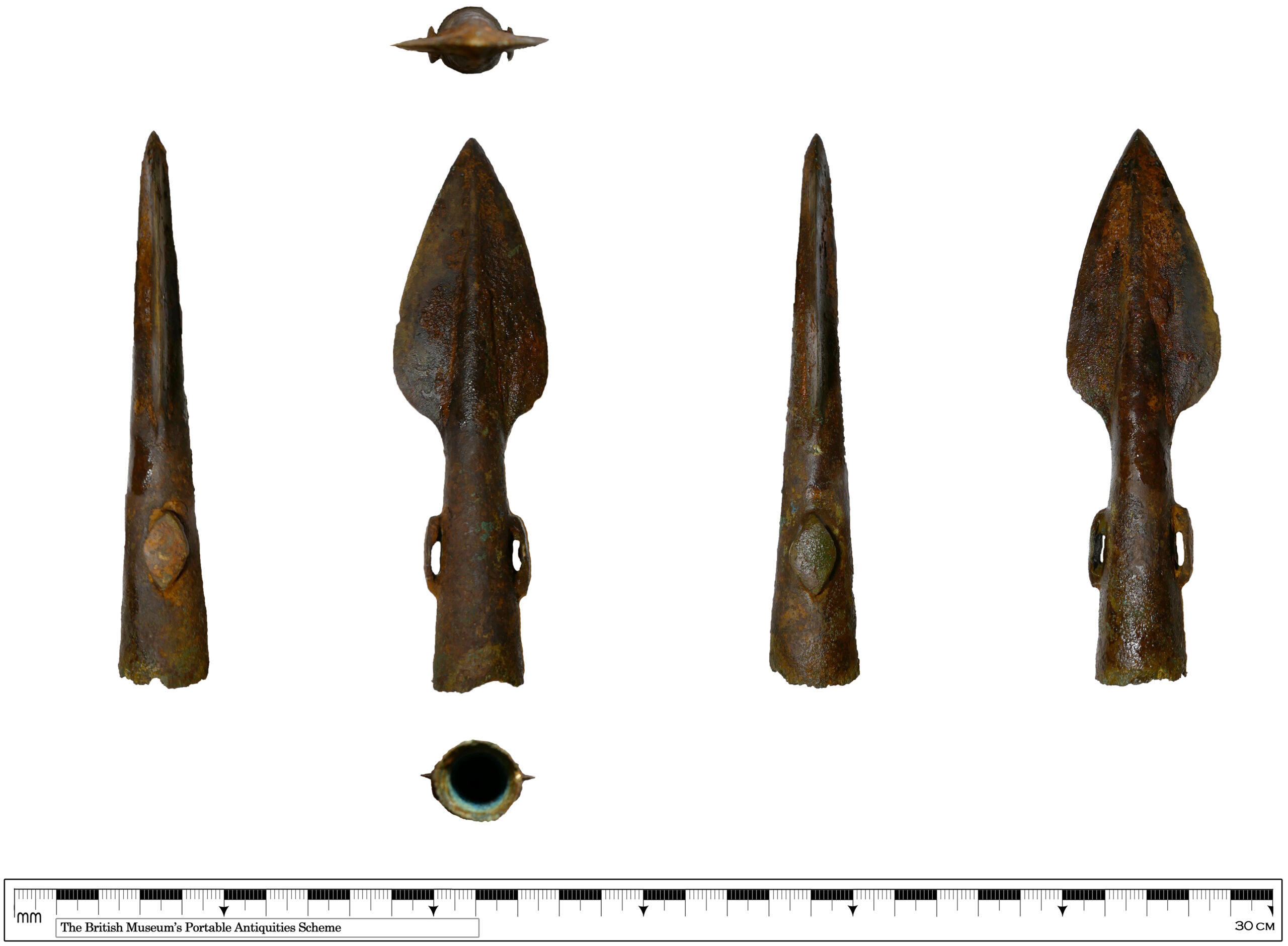
Museums Worcestershire has acquired a pair of Bronze Age weapons for the county’s collection. The spearhead and knife were discovered by a metal detectorist in June of 2021 and reported to the Portable Antiquities Scheme. They were later declared legal treasure under the Treasure Act, which gave the museum the opportunity to acquire the objects for the amount their assessed value. Museums Worcestershire snapped them up.
The spearhead is the older of the two, dating to 1550-1250 B.C. It is five inches long with an elliptical blade with a tapering rib and two side loops on the socket. The knife dates to ca. 1000-800 B.C. It is four inches long and has a leaf-shaped blade with a mid-rib down the length.
The spearhead and knife were found in relatively close proximity — about 55 feet away from each other — but may not have been buried together in a single event. They were in a layer of wet clay close to a spring or other water source. Bronze Age peoples often left artifact deposits in watery natural places (rivers, bogs, lakes, etc.), and might leave these offerings over a period of a time, so you find several objects that are clustered in one spot but were not all deposited ate once.
A Bronze Age barrow containing the cinerary remains of at least eight people buried in a single event between 1439-1287 B.C. was found in southwest Scotland. Five urns were buried packed tightly inside a pit, indicating it was a single mass burial, perhaps of a family group.
The barrow was discovered in an archaeological investigation during the construction of a new access route to Twentyshilling Wind Farm. In a pit in the center of a ring ditch were five urns in fragments. The burial pit and urns contain fill with a mixture of alder, birch and hazel charcoal. Some hazel nutshells were also recovered from the pit and the urns. The different woods, nutshells and grains suggest the cremation pyres were built with a variety of local woods and that the ritual may have included food offerings on the pyres.
One urn, which survived in 54 sherds, contained the cinerary remains of one adult and an animal. The second urn, composed of 245 sherds, contained the cremated bones of one adult and one adolescent. The third, consisting of 200 sherds, also contained the remains of an adult and a juvenile. The fourth urn, surviving in 350 sherds, contained the cinerary remains of one adult, plus grains of emmer wheat and barley. The most damaged vessel consisted of only 30 sherds in poor condition, but the fill was still packed in the space well enough to identify the remains of one adult, one juvenile, plus willow charcoal and a grain of barley. Additional human remains were found when the fill of the burial pit was sieved.
The ring ditch also contained a mixed assemblage of alder, birch and hazel wood charcoal with traces of hazel nutshell. Moderate size stones on top of the fill are believe to be the remains of cairn erected over the burial pit.
This is an unusual cremation burial for the period and location, and contributes new information on the Bronze Age funerary practices in southwestern Scotland.
The bodies of the deceased at Twentyshilling had not been left out for a lengthy period of time to partially decay, as is common in other barrows. This also indicates that they were interred at once, rather than over a longer period of time. At Broughton in the Scottish Borders, another barrow GUARD Archaeologists have excavated in recent years, the bodies of the deceased had all been exposed for a long time prior to cremation indicating an extended period of time between death and interment. And at Broughton as in many other Bronze Age barrows in Scotland, the burials were inserted over a protracted period, not all at once.
This was not apparent at Twentyshilling, perhaps because the local community here had less time to perform the burial rituals. The Bronze Age in Dumfries and Galloway may have been a time of particular stress as other burials, such as at Blairbuy in the Machars show evidence of famine and abandonment.
Historically, Romani Gypsies lived nomadic lifestyles, moving from place to place for cultural and economic reasons. As such, it can be challenging to spot physical remnants of Romani Gypsy heritage.
However, the influence of Romani Gypsy presence can be seen all around England. There are street names like ‘Gypsy/Gipsy Lane’, revealing where Romani Gypsies would have once used as traditional stopping places. Similarly, many permanent Traveller sites are built at locations where Romani Gypsies have already been returning to for generations.
‘Gypsy Graves’ are often recorded on historic maps, many by famed Sutton Hoo archaeologist Basil Brown. They can often be found at the crossroads of fields, and their history and origin are largely unknown. Modern Romani graves are easier to spot in cemeteries for their ornately decorated and immaculately kept headstones.
Additionally, there are the remains of compounds where Romani Gypsies were made to live in the New Forest. Memorials across the country at places like Birmingham’s Black Patch and Wardley Street in London commemorate the Romani populations of those areas.
Romani Gypsies are often incorporated under the umbrella term ‘Gypsy, Roma, and Travellers’, which includes many different and distinct groups, celebrated in June as part of ‘GRT History Month’. These include Irish Travellers, Scottish Gypsy/Travellers, Romani Gypsies, Roma, Show People, Boaters, and New Travellers.
‘GRT History Month’ began in 2008 and recognises the contributions of these distinct communities and ethnic groups “through celebration, education and raising awareness, [helping to] tackle prejudice, change the story, and amplify the voices of Gypsies, Roma and Travellers in wider society” – Friends, Families and Travellers.
It is important to note that whilst most of these groups share characteristics, such as their own or their ancestors’ nomadic lifestyle, areas of work and the importance of community and family network, they are separate groups who experience life and society in distinct ways.
Romani Gypsies are part of the wider Roma ethnicity. Over 12 million Roma are spread globally, amounting to Europe’s most significant ethnic minority.
Many British Romani Gypsies use the spelling Romany and are also known as Romanichal (part of the broader Roma ethnicity). We have chosen to use the more widely used global spelling of Romani in this blog to capture the history of this ethnic group throughout English history. However, both spellings are representative of many people mentioned here.
While the term Gypsy is viewed by many Roma across the world as an offensive term, in Britain, many Romani communities have reclaimed the word as a source of pride and identity.
View across the River Avon at Evesham, Worcestershire, towards the Bell Tower, with traditional horse-drawn wagons in the foreground. Source: Historic England Archive. View image OP08632.
When did Romani Gypsies arrive in England?
Romani Gypsies, believed to have originated in the north-western reaches of Rajasthan, embarked on a journey from India over 1,500 years ago and eventually arrived in Europe some 900 years ago. The first recorded Romani person in England dates back to 1512.
When Romani Gypsies arrived on English shores, the settled population assumed they had come from Egypt and referred to them as ‘Egyptians’. This eventually morphed into ‘Gypsy’.
A portrait of ‘Gypsy Smith’, Henley-On-Thames, Oxfordshire. Source: Historic England Archive. View image HT13656.
Pushed out and persecuted, Romani communities often existed on the outskirts of towns and the peripherals of society. In response, they created economic opportunities for which they became known, many involving moving from place to place, including fruit and hop picking, farm work, horse trading, and the skilled craftsmanship of carving pegs and weaving baskets.
Romani Gypsies also created practices viewed by those outside the community as mysterious and fascinating, such as fortune telling and tarot reading. These trades and art forms created economic opportunities and allowed for a sense of autonomy and protection in countries that punished their way of life.
The legal prosecution of Romani Gypsies in England began soon after their arrival, with the passing of the Egyptians Act in 1530. This law banned immigration and required Romani to ‘voluntarily’ leave the country within 16 days.
Only a few decades later, Queen Mary I made it a further crime to be a Romanichal Gypsy, punishable by death. The last Romani Gypsies to be hanged took place in 1658 in Bury St Edmunds, where 13 were executed, though the Act was not repealed until as late as 1856.
In the mid-17th century, Romani people in England began to be sold as slaves and deported to colonies like North America and the Caribbean.
Many Romani settled in the New Forest during this time, drawn to its wild beauty, fresh springs, and wildlife. However, in 1926, the Forest Commission introduced a compound system to corral the New Forest Gypsies into official enclosures, ending a centuries-old roaming lifestyle. The largest compound housed 400 residents at a time, remnants of which can still be seen today.
Where do Romani live now?
Around 200,000 Romanichal live in all corners of the United Kingdom today. Some have settled into permanent housing or caravan sites, while others still live nomadically.
Over time, traditional nomadism has become more challenging for Romani Gypsies and Irish Travellers. Between 1986 and 1993, roughly two-thirds of traditional Traveller sites, some of which had been used for centuries, were blocked and closed.
Then, the 1994 Criminal Justice Act repealed the duty of local government to provide alternative sites and removed the grant aid funding these sites. Therefore, there is a long waiting list for GRT communities to have access to official pitches and authorised sites.
During their travels, a unique culture formed that links Romani people worldwide despite living in vastly different countries. Nomadism, language, dress, marriage, religion, food, and music are just some of the cultural traits shared by Romani communities throughout the globe.
Additionally, iconic cultural art forms such as flamenco were created by Roma people. In response to their oppression, they used their musical heritage and elements from Spanish culture to develop the dance.
The music genre Gypsy Jazz was created by Roma guitarist Django Reinhardt, who has been cited as a defining influence by musicians like Willie Nelson and Black Sabbath’s Tony Iommi.
Many Romani people have fought for their country across the First and Second World Wars, including Jack Cunningham, who was awarded the Victoria Cross during the Battle of the Somme in 1916.
In England, Charlie Chaplin, one of the country’s most iconic entertainers, had Romani heritage, and many historians and his family have investigated the possibility that he was born at a Romani camp in Black Patch Park, Smethwick.
Other well-known Romani figures include artist Tracey Emin, actor Bob Hoskins, and boxers Dick Turpin and Johnny Frankham (the latter famed for knocking Muhammad Ali to the floor in an exhibition match). There’s also James Squire (who after being shipped to Australia became a renowned beer brewer and whose son became the Premier of New South Wales), Led Zeppelin’s Robert Plant, archaeologist and author John-Henry Phillips, writer Lady Eleanor Smith, and many more across all walks of life and culture.
The longevity of Romani Gypsies in England can be seen in how many words commonly used in the English language have potential Romani origins, like ‘posh’, ‘pal’, ‘drag’, ‘kosh’, and ‘chav’.
Some rare physical Romani heritage is protected. For example, the Joules family, a group of mid-19th-century Romani Gypsies well known around the Yatton area of Somerset, are referred to in the 1922 Somerset Yearbook as ‘the celebrated Somersetshire gypsies’.
Approximately 13 members of the family are known to be buried within the churchyard of the Grade I listed Church of St Mary. The monuments themselves are now Grade II protected.
When you take the time to look, it’s clear that Romani heritage influences many aspects of daily art and culture. It’s no surprise when a community has been in a country for as long as Romani Gypsies have in England.
Rose Sidgwick may have died of Spanish Influenza at just 41 years old, but she made pioneering contributions to the fields of history and international feminism. Here, we unpick her legacy.
Nestled in a picturesque garden behind the University of Birmingham Business School, there’s an ornate birdbath carved from stone. Look closely, and you’ll find a memorial inscription dedicated to a forgotten feminist pioneer, Rose Sidgwick.
Rose Sidgwick Memorial Birdbath. Source: Research and Cultural Collections, University of Birmingham.
When Mo Moulton, a Professor of History at the university, first learned about Rose Sidgwick through their research on detective novelist Dorothy L Sayers, the birdbath was hidden away in storage.
Now, it’s an essential stop on Moulton’s tour – “a walk through queer history” – which offers more insight into Sidgwick’s life, work and close relationship with fellow trailblazer Margery Fry.
Rose was born to a family of scholars. Her father, Arthur Sidgwick, an acclaimed researcher of Greek history, used his findings to draw modern conclusions on gender.
He was an early advocate for women’s rights, particularly in education. When Rose was born in 1877, she wasted no time following in his footsteps, first attending Oxford High School for Girls and later reading history as an Oxford Home student.
In 1904, at Somerville College, Rose first crossed paths with Margery Fry, a mathematics student and librarian. Both women held socialist values and a desire to champion marginalised communities.
In ‘Writings’, a 1908 pamphlet of Rose’s work available at Birmingham’s Cadbury Research Library, there’s a brief poem named ‘Tongues in the Tree’, a moral allegory which nods to the values of empathy and solidarity:
Don’t judge the folk in whose wood you walk Till you perfectly understand their talk
‘Tongues in the Tree’, from Rose Sidgwick’s 1908 pamphlet ‘Writings’
When Fry moved to the University of Birmingham in 1904 to take on a role as Warden of the women’s residence, Sidgwick decided to go with her.
Before long, Sidgwick earned her place as the first woman to lecture on history at the hallowed institution, and she moved into the women’s residence as a result.
Great Hall and Quadrant Range, formerly listed as Birmingham University. Contributed to the Missing Pieces Project by Tom Axford. View List entry 1076133.
This was a fascinating period in feminist history, the era of the so-called ‘New Woman.’ Higher education was gradually opening up to women, but many had to make sacrifices to succeed, and these opportunities were contingent on factors like race and class.
Yet, especially in women’s history, the term ‘spinster’ rarely tells a complete story. In the Margery Fry archive at Somerville College, there are huge stacks of letters and poems written by Rose Sidgwick, some of which make playful requests for confidentiality.
Moulton recalls one particular letter. There’s a message on the envelope: “For heaven’s sake, don’t leave this lying around!
“There’s a concern around who will see the letters, whether they should be burned,” says Moulton.
Margery Fry and Elizabeth Nuffield House, Somerville College, University Of Oxford. View image DP195314.
There’s more than a decade’s worth of letters exchanged between them, which nod towards a loving, intimate and sensual relationship. In one letter, Sidgwick writes about swimming naked in the sea, teasing Fry by saying, “Wouldn’t you have liked to see?”
Reframing histories through a queer lens is always challenging; after all, there’s no guarantee that past pioneers would have welcomed or embraced terms like ‘lesbian’, ‘bisexual’ or ‘gender non-conforming’ even if they’d had them. Yet Fry and Sidgwick worked tirelessly to create a sense of community for the university’s female students, creating intimate networks of outsiders.
Moulton recalls being moved by the words of scholar Sam Rutherford, a speaker at one of the queer history walks, who described the women’s residence as a queer kinship, a family setting or a way of life.
“We don’t have to reduce queerness to what people did in bed,“ says Moulton. “It’s a whole alternative way of building communities and relationships; I really like that as a reframing of what we’re looking for when we’re trying to recover queer histories.”
Mo Moulton, Professor of History at Birmingham University
Portrait of Rose Sidgwick, 1918. Source: Cadbury Research Library: Special Collections, University of Birmingham.
During the First World War, Fry travelled to France as part of her involvement with the Friends’ War Victims Relief, where she played a crucial role in nursing war victims to health and aiding vital relief efforts. Sidgwick’s letters become understandably melancholy during the war, fraught with a sense of longing and panic that Fry wouldn’t survive.
In late 1918, Sidgwick undertook a mission of her own. As part of an international feminist network, she travelled to New York, where she gave a memorable speech at the Women’s University Club.
Not only did she advocate for the inclusion of women in higher education, she cited a desire to see “the easy access of college to those who cannot afford to pay for it.”
During this visit to the United States, Sidgwick held discussions with British and North American academics to establish the International Federation of University Women (now named the Graduate Women International), which advocates women’s rights and access to secondary and tertiary education.
Tragically, Sidgwick contracted influenza on her travels. On 28 December 1918, she succumbed to the lethal virus.
Another remaining trace of Sidgwick at the university is her inclusion on a First World War memorial dedicated to “the sons of the university who gave their lives during the Great War.”
Upon closer inspection, a small handful of women are listed on the memorial. “I think it ties into how different roles and actions were gendered by society,” theorises Moulton.
“In going to the US and representing Britain on this educational mission, [Sidgwick] was serving her country. To die in that effort meant that she had died for her country, just like the soldiers.”
One heartbreaking detail revealed in the Margery Fry archives is that she was never notified of Sidgwick’s illness. In Fry’s words, she never had the chance to send a last telegram, to write of her great love for Sidgwick once more before her death.
Rose Sidgwick Memorial Birdbath. Source: Research and Cultural Collections, University of Birmingham.
Margery Fry commissioned the memorial birdbath, a sentimental decision made to honour Sidgwick’s love of nature, of birds in particular. Fry moved to London after returning from France, leaving Birmingham and the university behind to focus on prison reform.
In the early 1920s, she became one of the country’s first female magistrates, spoke out against the death penalty and took a role as an educational advisor at Holloway Prison.
Yet, as her life in Birmingham faded to a distant memory, she continued to send annual cheques for the upkeep of the memorial birdbath. “It feels like an alternate burial site,” says Moulton, who continues the queer walking tour in hopes of preserving Sidgwick’s distinctly feminist legacy.
About the author Jake Hall is a freelance journalist and author living in Sheffield, England. Jake’s first book, ‘The Art of Drag’,was an illustrated deep dive into the history of drag, published by NoBrow Press in 2020. Their upcoming book, ‘Shoulder to Shoulder’, is a history of queer solidarity movements over the last six decades; it’s scheduled to be published in May 2024 by Trapeze Books.
For years, Jake has been fascinated by everything from queer culture and histories to fashion, film and climate activism, and they’ve written for publications ranging from Dazed Digital and The Independent to Refinery29 and Cosmopolitan. They’re also a keen book fan and reviewer, publishing regular reviews on their Instagram.
Gwenda’s Garage was founded in 1985 in Sheffield, South Yorkshire, by 3 women mechanics: Ros Wollen (aka Roz), Annette Williams, and Ros Wall.
Faced with difficulty finding employment in a male-dominated field, they established their own repair workshop.
Women mechanics in 1980s Sheffield
In the mid-1980s, unemployment in England was high, and government training schemes were popular. After excelling in the TOPS motor vehicle training courses, Roz and Annette were eager to start their careers as mechanics.
Their friend, Ros, wasn’t a fan of formal training but was already a skilled mechanic. As a child, she learned about bicycles, motorbikes, and cars from her father and spent many enjoyable hours working on bike engines.
Roz and Annette volunteered in Leeds at Spanners, a radical female-run garage, gaining experience and learning from the renowned feminist Connie O’Donovan. Despite their efforts, finding jobs proved difficult.
Soon, the idea of starting their own garage began to take shape.
Gwenda’s Garage
Gwenda’s Garage opened in May 1985. It was named in honour of Gwenda Stewart (1894 to 1990), a racing driver who set multiple motorcycle and motor car records in the 1920s and 1930s.
The garage offered typical services like repairs, servicing, breakdown assistance, welding, and bodywork. However, Ros, Roz, and Annette focused equally on empowering women.
They provided DIY car maintenance classes, advice on buying second-hand cars, and information on adapting vehicles for disabled drivers.
Inspired by their impact, Ros helped set up a motor vehicle workshop with the Nottingham Women’s Training Scheme. Annette started part-time vehicle repairs training for women at Bradford College.
Women in Engineering, Science and Technology
In 1989, the garage faced a turning point. The women concluded they could reach more people through teaching and other roles.
Gwenda’s Garage was sold in 1990, the same year Gwenda Stewart passed away.
Annette developed the ‘Let’s TWIST’ (Train Women in Science and Technology) program at Bradford College in partnership with Ros at the Nottingham Women’s Training Scheme and Sheffield Hallam University.
‘Let’s TWIST’ challenged sexist attitudes prevalent in vocational training at the time and significantly impacted mainstream education.
Ros also initiated a Women in the Built Environment course at Sheffield Hallam University. Together, they founded the UKRC, a national resource centre for women in science and engineering.
Roz became the AA’s only female patrol person in northern England, breaking gender stereotypes during their ‘I Know a Man Who Can’ ad campaign.
She later taught at Sheffield College and helped establish the South Yorkshire Women’s Development Trust, ultimately managing the Women’s Construction Centre in Sheffield.
Roz co-founded the WEST (Women in Engineering, Science, and Technology) bursary fund in memory of Ros, who died in 2010. WEST has provided grants to young women entering male-dominated fields.
Gwenda’s Garage: The Musical
In 2023, Historic England funded Out of the Archive to produce a script-in-hand musical telling the story of Gwenda’s Garage as part of the Everyday Heritage Grants scheme celebrating working-class histories.
Bev (played by Nancy Brabin-Platt), Dipstick (played by Lucy Mackay) and Newbie (played by Georgina Coram).
In November 2023, 2 performances of Gwenda’s Garage were held at the Tanya Moiseiwitsch Playhouse, Sheffield Theatres. The shows sold out immediately and received exceptional audience responses.
Alongside the production, Out of the Archive created an exhibition and a public workshop to memorialise Gwenda’s Garage, coinciding with the 20th anniversary of the repeal of Section 28 in England. 130,000 people saw the exhibition.
Terry (played by Elena Vincent) and Newbie (played by Georgina Coram).
Founded in 2019 by Nicky Hallett and Val Regan, Out of the Archive is a collaborative project involving writers, musicians, performers, and academics.
Its mission is to bring archival material about LGBTQ+ lives to life, highlighting hidden histories and making them relevant to contemporary audiences.
Many monarchs have been crowned King or Queen of England over the centuries. But who is regarded as the very first King of England?
King Athelstan (reigned AD 924 to 939)
Athelstan (or Æthelstan) is considered by many as the first king to rule over the whole of England.
Born around AD 895, he was the grandson of Alfred the Great and the son of Edward the Elder and Ecgwynn.
King Athelstan presenting a book to Saint Cuthbert from Bede’s ‘Life of St Cuthbert’. This is considered the earliest surviving portrait of an English king. Source: Public Domain.
The monk and 12th century historian William of Malmesbury wrote that from a young age, Athelstan was favoured by Alfred the Great. He was honoured with a ceremony where he was presented with a cloak and a sword with a golden scabbard.
Some historians have suggested that this could have been a political symbol from Alfred, acknowledging Athelstan as his favoured future heir.
Before the Viking invasions, Anglo-Saxon England was divided into a changing number of kingdoms of varying size and importance. This had developed during Alfred the Great’s reign, so he ruled over some of them (including Wessex, West Mercia and Kent), while the Vikings controlled the north, the east midlands and the east, later known as ‘the Danelaw’.
Athelstan likely lived with his aunt, Aethelflaed, in the Kingdom of Mercia in his youth, where he received a princely education and military training.
A map of England, Wales and Scotland, showing the different kingdoms and prominent towns in the 10th century. Source: Ikonact / Creative Commons.
Following the death of Edward the Elder in AD 924, the Kingdom of the Anglo-Saxons was split between Athelstan and his brother, Alfweard. Athelstan became the King of Mercia, while Alfweard briefly became King of Wessex but died a few weeks after his father.
It was not unusual at the time for siblings to rule over different Anglo-Saxon kingdoms in order for the governing family to maintain control over large areas of land.
Consequently, Athelstan then inherited the title of King of Wessex and united the 2 areas again to make the Kingdom of the Anglo-Saxons.
Where was the first King of England crowned?
Athelstan’s coronation took place in Kingston upon Thames on 4 September AD 925. Some have suggested that this location was strategically selected as it was close to the border of the kingdoms of Wessex and Mercia.
He is said to have been the first king to wear a crown, rather than a helmet, for his coronation.
The Coronation Stone (or King’s Stone) still standing in Kingston upon Thames is an ancient sarsen stone said to have been used for the coronation of 7 Anglo-Saxon kings in the 10th century. Local legend says that Athelstan and other kings were seated upon a stone within a timber church during the ceremony.
How did Athelstan become King of England?
Athelstan was a strong military leader. Following his succession to the Kingdoms of Wessex and Mercia, he worked quickly to unite all the areas of England.
A stained glass window in All Souls College Chapel, Oxford, showing King Athelstan, dating from the 15th century. Source: Public Domain. View List entry 1046755.
In AD 927, Athelstan quashed a rebellion in Cornwall, took control of York from the Danes, and seized most of Northumbria. He secured annual payments from the 5 Welsh kings, and the King of Scotland, Constantine II, was forced to swear his allegiance.
In AD 937, Athelstan faced invasion from the forces of Olaf Guthfrithson, King of Dublin, Constantine II, and Owain, King of Strathclyde. This resulted in the Battle of Brunanburh in the north of England, where Athelstan’s troops overwhelmed the opposition and secured his position as King of England.
What was Athelstan like as a King?
Sources on Athelstan’s life and reign are limited. The 12th century historian William of Malmesbury provides a lot of information about Athelstan. However, some modern historians are wary of trusting his accounts fully as many of his original sources may have been lost or cannot be verified.
During his reign, Athelstan’s codes of law (a collection of statutes) were built on the ones his grandfather, Alfred the Great, had established. He worked to implement them across his large kingdom to demonstrate his authority as king, insisting that local officials follow the law.
Athelstan was keen to reduce robberies in local areas and wanted to have the death penalty more strictly applied. However, he changed the law to raise the minimum age and increase the value of goods that had to be stolen for this to be applied (from 12 years old and over 8 pennies in value to 15 years old and 12 pennies worth).
Athelstan advocated the establishment of burhs (an Anglo-Saxon fortification) where trade could be centred, encouraging the buying and selling of goods in local areas and establishing what later would become market towns.
He issued guidelines for the minting of coinage across the different areas of his kingdom, and strict penalties were given for anyone defrauding the Crown. His coinage from AD 933 to 938 shows the first Anglo-Saxon king wearing a crown.
Athelstan also stamped his coins and charters with ‘Rex Totius Britanniae’, asserting himself as the ‘King of Britons’.
A silver penny of King Athelstan, possibly from a mint in Norwich, showing him wearing a crown. Source: The Portable Antiquities Scheme / The Trustees of the British Museum.
Athelstan gained strategic foreign alliances throughout his reign by marrying several of his half-sisters to different European rulers.
As well as being an experienced soldier, Athelstan was a pious man who founded numerous churches and bestowed land, relics and holy books to religious bodies. He also issued the translation of the Bible into Anglo-Saxon and championed ecclesiastical scholarship.
Where was Athelstan buried?
After 14 years of rule, Athelstan died on 27 October 939 in Gloucester. As per his instructions for his funeral, his body was then moved to Malmesbury to be buried.
William of Malmesbury believed that Athelstan selected Malmesbury as his final resting place due to his piety and devotion to Saint Aldhelm, his distant relative and the Abbot of Malmesbury Abbey in the 7th century.
Athelstan may have also selected the town because it was on the border of Wessex and Mercia, making this a political statement that he was king of the West Saxons, the Mercians, and all of England.
Where exactly Athelstan is buried in Malmesbury is a mystery. He was buried in the abbey grounds, but 200 years later, his body was disturbed when the abbey church was rebuilt.
The tomb of King Athelstan in Malmesbury Abbey, Wiltshire. Source: Public Domain.
William of Malmesbury witnessed the removal of Athelstan’s body at the time. He noted that “the king was not above the average height, slim in build with fair hair as I have seen for myself in his remains, beautifully intertwined with golden threads”.
During the abbey’s rebuilding, the details of where the king’s remains were reburied were lost. The tomb we see today in the abbey dates back to the late 14th or 15th century.
Athelstan never married or had any known heirs, so he was succeeded by his half-brother, Edmund I.
England has a long and complex military history, from Roman battles and the English Civil War to threats of invasion during the Napoleonic and First and Second World Wars.
A new book, ‘England’s Military Heritage from the Air‘, tells the story of England’s rich heritage from thousands of years of conflict using 150 photographs from the Aerofilms Collection.
Aerofilms Ltd was founded in 1919 to provide commercial aerial photographs. While flying between targets, the aircraft passed over numerous historic sites of interest, from prehistoric earthworks to 20th-century battleships.
The Aerofilms Collection features sites from across the country, including many on the east and south coasts that have been on the frontline of invasion threats for centuries.
Here, explore some of these important historic locations from a bird’s-eye view.
Maiden Castle Iron Age hillfort, Dorset
The first sites connected with warfare in the collection are the ‘causewayed enclosures’ constructed around 3600 BC, several of which display evidence of mass armed conflict.
The Late Bronze Age (around 1000 BC) saw the construction of massively defended enclosures, while the succeeding Iron Age is noted particularly for its hillforts.
The fact that so many Iron Age hillforts have the word ‘castle’ in their names shows that these sites have long been associated with defence and warfare. Looking at the massive ramparts of a site like Maiden Castle, it is easy to see why.
Aerial photographs do not do justice to the sheer scale of these earthworks. Sites like this need to be visited on the ground to appreciate their size. Maiden Castle is over 1 kilometre long, and its ramparts are over 15 metres high.
Built between 800 and 400 BC, hundreds of people lived on this enormous hillfort during the Iron Age.
Britain’s first truly ‘military’ events were the brief incursions of Julius Caesar’s expeditionary forces in 55 and 54 BC. However, it was not until AD 43 that the Roman army occupied Britain.
Portchester Castle and Roman fort, Hampshire
The fort at Portus Adurni (Portchester) lies at the head of Portsmouth Harbour. The fort was built in the 3rd century by the Romans before being transformed by the Saxons and later the Normans into a castle.
It was an important location for monarchs and dignitaries to cross the English Channel.
Its fascinating history includes being a Roman fortress, a Norman tower, and then becoming a prisoner of war camp during the Napoleonic Wars. The castle remained part of England’s coastal defences under the Tudor monarchs, and a large military storehouse was built within the walls in the 16th century.
The retreat of Rome from Britain in the 5th century prompted a series of invasions, leading to the re-fortification of prehistoric hillforts and Roman forts and the establishment of massive frontier earthworks.
At the end of the 8th century, Viking raiders from Scandinavia first landed and later began to settle in the north of England. Fighting intensified, leading to the construction of new fortifications, including the ‘burhs’ of Wessex.
These fortified towns were built to resist the great Viking armies that ravaged England throughout the 10th century.
Bamburgh Castle, Northumberland
The Normans’ victory at the Battle of Hastings in 1066 led to the most significant transformation of England’s military infrastructure.
Following his victory at Hastings, William the Conqueror worked quickly to quash rebellions against Norman rule and establish his control over different areas of England.
Castles began to be constructed wherever the conquering forces were extending their control. At first, these might be motte-and-bailey or ‘ringwork’ castles with timber towers and palisades, but as resistance declined, larger, stronger stone castles began to be erected.
By the end of the 12th century, a network of fortifications acted as the military and administrative powerbase for Norman lords.
There was a need for castles to secure the north of England, which was particularly important for areas close to the border with Scotland. The large crag at Bamburgh was a natural fortification location and appears to have been in use at least since the 5th century.
By the 10th century, it had become the headquarters of the earls of Northumbria. In 1095, William II took the castle from Robert Mowbray, Earl of Northumberland.
Fear of attack by the Scots led to regular investment in repairs through the remainder of the 14th and 15th centuries. The castle also played an important part in the struggle between the Houses of Lancaster and York during the Wars of the Roses (1455 to 1485).
Stokesay Castle, Shropshire
The Middle Ages saw several bloody conflicts concerning the succession to the English throne and attempts by the barons to restrict the monarch’s powers.
Anglo-Norman incursions into Wales culminated in Edward I’s conquest of the principality and his creation of a series of unparalleled concentric castles to control the north of the country.
By the 13th century, fortified manor houses were also being constructed by wealthy families and nobles. Stokesay Castle was built by Lawrence of Ludlow, a successful wool merchant, as a fashionable home.
Despite being a castle, its design meant it would not have been able to withstand a strong military threat. Instead, the castle was used to display Laurence’s wealth and status.
Walmer Artillery Castle and Gardens, Kent
In the 16th century, artillery castles and smaller blockhouses with a few cannons began to be constructed using money raised from the Dissolution of the Monasteries following Henry VIII’s break with Rome.
In response to the perceived threats of invasion from Europe, the first comprehensive defence plan for the country, known as The Device, created fortifications around much of the English coastline.
Henry VIII demanded that Walmer Castle be built in 1539 to form part of the defensive line.
The castle never faced an invasion during Henry’s reign. However, it was seized by Parliamentarian forces during the English Civil Wars in the 17th century.
Cromwell’s Castle, Isle of Scilly
The English Civil War (1642 to 1651) saw skirmishes, battles and sieges of houses, castles, towns and cities across the country. It also saw the creation of many fortifications.
At first, the Royalists were successful, but radical reform of Parliament’s troops created the New Model Army, which eventually won a decisive victory. King Charles I was executed in 1649, and a Republic was instituted under Oliver Cromwell as Lord Protector.
Perhaps the greatest weakness of the Royalists throughout the Civil Wars was the loss of the Navy, which had been loyal to Parliament from the outset. For overseas communications, transport and seaborne operations, the Royalists relied on privateers sailing out of smaller ports and anchorages, such as the Isles of Scilly.
Cromwell’s Castle is a formidable artillery tower standing on a rock outcrop at the mouth of New Grimsby Harbour on Tresco. As a result of increasing tensions with the Dutch and Royalist privateers based on the islands, the fortification is thought to have been built in 1651 so Parliament could guard one of the main routes into the centre of the islands.
The French Revolution in 1789 and the subsequent Revolutionary and Napoleonic Wars between Britain with her allies and France brought conflict close to home.
Soon after becoming Emperor in 1803, Napoleon Bonaparte threatened to invade England. Defences, including a series of Martello towers, were built to protect the south-east of England.
Shipbuilding was necessary to prepare the Navy for potential threats across the Channel. HMS Victory was launched in 1765 and had a long career, serving several admirals, most famously Horatio Nelson.
On 21 October 1805, HMS Victory led the British fleet to a decisive victory over the French and Spanish fleets off Cape Trafalgar.
National Projectile Factory, Hackney, Greater London
The First World War (1914 to 1918) was the first major industrial war in which Britain was involved, and although most of the fighting took place in Europe, much of the supporting infrastructure of the war was at home.
There was a huge increase in demand for all sorts of products, such as uniforms, boots, vehicles, ammunition and equipment. As artillery dominated the battlefields of the Western Front, the demand for shells escalated significantly.
The National Projectile Factory on Hackney Marshes was built in 1915 and was managed for the Ministry of Munitions by Dick Kerr & Co Ltd.
From 1916, the factory produced high-explosive shells, employing over 3,000 men and 1,500 women.
The Air Forces Memorial, Runnymede, Surrey
Britain is home to a remarkable array of war memorials marking the large numbers of military personnel and civilians who lost their lives during the First and Second World Wars.
During the Second World War, the Allied air forces were often on the frontline and sustained heavy losses. Therefore, a new Air Forces Memorial was constructed at Runnymede with views over the site where the Magna Carta was sealed in 1215, recognising their role in securing Britain’s and Western Europe’s liberty.
The names of 20,456 personnel of the Allied Air Forces who lost their lives during the Second World War and have no known grave are inscribed on this monument.
Constructed in the early 1950s, it was designed by Sir Edward Maufe (1882 to 1974), principal architect for the Imperial War Graves Commission, who was knighted the year after its completion.
About the authors Allan Brodie is an architectural historian and historian who has researched everything from Roman forts to 20th century airports. His main interests are the history of tourism, prisons and law courts, and medieval architecture and sculpture.
Mark Bowden is a landscape archaeologist with a special interest in hillforts and castles and has published widely on these and related topics. He has also undertaken research in naval history.
The Mermaid was a large, dilapidated pub in Sparkhill, a working-class neighbourhood 3 miles south of Birmingham city centre.
A microcosm of Birmingham, Sparkhill has been shaped by Irish and South Asian immigration and was where pub landlords welcomed teenagers to play weirdo music in the upstairs room.
Sparkhill’s a very working-class area. It seemed like a bit of a natural home for us. Being punks, we weren’t welcome pretty much anywhere.
Matthew Knight, Mermaid regular
Grindcore at the Mermaid
The Mermaid’s live music scene in the 1980s was typified by anarcho-punk, hippies, and animal rights activism – not very heavy metal at first glance!
But the Mermaid was vital to the early days of the band Napalm Death and the creation of a new metal subgenre: Grindcore.
This metal-punk crossover Grindcore was steeped in a do-it-yourself (DIY) culture, typified by fanzines, hand-drawn leaflets, and bootleg cassettes.
The Mermaid appeared on dozens of these leaflets and zines, advertising all-day shows for free or as little as £1.
I think it was just very, very different to what people were used to who were from either like white working-class Irish backgrounds or white working class English or the Asian population. And they all just thought we were a bunch of freaks and didn’t know where we’d come from or what we were doing there.
Julie Barton, Mermaid regular
A hand-drawn flyer promoting music at the Mermaid in 1986. Source: Nicholas Bullen.
There was a lack of live music culture in Birmingham in the 1980s, and there weren’t many places where a band could reliably get regular gigs, develop its sound, experiment, and build a reputation. The Mermaid was a vital space for the underground music scene.
The Mermaid’s live music scene was characterised by a vibrant community of people who lived and breathed the politics of the anarcho-punk movement against the backdrop of Thatcherism, the miners’ strikes and the Cold War.
A flyer for music at the Mermaid pub in Birmingham in 1986. Source: Nicholas Bullen.
Regulars to the Mermaid speak of the impressive range of underground music showcased at the pub. Indie bands like Primal Scream, post-punk bands Au Pairs and World Domination Enterprises, experimental rock band Swans, early gigs for Chumbawumba, and even reggae and free festival dance music.
However, only Napalm Death could claim the ‘house band’ status at the Mermaid.
We did so many concerts there, sometimes 3 a week, that they were almost another level of rehearsal. So we became tighter and tighter and because we were doing something that very few groups were approaching at the time, that had extra power as well.
Nicholas Bullen, founding member of Napalm Death
Nicholas Bullen, Justin Broadrick and Miles Ratledge of Napalm Death at the Mermaid in the 1980s. Source: Nicholas Bullen.
The impact of this short-lived scene in the 1980s is still profoundly felt. People had found lifelong friends, and the music continued to send sonic shockwaves worldwide.
Today, Grindcore is a worldwide phenomenon. Napalm Death continue to be one of the biggest and most influential punk/metal bands of all time.
This was the magic. This was literally kids doing it for themselves. This was the real DIY. This was the real punk rock.
Justin Broadrick, member of Napalm Death and Godflesh
The Mermaid pub on Stratford Road, Birmingham, photographed between the 1950s and 60s. Source: Birmingham Live.
Birmingham: Home of Metal
Midlands-based music heritage project ‘Home of Metal‘ celebrates the music born from Birmingham’s metal-bashing industries: heavy metal.
Just as Manchester and Liverpool proudly celebrate their music history, Birmingham is beginning to own its metal heritage.
Home of Metal’s ‘Black Sabbath 50 Years’ exhibition at Birmingham Museum & Art Gallery in 2019. Source: Home of Metal.
Home of Metal’s first major exhibition in 2011 showcased important touchstones in local metal history, such as Black Sabbath and Judas Priest, just some of the bands that carved out what has come to typify the sound of heavy metal.
In 2019, the exhibition ‘Black Sabbath – 50 Years’ at Birmingham Museum & Art Gallery celebrated Black Sabbath from their fans’ perspective to show the band’s impact and cultural legacy.
The ‘At the Mermaid’ zine produced by Home of Metal with funding from our Everyday Heritage grant programme.
In 2023, Historic England funded Home of Metal to work with people who were part of the Mermaid scene in the 1980s as part of the Everyday Heritage grant programme, celebrating working-class histories.
The project gathered stories, ephemera, and memories from fans, musicians, and promoters to create a 4-part podcast and a zine publication.
This spirit of collaboration was important for the project, where a sense of community was strong.
An open event brought people together in panel and round-table discussions to pull out themes and questions important to those who remembered the Mermaid, some of whom hadn’t seen each other for many years.
Because if you were a fan of this music, you had to be at the Mermaid.
Sarah Lafford, Lead Researcher (top left) at Home of Metal, gathering memories of the Mermaid in a round-table discussion. Source: Home of Metal.
Written by Sarah Lafford, Lead Researcher at Home of Metal
Queen Elizabeth I was an unlikely queen. Although she was the daughter of Henry VIII and born a Tudor princess, she was declared illegitimate at just 2 years old following the execution of her mother, Anne Boleyn.
Following the birth of Henry’s son, the future Edward VI, in 1537, Henry now had the male heir he so longed for. Elizabeth was no longer in the line of succession, so her chances of ever becoming Queen of England were doubtful.
Following the reigns of her brother Edward VI, her cousin Lady Jane Grey, and her sister Mary I, Elizabeth took to the throne in 1558, aged 25. She inherited a country that faced complex religious and economic issues and difficult relations with foreign powers.
The only Queen of England to never marry, Elizabeth I dedicated her life’s service to her country and reigned for 45 years as the last and longest reigning Tudor monarch.
Discover the buildings around England connected to the ‘Virgin Queen’.
1. Greenwich Palace
Known then as the Palace of Placentia, Greenwich Palace was one of the most important residences in Tudor history. It was the birthplace of both Henry VIII and Elizabeth I, the latter of whom was born here on 7 September 1533.
Overlooking the River Thames, the palace held a desirable position close to the royal shipyards.Elizabeth particularly enjoyed the palace in the summer months, and it was from there that the queen saw the parade of ships after the defeat of the Spanish Armada in 1588.
The palace fell into disrepair during the English Civil War in the 17th century, and only a few archaeological remains are left of the site.
Hatfield House bore witness to many of Elizabeth’s defining moments in her life. She was first sent to the stately home when she was just 3 months old in December 1533, separating her from her mother, Anne Boleyn.
It was also where Elizabeth learnt the news of Mary I’s death in 1558 and that she was declared Queen of England. It is said she was sat beneath an oak tree in the grounds, and while the oak tree no longer exists, there is a new tree planted on the supposed spot.
Her first Council of State with her trusted advisers, such as William Cecil, took place in the Banqueting Hall of the Old Palace at Hatfield.
3. Chelsea Manor, London
The now-lost Chelsea Manor in London was bestowed to Katherine Parr, the final wife of Henry VIII, in 1544. Following Henry’s death in 1547, Katherine quickly married courtier Thomas Seymour. Elizabeth lived at Chelsea during Edward VI’s reign. This brought Seymour dangerously close to the young Elizabeth.
It is said that Seymour would pay Elizabeth unexpected visits to her bedchamber early in the morning, engaging in inappropriate behaviour with the princess and nearly compromising her reputation.
An illustration of the former Chelsea Manor, London. Source: Public Domain.
Elizabeth was ordered to leave Chelsea, and Katherine moved to Sudeley Castle in Gloucestershire, where she later died in 1548 from complications from childbirth.
The manor has long since been demolished, and the site is now covered by houses in Cheyne Walk in Chelsea.
4. The Charterhouse, London
The Charterhouse in London is one of only a handful of buildings that Elizabeth would still recognise in the capital.
After her sister, Mary I, died in 1558, Elizabeth made her way from Hatfield to the Charterhouse, making it her base before her coronation in 1559.
It was one of the most luxurious houses in the city, dating back to the 14th century, and she visited many times throughout her reign.
5. Hampton Court Palace, Richmond-upon-Thames, London
Elizabeth frequented Hampton Court Palace numerous times during her reign, but there was one visit that nearly took a tragic turn.
In October 1562, Elizabeth was staying at Hampton Court when she almost lost her life to smallpox, and there was real worry among court about who would inherit the throne if she died without a named heir.
The Pond Gardens, Hampton Court Palace, Richmond-upon-Thames, London. Contributed to the Missing Pieces Project by Dominic Martin. View List entry 1193127.
Elizabeth made a full recovery, and after a period of rest, she was able to return to her royal duties.
Elizabeth was known to love her morning walks in what is now known as the Pond Gardens at Hampton Court. It is said that she ordered the windows overlooking the gardens to be blocked out so she could walk secretly without being watched.
6. Abbey Gateway, Reading
As part of Henry VIII’s dissolution of the monasteries, hundreds of abbeys across England and Wales were closed, and much of Reading Abbey fell into disrepair.
This gateway in Reading then became the entrance to a Tudor palace. The Abbot’s House, which sat beyond the gateway, was saved and transformed into a royal palace by Elizabeth in the 1560s.
Although the palace is now lost, you can still see the gateway and the nearby St Laurence’s Church, where Elizabeth I worshipped. The church tower dates from 1458, while the gateway was remodelled by Sir George Gilbert Scott in 1861.
As summer weather made for better travel conditions, in the 16th century, monarchs would make royal progresses and travel around their kingdom to see their subjects.
Charlcote Park, Warwickshire. Contributed to the Missing Pieces Project by P Hampel. View List entry 1381799.
Situated between Stratford-upon-Avon and Warwick, Charlecote Park is a country manor first built in 1558 and is surrounded by a large deer park. Elizabeth visited here on progress in 1572 and 1575, staying in what is now known as the Drawing Room.
The porch was built for her arrival, which features her coat of arms below.
Elizabeth I’s Coat of Arms at Charlcote Park, Warwickshire. Contributed to the Missing Pieces Project by P Hampel. View List entry 1381799.
8. Kenilworth Castle, Warwickshire
The most famous event of Kenilworth Castle’s history was the 19-day lavish celebrations in 1575 put on by Elizabeth’s close friend and noble, Robert Dudley, to celebrate the queen’s visit.
This was the longest of all of her progress visits to a courtier. During the celebrations, there were fireworks, vast banquets and performances, all in a final attempt for Dudley to woo Elizabeth.
No expense was spared, and Dudley ordered the creation of Leicester’s Building within the castle grounds, which were extravagant apartments fit exclusively for the queen.
Elizabeth and Dudley’s relationship has been a subject of fascination for over 450 years. Dudley had real hope of marrying the queen, but she evaded his proposals.
Undoubtedly, they depended on each other, but Elizabeth swore till her dying day that nothing ever passed between them. There would be no scandalous relationship to tear away control of her kingdom.
9. Lord Leycester Hospital, Warwick
This hospital in Warwick was founded in 1571 by Robert Dudley. He was granted permission by the queen to found an almshouse for older soldiers, and the existing Guildhall buildings were incorporated.
Lord Leycester Hospital, Warwick, Warwickshire. Contributed to the Missing Pieces Project by Christopher John Photography. View List entry 1035441.
The soldiers were carefully and personally selected. Elizabeth sent a document from Greenwich Palace requesting a place at the hospital for Richard Deersham for ‘his faithful service in the wars where he received his many hurtes and maymes’.
The charity still supports veterans to this day.
10. Tilbury Fort, Essex
Henry VIII first constructed Tilbury Fort on the Thames Estuary to protect London against attack from France. But it was Elizabeth who reinforced the defences following the threat of a Spanish invasion in the 1580s.
When the Spanish Armada was launched by King Philip II of Spain in 1588, Elizabeth rallied her army at a nearby camp and supposedly gave her famous Tilbury speech.
Her words may have brought confidence to English troops. It was here that she may have said, “I know I have the body but of a weak and feeble women; but I have the heart and stomach of a King, and a King of England too”.
Unfortunately, none of Tilbury’s Henrician or Elizabethan buildings survive above ground. However, you can still see Charles II’s influence on some buildings, including the fort and battery.
11. St Margaret’s Church, Tivetshall, Norfolk
The idea that Elizabeth did not consider the memory of her mother, Anne Boleyn, was pushed for centuries. However, recent research counters this, and a remarkably preserved painting in St Margaret’s Church in Norfolk may demonstrate Elizabeth’s determination to show her connection to her mother to her subjects.
Tympanum at St Margaret’s Church, Tivetshall, Norfolk. Courtesy Dr Peter Rowan. View List entry 1373033.
The church was built in the early 14th century and contains a remarkably preserved tympanum, a semi-circular or triangular decorative wall. The wall paintings were ordered and painted in 1587.
They depict all 4 of the Tudor monarchs’ emblems. Remarkably, the falcon, which was Anne Boleyn’s emblem, is displayed right at the centre.
12. Richmond Palace, Richmond-upon-Thames, London
After reigning for 45 years, on 24 March 1603, Elizabeth I died at Richmond Palace.
Most of the palace was demolished in the 17th century. The only surviving Tudor parts are the Gatehouse and the Royal Wardrobe.
The Gatehouse was built in 1501 during the reign of Henry VII, Elizabeth’s grandfather. He died at Richmond Palace in 1509.
The Wardrobe is reached through the Gatehouse and is now private dwellings. It was once used to store the clothes of Tudor monarchs.
1 to 3 Old Palace Yard, The Wardrobe, formerly Richmond Palace, Richmond, Surrey. Contributed to the Missing Pieces Project by Brian Mawdsley. View List entry 1357730.
Although the Wardrobe building is primarily covered with 18th century brickwork, the walls are timber-framed and may survive from the medieval palace, which was burnt down in 1493.
Isambard Kingdom Brunel (1806 to 1859) was one of the giants of the Industrial Revolution.
Engineer Isambard Kingdom Brunel stood in front of the enormous launching chains of the SS Great Eastern in 1857. Source: Public Domain.
His originality of thought, extraordinary vision, and risk-taking ushered out the old world of sailing ships and horse-drawn transport. He pioneered a new age, revolutionising engineering and transport with ground-breaking designs for railways, steamships, bridges, tunnels and docks.
Here, we look at some of his greatest achievements, many of which remain in use today.
When was Isambard Kingdom Brunel born?
Isambard Kingdom Brunel was born on 9 April 1806 in Portsmouth, Hampshire. He was the only son of British-based French-émigré engineer Marc Isambard Brunel (1769 to 1849), a prolific and renowned inventor, and Sophia Kingdom.
Brunel drew this horse when he was just 6 years old. Source: SS Great Britain Trust.
He taught his son drawing, geometry, and the basic principles of engineering from the age of 4, as well as helping him become fluent in French.
Marc wanted his son to be an engineer and sent him to France at 14 for technical schooling, which was unavailable in Britain.
Isambard returned to England in 1822 to work in his father’s office. This marked the start of the extraordinary career of this diminutive genius.
What structures and bridges did Isambard Kingdom Brunel build?
1. Thames Tunnel, London
During the late 18th and early 19th centuries, 2 projects were underway to build a tunnel under the River Thames to alleviate the traffic jams on London Bridge, the only downstream bridge in the capital at that time.
A cutaway illustration from around 1827 of the Grade II* listed Thames Tunnel showing the rotunda-topped entrance shafts on either side of the river, joined by the 396-metre-long tunnel, 23 metres below the river surface. Source: Creative Commons. View List entry 1242119.
The projects failed due to flooding and the dangerous instability of the area’s clay, mud and quicksand. The concept of the tunnel was deemed impossible.
However, Isambard’s father took up the challenge, patenting a tunnelling shield and creating a new tunnel plan in 1823. Private investors funded the project, which began 2 years later, with Isambard joining his father as Resident Engineer in 1827.
The mammoth 3-storey tunnelling shield with each worker in a separate protective ‘cell’, enabling them to safely dig out sections of soil while the shield kept the rest of the earth in place while constructing the Thames Tunnel. Source: Public Domain.
The excavation was extremely hazardous. There were fires, methane and hydrogen gas leaks, and sudden flooding. Workers drowned, and Isambard himself was revived after being pulled unconscious from a flood.
The Thames Tunnel finally opened on 25 March 1843 after 20 years of delays, primarily due to flooding but also due to continuing financial problems.
One of the 2 circular neo-classical entrance shafts, one on either side of the river, leading 25 metres down to the Thames Tunnel. Finely dressed tourists descended the marble spiral staircases that were hung with paintings. Source: Creative Commons. View List entry 1242119.
The Brunels’ structure was the first subaqueous tunnel in the world. This was a spectacular triumph of engineering. But it was a failure financially.
Initially intended for horse-drawn vehicles to alleviate traffic across the river, extending the entrance shafts to accommodate them proved too prohibitively expensive. The tunnel instead became a major Victorian tourist attraction.
An aquatint print by RH Laurie (1777 to 1858) of the Thames Tunnel. Source: Creative Commons. View List entry 1242119.
An estimated 2 million people a year paid 1 penny to visit.
Smart shops selling fancy goods were sited within the arches between the 2 tunnels. They were decorated with marble counters, gilded shelves and mirrors, and brightly lit with gas burners.
The tunnel’s popularity as a tourist destination gradually waned, and it became the haunt of sex workers and robbers.
In 1865, the East London Railway Company bought it and converted it into a railway tunnel. The first steam trains ran through it in 1869. Later, it became part of the London Underground’s East London line. In 2010, it was repurposed as part of the new London Overground.
2. Clifton Suspension Bridge, Bristol
Following his near-drowning in 1828, and while the Thames Tunnel project was still underway, Isambard was sent to recuperate near Bristol. Here, he heard news of a competition to build what would become the Clifton Suspension Bridge over the deep limestone gorge of the River Avon.
Brunel submitted several designs and eventually, in 1831, was declared the winner. He was just 24.
Brunel’s design was an elegant bridge, with a great tower at either end in the then fashionable Egyptian style surmounted by sphinxes. The bridge crossed the whole gorge at a height of 75 metres in a single 214-metre span, suspended by colossal double chains. It was the longest bridge in the world at that time.
Parts of the bridge were completed in 1842, but funds ran out the following year. Brunel was ordered to suspend the work, and materials were sold off to pay creditors. The towers stood abandoned.
Brunel died in 1859 without completing his bridge. In 1860, as a memorial to him, the Institute of Civil Engineers formed a company to complete the bridge. Several changes were made to Brunel’s original design, including rejecting the Egyptian theme for the towers and adding more chains.
The bridge finally opened on 8 December 1864 and is still used by millions of vehicles a year.
3. The Great Western Railway, London to Bristol
The opening of the Stockton and Darlington Railway in 1825, the world’s first goods and passenger railway, and later the Liverpool and Manchester Railway with George Stephenson’s engine ‘Rocket’, proved the vast potential of railways in the 19th century.
To compete with the rival port of Liverpool over Atlantic trade, Bristol needed a railway to link it with London.
In 1833, Brunel was appointed Chief Engineer of the Great Western Railway (GWR), previously the Bristol Railway Company.
Brunel surveyed each mile of the GWR London to Bristol route himself on horseback, negotiated with landowners, controlled contracts, and designed most of the route’s buildings and bridges.
However, the route presented Brunel with enormous technical difficulties.
Bridges had to be constructed, such as Maidenhead Bridge over the River Thames in Buckinghamshire and the Royal Albert Bridge spanning the River Tamar between Plymouth, Devon, and Saltash, Cornwall (both Grade I listed).
An immense team of over 1,000 navvies excavated and constructed the route by hand. 3 viaducts, 4 major bridges, and 7 tunnels were built between the Bath and Bristol section alone.
The first leg from Paddington to Maidenhead opened in 1838. It reached Reading by early 1840 and Swindon by the end of the year.
A lithograph by John Cooke Bourne from 1846 of the Grade II* listed Box Tunnel, Box, Wiltshire. Source: Creative Commons. View List entry 1284962.
However, between Bath and Chippenham, Brunel faced one of his greatest engineering challenges: creating a tunnel nearly 3 kilometres long through solid rock.
The Box Tunnel took 3 years to construct. In the final months, around 4,000 workers used 1 tonne of explosives every week to blast through the rock, along with 1 tonne of candles for illumination. 20 million bricks were laid. An estimated 100 workers died during the construction.
When completed in 1841, the Box Tunnel was the longest railway tunnel in the world. In June 1841, the Great Western Railway London to Bristol route finally opened.
In the following years, the growth of the railways boomed across the country. Brunel was the chief engineer for GWR’s expansion. Over 1,200 miles had been built under his design and supervision by his death.
4. Steamships SS Great Western, SS Great Britain and SS Great Eastern
Brunel had a long-term vision of creating transatlantic travel from Bristol to New York. He offered to work for the Great Western Steamship Company for free to test his ideas.
His SS Great Western, then the longest ship in the world, with a hull mostly made of oak, made its maiden 15-day voyage from Bristol to New York on 8 April 1838, proving the viability of commercial transatlantic travel.
The SS Great Western, with its steam-powered paddle wheels and 4 masts, 1 of 3 steamships designed by Brunel. Lithograph by Henry R Robinson. Source: Public Domain.
Brunel missed the voyage, having been seriously injured in a 6-metre fall during a fire in the engine room.
Convinced that screw propellers were technically superior to paddle wheels, Brunel then designed the SS Great Britain, the first iron-hulled and propeller-driven ship to cross the Atlantic. She made her maiden voyage from Liverpool to New York in July 1845 in 14 days.
After several successful journeys, she ran aground in 1846. Sold for salvage and then repaired, she later carried immigrants to Australia before retiring to the Falkland Islands and eventually scuttled there in 1937.
In 1970, the historic ship was raised, towed back to England on a giant barge, and restored as a tourist attraction in her original home of Bristol.
Years ahead of his time, in 1852, Brunel designed and built the enormous SS Great Eastern, 6 times the size of SS Great Britain.
It would be a luxuriously appointed liner for over 4,000 passengers and several thousand tonnes of cargo that could make a non-stop voyage from London to Sydney, Australia.
The ship was over budget, behind schedule and suffered technical problems, but her maiden voyage from London to Holyhead in Wales was scheduled for early September 1859. Brunel, frail and unwell, visited his ship before the launch. He had a stroke on board and was taken home.
Brunel (second from right) with shipbuilder John Scott Russell, engineer Henry Wakefield and Lord Derby, watching what is thought to be one of the attempted launches of SS Great Eastern between November 1857 and January 1858. Source: Public Domain.
A few days later, the SS Great Eastern headed down the River Thames. However, she was wracked by a huge steam explosion near Hastings, killing and injuring members of the crew.
The Great Eastern failed as a passenger liner and lost money. Still, later, it found a significant role as an oceanic cable layer, laying the first transatlantic cable telegraph and enabling communication between Europe and North America.
When did Isambard Kingdom Brunel die?
Brunel, who regularly worked 20 hours a day, smoked 40 cigars daily, and worked on vast projects concurrently, was told about the Great Eastern’s tragedy and died days later on 15 September. He was 53.
He was survived by his wife, Mary, and 3 children: Isambard Junior, Florence Mary, and Henry Marc, who became a successful civil engineer.
A memorial window was erected in Westminster Abbey’s nave in 1868.
Brunel’s lasting legacy
There are many monuments to Brunel, along with many locations bearing his name.
But his enduring legacy is best represented by his railways, bridges, tunnels, viaducts, buildings and docks across the country, many of which were engineering firsts and remain in use today.
Commemorative stamps issued by the Royal Mail in 2006, marking the 200th anniversary of the birth of Isambard Kingdom Brunel. Source: Nicky Hughes.