Blog

  • The history of high street architecture in England

    The history of high street architecture in England

    The term ‘high street’ has been used for centuries and seems to have been first used in the 12th century, when ‘high’ signalled superior rank or importance. Today, there are over 6,000 high streets in England.

    From ancient beginnings, they have been the backdrop of communities and, to reflect the changing needs of consumers, their architectural styles have developed extensively.

    Explore how the architecture of the English high street has evolved over the centuries.

    The medieval high street (1066 to around 1540)

    Medieval English towns were famously filled with narrow streets so to maximise space. It was common to build upwards and outwards on the higher levels.

    Shambles in York is mentioned in the Domesday Book in 1086. It is home to many fine examples of medieval architecture, with many buildings dating back to the late 14th and 15th centuries.

    Originally a street filled with butchers’ shops and houses, it was then known as ‘the Great Flesh Shambles’.

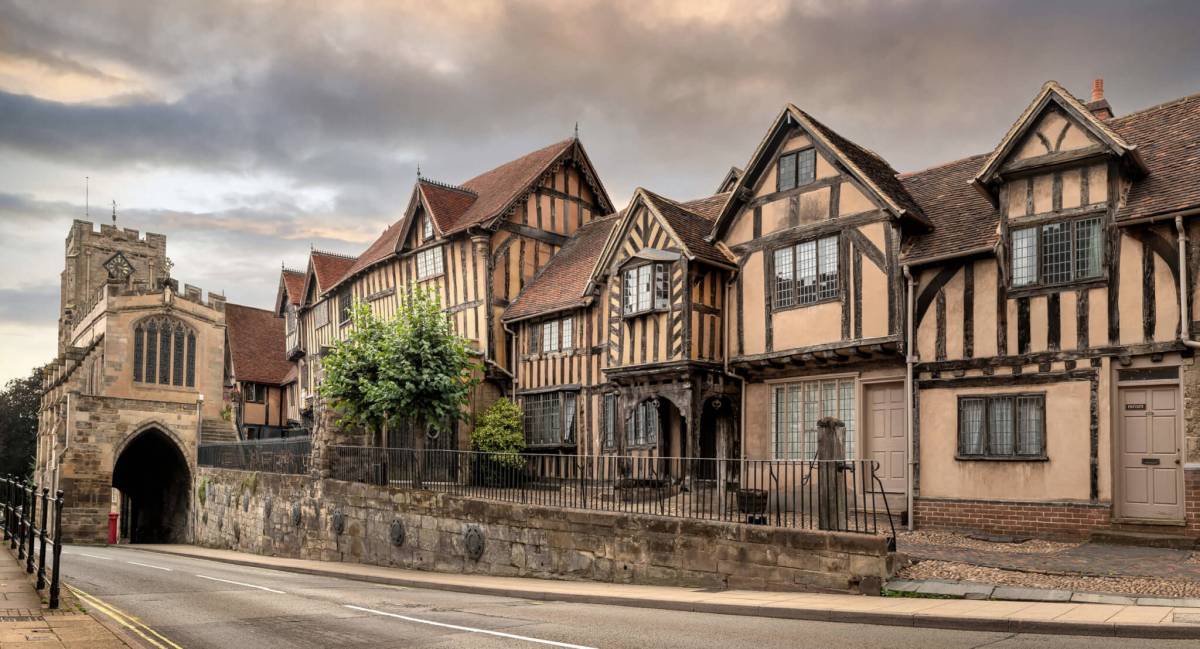
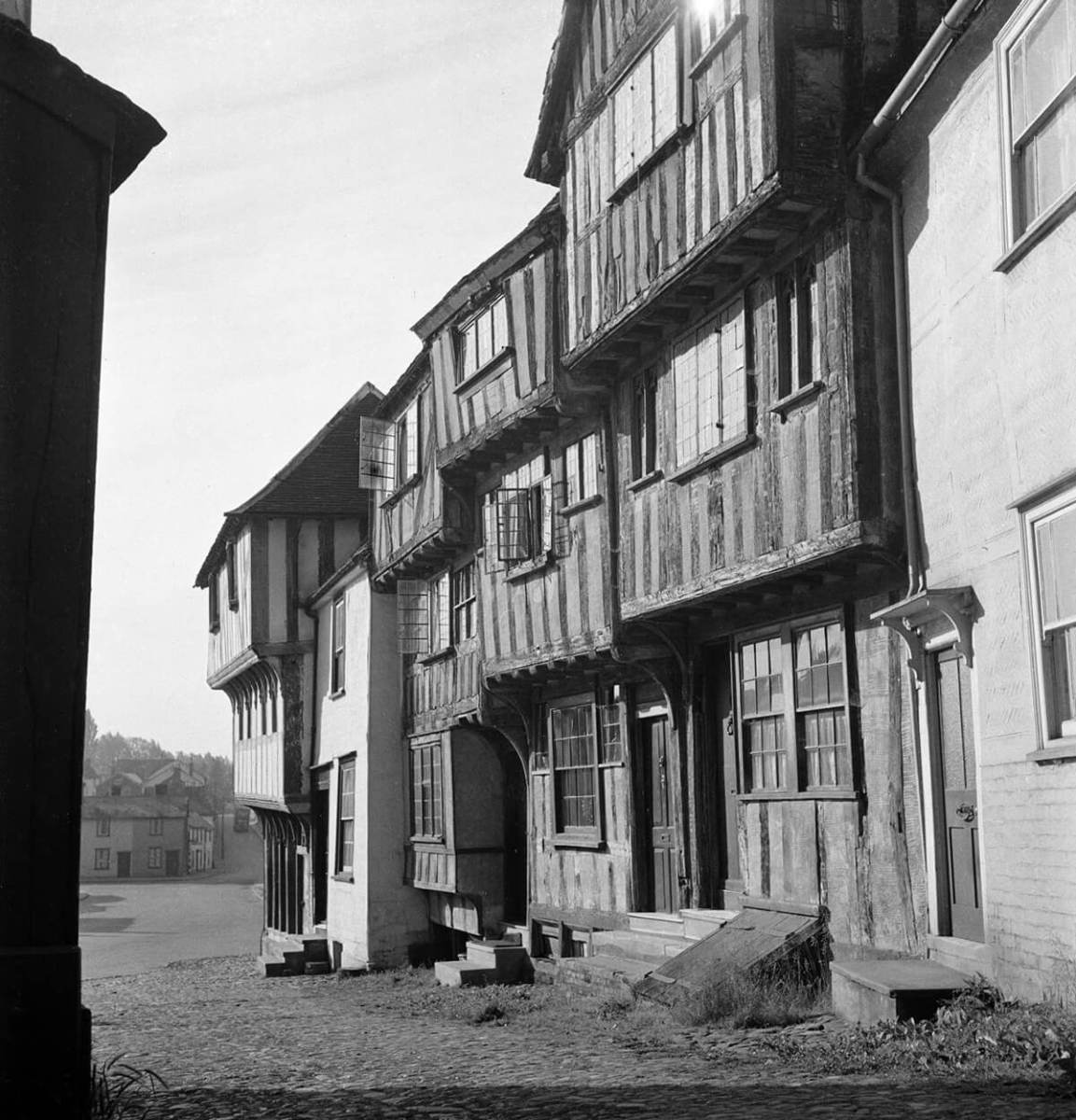
    Medieval buildings are characterised by their timber-framed structures that often overhang. This feature, known as a jetty, was useful in Shambles as meat would be hung outside the shops, and the overhanging feature would provide much-needed shade, protecting the meat from the sun.

    Stoney Lane, Thaxted, Essex. © Historic England Archive. View image AA089705.

    Houses in towns were narrow and built close together, so jetties also helped protect pedestrians from waste being thrown into the street. The row of timber-framed buildings on Stoney Lane in Thaxted were built around 1410 and are jettied on each floor.

    Georgian Classical architecture (18th century)

    Classical architectural features dominated 18th-century high street buildings.

    The ancient temples of Greece and Rome inspired architects at the time. This fascination developed into an appreciation for academic theories of proportion and symmetry and how architectural design had to obey these rules.

    With the rise of more pleasure pursuits and increased products coming in from abroard, the need for more fashionable shopping areas rose.

    It was important for the front of a property to make an excellent first impression, particularly in shops.

    The windows above the doors in this late 18th century shop in Westminster are known as patterned fanlights and were a common feature in high street architecture in the period. As well as the bay windows to create aesthetic shop displays.

    Victorian (19th century)

    The Victorian Age (1837 to 1901) saw a dramatic increase in the construction of buildings for specialist purposes.

    As a result, a whole array of new building types, from railway stations to swimming baths, were built.

    A photograph of a red brick purpose built bank next to a busy junction.
    Barclays Bank, 20 The Town, Enfield, Greater London. © Historic England Archive. View image DP434079. View List entry 1484988.

    In the 18th and 19th centuries, purpose-built banks appeared on England’s high streets. As public institutions, it was important for them to look the part and show that they could be trusted with people’s money.

    A close-up photograph of a red brick bank building with a carved stone reading 'BANK'.
    Barclays Bank, 20 The Town, Enfield, Greater London. © Historic England Archive. View image DP434084.View List entry 1484988.

    Designed in a Flemish Renaissance style in 1897 to designs by William Gilbee Scott, this bank in Enfield was purposely built for the London and Provincial Bank.

    Red brick and stone dressings were commonly used in this period on classical style buildings, and this Bank in Enfield is a strong example of late 19th-century commercial architecture.

    The department store boom (19th and early 20th century)

    This was the golden era of shopping in Britain as wealth and new products flowed in from the British Empire.

    Department stores developed in the second half of the 19th century as a new type of store that offered many different kinds of goods and services under one roof.

    A photograph of a large former Edwardian department store next to a busy road.
    The former Arding and Hobbs Department Store, 10 St John’s Road, Wandsworth, London. © Historic England Archive. DP313931. View List entry 1389528.

    They promised luxury and were rare spaces in Victorian towns and cities where women could go unchaperoned. But it was in the early 20th century when they took off as respectable places for women to socialise.

    The former Arding and Hobbs Department Store in London was constructed in 1910 by James Gibson. Many department stores erected new buildings to project a modern image and attract new customers.

    The focus was very much on the customer: service was impeccable, and the décor was attractive and comfortable.

    Art Deco style (Inter-war period)

    The time between the First and Second World Wars lasted from 1918 to 1939. Art Deco became a highly fashionable architectural style on the high street during that time.

    The bold, decorative, and geometric look originated in France in the 1920s. By the 1930s, this exciting and modern new style had been widely adopted throughout Western Europe and the United States.

    Art Deco was first used on public and commercial buildings for its practicality and its modern design.

    A black and white photograph of an interior of an empty cinema auditorium.
    Inside the former Odeon Cinema, Parsons Hill, Woolwich, Greenwich, London. Photograph taken in 1937. © Historic England Archive. View image BB87/03656. View List entry 1212649.

    The Odeon Cinema in Parsons Hill is now used as a church, but it was designed by architect George Cole, known for his Art Deco streamlined style.

    The emergence of Art Deco was timed perfectly with the dawn of Hollywood. No longer a technical novelty, the movies were mass entertainment, and new auditoriums in local communities were needed to meet demand.

    Post-war development (after 1945)

    Following the end of the Second World War in 1945, a mass programme of public spending saw 100s of 1000s of new houses, towns, high streets, and shopping precincts built across the country.

    During the war, Coventry had several factories that made engines, aeroplanes, and munitions, all vital to Britain’s war effort, so the city had a target on its back.

    The Coventry Blitz on 14 November 1940 was devastating and destroyed most of the city overnight. Most of the 14th century cathedral was destroyed.

    Coventry was almost completely rebuilt in the 1950s and 1960s following the heavy bombing of the Second World War.

    Broadgate House in Coventry is an office building that was part of the city architect’s master plan of 1941. It was built in a post-war style to maximise commercial space.

    The building features the Coventry legend of Lady Godiva and Peeping Tom in its large clock. Post-war architecture can be seen as quite contrasting to other architectural styles on the high street, so murals and sculptures were often used to fit in with the local town or city.

    Following the lifting of rationing after the Second World War, consumerism in England increased, and there was a greater need for larger commercial shopping spaces. New fashion brands and styles of the ’60s, ’70s and ’80s encouraged more people to buy new clothing and products.

    Queensgate Shopping Centre in Peterborough opened on 9 March 1982 and was built as part of a vast expansion programme to the city, aiming to increase visitors from London.

    A photograph taken in the 1980s of a bus shelter.
    Queensgate Bus Station at Queensgate Shopping Centre, Peterborough, Cambridgeshire in 1982. © Historic England Archive. View image JLP01/10/10760.

    It was built using reinforced concrete, a relatively cheap process and a favoured material to make large-scale commercial buildings.

    A black and white photograph of a shopping centre in the 1980s.
    Interior view of Queensgate Shopping Centre, Peterborough, Cambridgeshire in 1982. © Historic England Archive. View image JLP01/09/821045.

    Maximising space to display products and encourage buyers was crucial in these shopping centres. Windows were limited as there was no need for natural light in the shops.

    After the damage of the Second World War, the rebuilding of Britain was a period of optimism. Post-war architecture, therefore, represents an era of hope and renewal to many.


    Further reading

  • The History of England’s Village Greens

    The History of England’s Village Greens

    The idea of a quintessential village green is a neat grassy area, probably surrounded by old cottages, where fetes and village activities take place. A duck pond, a pub, and an ancient church might be nearby. A war memorial and benches under trees where people can watch the world go by.

    Boys fishing in the pond on Finchingfield Green, Essex, in the 1950s. © Historic England Archive. View image AA089438.

    Although many village greens across the country may fit this description, the reality is far more diverse.

    Village greens can also be a tiny scrap of land, such as ponds or wildlife havens. They can be vast open spaces that are covered in scrub or woodland. They can also be found in towns and cities, and are not always green.

    A photograph of a village green, surrounded by cottages, with a large water pump in the middle of the green.
    The view across the village green in Dufton, Cumbria, with a 19th century London Lead Company water pump at the centre. View image DP071233. View List entry 1144938.

    However, all village greens have one thing in common. They are all places where lawful recreation has traditionally taken place by a significant number of local people, as of right and without challenge or permission, for at least 20 years.

    It is believed there are around 3,650 village greens in England that are formally registered and therefore protected from development. Most are in the south and east. It is thought that many hundreds more are unregistered.

    Here, we look at the fascinating and occasionally turbulent history of England’s village greens.

    A photograph of a large village green covered in bushes with the top of a windmill in the background.
    Duncan Down, Whitstable, Kent. At 21 hectares, this is one of England’s largest registered village greens. Whitstable’s Black Mill (or Borstal Hill Windmill), erected in 1814, stands in the distance. Source: Open Spaces Society. View List entry 1084964.

    The origins of village greens

    Many village greens in England originated in the early Middle Ages (from around the 5th to the 10th century), although some may have been earlier.

    An illustration showing an aerial depiction of a village surrounded by farmland.
    A reconstruction illustration showing an aerial view of Ulnaby, a deserted medieval village in County Durham, as it may have appeared in about 1320. The settlement had a large central open area believed to be a village green. © Historic England Archive. View image IC221/001.

    A number had unplanned origins, formed when changes to agriculture meant scattered ancient communities gradually developed into villages, expanding into the fringes of existing small commons where cattle, sheep, pigs, and horses traditionally grazed. These often became village greens by default.

    In the later Middle Ages, some greens were planned and incorporated when new villages were laid out for resettling populations. Greens were locations for markets and fairs or when there was a need to tightly group local housing for fortification purposes, preventing livestock theft and providing security at night during times of unrest.

    An aerial photograph of a village with rows of cottages and green space at the centre of the village.
    An aerial view of Milburn in Cumbria. The largely intact medieval layout of the village, with its central green and protective ring of housing, indicates that defence was a major consideration. Source: Creative Commons.

    During the 17th to 19th centuries, several Acts of Parliament enclosed open fields and common land, restricting use to legal owners. With millions of hectares of land lost to the public, village greens became increasingly important for amenity, recreation and grazing.

    A photograph of a postcard showing a village green surrounded by trees beside a cottage.
    A vintage postcard of Selborne in Hampshire, one of England’s oldest village greens. It is known as ‘The Plestor’, a name with 1,000-year-old Saxon origins meaning ‘play place’. Source: Nicky Hughes.

    There was no formal recognition of village greens until the Commons Registration Act of 1965.

    With this Act, over 3,000 greens that fulfilled the 20-year rule were legally registered with unitary authorities and county councils, gaining protection from development.

    A photograph of a swan swimming in a pond, surrounded by a village green with large historic houses in the background.
    The village green in Frampton-on-Severn, Gloucestershire, is used mostly for cricket and fairs. Known as ‘Rosamund’s Green’, it was named after Rosamund Clifford, Henry II’s mistress. At almost a kilometre wide, it is one of the longest in England. Source: Graham Bathe.

    In 2006, a new Commons Act introduced new procedures for registering greens.  These new laws make registering before any planning issues arise even more important. An average of 10 village greens a year over the last decade have been registered, but many hundreds remain unregistered.

    In 2000, the number of village greens increased through an innovative scheme that saw 245 celebratory Millennium Greens established in cities, towns and villages throughout the country, managed by local trusts and volunteers.

    The village green in Little Shelford, Cambridgeshire, is thought to be one of the smallest in the country and was created by popular local vote in 2015.

    A photograph of an urban park surrounded by trees with the London Eye in the background.
    Waterloo Millennium Green, London. Source: Creative Commons.

    What are village greens used for?

    Although most village greens originally would have been used mainly for markets, commerce and the grazing of livestock and horses, other uses gradually emerged, including sports.

    The oldest sporting feature on a village green that still exists today is the quintain in Offham, Kent. It would probably have been used by medieval and Tudor knights for jousting practice.

    A black and white photograph of a tilting pole in a middle of a village green, with 2 cottages in the background.
    The tilting pole (quintain) on Offham village green, Kent, is probably originally a medieval structure that has been restored over the centuries. © Historic England Archive. View image AA001661. View List entry 1264802.

    Another early use was archery. King Henry VIII decreed that all males aged 7 to 60 should own bows and arrows, with local communities required to provide shooting butts for practice.

    Today, the law approves using village greens for ‘lawful sports and pastimes,’ a phrase qualifying almost any form of recreation.

    An oil painting showing a fun fair on a village green with large historic buildings and the sea in the background.
    A modern oil painting, ‘Fair on the Green, Gosport, 1904’. The castle pub featured in the upper left is the sole survivor of the Edwardian scene today. A car park replaced the green. Source: Neil Marshall Art.

    For centuries, markets and fairs have been a feature of village greens.

    The custom continues today in the form of local fetes, often offering the nostalgia of tug-of-war, dog shows, homemade cakes and jams, and vegetable competitions, all raising money for local causes.

    Spacious village greens are also sometimes used as for funfairs and circuses.

    A black and white photograph of children dancing around a maypole on a village green.
    Children performing a May Day dance around a maypole on an unspecified village green, probably in the late 19th century. © Historic England Archive. View image CC72/00189.

    Celebrations of all kinds on village greens are generally recognised, from maypole and Morris dancing to fireworks displays, carnivals, music festivals, and carol singing.

    Many village greens host local cricket matches. Others have football pitches marked out.

    Village greens with war memorials are also used for the annual remembrance of local members of the community who died in past conflicts.

    A photograph of a stone war memorial in the middle of a village green.
    The Grade II listed war memorial on Ringmer village green, East Sussex, was unveiled in 1920. Contributed to the Missing Pieces Project by War Memorials Online and David Larkin. View List entry 1400375.

    Law and order

    Over the centuries, some village greens have been sites for uprisings and unrest, symbolising the struggle of those seeking better pay and working conditions.

    A photograph of a village green filled with trees and a path running through the middle.
    Camberwell Green in London, where the Peasants’ Revolt of 1381 rebels camped before destroying St John’s Priory a few miles away in Clerkenwell. The green was ancient common land, bought in the late 19th century by the vestry, an early form of local government, to protect it from development. Source: Nicky Hughes.

    Village greens were used as meeting places during the Peasants’ Revolt in 1381. This ultimately defeated the popular movement against serfdom and the poll tax, led by Wat Tyler, started in Essex and Kent and ended in London.

    One of the most celebrated and notorious village greens associated with dissent was Tolpuddle, where, in 1834, local farm labourers lawfully gathered under the village sycamore tree to discuss the possibility of forming a trade union.

    Their meeting was heavily suppressed, with 6 workers later sentenced to deportation to Australia. A huge public demonstration and petition to release these ‘Tolpuddle Martyrs’ resulted in full pardons 2 years later.

    A photograph of a large sycamore tree at the centre of a village green.
    The Green at Tolpuddle, Dorset, has a famous ancient sycamore tree. People visit the village every year to commemorate the historic sacrifice made by its farm labourers in the 19th century. © Jerry Young.

    Crime and punishment

    As well as being protest sites, village greens could be places of public punishment.

    Stocks (where local offenders were held sitting, imprisoned by their feet) and pillories (where culprits stood upright with their head and arms secured in a wooden frame) had been used for over 1,000 years. Offenders were often mocked and pelted with eggs, rotten fruit, and vegetables by locals.

    Pillories were only abolished in 1837, while stocks continued to be used until the latter part of the 19th century.

    A photograph of a historic stock at the centre of a village green, with cottages in the background.
    The 17th century stocks on Threshfield village green, North Yorkshire. In the early 15th century, a law required every village and town to have stocks, with many placed on village greens. Source: Creative Commons. View List entry 1167704.

    Protecting village greens

    Many groups help to protect and preserve village greens, parks and green spaces across England. The Open Spaces Society has been supporting local groups with the registration of village greens for decades.

    A black and white photograph of a man sitting on a bench in front of a tree, overlooking a village green.
    A historic lantern slide of a man reading on a shady bench while someone rolls the cricket pitch on the village green in the Box Hill area, Surrey. Image courtesy of Open Spaces Society.

    Other examples include the charity Fields In Trust, established in 1925, which works to protect parks and green spaces. Local preservation societies such as Oxford Preservation Trust also conserve green open spaces, as well as historic buildings.

    In 2006, New Haven Town Council in East Sussex attempted to register its West Beach as a village green. It was turned down on appeal by the Supreme Court, which accepted the argument from the owners (the port authority) that the traditional public use of the tidal beach with no defined boundaries had not been ‘as of right’ but by implied licence.

    Several unregistered greens across the country still face threats to their existence, including development such as housing and road building.

    However, in 2024, local people in Havering, East London, succeeded in registering (and therefore protecting) their village green from future development.

    Written by Nicky Hughes
    Feature image courtesy of Graham Bathe


    Further reading

  • Meet Gwen Lally, the World’s Pageant Master – The Historic England Blog

    Meet Gwen Lally, the World’s Pageant Master – The Historic England Blog

    Inter-war Britain was obsessed with historical pageants: mammoth theatrical events featuring historical re-enactments.

    Many of the most successful were helmed by Gwen Lally, the ‘world’s pageant master,’ whose unorthodox gender presentation and meticulous work set her head and shoulders above the rest.

    A ‘pageant master’ is a person who oversees the production of an entertainment pageant.

    Gwen Lally, Pageant Master. Source: The Egham Museum Trust.

    In the summer of 1938, Birmingham’s Aston Park became the backdrop for a historical pageant of epic proportions. 

    Across 5 days, some 10,000 people came to witness a dramatic re-enactment of Birmingham’s history. There were prehistoric dinosaur hunters, trudging across the park in their Stone Age garb. In a scene depicting the 1791 Priestley Riots, a building was built and then burnt.

    Uproarious applause swept the crowd when an actress playing Queen Victoria stepped out to recreate the monarch’s famed visit of 1858.

    A black and white film still showing a pageant parade with a manmade dinosaur float and people in pre-historic costume.
    Film still from Birmingham Centenary Pageant 1938 film. Source: BFI National Archive / BFI Player.

    A slight yet dapper woman sat perched above the audience throughout the mammoth production, meticulously directing hundreds of actors with just a megaphone. This was Gwen Lally, fast developing her reputation as ‘the world’s pageant master.’

    Lally was charming, charismatic, and somewhat experienced by this point, with a handful of large-scale productions under her belt. Her refusal to call herself a pageant mistress was emblematic of her androgyny more broadly. Lally dressed in sharp, well-tailored suits, her white hair cropped short and wavy.

    “She is tall, virile, with a perfectly classical silhouette,” summarised a write-up of the pageant, published in ‘The News’.

    “[Lally] affects masculine modes, and has a perfect genius for infecting other people with her own vast enthusiasm.”

    A black and white photograph of a group of women in historical costume.
    A photograph of Gwen Lally with cast members, a queen and ladies in waiting at the Pageant of Runnymede. Source: The Egham Museum Trust.

    The review echoes other clippings, collated in Birmingham’s Cadbury Research Library, which describe her as well-liked and respected by peers and fans alike. After the grand climax of a pageant, it wasn’t uncommon for audience members to drape Lally in flowers and lift her atop their shoulders for a post-finale victory lap.

    By all accounts, Lally is the first woman to achieve such enormous success in the field of historical pageantry, but it didn’t come overnight. 

    A black and white photograph of a woman with cropped black hair wearing a suit and a cane.
    Gwen Lally (Gwendolin Rosalie Lally Tollandal Speck) by Bassano Ltd, whole-plate glass negative, about 1913. © National Portrait Gallery, London. View image NPG x30797

    Born in 1882, Lally spent the earliest years of her life in West London before moving with her family to Bedford, a Warwickshire town where her father had been summoned to work as a reverend.

    The oldest of 3 children, she was passionate about acting from a young age. In the early 1900s, against the advice of her family, she began training under Sir Herbert Beerbohm Tree, an esteemed actor and theatre manager. 

    Context is key here. The late 19th and early 20th centuries were the heyday of male impersonation, a period which saw some of the earliest iterations of what we’d describe as drag king performers today.

    A black and white photograph of a woman in a suit with a top hat, smiling at the camera.
    Vesta Tilley (1864 to 1952). © Pictorial Press Ltd / Alamy Stock Photo.

    In music halls across Victorian England, stars like Annie Hindle and Vesta Tilley commanded huge crowds with their subversive performances and hilarious send-ups of old-school masculine archetypes.

    These weren’t small, niche productions. At one point, Tilley was one of the highest-paid music hall performers in the world, regularly selling out shows not just in the United Kingdom but in the United States, too.

    Like these women, Lally always took to the stage with masculine looks. In an often-cited quote, she “claimed the distinction of being the only actress who has never worn skirts on stage.”

    The one time she did play a role written for a woman was in 1914, when she portrayed the aforementioned male impersonator, Vesta Tilley.

    A photograph of a woman in a suit of armour and a crown.
    Gwen Lally as King Henry V. The date and performance details are unknown. Source: Folger Shakespeare Library.

    The First World War raged on between 1914 and 1918, but in its wake came a burgeoning industry: the historical pageant. These events were a cross between theatrical productions and historical re-enactments, split into several acts which recreated key moments in British history.

    Initially, they were niche and predominantly viewed as middle-class entertainment. Before 1914, they had only ever been held to varying degrees of success in London and Liverpool. Only after the war did local councils across the UK form coalitions and incentivise the staging of historical pageants jointly.

    Not only could these pageants draw huge crowds, but they also offered a way to promote and retell local histories, boosting the national economy. Sometimes, they even raised cash for charities along the way. 

    A black and white photograph of a large group of people in a field, many of which are in historical costume.
    Gwen Lally with members of the Pageant of Runnymede cast. Source: The Egham Museum Trust.

    Pageant popularity blossomed throughout the 1920s and 1930s, and Lally wasted no time using her stage expertise to try her hand as a pageant master. Between 1924 and 1929 alone, she racked up master roles for 6 pageants, perfecting her craft as she went. 

    By 1930, Lally was presiding over enormous spectacles. The Great Warwick Pageant was a colourful, grandiose affair, themed largely around royalty and the works of Shakespeare. Reports estimate an audience of around 45,000, which smashed the county’s previous attendance record.

    Lally continued her work as a pageant master for several decades, becoming a mainstay of the industry. In the Cadbury Research Library, there’s a Gwen Lally pamphlet filled with gushing testimonies, describing her as a “marvellous producer,” a “super-woman” and a “genius of the highest order.” 

    A colourised photograph of two actors in historical costume and in the middle stands a female director holding a megaphone.
    Gwen Lally with 2 performers – Mr Hook and Mrs Liddiard – at the Pageant of Runnymede in 1934. Source: The Egham Museum Trust.

    Although Lally’s professional achievements are well-documented, there’s comparatively little information on her personal life.

    Increasingly, scholars are looking back on her life and achievements through a queer lens: no easy feat given the historical erasure of lesbians, whose stories haven’t survived in records of criminalisation like their gay male counterparts. 

    We know that Lally was a clear gender non-conformist and a story of triumph in an industry otherwise devoid of women. The official line is that Lally was unmarried and died a spinster, but there’s evidence to suggest otherwise.

    A black and white portrait photograph of a woman with cropped white hair and wearing a historical costume.
    Gwen Lally by Elliott and Fry, bromide print. © National Portrait Gallery, London. View image NPG x90178.

    In 1907, the distinctly sapphic poetry anthology ‘Behind the Veil’ collated a series of love poems written to a woman named only as Phyllis, whom Lally describes as having “the ecstasy of spring in [her] voice” and “the glory of the summer’s in [her] face.”

    Researcher Deborah Sugg Ryan pursued this line of inquiry. In an English Heritage podcast, she offers proof that Lally spent much of her life in an intimate, same-sex relationship with actress Mabel Gibson, even staging a same-sex wedding with her partner in a pageant scene. When Lally died, she left Gibson her fortune. 

    The nuances of these stories are still being uncovered. Still, the figure of Gwen Lally, the accomplished and charismatic pageant master, is a beacon of light in queer and feminist histories.

    We may never fully know what lay behind the veil, but increasingly, we know that there was more to the world’s pageant master than met the eye.

    About the author
    Jake Hall is a freelance journalist and author living in Sheffield, England. Jake’s first book, ‘The Art of Drag’, was an illustrated deep dive into the history of drag, published by NoBrow Press in 2020. Their upcoming book, ‘Shoulder to Shoulder’, is a history of queer solidarity movements over the last six decades; it’s scheduled to be published in May 2024 by Trapeze Books.

    For years, Jake has been fascinated by everything from queer culture and histories to fashion, film and climate activism, and they’ve written for publications ranging from Dazed Digital and The Independent to Refinery29 and Cosmopolitan. They’re also a keen book fan and reviewer, publishing regular reviews on their Instagram.


    Further reading

  • 7 Places Connected to Witchcraft in England

    7 Places Connected to Witchcraft in England

    During the 16th and 17th centuries, a widespread belief in witches permeated all levels of English society. Witchcraft was initially deemed a capital offence in 1542 during the reign of Henry VIII, only to be repealed 5 years later. 

    Witch fever reached new heights when witchcraft was again classed as a felony in 1563 under Elizabeth I. It was an era that brought a tragic rise in accusations, resulting in the unjust punishment of thousands, mainly affecting economically disadvantaged and vulnerable women.

    Colchester Castle, Essex. © Historic England Archive. View image TUP01/01/0671. View List entry 1002217.

    Even after the 17th century, people accused of and identifying as using magic fascinated the masses, yet were still pushed to the edges of society.

    Here are some sites that were witness to events associated with witchcraft throughout English history.

    1. Fisherton Anger (Salisbury), Wiltshire

    It is impossible to say who the first person to be executed for witchcraft was due to the lack of documents and surviving evidence. However, from what does still exist, one of the first we know of is Agnes Mills (or Mylles) from Wiltshire. 

    She was executed at Fisherton Anger (now Salisbury) for having killed the infant William Baynton by means of witchcraft in April 1564. 

    Agnes’ story also highlights how supposed witchcraft could be a source of income for many women. Allegedly, Agnes was paid to commit the murder by Dorothy Baynton, the wife of the infant’s uncle and next in line as heir to Sir Edward Baynton, a wealthy family with royal connections.

    A black and white photograph of a gatehouse.
    The Grade II* listed gate lodge to Spye Park, the former gatehouse of Brombam House, belonging to the Baynton family, and allegedly gifted by Catherine of Aragon to her friend Sir Edward Bayntun (1480 to 1544). Contributed to the Missing Pieces Project by Peter Connell. View List entry 1033912.

    Interestingly, another supposed witch named Jane Marsh was paid to help in the trial. She declared Agnes Mylles had undertaken the killing and that Dorothy Baynton had been the procurer. Afterwards, Agnes Mylles confessed and was hanged.

    Unfortunately for Jane, the Bayntons threatened that unless she denied her statement about Dorothy, she would be left in prison herself. Jane spent 18 months in jail before revoking her statement.

    2. Colchester Castle, Essex

    Self-proclaimed Witchfinder General, Matthew Hopkins, was the most notorious witch-hunter in the 1640s. He jailed and interrogated those he believed to be witches at Colchester Castle.

    The interrogation took place in the castle’s dark cells, where many are believed to have died as a result of their incarceration before even being brought to court. 

    A black and white photograph of a brick two storey castle surrounded by trees.
    Colchester Castle, Essex. © Historic England Archive. EAW008091. View List entry 1002217.

    In Essex alone, around 1,000 people were accused of witchcraft from the 1500s to 1800s. They included Elizabeth Lowys, an active cunning woman, who was also among the first women known to have been sentenced to death for ‘murder by magic’ in 1564.

    3. Tuesday’s Market Place, King’s Lynn, Norfolk

    For many years during the 16th century, the market place in King’s Lynn was the scene of public executions of alleged witches. This probably included Mother Gabley, who was the first person condemned in Norfolk under the 1563 Act Against Conjurations, Enchantments and Witchcrafts.

    A black and white photograph of a town square with market stalls.
    Tuesday Market Place, King’s Lynn, Norfolk. Source: Historic England Archive. View image DAC01/03/023.

    Gabley was accused of causing the death of 13 men who had sailed from Spain to England. Allegedly, she boiled eggs in cold water, stirring vigorously to raise a storm at sea.

    The most famous execution was of Margaret Read, who was found guilty of witchcraft in 1590 and burned alive. Legend has it that whilst being consumed by flames, Margaret’s heart jumped from her body and hit the wall opposite, leaving a permanent burn on the brick.

    It’s a good story. But the front of the building in question actually dates to the early 18th century, and the heart and diamond motif probably relates to an early 20th century alteration to the window.

    A photograph of a brick wall with the motif of a heart within a diamond.
    The heart of alleged witch Margaret Read jumped from her body and hit the wall opposite in Tuesday’s Market Place, King’s Lynn, Norfolk. © meatcher-imaging via Flickr.

    4. Mother Shipton’s Cave, Knaresborough, North Yorkshire

    Mother Shipton is a legendary figure who, if she did exist, probably lived in York in the 1530s. Her story first appeared in a pamphlet in 1641, where she was said to have predicted that Cardinal Wolsey would not reach York in 1530.

    Later accounts claim that she was born Ursula Soothtell in 1488. She was believed to have been a witch and an oracle who morbidly predicted the days of reckoning and tragedies that were to befall the Tudor monarchy.

    A black and white photograph of a the outside of a cave.
    Mother Shipton’s Cave, Knaresborough, North Yorkshire. Source: Historic England Archive.

    Mother Shipton was said to have died aged 73 in York. These later accounts also elaborated on her prophesies, claiming she foresaw the Spanish Armada in 1588 and the Great Fire of London in 1666.

    In 17th-century depictions, she was shown as an elderly woman with a deformed shape, portraying many of the classic tropes of a witch.

    The claim that Mother Shipton was born at Knaresborough was first made in a pamphlet from 1686. The wells and springs of Knaresborough had been attracting tourists since the 16th century, and as the story of Mother Shipton remained popular in the 18th and 19th centuries, interest grew in her supposed birthplace.

    A copy of an engraving showing a witch sat at desk, holding paper sketches and drawings.
    Old engraving of Mother Shipton, from the title page of ‘The Strange and wonderful history of Mother Shipton’, 1686. Unknown author. Source: Public domain.

    In the 19th century, a house near Low Bridge in Knaresborough was promoted as the place where she was born, but, in the 20th century, she became associated with Mother Shipton’s Cave.

    5. Pendle Hill, Lancashire

    Pendle Hill is well known for its associations with witches. One of the most famous witch trials in English history was the Pendle witches in 1612, where 12 accused witches who lived in the Forest of Pendle (primarily women) were charged with the murders of 10 people using witchcraft.

    The mass of confessions included in the trials recalled events of up to 18 years before and involved tensions between families, neighbours, landlords and tenants.

    A photograph of a statue of a woman in 17th century dress with chains around her hands.
    Statue of Alice Nutter, one of the accused witches, Barrowford, Lancashire. © Mark Waugh / Alamy Stock Photo.

    The events leading to the trials began on 18 March 1612, when Alizon Device was accused of witchcraft after a pedlar refused to buy her pins and claimed she had bewitched him. Her family, along with Anne Whittle and her daughter, were soon arrested and sent for trial.

    Meanwhile, their family members held a meeting at Malkin Tower, in the Forest of Pendle, where a plot to free the prisoners and destroy the castle was discussed. The location of the site is still unclear, although it may be close to the present-day Malkin Tower Farm. The meeting was seen as a witches’ sabbath.

    This led to further interrogations and the eventual involvement of several families, who were accused of witchcraft and plotting with the devil.

    A key witness in the trials was one of the accused’s 9-year-old daughter, her testimony leading to the execution of her mother, sister, and brother. One of the accused died in custody, another was found not guilty, and the other 10 were found guilty and hanged.

    6. Town Moor, Newcastle

    One of the largest mass executions in English witchcraft history took place in Newcastle in 1650. 

    It began in 1649 when 30 people were accused and brought to the town hall to be tried as witches. The trial involved being publicly stripped, searched for devil’s marks, and pricked with a pin.

    Superstition believed that a witch could not feel pain. If the accused did not bleed, it was evidence against them.

    A photograph of a city skyline.
    Skyline of Newcastle Upon Tyne viewed from Town Moor. © Harry Green / Alamy Stock Photo.

    Witchfinders often used retractable pins to ensure convictions, as they were paid per guilty verdict.

    The trials ended with 14 women and a man condemned to death, and gallows were built on Town Moor to execute them publicly. All of the deceased were buried in unmarked graves at St Andrew’s Church in the city centre on Newgate Street.

    In a twist of fate, the witchfinder who led the accusations against the group was later arrested, tried, and hanged for causing the deaths of 220 people.

    7. York Castle Prison, York

    Up until 1736, English law allowed courts to convict and execute people for witchcraft. However, once the law had been repealed, it didn’t mean that belief in magic was eradicated. 

    80 years later, a trial took place in Yorkshire that caused huge media attention. According to broadsheets from the time, a woman named Mary Bateman was executed for ‘witchcraft and murder’.

    A photograph of a stone prison with a grand column entrance.
    York Castle Museum, formerly York Female Prison, York. © Historic England Archive. View image DP072270. View List entry 1259324.

    Mary wasn’t formally accused of witchcraft. In fact, she was prosecuted for fraud as well as murder, but the media highlighted her popularity for telling fortunes and making charms and referred to her as the ‘Yorkshire witch’.

    It was her claims to be able to cure people which led to the death of her victim, Rebecca Perigo. In 1808, Mary treated Rebecca with white powders for a nervous or spiritual ailment, instructing her to mix them into a pudding. Rebecca died a week after eating it.

    Authorities found corrosive mercury powder on Mary, leading to her arrest, charge of murder, and hanging at York Castle on 20 March 1809, just 3 days after her trial.

    A photograph of the exterior of stone prison walls.
    The site of Mary Bateman’s execution at the York Castle Walls. © Historic England Archive. View image DP072306. View List entry 1259324.

    The story of the ‘Yorkshire Witch’ drew 5,000 people to witness Mary’s hanging, with more lining the road to see her coffin travel to Leeds General Infirmary, where hospital staff charged 3 pence to view her corpse.

    The story of the ‘Yorkshire Witch’ and physical evidence of protective measures like witches’ marks demonstrate that belief in witchcraft and the supernatural was widespread until the late 19th century.

    Over time, and throughout the 20th century, suspicions around witches and magic in England began to reduce. However, it’s important to remember the lives lost during past centuries, when the fear of the unknown, accusations and misunderstandings led to tragic consequences.

    Discover your historic local heritage

    Hidden local histories are all around us. Find a place near you on the Local Heritage Hub.


    Further reading

  • The Legend of King Arthur

    The Legend of King Arthur

    What does the name ‘King Arthur’ bring to mind for you?

    Chivalric tales of knights of the Round Table and their ladies? Maybe a Romano-British general beating off Saxon invaders from the continent? Or perhaps a ‘Celtic’ resistance leader?

    The story of King Arthur has fascinated people for hundreds of years, particularly after medieval versions of the legends were brought together in ‘The Matter of Britain’, an attractive fantasy world for the medieval elite, much later repackaged in numerous books and films.

    The modern statue of Gallos (meaning power in Cornish), inspired by the legend of King Arthur, at Tintagel Castle in Cornwall sums up the elusive nature of this figure. © David Samperio García / Alamy Stock Photo. View List entry 1014793.

    Was King Arthur a real person?

    Before looking at the places associated with the Arthurian legends, you might wonder if there really was a historical Arthur.

    There is little conclusive proof in historical sources or archaeology for a ‘King Arthur’. So, what can we say about evidence for the original ‘Arthur’?

    Historians think the source of the stories about Arthur lies in the confusing events of the 5th and 6th centuries AD after Roman rule collapsed in Britain.

    A detail from a medieval mosaic depicting a  mounted king labelled "rex Artus".
    A 12th century depiction of Arthur seeking the grail from Italy. Arthur is labelled as ‘Rex Artus’ or ‘King Arthur’. © Science History Images / Alamy Stock Photo.

    A case of a ‘missing’ Arthur?

    One of the main written sources for the immediate period after 410 AD is ‘The Ruin of and Conquest of Britain’. This is essentially an intense sermon attributed to a British monk, Gildas, directed against the British clergy and rulers of his day.

    In it, Gildas paints a picture of the events leading up to his lifetime. He mentions a battle later associated with Arthur and names a number of other rulers, but not Arthur himself.

    An illustration of a monk studying a book.
    Gildas as portrayed in a much later illustration. © Science History Images / Alamy Stock Photo.

    Gildas presents a bleak picture of a hapless tyrant (later associated with the figure of Vortigern) who invited Saxon mercenaries to fight for him against other raiders (the Picts and Scots).

    He recounts that the Saxons then rebelled and began to take the land in the east of the country for themselves.

    A reconstruction illustration showing a Saxon fighting a romano-british soldier by the gate of a hillfort.
    An artist’s reconstruction of fighting between Saxons and post-Roman British. The Briton carries the Christian Chi-Rho symbol (the first 2 letters of the name of Christ in Greek letters) on his shield. © Historic England Archive. View image IC074/014.

    Gildas mentions a fightback led by a Roman-sounding leader, Ambrosius Aurelianus, rather than Arthur, with a battle at Badon Hill.

    He seems clear in his mind that this battle really took place because he says it was in the year of his birth. Later medieval writers tried to square this by claiming that Ambrosius was Arthur’s uncle.

    Detail of a medieval manuscript depicting a man unfurling a long scroll in front of an enthroned king.
    Vortigern depicted in a 13th century medieval manuscript. © The Picture Art Collection / Alamy Stock Photo.

    Catterick: Arthur’s first mention… if only in passing

    The earliest actual mention of Arthur comes from a Welsh poem, ‘The Gododdin’, about another British fight-back. The Gododdin were the northern British inhabitants of a territory spanning what would later be Northumberland and southern Scotland.

    The surviving manuscript is a medieval copy of the poem, but the tale is likely to have been composed from the 6th or 7th century onwards (although some authorities think it is as much as 200 years after that).

    He fed black ravens on the rampart of a fortress
    Though he was no Arthur
    Among the powerful ones in battle
    In the front rank, Gwawrddur was a palisade.

    Extract from Welsh poem ‘The Gododdin’

    Curiously, it only mentions Arthur by comparison to one of the heroes attacking the former Roman base at Catterick (Catreath), by then held by the Angles.

    So, in song and literature, Arthur was clearly already viewed as someone to aspire to.

    Part of a medieval Welsh poem copied as a manuscript
    Part of a later manuscript copy of ‘The Gododdin’ in the ‘Book of Aneirin’. Source: Public Domain.

    Tintagel: the legendary place of Arthur’s conception and birth

    By the 12th century, chronicler Geoffrey of Monmouth claimed that Tintagel in north Cornwall was where Arthur was conceived, and by the 15th century, it was said that he had been born there too.

    In the later medieval legend, Uther Pendragon, the High King of Britain, becomes obsessed with Ygraine, the wife of Gorlois, ruler of Cornwall. Merlin, his wizard, disguises Uther to look like Gorlois so he can lie with Ygraine at Tintagel.

    Aerial view of the ruins of a Medieval atop a rocky coastal promontory.
    The dramatic site of Tintagel Castle, Cornwall © Historic England Archive. 33825/011. View List entry 1014793.

    The circle of Arthurian legends influenced how the real medieval castle at Tintagel was built as a place of chivalric display.

    Tintagel was also an important trading site in post-Roman Britain, which saw the genesis of tales about Arthur.

    Where is Camelot supposed to be?

    In the later medieval legends, Camelot is the location of Arthur’s court and home of the ’round table’ of knights.

    Later medieval writers thought this might be at Caerleon in Wales or Winchester in Hampshire. In Winchester’s Great Hall, you can see a later medieval ’round table’ created as part of that era’s fascination with the Arthurian legends.

    A huge wooden round table top painted and embellished with the heraldic motifs and gothic script, set on an internal stone wall of a building.
    The medieval ‘round table’ in The Great Hall in Winchester, inspired by the later chivalric tales of King Arthur and his knights. © Historic England Archive. PLB/K022093. View List entry 1351065.

    Based on a reference by the Tudor writer Leland, others have speculated that it might have been at the hillfort of Cadbury Castle in Somerset.

    Excavations at this mainly prehistoric site have revealed that it does have evidence of post-Roman re-occupation.

    Aerial view of a large hillfort with multiple grass-grown defensive banks.
    Cadbury Castle in Somerset. A prehistoric hillfort that was reoccupied in the insecure times after Roman rule ended in Britain. © Historic England Archive. View image DP263489. View List entry 1011980.

    Arthur: war leader

    The 9th century British historian Nennius refers to Arthur not as a king but by a pseudo-roman military title of ‘Dux Bellorum’, meaning war leader. Towards the end of the Roman empire in the west, a ‘Dux’ had been a leader of a specific military area.

    A medieval depiction two opposing forces of mounted knights in mail armour clashing, below them are the bodies of fallen soldiers.
    An illustration from a medieval manuscript showing an early 14th-century chivalric ideal of King Arthur in battle. © Album / Alamy Stock Photo.

    Nennius lists Arthur’s 12 main alleged battles. Bards, poets, and chroniclers may have retrospectively attributed some of these battles to the hero known as Arthur when they might have had different protagonists. Some may have been selected so they have a poetic rhyme to the names.

    The lucky number 12 (the number of Christ’s Apostles) may also be symbolic, with Arthur supposedly perishing in unlucky battle number 13 at Camlann, mentioned in a later source.

    A photograph of the excavated foundations of a Roman Fort, with visitors in the background.
    Binchester Roman Fort in County Durham is a possible site for ‘Guinnion Fort’, one of the 12 battles mentioned by Nennius. © Glyn Thomas / Alamy Stock Photo. View List entry 1002362.

    The description of Badon Hill is particularly poetic, portraying Arthur as a super-human warrior:

    The 12th battle was on Badon Hill and in it 960 fell in one day, from a single charge of Arthur’s, and no one laid them low save he alone.

    Later, probably in the mid-10th century, the ‘Annals of Wales’ (or ‘Annales Cambriae’) elaborates on 2 of Arthur’s battles. This ventures to give dates for events: Badon (516 AD), and the additional battle not mentioned by Nennius, Camlann (537 AD), “in which Arthur and Medraut fell.”

    Like Gildas’s sermon, the ‘Annals’ and the ‘History of the Britons’ (or ‘Historia Brittonum’) are not necessarily a neutral recording of history. Particularly where Arthur is concerned, they make him a figure of hope and construct a narrative about how the Britons defended themselves.

    Reconstruction illustration showing the edge of a Roman town, with an amphitheatre outside the walls
    Chester, which in Roman times was called ‘City of the Legion’, may be a possible location for one of the battles mentioned in Nennius’ accounts. Reconstruction of the amphitheatre by Peter Dunn. © Historic England Archive. View image IC258/001. View List entry 1375863.

    Where was the Battle of Badon Hill?

    The location for Badon has been suggested as being either at Bath; Ringsbury Camp, Braydon, Wiltshire; Badbury Rings, Dorset or Liddington Castle on the hill above Badbury (Old English: Baddan byrig), near Swindon.

    Colour photograph of a hillfort viewed across a series of fields.
    Liddington Castle hillfort in Wiltshire. One of the possible locations for the battle of Badon Hill. © Historic England Archive. View image DP031506. View List entry 1016312.

    How did King Arthur die?

    The Battle of Camlann is seen as the final battle King Arthur fought, where he was fatally wounded or died during the conflict.

    The search for the location of ‘The Strife of Camlann’ is complex. Some have made an association between Camlann and Camelot.

    Perhaps the lead candidate, however, is the Roman fort of Camboglanna or Housesteads on Hadrian’s Wall (not Birdoswald as previously thought).

    An aerial view of the ruins of a roman fort and associated earthworks.
    Housesteads Fort in Northumberland, possibly the site of the battle of Camlann. © Historic England Archive. PLB/N070070. View List entry 1018585.

    The Isle of Avalon

    The area around Glastonbury Tor in Somerset was once marshy, and some have speculated that it became linked to the legendary ‘Avalon’, the island where Arthur is said to have been sent to recover from his wounds in his last battle.

    Geoffrey of Monmouth makes the first reference to Arthur’s sword, Excalibur (Caliburn), being forged here.

    An aerial view of a hill surmounted by a tower set in an otherwise flat landscape.
    Glastonbury Tor, Somerset. An aerial view of the tor and surrounding countryside, reputedly the Isle of Avalon. © Historic England. View List entry 1019390.

    Glastonbury: the legendary burial place of King Arthur

    In the late 12th century, the monks of Glastonbury Abbey claimed to have discovered the graves of Arthur and his queen, Guinevere.

    However, the timing of this “discovery” is suspect, following as it did after a disastrous fire, which meant the monks needed funds from well-off visitors and pilgrims to rebuild. The wealthy nobles in medieval England loved the Arthurian tales, too.

    It seems that both King Henry II and Edward I endorsed the search for Arthur and the discovery, hoping to be associated with the chivalric glamour of the legends.

    An illustration showing a group of people standing outside the entrance to a church, while 5 people are shown digging the ground around an open grave with 2 skeletons in it.
    An illustration by Judith Dobie depicting the staged discovery of the graves of Arthur and Guinevere at Glastonbury Abbey, Somerset, in 1193. © Historic England Archive. View image IC141/001. View List entry 1021077.

    Beyond the legends: the real ‘Age of Arthur’?
    If this article has piqued your interest, look out for a follow-up unpacking what history and archaeology can tell us about what might have really happened after the end of Roman rule in Britain…


    Further reading

  • Life on the home front in the First World War

    Life on the home front in the First World War

    The First World War profoundly impacted life in England from 1914 to 1918, reshaping the home front in countless ways.

    Life on the home front

    Food shortages and rationing became the norm, and women took on roles traditionally held by men, becoming engineers and working in factories, farms, and offices.

    Cities and towns faced air raids, and public spaces became military training grounds, hospitals, and even munitions factories. These changes left a lasting mark on society and the English landscape.

    Throughout the First World War, pre-eminent architectural photography firm Bedford Lemere and Company recorded how the war affected life at home through a different type of war photography.  

    This selection of evocative photographs from Historic England’s Bedford Lemere and Company collection illustrates the variety of activities and places the firm was commissioned to record during the early 20th century, providing us with a lasting snapshot of what life was like during this period of significant upheaval.

    Automobile Association (AA) Scouts, Westminster, Greater London, 1914

    In this photograph, 500 AA Scouts parade in front of the Association’s offices in London.

    A parade of Automobile Association road scouts, Fanum House, Whitcomb Street, London. Source: Historic England Archive. View image BL22697.

    Following Great Britain’s declaration of being at war with Germany in August 1914, these staff members volunteered for service. Many men joined the 8th (Cyclist) Battalion of the Essex Regiment.

    The AA office, Fanum House on Whitcombe Street in Westminster, was used as an address where applications for recruitment could be made.

    Belgian refugees at General Buildings, Westminster, Greater London, 1914

    General Buildings in Aldwych, London, was built for the General Accident Fire and Life Assurance Company, which had strong links with the Belgian insurance industry.

    A black and white photograph of a crowd of people and a busy road of old cars.
    Belgian refugees outside General Buildings, Aldwych, London. Source: Historic England Archive. View image BL22817/003. View List entry 1066494. 

    During the First World War, the company’s grand head office became home to the War Refugees Committee and the Belgian Labour section of the Ministry of Labour’s Employment Exchange.

    In September 1914, ‘The Times’ newspaper reported that between 300 and 400 Belgian refugees a day were passing through General Buildings.

    This photograph shows a crowd of Belgian refugees making their way to and from the building.

    Australian soldiers outside the Union Jack Club, Lambeth, Greater London, 1915

    This photograph shows Australian soldiers, civilians, and a policeman posing for Bedford Lemere and Company’s photographer outside the Union Jack Club in Waterloo Road, Lambeth.

    A few of them are wearing the distinctive slouch hats of the Anzac troops. 

    A black and white photograph of a group of soldiers in uniform standing outside a large historic building.
    A group of Australian soldiers standing outside the Union Jack Club on Waterloo Road, London. Source: Historic England Archive. View image BL23031/001.

    Founded in 1904, the Union Jack Club was where service members could meet, eat and stay the night in London.

    The photograph, taken for Orient Line (Orient Steam Navigation Company), shows part of the original building when its address was 91A Waterloo Road, which was later demolished and replaced with a new building on the junction of Waterloo Road with Sandell Street.

    The splicing room at TT Nethercoat and Company, Burnham-on-Crouch, Essex, 1915

    TT Nethercoat and Company was a chandler and sailmaker that applied its specialist skills to help the war effort during the First World War. At its East Works, staff made ammunition carriers and tents.

    A black and white photograph of rows of men and a boy sitting on benches in a hut, making rope handles.
    The Splicing Room at TT Nethercoat and Company’s East Works in Burnham-on-Crouch, Essex, with seated men making rope handles. Source: Historic England Archive. View image BL23246.

    Photographed here, workers, including a boy and older men, make rope handles for canvas ammunition buckets destined for the Chief Inspector of Equipment and Stores at the Royal Dockyard, Greenwich.

    Some of the men are photographed wearing jumpers featuring the names of local yachts.

    Preparing aircraft propellers at Hampton and Sons Ltd, Lambeth, Greater London, 1916

    In this photograph, male and female staff work on 4-blade aircraft propellers in a workshop at Hampton and Sons Ltd in Lambeth.

    A black and white photograph of people working on large propellers in a workshop.
    Workers balancing aircraft propellers at Hampton and Sons Ltd munition works in Lambeth, London. Source: Historic England Archive. View image BL23561/039.

    Like many manufacturers with skilled workforces, furniture makers Hampton and Sons produced a variety of items for the war effort. In addition to aircraft propellers, the Lambeth factory made canvas bags and webbing.  

    Sadly, Hamptons and Sons was dealt a blow when a bomb hit its Pall Mall premises in the Second World War, destroying a large part of the building.

    Doping aircraft wings at Waring and Gillow, Hammersmith, Greater London, 1916

    Utilising the skills of its workforce, Waring and Gillow’s fine furniture factory in Hammersmith was used to build aircraft for the war effort.

    A black and white photograph people working on aircraft wings in a workshop.
    Women and boys painting the wings of aircraft for use during the First World War inside the Waring and Gillow factory in Hammersmith, London. Source: Historic England Archive. View image BL23701/012.

    In this photograph, women, men and a boy are seen varnishing or ‘doping’ wings in a workshop.

    This is a good example of life on the home front, where societal gender norms were banished, and an ‘all hands on board’ attitude was adopted.

    Workers at Waring and Gillow, White City, Greater London, 1916

    Waring and Gillow didn’t just facilitate the building of aircraft. The company’s role in the home front effort also extended to turning their facility at White City into a war equipment factory.

    A black and white photograph of a large group of workers leaving the entrance of a factory.
    A large crowd of people gathered outside the premises of Waring and Gillow in White City, London, converted for use as a munitions factory during the First World War. Source: Historic England Archive. View image BL23600/002.

    This photograph shows the workers, mostly female, leaving the main entrance.

    After large numbers of men joined the armed forces, and following the implementation of conscription in 1916, over 600,000 women filled the jobs that men left as they went off to war. These roles included industrial work, driving, and producing explosives.

    At the Waring and Gillow factory, they produced items such as valises, respirator satchels for use during gas attacks, horse nosebags, machine-gun belts, and tents.

    Tent manufacturing at Waring and Gillow, White City, Greater London, 1916

    Female sewing machinists at Waring and Gillow’s White City factory in London used Singer sewing machines to make tents for troops.

    A black and white photograph of a busy factory with women sitting at sewing machines.
    Inside Waring and Gillow’s premises at White City, London, showing women machine sewing cloth to make tents for the war effort. Source: Historic England Archive. View image BL23600/009.

    A serving soldier wrote to Waring and Gillow: “It may please you to know that the tentage of the troops on this station bears the name of Waring and Gillow, the tents are all under my charge, and I have not had a single complaint through all the storms of sand, wind and rain.”

    A workshop at the Belgian Munition Works, Richmond upon Thames, Greater London, 1918

    In January 1915, labour exchanges were instructed to obtain lists of employable Belgian refugees.

    A black and white photograph of a group of workers standing beside machinery in a workshop.
    A workshop in the Belgian Munition Works, also known as the Pelabon Works, in Richmond Upon Thames, London. Source: Historic England Archive. View image BL24380/009.

    One refugee, the Belgian engineer Charles Pelabon, was living and working in Antwerp when the German army invaded. He successfully escaped to England with a few of his workers.

    Dedicating himself to the war effort, he established a munitions factory in Richmond, where a sizeable Belgian community soon developed.

    This photograph shows the Belgian Munition Works in action, where workers, mostly women, use lathes to create ammunition casings and other parts.

    WH Smith bookstall at Piccadilly Circus underground station, Westminster, Greater London, 1916

    Commissioned by printers’ engineers William Dawson and Sons, this photograph shows a WH Smith bookstall at Piccadilly Circus underground station.

    A black and white photograph of a bookstall filled with books, posters and magazines.
    A WH Smith bookstall at Piccadilly Circus tube station, London. Source: Historic England Archive. View image BL23606/001.

    This stall displays newspaper placards mentioning the Battle of the Somme, ‘Vogue’ magazine, and novels, demonstrating the need for entertainment as well as news during this difficult time.

    An advertisement for the illustrated paper ‘The Gentlewoman’ promotes an article on ‘Gentlewomen as Munition Workers’.

    Temporary buildings for the War Office, Victoria Embankment Gardens, Westminster, Greater London, 1917

    Before the war, the grand Hotel Cecil, with 800 rooms, was a hotspot for dancing and socialising in London. When the war broke out in 1914, the War Office took it over, using it as a base for operations.

    A black and white photograph of a large 2-storey building surrounded by railings.
    The War Office extension in Victoria Embankment Gardens seen from Hungerford Bridge, London. Source: Historic England Archive. View image BL23781/001.

    However, more offices were required, so a temporary 2-storey building was erected next to the hotel in Victoria Embankment Gardens.

    In this photograph, the hotel can be seen in the background. The Hotel Cecil was largely demolished in the 1930s when Shell-Mex purchased it.

    The dining hall at the Eagle Hut, Westminster, Greater London, 1918

    The United States declared war on Germany on 6 April 1917, almost 3 years after the war started.

    At the beginning of the First World War, the US army consisted of 127,500 officers and soldiers. By the end of the conflict, this number had expanded to 4 million.

    A black and white photograph of a dining hall filled with soldiers and sailors sitting at tables.
    The dining room in Eagle Hut, Aldwych, London, showing volunteers serving service members sitting at tables. Source: Historic England Archive. View image BL24268/005.

    Many US troops were stationed in England during the war while waiting to embark to France to join the front or to convalesce and get medical treatment.

    The Eagle Hut was erected in September 1917 by the American YMCA on a vacant plot in Aldwych, London. It provided company and refreshments to US and other service members, attended by American ladies living in London.

    The YMCA in Bloomsbury opened a similar facility in 1916. Named the Shakespeare Hut, it was built on a site that had been earmarked for a Shakespeare memorial theatre before the war.

    The Red Cross Prisoners of War Parcels Department, Westminster, Greater London, 1917

    The Red Cross and the Order of St John of Jerusalem formed a committee to serve prisoners of war during the conflict.

    Photographed here, workers can be seen sorting through many parcels at their Prisoners of War Parcels Department in London.

    A black and white photograph of women working through piles of packages in a postroom.
    Women at 15A Pall Mall, Westminster, London, packing parcels intended for prisoners of war from the Canadian Red Cross Society. Source: Historic England Archive. View image BL23710.

    This photograph was taken for Mrs Rivers Bulkeley, who was invested as a Lady of Grace for the Order of St John following the death of her husband, who was killed in action in 1914.

    The recreation room at the Voluntary Aid Detachment Hospital, Woburn Abbey, Bedfordshire, 1915

    Woburn Abbey was one of many country houses used as hospitals in England during the First World War.

    A black and white photograph of First World War service members sitting at tables in a recreation room.
    Wounded service members in the recreation room in the military hospital at Woburn Abbey, Woburn, Bedfordshire. Source: Historic England Archive. View image BL23131. View List entry 1114006.

    The abbey’s owner, the Duchess of Bedford, provided the use of her riding school and tennis court, as well as facilitating (among other things) an operating theatre and 100 beds for the wounded.

    Here, soldiers relax in the hospital recreation room, formerly the tennis court. Many of them have crutches or visible bandages.

    Patients and staff at St Andrew’s Hospital, Dollis Hill, Greater London, 1916

    St Andrew’s Hospital in Dollis Hill was originally built in 1912 to serve paying patients, primarily Catholics. However, during the war, it became a hospital for wounded soldiers.

    A black and white photograph of a group of patients and hospital staff outside a large hospital building.
    Nurses, nuns and military patients posed outside St Andrew’s Hospital, Dollis Hill, Brent, London. Source: Historic England Archive. View image BL23681.

    Bedford Lemere and Company photographed the newly completed hospital in 1914. The firm returned in 1916 to photograph patients, nurses and nuns.

    The hospital’s treasurer and chaplain, Monsignor M E Carton de Wiart, was a cousin of the war hero Adrian Carton de Wiart, who had recently been awarded the Victoria Cross.

    The Muslim Burial Ground, Horsell Common, Woking, Surrey, 1917

    T Herbert Winney, an India Office Surveyor, designed this burial ground in Woking.

    On its completion in 1917, the cemetery was a place where Muslim soldiers killed in action during the First World War could be buried according to their religion. By 1917, 19 Muslim soldiers were laid to rest here.

    A black and white photograph of a man standing in front of the entrance to a burial ground.
    Author Khwaja Kamal-ud-Din standing beside the chattri (a domed pavilion) at the entrance to the Muslim Burial Ground at Horsell Common, Woking, Surrey. Source: Historic England Archive. View image BL23738/006. View List entry 1236560.

    The gravestones were made from simple Portland stone, with round-arched heads facing west, according to Islamic tradition.

    The India Office commissioned this photograph.


    Further reading

  • What Is the Oldest Castle in England?

    What Is the Oldest Castle in England?

    A castle is a fortified structure built by monarchs and nobility, serving as a residence and a stronghold. Strategically located to control key territories, castles were vital in medieval military and political landscapes.

    Castles also indicated status and displayed their owners’ wealth and power. While ruined castles can look bleak and inhospitable today, many would have been richly furnished and comfortable, providing rooms to host guests.

    Reconstruction illustration depicting a banquet taking place in the Great Hall at Warkworth Castle in Northumberland, as it may have appeared in the late 15th or early 16th century. © Historic England Archive. View image IC107/002. View List entry 1011649.

    Castles in England are typically considered a Norman innovation, built after the Conquest in 1066. However, dating their construction can be difficult due to the lack of records and the evolution of castle sites over the centuries.

    Based on archaeological evidence, here are some of the oldest known castles in England.

    Ewyas Harold Castle, Herefordshire

    Castles are usually considered a product of the Norman Conquest of 1066, but a small number may have been built just before.

    3 castles are said to have been built in Herefordshire by French associates of King Edward the Confessor (ruled 1042 to 1066), usually identified as Ewyas Harold Castle, Richard’s Castle, and Hereford Castle.

    Ewyas Harold Castle and Richard’s Castle are mentioned in the Domesday Book, which suggests they were built before 1066.

    A photograph of a medieval motte.
    The motte at Ewyas Harold Castle in Herefordshire. © Derrick Golland / Alamy Stock Photo. View List entry 1020363.

    Of these, Ewyas Harold (which is on private land) is traditionally considered the earliest, as one of many medieval defensive sites along the Golden Valley and adjacent Marches valleys.

    Most were built before the Norman Conquest of Wales in 1295, although some sites continued in use until the 16th century.

    Unfortunately, we can’t know for sure whether any of the Herefordshire castles are actually pre-Conquest or in which order they might have been built.

    A photograph of a the ruins of a castle wall covered in ivy and surrounded by trees.
    The remains of an exterior wall of Richard’s Castle in Herefordshire. Contributed to the Missing Pieces Project by Paul Adams. View List entry 1011020.

    Pevensey Castle, East Sussex

    The first castle built after the Norman Conquest of 1066 is traditionally said to have been Pevensey Castle in East Sussex, adjacent to the beach where the Norman ships are thought to have landed in England.

    A photograph of a ruined medieval castle.
    The scheduled ruins of Pevensey Castle in East Sussex, showing the castle’s inner bailey and gatehouse. © Historic England Archive. View image DP236439. View List entry 1013379.

    Here, William the Conqueror’s army made use of a Roman fortification on the clifftop, the outer walls of which were still standing. There is no evidence of what they constructed at the castle, but they may have built a wooden tower or other temporary structures.

    Pevensey was later rebuilt in stone. The remains visible today date to the 13th and 14th centuries, and parts of the Roman outer walls are still in situ.

    A photograph of a ruined medieval castle, focussing on a ruined tower.
    The South Tower at Pevensey Castle, East Sussex. © Historic England Archive. View image DP236377. View List entry 1013379.

    Hastings Castle, East Sussex

    Alongside Pevensey, the other 2 castles said to have been built immediately following William the Conqueror’s conquest are Hastings Castle and Dover Castle.

    The Bayeux Tapestry illustrates William at Hastings bringing timber for castle construction across the channel as part of the conquest and constructing a small mound (motte) with a timber tower.

    A photograph of an embroidered cloth depicting a motte castle being constructed.
    In this scene from the Bayeux Tapestry, William the Conqueror appears in discussion with his half brothers, Bishop Odo and Robert, Count of Mortain, while a motte castle is built to strengthen the Norman invaders’ base at Hastings. © Reading Museums.

    Like Pevensey Castle, the original castle at Hastings was probably a temporary wooden structure, and it may not even have been on the site of the later castle we see today.

    Shortly after it was built, William defeated King Harold in the Battle of Hastings, one of the pivotal battles in English history.

    Following his triumph, the Norman king commanded the transformation of Hastings Castle into a fully fortified stone structure. The ruins still stand today.

    A photograph of a ruined medieval castle overlooking the sea.
    The Grade I listed Hastings Castle in East Sussex. Contributed to the Missing Pieces Project by Paul Adams. View List entry 1043579.

    Dover Castle, Kent

    Dover Castle in Kent is the third of the castles to be built by William the Conqueror as part of his initial campaign.

    The cliffs of Dover have long been a favoured location for constructing strongholds, with fortifications dating back to the Iron Age. The remnants of a Roman lighthouse and an Anglo-Saxon fort remain visible within the castle’s walls.

    An aerial photograph of a medieval castle overlooking the sea.
    The Grade I listed Dover Castle in Kent, showing the Great Tower, Keep, and Constable’s Gate. © Historic England Archive. View image DP314052. View List entry 1070326.

    Some suggest that the Anglo-Saxon structures on the site should be considered another pre-Conquest castle, like those in Herefordshire.

    While later changes make this hard to prove, it shows the continuity these defended sites had in use before and after 1066.

    A photograph of the entrance gate to a castle.
    Constable’s Gate at Dover Castle dates from the 13th century. © Historic England Archive. View image DP178883. View List entry 1070326.

    The first version of Dover Castle was built in the 11th century by William the Conqueror, likely as a motte-and-bailey structure, soon after his victory at the Battle of Hastings.

    However, it was King Henry II who transformed Dover Castle into the iconic stone fortress that stands today.

    Castles after the coronation of William I

    Once William the Conqueror had taken the throne in 1066, castles began to be constructed across the length and breadth of England to establish the Normans as the ruling power.

    A photograph of the interior of the keep of a castle.
    The keep interior at Rochester Castle in Kent, one of the first Norman castles to be fortified in stone. © Historic England Archive. View image DP150517. View List entry 1336100.

    The exact sequence in which they were constructed is unknown, and they would have been under construction simultaneously, but many were probably built between 1066 and the early 1070s.

    Sites known to have been under construction at this date include Old Sarum, Oxford, Warwick, Norwich, Shrewsbury, Chester, Lincoln and Cambridge.

    There are some notable castles from William I’s reign that have survived, including the following sites.

    The White Tower, London

    Perhaps the most famous of William the Conqueror’s surviving works is the White Tower, now part of the Tower of London.

    Although altered in later centuries, late 11th-century fabric still survives in the tower’s undercroft and the Chapel of St John the Evangelist.

    The Tower’s name suggests that it was initially rendered and painted white, something that was originally a feature of many castles.

    A photograph of a medieval castle surrounded by later walls, with a 20th century sky-scraper in the background.
    The Grade I listed Norman White Tower rises behind the later outer wall at the Tower of London, with The Shard in the background. © Historic England Archive. View image DP183190. View List entry 1260258.

    Rochester Castle, Kent

    Tower-keep castles were built throughout the medieval period, from immediately after the Norman Conquest to the 15th century.

    They provided protected residences for the castle occupants, but some could be elaborate and comfortable structures with multiple large rooms for hosting guests.

    A photograph of a medieval castle.
    The Grade I listed Rochester Castle in Kent. © Historic England Archive. View image DP150418. View List entry 1336100.

    Rochester Castle was one of the first Norman castles to be fortified in stone and has the distinction of being the tallest tower keep in England. Its construction can be dated to between 1066 and 1088.

    Rochester Castle has survived largely in its original form. Although some features have been lost over time, it still dominates the town, cathedral, and river crossing it was built to defend.

    A reconstruction illustration depicting a castle as it may have appeared in the 15th-century, with a cathedral in the background.
    Reconstruction illustration depicting Rochester Castle as it may have appeared in the 15th century, with Rochester Cathedral in the background. © Historic England Archive. View image IC087/001. View List entry 1336100.

    Windsor Castle, Berkshire

    Windsor Castle is the largest castle in England. It also holds the distinction of being the oldest and largest occupied castle in the world.

    For over 900 years, it has served as a residence for the English and British Royal Family.

    A photograph of a massive castle seen from across a river with a speed boat going past.
    Windsor Castle in Windsor, Berkshire, seen from the River Thames. © Historic England Archive. PLB/K011607. View List entry 1117776.

    Construction of Windsor Castle began in the 1070s under the orders of William I. Its strategic purpose was to guard the western approach to London.

    Over the centuries, numerous monarchs have enhanced and expanded the castle. Notably, in the 1170s, Henry II reconstructed much of the castle in stone.

    Berkhamsted Castle, Hertfordshire

    Berkhamsted Castle, an 11th-century Norman stronghold in Hertfordshire, may have been another site developed immediately after the Norman Conquest.

    The site was strategically positioned on the route between London and the Midlands.

    An aerial photograph of the ruins of a medieval castle.
    The scheduled Berkhamsted Castle in Hertfordshire. © Historic England Archive. PLB/K860062. View List entry 1010756.

    Originally, it was probably built as a timber structure by William the Conqueror’s half-brother, Robert of Mortain. Its exact date of construction is unclear as there are no surviving records. Most of the surviving fabric dates to the 12th and 13th centuries.

    Some claim Berkhamsted to be the oldest castle in England, but while it may have late 11th-century origins, it’s probably slightly later than those established during William’s initial campaign on the south coast.

    Clifford’s Tower and Baile Hill, York

    Clifford’s Tower is a well-known landmark in the city of York, and the motte on which the later tower stands is probably a surviving remnant of a castle built by William I between 1068 and 1069.

    This was part of a large motte and bailey castle, which became one of the key administrative sites in the north of England in the later Middle Ages.

    Later, it became the site of York’s prison and law courts, and the courts and some of the prison buildings still stand within the former bailey.

    A photograph of a medieval tower.
    The Grade I listed Clifford’s Tower in York, North Yorkshire. © Historic England Archive. View image DP290266. View List entry 1259325.

    Less well known is another York motte and bailey castle at Baile Hill, just the other side of the River Ouse. Initially constructed between 1068 and 1069, this is now incorporated into the later tower walls, but the mound is still visible.

    The excavation found traces of timber structures on the top of the motte, which may have been from the 12th century.

    A photograph of a medieval motte and later city walls.
    The scheduled motte at Baile Hill and the York city wall entrance. © Historic England Archive. View image DP290142. View List entry 1259325.

    These twin mottes at Clifford’s Tower and Baile Hill would have flanked the River Ouse and helped to control the city and the river. These may have been the first castles built in the north of England.

    Richmond Castle, North Yorkshire

    Although the exact date remains uncertain, Richmond Castle was likely founded in the 1070s by Count Alan Rufus, also known as ‘the Red’ of Penthièvre.

    William the Conqueror granted him the land in recognition of his service during the Battle of Hastings.

    A photograph of a medieval castle and surrounding town.
    The Grade I listed Richmond Castle in North Yorkshire. © Historic England Archive. View image DP184263. View List entry 1318398.

    Though fortified throughout the Norman period, the castle saw little use after the 14th century and gradually fell into disrepair.

    Despite this, Richmond Castle preserves more 11th-century architecture than any other castle in England.

    And finally, the Marlborough Mound, Wiltshire

    While the technical definition of a castle means it relates to the medieval period, the idea of defended sites was nothing new.

    From iron-age hillforts and Roman fortifications to defensive burghs built by the Anglo-Saxons, England was already served by networks of sites that had earlier defences on them when the Normans came along in the 11th century.

    A reconstruction illustration showing a gatehouse at an Iron Age hillfort. Defenders celebrate or jeer from the gatehouse platforms, and the heads of defeated enemies have been placed on spikes.
    Reconstruction illustration showing the gatehouse of the Iron Age hillfort at Old Sarum in Wiltshire. Defenders celebrate or jeer from the gatehouse platforms, and the heads of defeated enemies have been placed on spikes. © Historic England Archive. View image IC074/013. View List entry 1015675.

    Some castle builders reused pre-existing man-made features, quite often hill forts. The earliest such feature known to have been reused as a castle is the Marlborough Mound in Wiltshire, which was already several thousand years old when it was adapted to form a castle motte in the 11th century.

    Recent archaeological work dates it to the Neolithic period, built around 2400 BC. This makes it a similar date to the nearby Silbury Hill, the famous Neolithic site near Avebury and the largest artificial mound in Europe.

    A photograph of a prehistoric mound with later stone walls.
    The prehistoric mound in the grounds of Marlborough College in Marlborough, Wiltshire. Contributed to the Missing Pieces Project by David Parry. View List entry 1005634.

    Marlborough Mound is not accessible to the public.

    Other examples, such as Skipsea Castle in the East Riding of Yorkshire, have been identified as being built on a possible Iron Age enclosure; other castles, including Scarborough and Dover, reused Roman sites.

    None of these are as old as the Marlborough Mound, however, which might make it the oldest man-made site with a castle on it in England, even if it wasn’t originally a castle!


    Further reading

  • What Happened After the End of Roman Rule in Britain?

    What Happened After the End of Roman Rule in Britain?

    Following Emperor Claudius’ conquest, the Roman Empire lasted from AD 43 to AD 410 in Britain. After more than 3 centuries of direct rule, Britain stopped being of the empire, when local rebellions and an emperor with more pressing concerns closer to home made central rule untenable.

    We have previously explored the basis for the Arthurian legend, which has its source in the events of the 5th and 6th centuries AD.

    Here, we look at what the archaeological evidence can tell us about life at that time after the Romans left England’s shores. This period is like a long journey where the scenery changes dramatically between the starting point and the destination.

    In the beginning, we have a Roman province (however troubled) with its towns, villas and defensive structures.

    At the end, we have an array of small kingdoms of people identifying with rich cultures, either inspired by Germanic people from the North Sea area or evolving British (or Welsh) identities, all mostly without cities as we would recognise them.

    But how did this massive change happen?

    A map of Roman Britain. © Antiqua Print Gallery / Alamy Stock Photo.

    When and how did Roman rule end in Britain?

    As recorded by the eastern Roman Zosimus, the basic narrative is that direct Roman rule ceased in AD 410. We hear from Zosimus that the emperor of the western half of the empire, Honorius, told Britain’s cities to look after their own defence (he had his hands full with the Goths in Italy).

    A gold coin with a portrait of a Roman Emperor wearing a diadem and armour, draped with a cloak.
    The Emperor Honorius on the front of one of his coins. Source: York Museums Trust (Yorkshire Museum).

    Also, Britain previously had broken away under rebel emperors at various points, most recently in AD 407 when a Roman soldier from the field army rebelled and set himself up as ‘Emperor’ Constantine III, probably as a result of mutiny over the troops’ pay arrears.

    He was killed after campaigning against the official emperor’s forces in Gaul (present-day France). It’s likely that he took some of the field army with him and they didn’t return.

    A photograph of a museum case with artefacts from an archaeological treasure hoard including coins, spoons and vessels.
    Hoarding of precious objects indicates the unstable times. The Hoxne Hoard from Suffolk, now in the British Museum, was probably buried between AD 410 and AD 450. It contains coins of the rebel emperor Constantine III and those of ‘official’ Roman rulers. Source: Creative Commons. Photograph by Mike Peelwww.mikepeel.net.

    What do the written sources tell us about this time?

    Contemporary or near-contemporary written sources for the immediate period after AD 410 are very scant. As noted in our Arthurian legends blog, the key source from the time is the narrative written in Latin by the British monk Gildas.

    His story describes the decay of the Roman province, raids by barbarians (Picts, Irish and Saxons), the rise of a “great Tyrant” and the rebellion of Saxon mercenaries, Britons being driven into the west of the island and the squabbling of British petty kings to his day.

    He records that there seems to have been a last-ditch appeal by a pro-Roman faction to get aid from Aetius, the warlord-governor of what was left of Roman Gaul in the mid-5th century.

    However, some scholars think he may mean the appeal was to Aegidius, a slightly later ruler of a sub-Roman rump state around Soissons. In either case, it appears that the plea was not answered.

    Carved portrait of a Roman official.
    Representation of a late Roman official, thought possibly to depict Aetius or the earlier warlord Stillicho. Source: Tataryn / Creative Commons 4.0 licence.

    Gildas’ narrative reads more like a sermon than a history, and he lambasts his compatriots for their moral failings.

    While historians have different theories, we are also not conclusively sure exactly when he wrote his account; it could be anywhere between about AD 450 and AD 550. So, we don’t know exactly how close he is to the first decades of post-Roman life.

    There are also some records about the life of a saint-bishop Germanus from Gaul, who we are told visited Britain in AD 429 on a mission to stamp out heresy there. He visited the shrine of St Albans. Allegedly, he also helped to defeat a pagan Saxon band by getting the British to shout “Alleluia” at them. The description gives the impression of troubled but still functioning British communities in the south.

    A photograph of a section of Roman walling, with characteristic bands of red brick/ tile between the stone.
    St Germains Block, remains of a Roman wall within Verulamium Park, St Albans, Hertfordshire. © LH images / Alamy Stock Photo. View List entry 1003515.

    There are chronicles compiled many centuries later by the Welsh and Saxons, but these are very distant from the events and try to ‘retrofit’ competing traditions in their own day. Both tell a story of mutual violence.

    What does archaeology tell us about the period after Roman rule?

    After the end of the Roman Empire in England, the inhabitants of the former province might have experienced the changing circumstances differently depending on their class or degree of Romanisation.

    Urban decay after the Romans

    Roman towns had generally been in some difficulty before AD 410, with evidence of a decline in the use of many places and economic troubles. However, some places, such as Cirencester in the west, flourished for much of the 4th century.

    After the end of direct Roman rule, urban life fell apart in the space of a couple of generations. With no standing army or groups of officials as customers and no steady flow of central coinage as pay for those groups, urban economies collapsed.

    A roman coin with a Chi-Ro monogram formed from the letters of Christ's name in Greek.
    Reverse of a late Roman coin with a Christian monogram motif from Denny Abbey, Waterbeach, Cambridgeshire. © Historic England Archive. View image DP436151.

    Even in once prosperous Cirencester, the forum (or marketplace) went out of use, and its paving was covered by silt. Some inhabitants relocated to shacks within the town’s amphitheatre, perhaps as a more defensible site.

    Photograph of the earthwork remains of an amphitheatre, the small figures of visitors  give an idea of the height of the earthwork  banks where tiers of seating once were.
    The banks of the Roman amphitheatre, Cirencester, Gloucestershire. © imageBROKER.com GmbH & Co KG / Alamy Stock Photo. View List entry 1003320.

    The need for defence also saw the reoccupation of several ancient hillfort sites, such as Cadbury Castle in Somerset.

    An aerial view of a hill fort with multiple banks, the lower slopes are tree-grown.
    Hillfort at South Cadbury, Somerset. © Historic England Archive. View image DP263489. View List entry 1019540.

    In several towns, there is evidence of un-Roman burial habits, such as inside settlements, including within decaying buildings or ditches.

    At Wroxeter, in Shropshire, there is some evidence of a revival of settlement in a part of the town: a complex of new wooden buildings in the area of the old Roman baths basilica. Quite how urban this development was is still being debated. Some historians and archaeologists see this as evidence of the ‘privatisation’ of towns by local strongmen.

    An artist's reconstruction a Post-Roman town with new timber buildings amid the ruins of a earlier larger civic building.
    A reconstruction illustration by Ivan Lapper depicting the site of the Baths Basilica at Wroxeter Roman City, as it may have appeared in the 5th century after the baths had gone out of use. © Historic England Archive. View image IC118/003. View List entry 1003705.

    The countryside after Roman rule

    In the countryside, especially in the west of England, the century before the end of Roman rule had continued to be good to wealthy landowners, who built or extended large villas with impressive mosaics.

    An artist's reconstruction showing  a group of men and women in late Roman clothing reclining on couches at a banquet within a villa.
    A doomed way of life? A scene in a Roman Villa around AD 380. An artist’s reconstruction by Peter Dunn. © Historic England. View image IC165/003.

    After direct Roman rule ended, the villas generally seemed to have suffered a decline in their fortunes and were eventually abandoned. There is evidence of a change of function in some previously elaborate rooms, such as occupants keeping livestock in them or digging corn-drying ovens through mosaic floors.

    However, at Chedworth Roman Villa in Gloucestershire, there is evidence that bucks this trend. New dating has shown that after AD 424, a new mosaic was laid. It is not as elaborate or technically skilled as some previous ones at the site.

    However, it is significant that it happened at all, and that the owner could devote resources to having a new mosaic floor laid and find the craftspeople to carry it out.

    A photograph of an archaeologist excavating a mosaic floor.
    England’s only 5th-century mosaic so far discovered at Chedworth Roman Villa in Gloucestershire. © National Trust Images / Stephen Haywood. View List entry 1003324.

    The evidence for the ordinary country people in this period is much more fleeting. They may have even welcomed lower taxes and less control by the local landowners and the Roman state, though this has to be balanced against the dangers of the more unstable times.

    Gone to pot?

    Continuing the crafts theme, as the army, administration and urbanised elite customers faded away, Britain’s Roman wheel-thrown pottery industry quickly ceased making new ceramics.

    Existing wheel-thrown pottery was apparently used until it finally broke, to be replaced by hand-thrown coarse pottery (which is hard to date by archaeologists) or perhaps wooden vessels which haven’t survived. As we will see, some high-end customers satisfied their need for display by importing pottery from abroad.

    A reenactor using a roman potter's wheel.
    No longer ‘made in Britain’. Wheel-thrown pottery industries do not appear to have survived far into the 5th century in Britain. © Peter Lane / Alamy Stock Photo.

    What happened to the army after the end of the Roman empire?

    We have already mentioned the army, but what happened to them? Some of the small force of elite mobile field army units may have already left.

    However, Hadrian’s Wall was garrisoned in the late Roman period by static border troops known in the Roman records as ‘limitani’, who were there to control northern raiders like the Picts.

    A reconstruction drawing of a late Roman soldier wearing a long tunic, a broad belt with metal fittings, trousers, cloak, a segmented helmet and a large oval shield; he is armed with a spear.
    Illustration by Nick Harcastle showing an ordinary frontier soldier of the late Roman period, like those who would have been stationed at Housesteads Roman Fort. © Historic England Archive. View image IC048/171.

    Unlike the elite mobile field army, many of these troops, with their local loyalties, didn’t leave after direct Roman rule ended. Indeed, there is evidence that several forts were occupied for centuries after.

    The nature of the occupation changed. An example of this is at Birdoswald, where large wooden halls were built. Some archaeologists and historians have suggested that these could be the feasting halls of the descendants of the Roman soldiers and their commanders, who were no longer paid by the Roman administration and had to look after themselves and their families, mutating into small warbands.

    They may have had to compete with other neighbouring garrisons turned warbands as well as northern raiders.

    An aerial view of the remains of a fort.
    An aerial view of Birdoswald Roman fort, Brampton, Cumbria. © Historic England Archive. 33040/037. View List entry 1010994.

    Did any areas flourish after the end of Roman rule?

    Archaeology shows us that it wasn’t all doom and gloom. In some places, far-flung trading connections continued.

    An example is at Tintagel in Cornwall, then part of the kingdom of Dumnonia. The famous medieval castle was built much later, and its construction was influenced by tales linking the place to Arthurian legend.

    However, archaeologists have uncovered several 5th to 7th-century post-Roman buildings with stone footings.

    Reconstruction art showing a rocky peninsula jutting out into the sea, on which is a settlement of low thatched buildings and enclosures.
    A reconstruction of Tintagel in the post-Roman period by Aaron Watson. © Historic England Archive. View image IC100/014. View List entry 1014793.

    They also found large quantities of imported high-status pottery (especially wine jars) from the Mediterranean, specifically North Africa and Asia Minor, along with imported glass vessels.

    A photograph of a pottery sherd from the decorated rim of a vessel treated with a red slip.
    Phocean Red Slipped ware, from what is now Turkey, found at Tintagel Castle, Cornwall. © Historic England Archive. View image DP248005.

    We can’t be sure what the people of Tintagel were trading in return, but tin is a strong possibility.

    A reconstruction of a scene of traders from North Africa meeting local people on the beach at Tintagel, the traders have brought large wine jars.
    An artist’s reconstruction by Ivan Lapper of trading at the beach by Tintagel. © Historic England Archive. View image IC100/005.

    Also, in Cornwall, there are a number of incised memorial stones with British or Roman-sounding names or Christian symbols, such as “Cumregnus son of Maucus” commemorated on a stone at St Sampson’s Church in South Hill.

    A photograph of a weathered stone pillar in a churchyard.
    Memorial stone at the Church of St Sampson, South Hill, Cornwall. © Historic England Archive. View image DP019037. View List entry 1014016.

    The arrival of the Anglo-Saxons in England

    In addition to the culture of the Britons, archaeology has revealed a great deal about the new Anglo-Saxon culture spreading from the east coast (see more in ‘Five Sites That Tell the Story of Early Anglo-Saxon England’).

    Following the collapse of Roman rule, a mix of people from northern Germany and Denmark travelled to Britain. The resulting culture eventually became dominant in England until the Norman Conquest in 1066.

    Black and white reconstruction drawing of an Anglo-Saxon man: he carries a spear  and has a belt with metal fittings with a knife attached to it, his cloak is fastened by a broach at the shoulder.
    Reconstruction of Anglo-Saxon costume and equipment based on grave goods from Mucking, Essex. © Historic England Archive. View image IC220/005.

    There has been much debate about the extent of migration from Germany and neighbouring coastlands and whether incomers displaced the local populations. It is fair to say that the picture is certainly more nuanced than the view of ‘ethnic cleansing’ given in Gildas’ sermon.

    However, some current interpretations are moving back to the idea of there being considerable real migration.

    Investigations of human remains using DNA or isotope analysis on teeth may shed more light on this, but are only just beginning. The Isotope technique shows where a person may have grown up.

    Evidence from some Anglo-Saxon cemeteries in eastern England shows a high percentage of people coming from the Saxon homelands. Some investigated in the south-east show DNA linked to western Germany, France and Belgium- possibly Frankish.

    Reconstruction painting showing a 5th century pagan Saxon funeral
    A reconstruction by Judith Dobie of a pagan Saxon burial taking place at Mucking, Essex, in the 5th century. © Historic England Archive. View image IC035/014.

    In other places, there may have been more of a gradual mingling of populations with the local people throwing in their lot with the successful incomers’ way of life, using their metalwork styles, perhaps taking on their religious beliefs over time.

    In some places, there is a continuity in land use patterns, so perhaps in some cases just the landowners changed to begin with. In some areas, Anglo-Saxon settlements are on marginal land that would not have been such a great loss to the locals.

    There is no direct archaeological evidence for wholesale massacre, but doubtless, there would have been conflict between different groups.

    Photograph of two excavated iron spearheads.
    Saxon spearheads from Ablington, Wiltshire. © Historic England Archive. View image DP052005.

    There were also people coming from Ireland during this period. At Wroxeter, there is a tombstone in Latin letters with an inscription recording Irish names: “Cunorix macus Ma-q̣ui Coḷiṇe”, so probably “Cunorix the son of Colini”.

    “Cunorix” means ‘Hound-King’. He may have made himself a local ruler or have been a mercenary.

    Photograph of an inscribed memorial stone.
    Tombstone of a man named Cunorix, found at Wroxeter buried between AD 450 and AD 475. Now in the museum. © Arcaid Images / Alamy Stock Photo.

    Cultural differences hardened later as the various bigger kingdoms making up ‘England’ and ‘Wales’ began to emerge from the post-Roman period of instability.

    We can see this in early law codes of Wessex, where compensation for crimes such as murder (weregeld) depended on whether one was ‘Welsh’ or ‘Saxon.’ Cornwall and Cumbria would long have their own separate identities.

    The end of an era and a new beginning

    So archaeology gives us a complex, varied and subtle picture of definite change over the 5th and 6th centuries and also opens up vistas of the fascinating new era of Anglo-Saxon England.


    Further reading

  • 6 Places Connected to Queer Jewish History in London

    6 Places Connected to Queer Jewish History in London

    England has a rich Jewish queer history that dates back at least to the 19th century.

    From safe spaces for socialising to stories of protest and performance, each location tells an important story. At first glance, many of the places may seem quite ordinary, but for LGBTQ+ Jews, they were vibrant social spaces and homes away from discrimination.

    Here we explore 6 places connected to queer Jewish history in London that you might not know about, plus an additional place in Brighton and Hove.

    1. Hyde Park, London: Jewish Lesbian and Gay Helpline at the Walkabout in 1992

    Hyde Park’s connection to Jewish queer history comes from the Chief Rabbi’s Community Walk for Charity, which was held there in 1992.

    An aerial photograph of Hyde Park in London, where the Chief Rabbi’s Community Walk for Charity took place in 1992. © Historic England Archive. 26620/024. View List entry 1000814.

    The Jewish Lesbian and Gay Helpline and Jewish Lesbians marched at the charity walkabout to raise awareness of the work of the helpline.

    Opened in 1988, the helpline was the first ever queer Jewish telephone support service. It supported hundreds of queer Jews and provided support on religious pressure, isolation, relationships, and medical concerns surrounding AIDS and HIV.

    The helpline was completely confidential and run by queer Jews for queer Jews. In addition to being advertised at the walkabout and various Pride events, the helpline had an advertisement in the 12th issue of the ‘Jewish Socialist Magazine’ in 1988.

    A photograph of an extract of an advert from a magazine promoting a telephone helpline.
    An advert for the Jewish Lesbian and Gay Helpline from the Rainbow Jews Collection at The London Archives. Photographed by Emily Jordan.

    It was also advertised at different national conferences and was a key pillar of support for the community.

    The Jewish Lesbian and Gay Helpline didn’t just exclusively support queer Jews, but also their families. They are now known as the Jewish LGBTQ+ group and are partnered with Brighton and Hove LGBT Switchboard, which continues to provide advice and support.

    2. Gateways Club, Chelsea, London: Jewish-owned lesbian nightclub

    The Gateways Club on the King’s Road in Chelsea was a Jewish-owned lesbian nightclub, popular within the queer community in the 20th century. It was taken over by Ted Ware in 1943 and turned into a sanctuary for people from marginalised groups.

    When Ted married Gina Cerrato, it became the best-known lesbian club in London. With her ‘right-hand woman’ Smithy (an American who served the US Air Force), Gina began to run the club full time. It became women-only in 1967.

    A black and white photograph of a woman holding a drink, leaning against a bar with lots of liquor bottles on it.
    Gina Ware, the proprietor of Gateways Club at 239 Kings Road, Chelsea, London. © Royal Borough of Kensington and Chelsea / John Bignell.

    It was a safe space for all lesbians from different backgrounds and faiths. In the journal article ‘20th-Century Jewish LGBTQ London’, James Lesh wrote about how Jewish lesbian patrons at Gateways recognised each other from Jewish youth groups. Some were able to form relationships, even if only in secret.

    In oral histories, the Gateways Club is recalled as being a small, dark room. It was members-only, and women had to apply in advance for membership and pay an annual fee of 10 shillings. Its private status as a club helped shield it from police scrutiny.

    A photograph of a doorway to a club beside a road.
    The door of the Gateways Club in Chelsea, London. Source: Public Domain.

    The club was so iconic that it featured as the backdrop to the 1968 film ‘The Killing of Sister George’, with its regulars dancing closely in the background, outing themselves on screen.

    The decline of the club began when Ted Ware died in 1979. Younger lesbians started frequenting other ‘trendier’ spots, and the club lost its late license and closed in 1985.

    It leaves a legacy of being an iconic spot for lesbians of all classes and faiths to find sanctuary, make friends and have fun.

    3. The Black Cap, London: Jewish Lesbian Group

    The Black Cap is a pub and cabaret bar in Camden, London, which traded for over 250 years before its closure in 2015. Here, the Jewish Lesbian Group held their bi-weekly meetings.

    A black and white photograph of a high street with a row of shops and a pub.
    The Black Cap pub and shops in Camden High Street, London, in 1977. Source: The London Archives.

    In the early to mid-1960s, the Black Cap was one of London’s leading LGBTQ+ cabaret bars. It was so popular that in 1969, an American filmmaker made a short documentary featuring some of the bar’s drag performers. The Black Cap featured queer Jewish performers such as Mark Fleming, a drag queen who was known for singing in baritone.

    It was a space to be free before the decriminalisation of homosexuality. Today, it is still an iconic pillar of drag culture, coined as the ‘Palladium of Drag ’.

    A photograph of a cutting from a newspaper with the title 'Drag Cabaret'.
    A drag listing in the ‘Gay News’ from 1972, promoting acts including Mark Fleming at The New Black Cap, Camden, London. © Gay News Archive Project.

    4. The Wiener Holocaust Library, London: Pink Triangles

    In 1937, the German SS (the paramilitary organisation Schutzstaffel) created a system of marking prisoners in concentration camps. The colour-coded badges sewn onto uniforms identified different groups. The symbol used for gay men was the pink triangle. The Gestapo (the Nazi secret police) kept a ‘pink list’ of violators.

    A photograph of the exterior of a terrace of 4-storey town houses beside a road.
    The Wiener Holocaust Library, 25 to 29 Russell Square, Camden, London. Contributed to the Missing Pieces Project by Charles Watson. View List entry 1246377.

    The comments section for the listed building entry for 25 to 29 Russell Square in London, which includes the Wiener Holocaust Library, discusses the symbolism and origin of the pink triangle.

    The library is one of the world’s leading and most extensive archives on the Holocaust, the Nazi era and genocide. The library’s archive holds items that demonstrate the persecution faced by gay people in Nazi Germany.

    At the end of the war, liberation for gay survivors was only partial, as they re-entered a society where their sexuality was still criminalised.

    A photograph of a selection of pin badges.
    Pride badges in the Rainbow Jews Collection at The London Archives, some of which feature the pink triangle. Photographed by Emily Jordan.

    From the 1970s, queer people reclaimed the pink triangle and made it into a symbol of pride, power, and remembrance.

    5. The Kings Arms, London: The Jewish Gay Group

    The Kings Arms is an iconic gay bar in the heart of Soho. It turned from a gentlemen’s bar to a gay bar in 1981. It continues to thrive, featuring in many queer London tour guides.

    It was once the location of the Jewish Gay Group’s regular meetups. The classified section of ‘Time Out Magazine’ advertised that they met there on the first Tuesday of every month, and it was even featured in the 1986 Jewish London guidebook.

    A photograph of the exterior of a public house beside the pavement.
    The Kings Arms, Poland Street, Soho, London. © Nick Scott / Alamy Stock Photo.

    Founded in 1973, gay Jewish men would meet for social events such as pub nights, conferences, and Shabbat. They later expanded to the Jewish Gay and Lesbian Group and then became the Jewish LGBTQ+ group.

    This is the longest-established Jewish LGBTQ+ group in the world.

    The choice of using the Kings Arms as a regular venue excluded lesbians, so the group pivoted to different spaces to be more accommodating for all. As well as creating a safe social space for queer Jews, the group further set up helplines for people living with AIDS and regularly educated people on safe sex.

    The group had over 100 members, with the aim of providing an atmosphere of friendship and support for queer Jews. They acted as ambassadors between the ‘gay and Jewish’ world, trying to build a bridge between and dispel prejudice for both minorities and those with intersecting identities.

    6. The Colony Room Club, London: Jewish lesbian-owned club

    The Colony Room Club in Soho, London, was a haven for queer people after the pressures of the Second World War. It was run by Muriel Belcher, a non-practicing Jew and lesbian. In 1948, she secured an evening drinking license for the private members club.

    A photograph of a terrace of 4-storey buildings with shops and cafes on the ground floor.
    39 to 41 Dean Street, Soho, London. Source: Stephen Richards / Geograph.

    Muriel’s open attitude to sexuality was one of the things that attracted gay men to the space. Her girlfriend, Carmel, also made the venue popular among gay men as she was a pillar in the community.

    Artist Francis Bacon worked closely with Muriel and became one of the club’s founding members. Bacon was said to have used the club as a ‘creative launchpad’ where he could meet like-minded people and find inspiration for his art. He was jokingly referred to as ‘Muriel’s daughter’.

    A black and white photograph of a person smoking a cigarette.
    A portrait of Muriel Belcher, Colony Room proprietor and model for Francis Bacon, in the mid-1950s. © John Deakin / John Deakin Archive / Bridgeman Images.

    The Colony Room was home to many of London’s artists, creatives and queers. A regular patron was Otto Lucas, a wildly successful Jewish and gay milliner with internationally renowned designs.

    Despite its closure in 2008, the Colony Room Club will be remembered as a place where ‘misfits’ or ‘outsiders’ could feel a sense of belonging.

    In addition: Brighton and Hove Progressive Synagogue, Hove: Pioneering LGBTQ+ inclusion

    The Brighton and Hove Progressive Synagogue has pioneered a safe space and community for queer Jews. Elli Tikvah Sarah was the Rabbi from 2000 to 2021, becoming the first lesbian to lead a mainstream congregation worldwide.

    She is a pioneer for LGBTQ+ inclusion and actively fought to create a safe space for queer Jews within the community, championing it into a fully inclusive and accessible space for all gender identities and sexualities.

    Some of these features include a lift and no bimah (a raised platform), so it’s physically and mentally easier for people to face the congregation. As well as being fully accessible, the synagogue offers gender-neutral bathrooms and baby changing tables in men’s and women’s facilities. It even has a rainbow ark, where the Torah scrolls are kept. It is also featured in the ‘Queer Brighton trail’.

    The synagogue has championed how queer people are treated in Jewish spaces. It is an inspiring example of how LGBTQ+ Jews can celebrate their faith and love in tandem.

    Written by Emily Jordan

    To see more locations with queer Jewish history, see our Missing Pieces Project page exploring the built environment and Jewish LGBTQ History.


    Further reading

  • 10 Places connected to King Henry VIII

    10 Places connected to King Henry VIII

    King Henry VIII is one of the most infamous monarchs in English history. Historic sites like Hampton Court Palace and Westminster Abbey are often well known backdrops to his 36 year reign.

    Being the second oldest son of King Henry VII and Elizabeth of York, Henry wasn’t meant to inherit the throne. But when his older brother, Prince Arthur, died at age 15, he became heir to the throne and later King of England in 1509.

    Like him or loathe him, his dramatic religious reform shaped Britain as we know it, and his 6 wives – each with their own legacies and stories – still fascinate people today.

    Here are some lesser known places across England that help tell the story of Henry VIII’s reign.

    A painting of King Henry VIII, photographed at Audley End House, Essex. Painted by Biagio Rebecca in 1786. The painting is based on a picture in Hampton Court Palace attributed to Joos Van Cleve. © Historic England Archive. PLB/J010074.

    1. Eltham Palace, Greenwich

    Henry VIII was born at Greenwich Palace on 28 June 1491, but he spent much of his childhood nearby at Eltham Palace. Between the 14th and 16th centuries, it was a significant royal palace favoured by visiting monarchs who enjoyed the extensive hunting grounds. But primarily, it was used as a nursery for Henry VII’s children.

    Henry was the last monarch to invest substantially in Eltham when he added new royal lodgings there.

    The Great Hall was constructed in the 1470s for Edward IV and still exists today.

    A photograph of the exterior of a medieval great hall.
    The Great Hall at Eltham Palace, Eltham, London. Exterior view of the Great Hall, built in the 1470s for King Edward IV. © Historic England Archive. View List entry 1079041.

    After over 300 years as one of England’s most prominent royal households, Eltham fell into decline and was overshadowed by Greenwich Palace and Hampton Court Palace.

    2. Whitehall Palace, London

    Originally built for archbishops, Whitehall Palace, once known as York Place, became one of Europe’s largest palaces during Henry VIII’s reign.

    After Cardinal Wolsey failed to annul his marriage to Katherine of Aragon, Henry seized the palace and renamed it ‘White Hall’ in 1532.

    It was here that he married Anne Boleyn in 1533 and Jane Seymour in 1536.

    The Tudor Whitehall Palace was destroyed by fire in 1698, but parts were uncovered during the Ministry of Defence’s construction, which was built on the site in the mid-20th century.

    Plans to destroy this discovered Tudor wine cellar were halted thanks to Queen Mary, widow of King George V. The cellar is now preserved in the newer building’s basement.

    Henry VIII died at Whitehall Palace on 28 January 1547, aged 55.

    3. Buckden Towers, Cambridgeshire

    Henry sent his first wife, Katherine of Aragon, to Buckden Palace, as it was formerly known, after their marriage was annulled in 1533.

    Katherine was popular with the villagers, so Henry sought to move her elsewhere. He sent Charles Brandon, Duke of Suffolk, to move Katherine to a different property away from her supporters, but she resisted.

    She eventually moved the following year, but Buckden became a place where Henry’s long-standing first wife remained firm against him and his orders.

    Henry also visited here years later with his fifth wife, Catherine Howard, in 1541.

    4. Acton Court, Gloucestershire

    Acton Court is often known as one of England’s best preserved Tudor manor houses.

    Royal Progresses helped the monarchs vacate the city in the summer months and connect with people across their kingdom. Monarchs stayed with their close royal courtiers, and it was common for owners to renovate their houses extensively to ensure they were fit for royalty.

    In 1535, the owner of Acton Court, Nicholas Poyntz, built an entirely new East Wing in honour of Henry VIII and his second wife, Anne Boleyn, during their summer progress around the West Country.

    Poyntz went to immense trouble and expense, decorating the state apartments lavishly and fashionably. His effort seemed worth it, as he was supposedly knighted during the couple’s visit.

    Much of the 16th-century historic fabric survives, including stone doorways, panelling, fireplaces and even decorative friezes that Henry and Anne would have seen.

    5. Rievaulx Abbey, North Yorkshire

    The dissolution of the monasteries was one of Henry’s most important political legacies, significantly impacting today’s historic environment.

    Hundreds of monasteries, abbeys and other religious houses were dissolved between 1536 and 1541, and Rievaulx Abbey was no exception.

    Suppression Acts were passed in 1535 and 1539, resulting in the devastating loss of properties, land and wealth, which were either transferred to the crown or sold off to supporters of the King.

    Rievaulx Abbey was founded in the 12th century and was once one of the foremost Cistercian monasteries in England. The abbey was closed in 1538 and sold to the Earl of Rutland.

    Around 800 monasteries were dissolved or closed across England. Monastic ruins throughout the country and are a stark reminder of Henry’s role in the Reformation.

    6. St James’ Church, Louth, Lincolnshire

    Henry’s decision to break from the Catholic Church and become the Supreme Head of the Church of England did not come without opposition. Henry and Thomas Cromwell‘s policies resulted in the largest rebellion in Tudor history.

    The Pilgrimage of Grace, as it is more commonly known, was a series of rebellions that took place in the North of England between October 1536 and January 1537.

    The Lincolnshire Rising was one of the first, and it all started in St James’ Church in Louth, where protestors first gathered. Rebels seized hold of the church to ensure nothing was stolen or taken by the crown.

    A photograph of the interior of a Church with a timber-framed beam ceiling.
    St James’ Church, Louth, Lincolnshire. Contributed to the Missing Pieces Project by Robert Walton. View List entry 1063264.

    Henry responded by sending the Duke of Suffolk with an army of thousands to put down the rising. Most of the protesters dispersed before any violent action took place. However, a number of the ring leaders were arrested and executed.

    The Lincolnshire Rising was a brief but direct protest against the dissolution and marked the start of religious unrest, which became a real threat to Henry’s reign.

    7. Nonsuch Palace, Surrey

    Nonsuch Palace was one of the largest of Henry’s building projects during his reign. It was ambitious in style and size and named ‘Nonsuch’ because there would be no such palace like it.

    It was commissioned in 1538 to mark the birth of Henry and Jane’s son, the future King Edward VI.

    A reconstruction model of Nonsuch Palace made by Ben Taggart, held at the Service Wing Museum at Nonsuch Mansion. Contributed to the Missing Pieces Project by Epsom and Ewell Borough Council. Image courtesy of Bourne Hall Museum. View List entry 1017998.

    Construction began in 1538, but Henry died before it was completed. It was eventually demolished in 1682 by Charles II’s mistress, Barbara Villiers, to help pay her debts.

    8. Calshot Castle, Hampshire

    Calshot Castle was part of the extensive network of coastal defences built under Henry’s orders. These artillery castles and forts were built at a time of great political turbulence after England’s break from the Roman Catholic Church.

    A photograph of a 16th century artillery fort on the coast.
    Calshot Castle, Calshot, Southampton. Contributed to the Missing Pieces Project by Roger Osborn-King. View List entry 1014619.

    This artillery fort was completed in 1540 to help defend England against potential attacks from France and the Holy Roman Empire. Calshot guarded the entrance to Southampton Water against the threat of invasion and was part of Henry’s major maritime defence programme.

    These forts protected some of the most important stretches of coastline, such as the Downs in Kent, Falmouth Harbour, the Thames Estuary, and the Solent in Southampton.

    By the end of the 1540s, Calshot was one of the most heavily armed of the Solent fortresses, with a total of 36 guns.

    9. King’s Manor, York, North Yorkshire

    When Henry and Catherine Howard visited King’s Manor in 1541, the memory of the Pilgrimage of Grace was still fresh in people’s minds.

    Today, the building backs onto the ruins of St Mary’s Abbey, yet another monastery lost under Henry’s orders and where Henry and Catherine stayed during their 12-day trip. It was originally constructed in 1270 as an Abbot’s house.

    The heavy resistance and rebellions in the north prompted Henry to revive the Council of the North, an administrative body designed to enforce crown policies in the region.

    The surviving Abbot’s house in York was used as the council’s headquarters in 1541.

    A black and white photograph of medieval brick manor with with large arched windows.
    The entrance to the former Council Chamber, King’s Manor, York. © Historic England Archive. YC01653.View List entry 1257855

    York was the furthest north Henry had ever travelled.

    Extensive building work was undertaken in preparation for Henry and Catherine’s arrival, and it was this visit that gave the building its current name, King’s Manor.

    The Council of the North continued here for 100 years until it was disbanded in 1641.

    10. Windsor Castle, Berkshire

    Henry VIII died at Whitehall in 1547, and his 9-year-old son, Edward VI, subsequently became King of England. Historians are not certain about how Henry died, but his obesity may have contributed to possible organ failure, as well as an ulcerated leg wound from a jousting accident.

    While it is often thought that he is buried in Westminster Abbey, Henry VIII is buried in a vault in George’s Chapel at Windsor Castle alongside his third wife, Jane Seymour.

    Henry, who took great pride in his public image and how he was viewed, had detailed plans for an elaborate tomb. However, his requests were never followed through, and his body remains in a tomb now marked by a fairly understated marble slab in the altar.

    Despite his lifelong hopes of securing a male heir, the succession did not unfold as Henry might have hoped.

    His son, Edward, died in 1553, aged 15. His eldest daughter, Mary, then inherited the throne, becoming the first Queen Regnant of England. She reigned for 5 years, dying in 1558, aged 42.

    But it was Elizabeth, his daughter by Anne Boleyn, who ultimately reigned supreme. Elizabeth I became the longest-reigning Tudor monarch, ruling for 45 years. Her decision never to marry or have children marked the end of the Tudor dynasty when she died in 1603.

    Discover your historic local heritage

    Hidden local histories are all around us. Find a place near you on the Local Heritage Hub.


    Further reading