Blog

  • The History of Carnival in England

    The History of Carnival in England

    From the burning flames of effigies of Guy Fawkes, ignited and ashy annual reminders to keep in line or be immortalised into history as an enemy of Great Britannia, to the burning of sugared plantations in the Caribbean causing panicked uproars in British Parliament, flames and fury transforming itself into jubilant celebration is an evolution that is no stranger to the United Kingdom.

    These are the roots of Carnival as we know it.

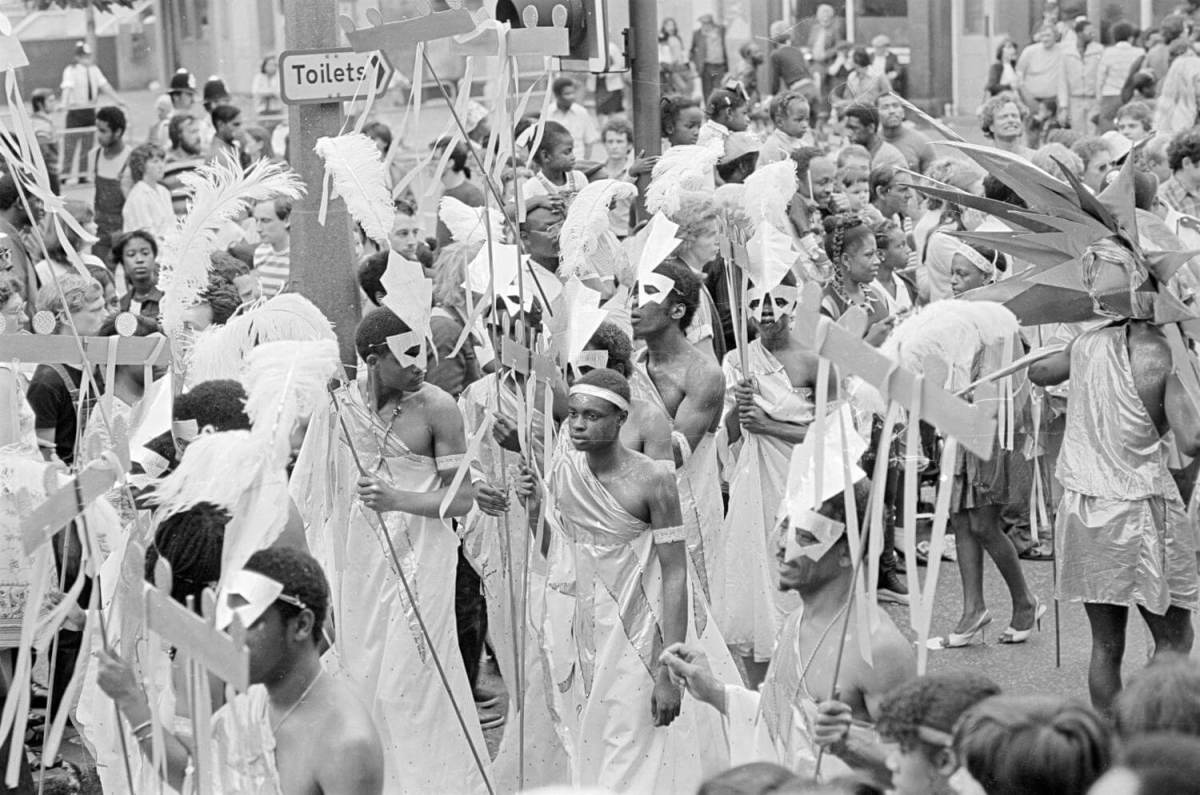
    Leeds West Indian Carnival. © Historic England Archive / Solomon Charles-Kelly. View image HEC01/134/02/02/06.

    What is the oldest carnival in the UK?

    Many may know of Bridgwater Carnival, proudly stating its beginnings as far back as 1605, and said to be Britain’s oldest Carnival. Its fiery festivities inspired the illuminated Carnival celebrations across Great Britain.

    A fundamentally Protestant region, Bridgwater jumped at the opportunity to celebrate the demise of Fawkes’ Catholic aspirations to blow up the Parliament in protest against the then King James I. 

    A drawn illustration of a Victorian street festival, with fireworks firing above a large crowd and domestic buildings in the background
    Bridgewater Guy Fawkes Festival, 1883. Source: 2025 Bridgwater Carnival Ltd.

    There are parallels between Bridgwater and Bridgetown, Barbados. Just a few short months after Fawkes was hanged, drawn, and quartered in 1606, the Caribbean Island was landed by the young James Drax, who built his empire on enslaving hundreds of African lives.

    Britain’s first Caribbean colony swiftly banned all forms of African music, instruments, and dance. Yet these customs survived, culminating in what we know today as ‘Crop Over’ or ‘the Grand Kadooment’ in Barbados – a yearly explosion of glitter and glamour on the streets cradled by old sugar cane plantations.

    While Carnivals like Bridgwater grew and grew, so did the British palettes for all things sweet, leading to an economic boom that culminated in millions of African souls living and dying on Caribbean soil weaved tightly by the roots of sugar cane.

    Amongst the growing innovations of wine gums and chocolate drops sold at passing carnival fairs and celebrations, sugared lips in towns and villages sang in jubilant chorus ‘God Save the King or Queen’, whilst Africans sang in whispers in the cane fields or absconded into wild unchartered Caribbean forests to have a moment’s respite to play their forbidden drums in secret.

    A man in military uniform, possibly a Lord Lieutenant, and Canadian Mounted Police passing crowds on the High Street.
    A procession along the High Street, Arundel, Arun, West Sussex in 1937. © Historic England Archive. View image TUP01/01/1644.

    Carnival merrymaking and festivities

    Yet, going even further back into the history of what Carnival is from the perspective of Britain, Europe, and also the Caribbean and South America (when referring to carnivals like Brazil), we must see Carnival as a human demand for the joys of life.

    Be it the joys of life’s indulgences controlled by church and society – sex, alcohol, foods seen as sinful – or the fundamental human right to freedom and autonomy over one’s own life, Carnival is a demand for freedom.  

    We can find records of celebration dating back to 1226 for Shrove Tuesday in Great Britain – the Tuesday before the 40 days and nights of abstinence from the pleasures of life, a nod of acknowledgement to Jesus Christ’s sacrificial walk about in the desert.

    Known also as ‘Fat Tuesday’, it was the day of consumption of all the fats in the household before the 40 days of sacrifice. Music, jubilation, and a last grab for joy were the modus operandi across Christian homes in Europe and the UK.

    An illustration showing a large family gathered by the fireplace. A woman is holding a pan and flipping a pancake.
    Shrove Tuesday, 1870. © Antiqua Print Gallery / Alamy Stock Photo.

    The transference of festivities was evident on Caribbean plantations from as early as the 1500s, when Columbus’ protégées bore witness to their enslaved cargo taking the holiday period as an opportunity to engage in their own Black celebration.

    Yet, one of the pinnacle moments that would have lit the spark of the largest carnival we know in the UK – Notting Hill Carnival – began many centuries before the first steel pan hit the streets of West London. In 1783, as France’s revolution was in full bloom, hundreds of Catholic French people relocated to Trinidad and settled in neighbouring islands.

    A black and white photograph showing dancers and children dressed in costume.
    Dancers who took part in the Carnival procession held in honour of Princess Margaret in Trinidad in 1955. © Keystone Press / Alamy Stock Photo.

    Tied by Catholic allegiance, they swore loyalty to the Spanish crown as they trembled under the weight of letters carrying the news of yet another beheading of their allies in France, Martinique, Saint Lucia, and Guadeloupe.  

    These Catholic plantation owners celebrated pre-lent in magnificent masquerade, elaborate balls where their enslaved African and ‘mulatto’ labourers bore witness to all its splendour. And as their ancestors had done on Columbus’s Spanish colonies, they capitalised on the distraction of their captors to remind themselves of their lost identities and created a carnival of their own.

    Subverting European custom, introducing parody and satire, as they too frolicked in the revelry of resistance – a refusal to let go of who they really were.

    Regal celebrations and Carnival prohibition

    Fast forward several centuries to 1887, when vibrant celebrations of Queen Victoria’s Jubilee were dotted around the nation, and the Isle of Wight took the lead with a parade to celebrate the monarch.

    Referred to as “A Rather Bewildering Spectacle” by the County Press, its precedence encouraged its return the following year, and for it to be dubbed ‘Isle of Wight Carnival’.

    An illustration depicting a street carnival in the late 1800s with carriages and fancy dress.
    Carnival and Torchlight Procession in the Isle of Wight, 1889. © Penta Springs Limited / Alamy Stock Photo.

    Yet, across the Atlantic this very same year, British law enforced something else new – a law banning all forms of African percussion in the islands of Trinidad and Tobago, deeming the practice ‘demonic’ and riot-inciting.

    Despite 1888 being half a century since the Abolition of Slavery, colonial oppressive forces still denied thousands the right to hold festive occasions. So, while carnival celebrations spread across Yarmouth, St Helens, Newport, and other towns and villages, British laws spread across the Caribbean banning any forms of parade, percussion, or masquerade.  

    When was the steel drum invented?

    A new variant of percussion was born in the quiet lull of the Second World War, where the world rationed out livelihoods in stamp books and tiny portions. Under the heaviness of the colonial laws, innovation broke through in the form of drums.

    Trinidad and Tobago, a nation with a growing petroleum economy, was littered with abandoned oil drums. When life was brought to a wartime standstill, musicians experimented until they invented the only new instrument to be born in the 20th century: the steel drum.

    A black and white photograph of a lively group of musicians plays steel drums in a rehearsal space,
    Arthur France playing a percussion instrument and dancing with members of a steel band, at an event celebrating the 40th anniversary of the Leeds West Indian Centre. © Historic England Archive. View image DP462789.

    Also known lovingly as ‘steel pan’ or simply ‘pan’ by most Caribbean communities, the discarded oil drums became the voice of a community that experienced generations of cultural suppression.

    Coming out of working-class neighbourhoods, the steel pan was perfectly paired with the plight for the right to parade the streets, and so with that, the English-speaking Caribbean witnessed a new resurgence of a cultural practice that survived centuries of laws to stop it.  

    After the Second World War ended in 1945, many thousands of Caribbean people from the then British colonies migrated to what was affectionately called ‘The Mother Country’ to assist in Britain’s effort to rebuild after the war’s devastation. While the Caribbean experienced a brain drain of some of the most dedicated minds, the UK experienced an incredible cultural injection.

    A black and white photograph of a market with a woman examining produce, surrounded by various fruits and vegetables. Nearby, a man looks on, while others engage in shopping and conversation.
    Inverness Street, Camden Town, Camden, Greater London, photographed between 1946 and 1959. © Historic England Archive. View image AA054028.

    Thousands of Caribbean arrivals did not receive the warm motherly embrace they were told they would, with a backlash from racist groups like the National Front and some Teddy Boys leading to losses of Black life, while groups of thugs and some police went on targeted hunts to assault Black British citizens in the dark of night or brazenly in broad daylight.

    A black and white photograph of people dressed in costume in a street carnival.
    Notting Hill Carnival, London, photographed between 1979 to 1983. © Historic England Archive. View image MF001653/06.

    And much like how Carnival began in the Caribbean as a march for freedom, an unwavering desire for the basic human right to joy, so it continued in the UK with the birth of Leeds Carnival and Notting Hill Carnival.

    When was the first Notting Hill Carnival?

    With the brilliant activist Claudia Jones hailing from Trinidad and Tobago, banished from her homeland and the USA for her community work, championing the rights of Black and Brown people, she found herself traversing the streets of Vauxhall in the 1950s.

    Bearing witness to yet another race war as the post-war influx of Black faces, heads down and voices lowered as they worked dutifully to have a place in the land of their ‘Mother’, Jones couldn’t stand to see yet another Black face bloodied by the fists of some well-dressed Teddy Boys or Bobbies.

    A black and white photograph showing people dancing in a crowded space.
    The first ‘Notting Hill carnival’, organised by Claudia Jones. © Trinity Mirror / Mirrorpix / Alamy Stock Photo.

    Beginning as an indoor carnival in King’s Cross, London, to allow a safe space for Caribbean people to sing and dance together, a place where familiarity was a rarity, Claudia Jones began the first Caribbean Carnival in the UK.

    Knowing Caribbean Carnival’s political roots, she used the event as an opportunity to raise funds to pay for the legal fees for those affected by the race riots, both Black and Brown Caribbean people and white British who stood as allies against racism.  

    A photograph of people in fancy dress dancing in a street carnival.
    Leeds West Indian Carnival, 2024. © Historic England Archive / Solomon Charles-Kelly. View image HEC01/134/02/02/02.

    Communities like Leeds brought to the streets for the first time a processioned Caribbean Carnival in 1967, often forgotten under the multi-million-pound enterprise that is Notting Hill Carnival today. 

    Notting Hill’s streets became the epicentre of pageantry and parade after community activist Rhaune Lasslett began the Notting Hill Fayre in 1966, inviting marginalised community groups from the predominantly migrant West London neighbourhood.

    Whilst the Irish, Russians, Ukrainians and Poles created festive treats and games, a group of Caribbean steel pan players did what they always knew – they took to the streets in procession. Once again, they put their culture and identity to the forefront, a reclamation of space, a demand for the right to equality. Carnival became a transference of marches for freedom from one colonial space to another.  

    Carnivals within the UK draw on many parallels from Catholic and other Christian rituals, parades, and pageantry. The foundations of British Carnival stem from celebrations of monarchical legacies, often oppressive ones, stamping out the voices of many disenfranchised. Those from the Caribbean are founded on a fundamental right: human equality.

    About the author
    Fiona Compton is a St Lucian filmmaker, historian, and cultural ambassador, and the founder of ‘Know Your Caribbean’, the leading platform for Caribbean history and culture. Through vibrant storytelling, educational resources, and visual art, she amplifies the Caribbean’s rich legacy, challenges colonial narratives, and inspires pride across the global Caribbean diaspora and beyond.


    Further reading

  • The History of Chinatowns in England

    The History of Chinatowns in England

    Lined with vibrant restaurants and bustling shops, Chinatowns are lively culinary hubs at the heart of England’s cities.

    A melting pot of diverse Asian cultures and communities, they are often marked by a distinctive Chinese archway, or paifang, which stands as a cultural symbol of Chinese heritage in England.

    Chinatown, Gerrard Street, London. © Historic England Archive. J070045.

    From the hidden stories of Chinese sailors to creating new culinary hotspots, England’s Chinatowns trace the development of Chinese communities in this country.

    The Chinatowns in Liverpool, London, Manchester, Newcastle and Birmingham are emblems of local Chinese culture.

    Discover how they have shaped the multicultural landscapes across England’s cities.

    Nelson Street, Liverpool, Merseyside

    Home to the oldest Chinese community in Europe, Liverpool has seen a long history of Chinese immigration in England.

    In the 1860s, strong trade links were established between Shanghai, Hong Kong and Liverpool, importing silk, cotton and tea.

    An intricately decorated Chinese archway with traditional green, red, and gold colours, standing at the entrance to a street lined with brick buildings and Chinese businesses. Stone lion statues guard the arch.
    The Chinese paifang or arch at the entrance to Nelson Street, Chinatown, Liverpool, Merseyside. © Phil Nash / Creative Commons.

    These shipping lines brought many Chinese seamen employed by British shipping companies to Liverpool, with Alfred Holt and Company opening boarding houses near the docks to accommodate their workers.

    While the workers initially stayed in these boarding houses, they gradually started laying down roots in the city. In the 1890s, settlers started opening businesses catering to Chinese sailors, forming Liverpool’s first Chinatown on the docklands.

    After the city suffered heavy aerial attacks during the Second World War, the community moved further inland towards Nelson Street and its surrounding areas, forming the Chinatown we see today.

    As part of a redevelopment plan for the area, a Chinese arch was erected on Nelson Street, a homage to the oldest Chinese community in Europe. Standing at 13.5 metres tall, this impressive arch is the tallest of its kind in Europe and the second tallest outside China.

    A 3-story red brick building with 2 prominent red doors on the ground floor, featuring arched windows. Above the doors, a sign with Chinese characters and the words "Chinese Freemason U.K." is displayed. There is a restaurant sign partially visible on the left.
    10 and 12 Nelson Street, beside the Chinese arch in Liverpool, Merseyside. Contributed to the Missing Pieces Project by Phil Nash. View List Entry 1293145.

    Despite its significance in the earliest days of British Chinese history, Liverpool also offers a glimpse into the prejudice historically levelled against British Chinese communities, with a hidden history that, until the early 2000s, went largely untold.

    Despite serving Britain during the Second World War, many Chinese seamen were subjected to significant pay disparities compared to their British counterparts. This led to a strike for rights and equal pay in 1942, stirring up xenophobic sentiments against Chinese workers and labelling them as troublemakers.

    A street scene in a Chinatown area, featuring a prominent Chinese archway adorned with intricate patterns in the background. The street is lined with brick buildings housing Chinese restaurants and shops. Several bright green and red lampposts and decorative elements hang overhead.
    Nelson Street in Liverpool, Merseyside. © Historic England Archive. View image AA029085.

    This built-up resentment culminated in the mass deportation of Chinese men by the British government after the war, tearing thousands of workers away from their families.

    For decades, this event was kept under wraps, leaving wives and children in the dark over where their husbands and fathers had gone, with many children still searching for their fathers today.

    Gerrard Street, Soho, London

    Attracting more than 17 million visitors per year, the bustling streets of London’s Soho are home to England’s most famous Chinatown. The ever-busy streets are lined with some of the country’s best Chinese restaurants and bakeries, with over 150 businesses and thousands of workers.

    A busy Chinatown street decorated with numerous red lanterns hanging overhead. A large archway adorned with Chinese characters spans the street. Crowds of people walk below, surrounded by red banners and signs.
    Chinatown, London. © Mark Wordy / Creative Commons.

    Despite its significance now, Gerrard Street is not London’s first Chinatown. In the 1880s, London’s first Chinatown formed in Limehouse in the East End, when Chinese seamen working for British shipping companies, such as the East India Company, started arriving in London for work.

    These seamen often stayed in the Docklands, where many Chinese businesses, from restaurants to laundries, provided them with a glimpse of home.

    To the outside, however, the area had gained a reputation in the press for its gambling houses and opium dens. This contributed to discrimination directed at Chinese immigrants and a rise in fears of ‘Yellow Peril’, an expression referring to East and South East Asians, particularly the Chinese, as a threat to Western civilisation.

    Though these fears were unfounded and steeped in prejudice, they nevertheless led to slum clearance programmes from the local council.

    A bustling city street at night is adorned with strings of red lanterns. A crowd of people walk beside illuminated shops and restaurants.
    Chinatown, London. © Daniel / Creative Commons.

    Such programmes displaced many Chinese families in Limehouse and more were driven from the area following the Blitz in the Second World War.

    They started relocating towards Soho in the West End, an area known for its low rent and vibrant nightlife. Soho’s long history of welcoming immigrant communities, from Italian to Jewish communities, made it the ideal new home for the displaced Chinese families.

    With overseas British soldiers returning after the end of the war in 1945, some had a taste for more diverse cuisines. Consequently, Chinese cuisine became increasingly popular, with many Britons seeking out authentic, flavourful Chinese food.

    Chinese workers seized the opportunity to shift their business interests from laundries to restaurants, offering the English a taste of the vibrant flavours of the East.

    In the 1970s, the number of restaurants and businesses on Gerrard Street expanded significantly, properly establishing what would become the current Chinatown: a busy neighbourhood in the heart of central London that is still thriving today.

    Stowell Street, Newcastle upon Tyne, Tyne and Wear

    Although the Chinatown on Stowell Street in Newcastle was not established until the late 20th century, the story of Newcastle’s Chinese community dates back much earlier.

    A Chinese archway with red pillars and intricately decorated carvings stands prominently on a city street. Behind it is a modern stadium.
    The Chinatown ceremonial arch, or Chinatown Gate, on St Andrew’s Street in Newcastle upon Tyne, Tyne and Wear, with the Gallowgate stand of St James’ Park stadium beyond. © Historic England Archive. View image PLA01/05/0022.

    Some of the earliest Chinese presence in Newcastle can be traced back to the 19th century, marked on distinctive headstones in St John’s cemetery in Elswick, Newcastle. Dating back to 1881, the headstones are dedicated to Chinese sailors who were sent as crew for battleships being built in the Elswick shipyards for the Imperial Chinese Beiyang Fleet, and died from illness.

    We recently funded a project run by the Tyne and Wear Building Preservation Trust on behalf of Newcastle City Council at the cemetery, which included engaging with members of the Chinese communities and the production of a new interpretation panel about the sailor graves.

    Despite the early presence of Chinese communities, the first Chinese restaurant, Marlborough Café, only opened in 1949. At the time, the Chinese population in the city was only about 30 people, a number that grew over the 20th century, bolstered by post-war migration.

    A small metal sign screwed to a brick wall featuring the wording 'Stowell Street' with a Chinese translation underneath.
    A sign for Stowell Street, Newcastle upon Tyne, Tyne and Wear. © Mike Quinn / Creative Commons.

    It was not until 1978 that the first Chinese business opened on the street that would become Newcastle’s Chinatown today. The opening of the Chinese supermarket, Wing Hong, was followed by many other businesses, though it took another 10 years before businesses were permitted to have signs in Chinese in addition to English.

    An 11-metre Chinese arch, built in China and shipped to Newcastle, was erected in 2005, solidifying Stowell Street as one of the country’s main Chinatowns.

    Faulkner Street, Manchester, Greater Manchester

    On Manchester’s Faulkner Street sits the second largest Chinatown in the UK and the third largest in Europe. It is a vibrant neighbourhood welcoming a diverse array of cultures.

    A vividly decorated Chinese archway on an urban street. A few pedestrians walk beneath the arch.
    The Imperial Chinese Arch, Chinatown, Manchester, Greater Manchester. © David Dixon / Creative Commons.

    The first Chinese settlers arrived in Manchester in the early 20th century as an alternative to Liverpool. Filled with 19th-century cotton warehouses, Faulkner Street was known locally as a slum area that was gradually transformed by the opening of Chinese businesses.

    Many early settlers participated in the laundry trade, eventually moving to the business of takeaways following the opening of the first Chinese restaurant, Ping Hong, in 1948.

    Much like the other Chinatowns in England, Manchester’s Chinese population saw a significant growth from post-war migration, spurred on by the introduction of the British Nationality Act in 1948, which created easier access into the country.

    Following the Chinese Communist Revolution and the establishment of the People’s Republic of China, huge numbers of refugees fled from mainland China to Hong Kong to escape the unstable politics of the region. This, combined with farmers in Hong Kong displaced by urban sprawl, initiated a swell in Chinese immigration into Britain in the 1950s and 60s.

    A street scene with historic red-brick buildings featuring a yellow and red storefront sign reading 'Wing Fat Supermarket' in both English and Chinese.
    49 Faulkner Street, Manchester, Greater Manchester. Contributed to the Missing Pieces Project by Barrie Price. View List Entry 1200831.

    With an ever-increasing number of restaurants and other businesses such as supermarkets and medicine shops opening in the 1970s, Manchester’s Chinatown gradually became a major cultural hub.

    In 1987, an Imperial Chinese arch was specially built in China and shipped to Manchester, celebrating the cultural heritage of the local area’s Chinese community.

    Now, Faulkner Street boasts an impressive variety of cuisines, with not only Chinese restaurants, but Japanese, Korean, Nepali, Malaysian, Singaporean, Thai and Vietnamese restaurants lining its streets.

    Hurst Street, Birmingham, West Midlands

    As one of England’s newer Chinatowns, Birmingham’s Chinatown is a hidden multicultural gem in the Midlands.

    Unlike the port cities where Chinese sailors settled before the 20th century, Birmingham did not see large-scale Chinese immigration until post-war migration brought an influx of immigrants from Hong Kong after 1945.

    A street at night, illuminated by glowing red and white lanterns. Bright neon signs in various colours hang above storefronts showcasing vibrant window displays.
    Cathay Street, Birmingham, West Midlands. © Historic England Archive. View image HEC01/128/02/03/08.

    Settling around Hurst Street in the 1960s, the Birmingham Chinese community started as an informal cluster of Chinese businesses, community organisations and social clubs that formed a hub of Chinese culture.

    The community grew and thrived over time, until it was recognised as the Birmingham ‘Chinese Quarter’ in the 1980s.

    A narrow urban alley lined with brick buildings and decorated pillars painted with vibrant patterns. The alley features hanging flower baskets and various restaurant signs.
    Arcadian Shopping Centre, Hurst Street, Birmingham, West Midlands. © Brian Robert Marshall / Creative Commons.

    The opening of the Arcadian Centre in 1991 brought a host of restaurants, bars and shops to Birmingham, forming the heart of Chinatown with its 2-tiered courtyard and elegant Chinese architecture. The donation of the 7-storey Pagoda at Holloway Circus by the supermarket chain owners, the Wing Yip brothers, cemented the legacy of Birmingham’s Chinese Quarter.

    In May 2024, Birmingham’s Chinese Quarter was renamed Birmingham Chinatown, celebrating the community’s cultural heritage. Unlike other Chinatowns in England, Birmingham does not boast its own paifang, but there have long been plans to install a traditional arch, marking the legacy of Chinese culture in Birmingham.

    Written by Steph Chan


    Further reading

  • The Pioneering Stockton and Darlington Railway

    The Pioneering Stockton and Darlington Railway

    When the railway expanded in Britain in the 19th century, it transformed the way people lived, worked and socialised.

    Heavy goods could be transported faster than before, rural areas now had access to urban centres and new employment opportunities, and travel and leisure activities became more accessible for most people.

    But how and when did people first start using the railways?

    The Stockton and Darlington Railway (S&DR) became the world’s first standard-gauge, steam-hauled public railway when it opened in 1825.

    George Stephenson’s steam locomotive was used for the Stockton and Darlington Railway opened in 1825. © Luisa Fumi / Alamy Stock Photo.

    27 September 2025 marks its bicentenary, and Railway 200 is a year-long, nationwide campaign to celebrate 200 years of the modern railway.

    Explore what made the S&DR special and discover how you can experience it in the historic environment today.

    Early railways in England and Wales

    Railways had been used in the mining industry since at least the 16th century to move materials from mines and quarries for onward transport to market. On fairly level terrain, these were simple wooden rails with wagons pulled by horses, but rope-hauled incline planes could be used on steep gradients.

    Timber-railed, horse-drawn wagonways were extensive by the 18th century, with iron gradually replacing timber by 1800, which also saw the first railways being built for public use.

    The first use of a steam locomotive was in South Wales in 1804, and the first (horse-drawn) passenger service also started in South Wales in 1807.

    When did the Stockton and Darlington Railway open?

    On 27 September 1825, the S&DR built on early railway technology and changed the world of travel. It brought together many strands of existing railway technology to create a remarkably pioneering endeavour.

    A painting of a railway bridge in the background with a steam train travelling across it. In the foreground, groups of people in early 19th-century dress stand on an unpaved road, looking towards the bridge.
    The opening day of the Stockton and Darlington Railway, 27 September 1825, painted in 1875 by John Dobbin. © Hopetown Darlington / Borough Art Collection.

    At the railway’s hilly western end, coal wagons were rope-hauled up inclines by stationary engines and pulled by horses along the level.

    At New Shildon, a train of wagons was formed, including the passenger coach known as the Experiment. This train, carrying 600 passengers and tonnes of goods, was then hauled by Stephenson’s engine Locomotion to Stockton.

    Why was the Stockton and Darlington Railway built?

    The railway connected the Durham coal field to the west of Bishop Auckland with the market town of Darlington and the port of Stockton-on-Tees, where goods could be loaded onto boats. This reduced the cost of transporting coal, but it also allowed the carriage of other freight and passengers.

    A photograph of a stone railway bridge over a small canal. A train travels across the bridge.
    Skerne Railway Bridge in Darlington was constructed as part of the Stockton and Darlington Railway. © Historic England Archive. View image DP175626. View List entry 1475481.

    In 1818, businessmen and colliery owners collaborated to promote a horse-drawn railway, which was approved by parliament in 1821.

    However, Edward Pease (1767 to 1858), a Quaker who was one of the S&DR’s investors and a Darlington merchant, discussed using steam locomotives with the engineer George Stephenson (1781 to 1848), and so the S&DR was redesigned in 1823 to be steam-hauled for much of its 26 miles.

    Passengers were initially carried on horse-drawn services, which were independently operated under licence. One of the licence holders was Daniel Adamson, who built a stone coach house to store his coach overnight.

    A photograph of a stone, 2-storey cottage with bright green painted doors and window surrounds.
    Daniel Adamson’s coach house, Shildon, County Durham. Contributed to the Missing Pieces Project by Stan Laundon. View List entry 1365641.

    A railway based on coal

    Coal made the S&DR profitable, as the railway carried vast quantities of it. The railway was soon extended to the new port of Middlesbrough, built on the river Tees from 1829. Coal, ore and the S&DR led to massive industrial growth on Teesside, feeding the area’s ironworks.

    The S&DR needed coal to run its locomotives, too. Coaling stations were built to refill the locomotives’ tenders, and an extensive one survives in Shildon.

    A photograph of a long row of a stone railway coal drops beside an empty railway track. It is surrounded by trees and long grass.
    The conserved railway coal drops, Shildon, County Durham. © Historic England Archive. View image DP289852. View List entry 1160320.

    The first railway town in England

    New Shildon in County Durham was a new town built on land drained for the railway where several coal lines met, and it was where the S&DR manufactured and serviced steam locomotives and then wagons.

    It was also home to the Soho Works where their principal engineer, Timothy Hackworth (1786 to 1850), built locomotives from 1833. The S&DR bought his company in 1855 and combined it with its own.

    Employment on the railway and in local coal mines made New Shildon a successful place to live and work, and as it expanded, it joined up with the historic village of Shildon.

    A black and white aerial photograph of a village surrounded by farmland.
    An aerial photograph showing the historic village of Shildon to the north and New Shildon on either side of the Stockton and Darlington Railway’s main line in 1946. © Historic England Archive (RAF Photography), RAF/106G/UK/1700 V 5087.

    Roads and several branch lines link the 2 parts of Shildon. The pre-1825 village is to the north, and New Shildon was built around the east to west part of the S&DR.

    The west of New Shildon features the long buildings of the former wagon works, started by the S&DR and closed in 1984. It is now the Hackworth Industrial Park.

    The centre of New Shildon contained rows of housing, the earliest being the 2 triangular blocks on either side of the railway line. To the east was the vast sidings for coal wagons, now home to the National Railway Museum’s Locomotion.

    A photograph of the long side of a dilapidated brick wagon works building with blocked up windows with a road running along beside it.
    Former wagon works, Shildon, County Durham. © Lucy Jessop / Historic England.

    Railway innovation and new building types

    In 1825, the S&DR was a complex endeavour. Aspects that are obvious now, such as railway stations, ticketing, booking, signalling, and directly employing or contracting out staff, were thought out in its early years.

    Locomotives and wagons needed buildings where they were manufactured, housed and serviced. Goods and aggregates needed places where they could be unloaded and sold. People needed shelter, platforms and stations.

    The Goods Depot at Darlington shows how the fledgling public railway innovated, changed and adapted in its early years. In 1827, the company built its first goods depot in Darlington, but by 1833 it was turned into a passenger station.

    A photograph of a large. external stone staircase leading up to a renovated industrial building with a small clock tower at the centre.
    Goods Depot, Darlington, now the entrance to Hopetown Darlington. © Hopetown Darlington / Borough Art Collection. View List entry 1121262.

    The present building was then constructed for undercover unloading, with arched openings for windows and tracks, possibly for 2 railway tracks. By 1839, it had been doubled in length so that 4 railway tracks could enter the building. The next year, it was expanded again.

    The swift evolution of the building shows how the needs of the S&DR were constantly shifting in the railway’s early years.

    Inventing the railway station

    The idea of a building that combined ticket sales, parcel depots, waiting rooms, and platforms for passengers was not conceived in 1825. Trains stopped at level crossings and tickets were sold in public houses.

    In 1826, the S&DR built a ‘house’ between Heighington and Aycliffe “for a booking office, and the reception of passengers” (‘Durham Chronicle’, 29 October 1829), but local magistrates initially refused it a licence to sell alcohol until an appeal was successful. This building became known as Heighington Station.

    A black and white photograph of a small, single-storey stone railway station beside a railway track. A train travels across the track.
    Heighington Station in Newton Aycliffe, County Durham, when still in use in 1964. © Friends of Stockton and Darlington Railway / R Goad. View List entry 1322808.

    In 2023, the building had its listing upgraded to Grade II*, recognising its historical importance. It is probably the first station building in the world.

    Following a crowdfunding campaign and a donation by Hitachi in 2025, the building is being acquired by the Friends of the Stockton and Darlington Railway.

    Stockton and Darlington’s wider influence

    As use of the railway increased, engineers and potential investors came to see the S&DR and the lessons learned from its experimental operation were carried across the world.

    Described as “the great theatre of practical operations on railways” by Edward Booth of the Liverpool and Manchester Railway, the S&DR influenced the development of many early railways.

    These included the Saint-Étienne-Lyon (France, 1828), Baltimore and Ohio (USA, 1830), and the Liverpool and Manchester (1830). Locomotives built in Shildon were supplied to Russia in 1836 and Canada in 1838.

    A photograph of the front section of a steam train on display in a large station building.
    The Stockton and Darlington Railway engine No 1 ‘Locomotion’ on display at Bank Top Station, Darlington, County Durham, in 1968. © Historic England Archive. View image IMP01/01/0100.

    Experiencing the Stockton and Darlington Railway today

    Much of the S&DR is still in use as part of the national rail network, and museums at Shildon (Locomotion) and Darlington (Hopetown Darlington) utilise and maintain historic railway buildings, telling the story of its history.

    As part of the bicentenary celebrations in 2025, the S&DR Trail of Discovery (a public walking and cycling route following sections of the original line) has information boards and links to podcasts about aspects of the company’s history.

    You can also explore new and revised descriptions of S&DR buildings and archaeology on the National Heritage List for England.

    Written by Lucy Jessop and Eric Branse-Instone

    The Stockton and Darlington Railway Heritage Action Zone ran from 2018 to 2023 and laid essential foundations for the S&DR200 bicentenary celebrations, as well as the line’s long-term management as a world-class visitor attraction.

    Our investment in the project included funding the repairs to key heritage sites, new research into the railway’s history, community engagement, and heritage skills training.

    Key partner organisations included Darlington Borough Council, Durham County Council, Stockton Borough Council, Tees Valley Combined Authority, the Friends of Stockton and Darlington Railway, the Science Museum Group, and Network Rail.


    Further reading

  • What Is the Oldest Pub in London?

    What Is the Oldest Pub in London?

    There are many claimants for London’s oldest public house, with several names repeatedly cropping up.

    The earliest pubs were medieval alehouses, taverns, and inns. The term ‘public house’ was in use by the early 17th century and included these early types of buildings.

    No historic pubs survived the Great Fire of London in 1666, and 21st-century Greater London is much larger than the historic core mapped during the late 17th century.

    A map of London from around 1673 by Wenceslaus Hollar, extending from Westminster to Stepney and from St George’s Fields in the south to fields north of the city. Source: Alamy / The History Emporium.

    Therefore, our search for the oldest pub concentrates on Westminster, Southwark, Temple (the historic area around the Inns of Court) and the suburbs including Shoreditch, Whitechapel, Wapping, and Rotherhithe.

    To start, let’s look at some of the popular contenders:

    The Prospect of Whitby, Wapping

    Claim: 1520

    It’s claimed that the Prospect of Whitby is the oldest riverside tavern in England, and some say that the writer and politician Samuel Pepys was once a local. However, it’s unlikely that Pepys saw the building that stands today, as it appears to date from the 18th and 19th centuries.

    The first references to the pub’s foundation in 1520 did not appear until the 1950s and may have been related to a marketing campaign rather than historical research.

    Ye Olde Mitre, Holborn

    Claim: around 1546

    Supposedly founded in 1546 as a drinking den for the servants of the Bishop of Ely, the origins of Ye Old Mitre are much later. The site of the bishop’s London estate was taken over by the Crown in 1772 and completely redeveloped.

    The Mitre was established during the 1770s, and the names of some of the early licensees, including William Dash (1791) and James Parker (1794), are known through fire insurance records.

    The Mayflower, Rotherhithe

    Claim: around 1550

    Although not a listed building, it’s often claimed that the Mayflower first opened its doors for trade as a pub called The Ship around 1550.

    The earliest parts of the standing building date to the 1780s, when it was a pub called the Spread Eagle and Crown. However, the building was severely damaged during the Second World War, leaving only the ground floor standing.

    The building was rebuilt during the late 1950s and renamed the Mayflower in memory of the nearby mooring of the Pilgrim settlers’ famous ship that set off for the Americas in 1620.

    Hoop and Grapes, Whitechapel

    Claim: 1593

    Some suggest that the Hoop and Grapes is London’s oldest licensed pub and that it survived the Great Fire of 1666. However, the building is more likely to be from the late 17th century.

    It’s also recorded in trade directories and fire insurance records that the property was used by wine and brandy merchants throughout the latter 18th and the 19th centuries. It was eventually converted into a pub in 1920.

    The Seven Stars, Holborn

    Claim: 1602

    It has sometimes been thought that the carpentry details of the staircase and roof structure at the Seven Stars are characteristic of the late Elizabethan period (1558 to 1603). It also claims the specific date of 1602 as its origin.

    Instead, pub historians Geoff Brandwood and Jane Jephcote have pointed to a more likely date of construction in the 1680s. This structure was then significantly remodelled when a new façade was added in the 19th century.

    What is the oldest pub in London?

    The dates painted on pub signs can be inaccurate. Some pubs are on old sites, but their structures were rebuilt later. Others were built for a different purpose and were later converted into pubs.

    However, based on archival research, archaeology and tree-ring dating, it’s possible to identify 2 genuinely old pubs surviving in London:

    Ye Olde Cheshire Cheese, Fleet Street

    Established by 1680

    Despite claims that the cellars of Ye Olde Cheshire Cheese were built in the 13th century for a Carmelite monastery or that there was a pub on the site in 1538, the origins of this pub are a little later.

    Stylistically, the earliest parts of the building, including the brick-vaulted cellar, date back to the late 17th century. It seems likely that the building was constructed after the Great Fire of 1666, although it was then significantly remodelled around a century later.

    A photograph of a 17th century pub in an alleyway with a sign reading "Ye Olde Cheshire Cheese / REBUILT 1667".
    Ye Olde Cheshire Cheese at 145 Fleet Street, London. © Historic England Archive. View image DP150337. View List entry 1064662.

    The earliest reference to the Cheshire Cheese comes from a broadside ballad, ‘The Midwives’ Ghost’, which was published in 1680. This marked the beginning of a strong literary association for the pub, which was later patronised by figures including Charles Dickens, W. B. Yeats, and P. G. Wodehouse.

    The George Inn, Southwark

    Established by around 1542 and rebuilt in 1677

    Borough High Street was once thick with public houses serving travellers approaching or leaving the City via London Bridge. The George Inn is the only one to have historic fabric which has survived to the present day, giving it the best claim to be London’s oldest pub.

    The earliest known reference to an inn on the site comes from a map of Southwark made around 1542. Later in the 16th century, it was referred to by the topographer John Stow in a list of ‘many fair inns’.

    The building was rebuilt entirely during the 1620s, partly rebuilt in 1670, but was then consumed by the 1676 great fire of Southwark. In 1677, the tenant, Mark Weyland, began the reconstruction of the George.

    The only surviving part of Weyland’s 1677 rebuild is the western part of the south range. This part of the inn probably had services on the ground floor below 2 storeys of bedchambers accessed from galleries. This makes it London’s only surviving galleried inn, once a common sight during the medieval and early modern periods.

    The significance of pubs
    Much blood, ink and beer have been spilt during discussions about London’s oldest pub. Given the tricky nature of the available information, it’s easy to see why. At a time when public houses are under increasing threat of closure, we should celebrate their value to the communities that they serve. Whether it’s a 17th-century galleried inn or a 19th-century beerhouse, let’s enjoy the warm welcome offered by London pubs. Cheers!

    Written by Dr James Wright FSA


    Further reading:

  • A Brief Introduction to Martello Towers – The Historic England Blog

    A Brief Introduction to Martello Towers – The Historic England Blog

    Martello towers are a series of small coastal artillery forts, built to counter the threat of invasion from France in the Napoleonic era (roughly 1799 to 1815).

    The name and form of the Martello tower derive from a small defensive tower at Punta Mortella, a point in the bay of San Fiorenzo in Corsica. The British Army struggled to capture the tower in 1794, and when they withdrew from Corsica in 1796, they demolished most of the tower so that it could no longer be used. Contemporary correspondence misspelt Mortella as ‘Martello’, and the misspelling has remained to this day.

    Martello Tower No. 64, Eastbourne, East Sussex. © Historic England Archive, View image DP059979. View List entry 1043661.

    Between 1796 and 1815, 194 towers were built in Britain and its dependencies as a result of the British being at war with France and the United States of America. The intention was to strengthen batteries, protect coastline particularly vulnerable to enemy landings, and guard estuaries and marshland sluices.  

    A proposal to build defensive chains of Martello towers along the south and east coasts of England was agreed in 1804. From Folkestone in Kent to Seaford in Sussex, 74 towers were built along the south coast between 1805 and 1808 and were identified by numbers (1-74). 

    Twenty-nine towers were constructed along the east coast of Essex and Suffolk between 1808 and 1812; these were identified by letters of the alphabet, starting with Martello ‘A’ at St Osyth, and ending with ‘CC’ at Slaughden just south of Aldeburgh (having started again at AA once they passed Z).

    A photograph of a large, round, stone structure stands between 2 brick buildings. In the foreground, 2 black cars are parked on either side.
    Martello Tower no. 24, High Street, Dymchurch, Kent. © Historic England Archive. View image DP217454. View List entry 1061124.

    How many Martello Towers survive?

    Of the 103 towers built in England, around 45 survive to varying degrees.

    Around one fifth of the towers were built with a dry moat, typically 5 metres deep and 10 metres wide. Lined with a perimeter brick retaining wall, compacted soil was piled around the exterior to create a sloping surface against the outside face of the wall. The idea was that the dry moat would act as a trap for enemy troops, who could be picked off by musket fire from the tower roof.

    Some towers were also constructed with a subsidiary water-filled trench at the foot of the tower, known as a cunette, or a defensive sloping bank known as a glacis.

    A photograph of a round Martello tower made of stone near the edge of a coastal cliff, overlooking a rocky beach and the sea.
    Martello Tower W, East Lane, Bawdsey, Suffolk. © Historic England Archive. View image DP046352. View List entry 1377188.

    Both the south and east coast towers were designed around the concept of a single robust round tower with roof armament; the only exception is Tower CC which is quatrefoil (four-leafed) on plan.

    The south towers were constructed of yellow-grey London brick or locally made red brick, while the east towers were constructed of red brick manufactured at Grays in Essex. Both were constructed with a high-strength hot lime mortar which set as hard as iron and rendered.

    A vast quantity of raw materials was needed for these towers and it’s estimated that over 700,000 bricks were used in the construction of each east coast tower.

    A photograph of a round martello tower with two windows.
    Martello Tower W, East Lane, Bawdsey, Suffolk. © Historic England Archive. View image DP046352. View List entry 1183230.

    The quality of workmanship on the east towers is considered higher than the earlier south towers, as by that time much experience had been gained in building the structures and the threat of invasion had ebbed, so the work was not as hurried. The parapet, windows and doors of the east towers are dressed with stone. 

    Aerial photograph of a stone Martello tower with circular patterns in the centre. Below the structure is a sandy beach and promenade.
    Martello Tower E, Tendring, Essex. Contributed to the Missing Pieces Project by Paul Davis. View List entry 1337150.

    The walls are 10 metres (33 feet) high, being slightly tapered from base to roof.  Although they appear round, the south towers are actually elliptical on plan, having thicker walls on the seaward side.

    The plan was modified slightly for the east towers to accommodate an increase in roof armaments and 2 stairs to the roof, resulting in a cam-shaped or ovoid plan. The south towers generally measure around 13.6 metres (45 feet) in diameter, and the east towers have a wider diameter of around 16.7 metres (55 feet), providing larger floor areas on each level.  

    What was inside a Martello tower?

    Each of the towers had 3 circular floors, namely a ground floor, first floor and roof. The entrance was at first floor level, reached either by means of a retractable ladder or a drawbridge where a moat and glacis had been constructed.

    The first floor was partitioned into three sections around a central brick pillar, one room for the commanding officer, another for housing a garrison of between 15 and 24 men, and the rest for storage of provisions.

    The substantial central brick pillar (thicker in the east towers to support the increased roof armaments) supported a brick-vaulted ceiling, oak radial floor joists and a rack to hold 27 muskets.

    A photograph of a Martello Tower with two windows. Next to the tower is picnic benches on grass.
    Martello Tower E, Tendring, Essex. Contributed to the Missing Pieces Project by Paul Davis. View List entry 1337150.

    Small side windows provided natural light, 2 on the south towers and 4 on the east towers. The ground floor was entered from the first floor through a trapdoor by means of a ladder and was used for the storage of gunpowder, ammunition, provisions, fuel and water (fed from the roof and operated by a pump at first floor level).

    In the south towers, a single staircase from the first floor provides access to the seaward side of the roof, while in the east towers a pair of staircases provide access to the landward side of the roof.

    The south towers were each armed with a 24-pounder, long range cannon mounted on a rotating oak carriage, enabling the cannon to be fired in any direction. The east towers have a quatrefoil (four-leafed) arrangement, with a 24-pounder cannon in the seaward emplacement, and carronades (smaller cannons) in the lateral (side) emplacements.

    A photograph of a Martello tower made of brown with a narrow wooden walkway leading to a central arched entrance.
    Martello Tower CC, Slaughden, Suffolk. © Historic England Archive. View image DP046364. View List entry 1269724.

    Howitzers were also installed as short-range guns to defend the tower on the landward side or at close quarters. The inside of the parapet wall has ammunition recesses for storing cannonballs, all ammunition being passed up the stairs by hand from the ground floor magazine.

    Two chimneys of light-weight construction could be rapidly demolished in the event of an attack (as they would otherwise impede the guns and create blind spots within the field of fire). 

    Were Martello towers ever used?

    The towers were never actually tested in combat, and after the Napoleonic threat of invasion passed a number of towers were demolished for materials, and a number adopted as coastguard stations to monitor smuggling.

    A photograph of a road surrounded by greenery. In the distance a converted brick tower is visible.
    Martello Tower 1, Folkestone. Contributed to the Missing Pieces Project by Terry Begent. View List entry 1392511.

    Some towers continued to contribute to the defence of the country during the conflicts of the 20th century, including use as wireless telegraphy stations, and observation posts during the First and Second World Wars and Cold War. A significant number have been lost to erosion, and of those that do survive, many have been converted into private dwellings.   

    A photograph of a white Martello tower with two small windows sitting within a field.
    Martello Tower ‘C’, Jaywick, Essex. © Historic England Archive. View image DP130272. View List entry 1165569.

    How to visit a Martello tower?

    In East Sussex you can visit Martello Tower No.74 at Seaford which has been adapted as a museum by the Seaford Museum and Heritage Society. In Essex, at Martello Tower D at Jaywick visitors can explore an exhibition on the ground floor, get up close to a replica cannon, and enjoy wonderful views across the sea from the roof.


    Further reading

  • 10 Historic Locations Featured in Classic British Horror Movies – The Historic England Blog

    10 Historic Locations Featured in Classic British Horror Movies – The Historic England Blog

    Scares on screen are as old as cinema itself. From the early years of horror film production in England to the present day, ghosts, haunted houses and other creepy subjects found a suitable outlet in the darkened space of the movie theatre.

    One obvious advantage to English filmmakers is that living in a country steeped in history provides a rich seam of historic buildings and sites perfectly suited to telling tales of evil, the supernatural and horror.  

    From Hammer Films’ golden age to modern blockbusters, England’s protected heritage has provided the perfect backdrop for spine-chilling tales. 

    Inspired by the recent release of ‘28 Years Later’, members of Historic England’s central Listing team have compiled their favourite 10 listed buildings to feature in British horror.

    The Curse of Frankenstein (1957) 

    Oakley Court was the location for some of the scenes in the 1957 / 1960 / 1966 horror films “Curse of Frankenstein” ,”Brides of Dracula” and “Plague of the Zombies”. Image contributed to the Missing Pieces Project by Domonic Martin.

    Oakley Court, Bray, Berkshire 

    Hammer Films’ breakthrough success, ‘The Curse of Frankenstein’ transformed Oakley Court Hotel into the most recognisable horror film location in Britain.

    Built in 1859 in outlandish Gothic Revival style, the Grade II* listed building near Bray featured two gabled ranges around a tall octagonal tower that perfectly embodied popular Victorian Gothic horror aesthetics.

    This horror film marked the beginning of Oakley Court’s association with the horror genre and made Hammer an international name. 

    Other Hammer Horror Films filmed at Oakley Court include: ‘The Brides of Dracula’ (1960), ‘Plague of the Zombies’ (1966) and ‘The Rocky Horror Picture Show’ (1975).

    A black and white archive image of a gothic mansion with a river in teh foreground.
    A Victorian photograph of Oakley Court viewed across the River Thames, Bray, Windsor and Maidenhead. Source: Historic England Archive. Image reference number: al0488_053_01.

    28 Years Later (2024)

    Lindisfarne Castle, Holy Island, Northumberland

    Danny Boyle’s post-apocalyptic sequel to ‘28 Days Later’ brought horror to Holy Island, in the northeast of England. The Grade I listed Lindisfarne Castle appears fleetingly in the background of its haunting coastal landscape.

    A colour photograph showing a stone castle built in a raised position on an Island.
    Lindisfarne Castle, Holy Island, Berwick-upon-Tweed, Northumberland. This was the location for some of the scenes in the 2025 horror film ’28 Days Later’. © Historic England Archive. Image number: DP438267.

    Though not a central feature, the 16th-century fortress, remodelled in 1902 by Sir Edwin Lutyens for Country Life founder Edward Hudson, quietly echoed the film’s themes of isolation and endurance.

    Its tidal-access location and enduring architecture offered a subdued yet poignant backdrop to this story of survival and transformation.  

    A colour photograph of a stone castle keep built on rock.
    Lindisfarne Castle, Holy Island, Berwick-upon-Tweed, Northumberland. This was the location for some of the scenes in the 2025 horror film ’28 Days Later’. Image contributed to the Missing Pieces Project by Peter Schofield.

    The Woman in Black (2012)

    Cotterstock Hall, Northamptonshire 

    ‘The Woman in Black’, based on Susan Hill’s Gothic horror novel, has been adapted twice for the screen. The 2012 theatrical version, starring Daniel Radcliffe as lawyer Arthur Kipps, brought the ghost story to a wider audience with heightened visuals and jump scares.

    The Grade I listed Georgian mansion Cotterstock Hall was transformed into the infamous Eel Marsh House, where Arthur Kipps uncovers the terrifying secrets of the Woman in Black.

    Despite lacking the novel’s marshland setting, the hall’s remote location and architectural gravitas created the perfect atmosphere for this tale of supernatural revenge, demonstrating how Georgian elegance could be transformed into Gothic terror through careful cinematography. 

    An actor in Victorian Costume stands at the gates of a historic mansion, the main building is in the background.
    Daniel Radcliffe in ‘The Woman in Black’© AJ Pics / Alamy

    The Omen (1976)

    Guildford Cathedral and All Saints’ Church, Fulham, London

    ‘The Omen’ is an American-financed horror epic which showcased multiple historic locations in Surrey in its tale of Satan’s son, Damien.

    Pyrford Court, a Grade II listed Neo-Carolean mansion built in the 1920s partly to the owner’s own design, served as the US Ambassador’s residence.

    Guildford Cathedral, Edward Maufe’s Grade II* listed Gothic Revival masterpiece and England’s last new Anglican cathedral, provided the setting where the devil-child’s reluctance to enter churches first becomes apparent.

    A colour photograph showing a cathedral built of brick against a cloudy sky.
    The Cathedral of the Holy Spirit Guildford. Also known as Guildford Cathedral, this was the location for some of the scenes in the 1976 horror film ‘The Omen’. Image contributed to the Missing Pieces Project by Alexandra Yates.

    All Saints’ Church in Fulham, a Grade II* listed 19th-century Gothic church, witnessed Patrick Troughton’s character’s dramatic lightning rod demise, whilst the American Military Chapel at Brookwood Military Cemetery provided the backdrop for the ambassador’s funeral.

    A colour photograph of a church built of stone with surrounding wall and ornate wrought-iron gate.
    All Saints Church, Fulham. This was the location for some of the scenes in the 1976 “The Omen”. Image contributed to the Missing Pieces Project by Domonic Martin.

    An American Werewolf in London (1981) 

    Trafalgar Square, London  

    When it comes to horror, dark comedy, and groundbreaking special effects, John Landis’s ‘An American Werewolf in London’ is the cult film that helped shape the genre.

    It tells the story of American student, David Kessler, who survives a werewolf attack on the Yorkshire moors and is cursed to transform under the full moon as he convalesces in London.

    Among numerous locations around the capital, the film features Grade I listed park and garden, Trafalgar Square.

    A still from a film showing an actress and  actor embracing with the base of a monument in the background.
    Trafalgar Square, London is featured in ‘An American Werewolf in London’. © Cinematic / Alamy.

    The base of Nelson’s Column provides instantly recognisable London iconography and showcases how historic urban environments can be reimagined to serve modern horror storytelling.

    Rick Baker’s ground-breaking ​special effects also earned the first-ever Academy Award for Best Makeup. 

    A black and white archive image of the base of a monumental column featuring the sculpture of a lion, with visitors and passers-by.
    Detail view of Nelson’s Column in Trafalgar Square, London showing a lion sculpted by Edwin Landseer and set up in 1868. © Historic England Archive. Image reference number AA98_05640.

    The Haunting (1963) 

    Ettington Park, Warwickshire 

    This American-financed production chose Ettington Park Hotel as the film location for this psychological thriller, based on the novel ‘The Haunting of Hill House’ by Shirley Jackson.

    This imposing Grade I listed building stands in for a remote New England mansion. Built between 1858-1862 to designs by John Prichard, the Continental Gothic style mansion’s polychrome stonework, traceried windows and a dramatic roofscape of towers and turrets, was shot in striking black and white to emphasise its menacing silhouette against moonlit skies.

    A colour photograph of a gothic-style country house and part of its grounds.
    Ettington Park, Warwickshire. This was the location for some of the scenes in the 1963 horror film ‘The Haunting’. Image contributed to the Missing Pieces Project by Graham Martin.

    The Witches (1990) 

    The Headland Hotel, Newquay, Cornwall 

    ‘The Witches’, adapted from Roald Dahl’s 1983 novel, has earned its place as a frightening cult classic. The story follows a young boy and his grandmother as they uncover a secret society of child-hating witches.

    It transformed The Headland Hotel into the imposing ‘Hotel Excelsior.’ This Grade II listed Victorian building, designed by celebrated Cornish architect Silvanus Trevail, provides the dramatic clifftop setting for the Grand High Witch’s child-hating convention.

    The film also showcases the work of Jim Henson’s Creature Shop, which designed the grotesque prosthetics for the witches and created animatronic rats.  

    Colour photograph of a large historic hotel with four storeys.
    The Headland Hotel, Newquay, Cornwall. This was the location for some of the scenes in the 1990 horror film ‘The Witches’. Image contributed to the Missing Pieces Project by Brook Bishop.

    Witchfinder General (1968)

    Multiple East Anglian sites

    Michael Reeves’s historically grounded horror film showcased multiple Suffolk heritage sites to create unprecedented authenticity.

    The production featured the Church of St John the Evangelist in Rushford, the moated Kentwell Hall at Long Melford and Lavenham’s market place with its exceptional collection of timber-framed buildings including the Grade I listed Guildhall.

    All locations were carefully chosen for their pre-mid-17th century origins, ensuring historical accuracy for this tale of Matthew Hopkins’s witch hunts, with Vincent Price famously photographed in period costume outside Lavenham’s sweet shop.

    A colour photograph of a medieval timber framed-building with jettied upper storey and gabled roofs.
    Market Square Guildhall, Lavenham, Suffolk. This was the location for some of the scenes in the 1968 horror film ‘The Witchfinder General’. Image contributed to the Missing Pieces Project by P Hampel.

    The Amazing Mr Blunden (1972)

    Heatherden Hall, Buckinghamshire

    This family-friendly supernatural tale used Heatherden Hall, Pinewood Studios as its atmospheric country estate setting.

    This Grade II listed building, originally built as a private residence before becoming the centrepiece of Pinewood Studios in 1936, provided the perfect backdrop for this time-travel ghost story.

    The hall’s role in British cinema history, having accommodated countless visiting actors and directors, adds significance to its appearance in this tale of spectral children from a century past.

    A black and white image of a country house and grounds.
    The south elevation of Heatherden Hall, Pinewood Studios, taken during the 1940s when it was part RAF photographic unit ‘RAF Iver’. © Heritage Image Partnership Ltd / Alamy.

    Hammer House of Horror (1980) 

    Church of St Mary Magdalene, Great Hampden, Buckinghamshire 

    ‘Hammer House of Horror’ is a British horror anthology TV series that first aired in 1980. Each episode explores a distinct facet of horror, ranging from supernatural themes, such as ghosts, witches and werewolves to psychological terror.

    The Grade II* listed medieval Church of St Mary Magdalene featured in many episodes, including the ‘Witching Time’ and ‘Thirteenth Reunion’.  

    Its inclusion demonstrates how authentic medieval architecture enhanced supernatural television narratives and extended the horror genre’s relationship with England’s ecclesiastical heritage beyond cinema into television.

    A colour photograph of a stone church taken with snow on the ground.
    St Mary Magdalene Church, Great Hampden, Buckinghamshire. This was the location for some of the scenes in the 1980 horror series ‘Hammer House of Horror’ including the episodes – ‘Witching Time’ & ‘Thirteenth Reunion’. Image contributed to the Missing Pieces Project by David Brown

    Please be aware that some locations mentioned in this article are privately owned properties.

    This is our ‘top 10 and we weren’t able to cover all locations’: let us know in the comments your favourite historic locations for British Horror Films that we haven’t had space to cover.


    Further reading:

  • A Brief Introduction to Arts and Crafts Architecture – The Historic England Blog

    A Brief Introduction to Arts and Crafts Architecture – The Historic England Blog

    The Arts and Crafts movement emerged in the late 19th century in reaction to the Industrial Revolution.

    It celebrated craftsmanship, local materials and functional design, positioning itself in contrast to the arrival of mass production and machine-made goods.

    William Morris and John Ruskin

    The Arts and Crafts movement was inspired by the ideas of writer John Ruskin and the work of artist, poet and textile designer William Morris.

    They believed that industrialisation had cheapened the quality of goods and reduced the value of labour. They thought that mass-produced objects could not achieve the same level of individuality and artistry as those made by skilled human hands.

    The strawberry thieves pattern (1883) by William Morris. © Andrew Duke / Alamy Stock Photo.

    What is Arts and Crafts architecture?

    Arts and crafts architecture embraced simplicity, utility and craftsmanship, with each design influenced by local building materials and construction techniques. The movement’s buildings often reject ornate designs that lack function or a connection to local identity.

    The movement was followed by the similar-sounding styles of Art Nouveau (which embraced designs including leaves and flowers and distinctive flowing lines) and Art Deco (which celebrated modernity with straight lines and geometric patterns).

    The Arts and Crafts movement eventually spread beyond Britain, and architectural examples can be found as far as Europe, Japan, and, most famously, in the architect Frank Lloyd Wright’s Prairie School in the United States. In each country, the style was adapted to new local traditions and materials.

    Here are 8 Arts and Crafts buildings you can see in England:

    1. The Red House, Bexleyheath, London

    The Red House was commissioned, created and lived in by William Morris, founder of the Arts and Crafts movement. The artist Edward Burne-Jones described it as ‘the beautifullest place on earth’.

    Completed in 1860, Morris worked with architect Philip Webb to create a home without unnecessary decoration, focusing on the simple, useful design that would become a key principle of the Arts and Crafts movement.

    The house is asymmetrical because no unnecessary features were added. For example, each room has only the number of windows Morris and Webb judged to be needed for its purpose.

    As well as a family home, the house was also a place where Morris and his circle of friends could work.

    It still features original designs and furniture by Morris and Webb, stained glass and paintings by Burne-Jones and embroidery by Jane and Elizabeth Burden, often celebrating the manufacturing process and the skill of craftsmen.

    A photograph of the interior of a house, showing the hallway and stairwell decorated in an Arts and Crafts style.
    The hallway in the Red House, Bexleyheath, London. View List entry 1064203. © Bildarchiv Monheim GmbH / Alamy Stock Photo.

    2. Standen House and Garden, East Grinstead, West Sussex

    Also designed by Philip Webb, Standen House was built for solicitor James Beale and his wife Margaret using local materials and traditional construction methods.

    Designed to look as if it were part of the landscape, only ‘the best materials and workmanship’ would do, in line with the ideals of the Arts and Crafts movement.

    Featuring Morris & Co. interiors throughout and views across the Sussex countryside, the house and garden were designed to complement each other.

    ‘A house should be clothed by its garden,’ Morris said, believing that gardens were a continuation of a house and should be used as such.

    3. Wheal Betsy, Newlyn, Cornwall

    This Arts and Crafts house was built between 1909 and 1911 for artists Thomas Cooper Gotch and Caroline Burland Yates by architect Arnold Bidlake Mitchell.

    The Gotches wanted a house like those they had seen in ‘The Studio’, a magazine launched in 1893 to promote the Arts and Crafts movement. The work of architect Mitchell was regularly featured, and when their search for their ideal home was unsuccessful, they commissioned him to build one.

    Local construction methods and materials are found in the slate roofs and the use of locally-quarried granite, giving the house a distinctively Cornish character.

    Wheal Betsy became the hub of the Gotches’ life in Newlyn’s artistic community, and the inspiration for many of Thomas’s works.

    4. Stoneywell, Ulverscroft, Leicestershire

    The Arts and Crafts architect and designer Ernest Gimson designed Stoneywell Cottage to appear as if it were growing among the rocky outcrops of Charnwood Forest.

    It was first intended as a summer house for his brother, away from Leicester’s industry, before becoming a family home in the 1950s.

    Stoneywell is typical of the Arts and Crafts desire for simple and functional living. As Morris said, ‘Have nothing in your house that you do not know to be useful or believe to be beautiful.’

    The cottage is still furnished with many original pieces crafted by Ernest and his circle of craftsmen: the dining table with a top fashioned from a single oak plank, stone hot-water bottles on the slate steps, and children’s toys in the nursery.

    5. Former Maternity Ward, West Yorkshire

    The Arts and Crafts style influenced buildings beyond houses, and this former Maternity Ward from 1928 is an example of an Arts and Crafts-style ‘bungalow’, built with half-timbered gables.

    Alongside communal pavilion rooms and patios to enhance the well-being of recovering mothers, the ward at the Huddersfield Municipal Maternity Home represented a revolutionary progression in British healthcare, at a time when mortality rates for new mothers were very high.

    Its original floor plan, designed with infection control, sanitation and care of new mothers at its heart, has remained unchanged over the years.

    6. Church of St Andrew, Tyne and Wear

    Known as the cathedral of the Arts and Crafts movement, the church of St Andrew in Sunderland is famed for its limestone exterior and exquisite interior.

    Built by Edward Prior in 1907, the cathedral features stunning wall and ceiling murals depicting the creation of the cosmos by MacDonald Gill, as well as a carpet by William Morris, a tapestry by Edward Burne-Jones and stained glass by Albert Henry Payne and Burne-Jones.

    A photograph of the interior of a church with a large ceiling painting depicting the cosmos.
    The Church of St Andrew in Roker, Sunderland, Tyne and Wear. © Historic England Archive. View image DP248655. View List entry 1207113.

    7. Graithwaite Hall Gardens, Cumbria

    The gardens at Graythwaite Hall in the Lake District were designed for the politician Colonel Sandys between 1889 and 1895, at a time when garden design was moving towards Arts and Crafts principles.

    They were the first major design by Thomas Mawson, now considered to be the founder of modern landscaping, in which he pioneered his ‘composite’ garden: a combination of the formal and informal.

    The design was fully illustrated in Mawson’s work, ‘The Art and Craft of Garden Making’, and became one of the most influential gardens of the early 20th century.

    8. Mausoleum of Sir Alfred Apperly, Gloucestershire

    The Apperly mausoleum was constructed around 1913 to house the remains of Sir Alfred Apperly, a member of a local family made wealthy from the woollen trade.

    It was designed by architect Percy Richard Morley Horder, who frequently worked in an Arts and Crafts style, and the mausoleum is influenced by the building materials and traditions of the Stroud valleys.

    The carved tympanum depicting mourning angels was also made by Arts and Crafts designer and craftsman John Houghton Maurice Bonnor.


    Further reading:

  • Hostel, House, and Chambers – The Historic England Blog

    Hostel, House, and Chambers – The Historic England Blog

    In her guidebook from 1900, the journalist Dora Jones declared “The life of a bachelor girl in a big city [is] a wonderful and glorious vision … What a thing it must be…to be like Celia in London, who has a career, in music perhaps, or art or journalism, who lives in chambers like a man and has a latchkey…and goes in and out unquestioned, and knows – by sight at least – so many interesting men and women.” 

    Paving the way for independent female living

    The thrill of an independent life was no doubt a draw to London for some young women, while for others it was the necessity of earning a living in the new roles of the turn of the century. The 2025 book ‘Hostel, House and Chambers‘ tells the story of the buildings – hiding in plain sight on the streets of Victorian and Edwardian London – that enabled and housed the intrepid new working woman.  

    The story begins with a few enterprising schemes of the mid-19th century that paved the way for independent female living, but the movement was established by the large ladies’ residential chambers of the 1880s and 1890s. Women campaigned for their so-called ‘Castle in the Air’ eventually built by limited dividend companies – emphatically not charities – for newly professional gentlewomen. Some were ladies of private means, but most were of slender means, and chambers provided a room (or two) of their own, in respectable surroundings.  

    Sloane Gardens House

    Sloane Gardens House exemplifies Victorian ladies’ chambers. It was the first project of the Ladies’ Associated Dwellings Company, and an architecturally impressive red brick and terracotta edifice in Chelsea. John T. Lee designed the handsome building which opened for 55 women in 1888 then quickly expanded to more than triple that occupancy by 1890. Suiting its well-heeled neighbourhood, Sloane Gardens House had a lively roofline with finialled gables, tall chimneys and oriel windows in an idiosyncratic Jacobean style. It had ground floor shops, to help with the financing, and featured a lift and fireproofed construction, which meant that each floor could house bedrooms and cubicles for the single lady residents.  

    At the opening, Princess Mary Adelaide ‘inspected their very tastefully furnished rooms’, perhaps seeing room B14, which had been photographed for the architect a few days before (see Historic England Archive BL10075 above). It provides a rare glimpse of a bed alcove screened by a curtain, making a snug sleeping space when entertaining guests in the tiny multipurpose room. We see the paisley-print quilt and a striped garment casually slung over the screen, as well as a fireplace providing display space for the precious photographs and delicate trinkets from home. The resident of B14 is unknown to us but she likely shared a profession with the first generation of the House’s residents: artists and photographers, government clerks and civil service typists, secretaries and journalists, a political speaker and organiser, a chemist and a librarian. 

    The serviced building provided the residents with genteel communal rooms, including a library, several sitting rooms and music rooms for practising. They took their meals in a large communal dining room which was photographed before the formal opening, with white tablecloths, potted plants and silver salt cellars, all under a lantern, arched trusses, electric lights and a stencilled frieze (See Historic England Archive BL10074 below).  

    York Street and Chenies Chambers

    Other ladies’ chambers followed in a similar vein, including York Street (see Historic England Archive BL11578 below) and Chenies Street Chambers funded by the Ladies’ Residential Chambers Company Ltd. These had more generous room arrangements and pioneered space for bicycles, which became a hallmark of the Edwardian hostels that followed.  

    It was this next generation of hostels that were radically new – taking the model of London’s ladies’ chambers, and vast men’s lodging houses, to build hostels for the women who flooded London after 1900 to work in new offices, telephone exchanges, stores. They needed somewhere safe and respectable to live, on their own, albeit in the company of 50-200 others. 

    Brabazon House

    The first, celebrated, purpose-built residence on a large scale for lower-waged working women was Brabazon House, opened in Pimlico in 1902. It was funded by the Brabazon House Company Limited, a business initiative of Lady Brabazon, who had run a converted hostel of the same name in Bloomsbury. The architect was Robert Stephen Ayling, who pioneered and fine-tuned the design of many hostels in London neighbourhoods.  

    The architectural flair (see Historic England Archive BL17208 below) was concentrated on the façade with bay windows and oriels, Dutch gables and ogee copper roofs. The return elevation, however, was much plainer with many narrow windows that hinted at the high density accommodation inside.

    A 5 story brick building with Dutch style gables.
    Brabazon House, 1902. Source: Historic England Archive (BL17208,

    Here were a mix of small bedrooms or cubicles to suit a range of small budgets, each with a single bed, a chest of drawers and a washstand. The residents efficiently and lovingly decked out their rooms or cublicles with photographs, knick knacks and textiles (See Historic England Archive BL17343A below).  

    Black and white archive image of the interior of a small room  with a narrow bed, chest of drawers and wash stand.
    Room inside Brabazon House, 1902. Source: Historic England Archive, BL17343A,

    The majority of Brabazon House’s first residents were secretaries and clerks in central London’s government and commercial offices. The women balanced their busy working days, and their small private spaces, with time together in the comfortable shared dining and sitting rooms. Here they could read the newspaper in wicker chairs, play the upright piano, or sew, write and paint at tables, as well as enjoy each others’ company (Historic England Archive BL17342).  

    A black and white archive image of a sitting room, with wicker chairs,  and a piano.
    Brabazon House, sitting room 1902. Source: Historic England Archive, BL17342

    The residents ate together and no doubt conversed on issues of the day in large basement dining rooms with tiled walls, on which the impressive superintendent, Jeannette Lindsey, left a tantalisingly not-quite-legible note of instruction (See Historic England Archive BL17343 below).

    A black and white archive image of a large, partly tiled dining room with rows of tables and chairs.
    Brabazon House dining room. Source: Historic England Archive. BL17343.

    Lindsey, who had worked at the previous Brabazon House, set up this hostel and the Company’s next projects, lived in a well-placed ground floor room. From here she could oversee the affairs of the House and perhaps provide some reassurance to investors, residents and their families. Like the communal rooms, with framed pictures and elegant furniture, Lindsey’s own bedroom and sitting room were the epitome of a middle-class domestic set up (See Historic England Archive BL17341 below).  

    In the basement of Brabazon House, Ayling pioneered an exciting new amenity, accessed by a handy ‘Bicycle Slope’ down from the pavement. There had been external stores in the late-19th century but bringing bicycles into their own storage room within the building formalised the new custom of women cycling and associated it with their independent living in London. It also fulfilled one of the aspirations of the ‘Castle in the Air’ when the activist Emily Hobhouse specified that ‘Bicycles (and a place to clean them – the suggestion of an architect) would not be forgotten’ in the planning of women’s residences.  

    Brabazon House was the first of many architect-designed women’s hostels built in the next two decades, each making their own mark in the urban landscape, each housing dozens to hundreds of working women in smart Queen Anne, Edwardian Baroque or Arts and Crafts style residences.  

    Life in chambers and hostels

    These two residences – a Victorian chambers and an Edwardian hostel – illustrate the 170 or so residences for working women built in Bloomsbury, Fitzrovia, Pimlico, Chelsea, Kensington and other places. Women’s hostels, houses and chambers gave them a foothold and a presence in the city as they went about their work, their business and their lives. In this period of great change, Edwardian London took on new sounds of tapping typewriters, ringing bicycle bells and the swish of long skirts as women navigated an urban landscape where they newly felt at home. We can imagine the scenes of businesswomen travelling to and from work in the neighbourhoods where clusters of the chambers and hostels took root, ensuring that their very presence was shifting the opportunities for their peers and the generations to follow.  

    Women now took their place in cities through their new forms of labour – with courage and ambition and by necessity – in offices, exchanges, workshops and stores. They were bolstered by these new residences, exclusively for them, which brought relative comfort, camaraderie and respite at the end of the working day. Small private spaces with a metal framed bed and a jug and basin were set against larger, cheerful communal sitting and dining rooms. These provided space for each resident – with few resources of her own, but with gumption and companionship in spades – to find her way, supported by fellow female residents and staff in this self-sustaining model.  

    Hostel life was not luxurious or spacious but it provided a foothold and a place of mutual support and camaraderie. A rare glimpse of joyful abandon is shown in this extraordinary scene of hostel residents demonstrating the canvas fire escape shutes from the upper floors of the Homes for Working Girls’ Hyde House hostel in 1913 (See Historic England Archive BL22171 above). The fire brigade assisted the practice session, while a bicycle delivery boy looked on in astonishment. 

    Loss and survival

    Sloane Gardens House is now a smart members’ club and Brabazon House was sadly demolished in the early 2000s. Many other residences survive, now upmarket hotels, flats, backpackers’ hostels and NHS and charitable accommodation.

    A handful are listed including:

    Special buildings for pioneering lives

    I wrote Hostel, House and Chambers with gratitude to those who had the visions and led the campaigns, the architects who designed the buildings, and the women who championed, serviced and lived their own pioneering lives in these special buildings, paving the way for later generations of working women to live, work and thrive in London. 

    Further reading on women’s history

  • Lubetkin’s Works in England

    Lubetkin’s Works in England

    Written by Nicky Hughes

    Berthold Lubetkin, who co-founded the radical 1930s architectural practice, Tecton, was a leading figure in the development of Modernist architecture in Britain.

    His architectural education coincided with the Russian Revolution in 1917 and he became immersed in the Constructivist movement, in which all the arts were brought together in the service of social progress.

    Berthold Lubetkin, photographed in 1933. The architect, a lifelong socialist, saw architecture as a tool for social renewal. Source: RIBA Collections.

    Lubetkin’s influential designs include London Zoo’s Penguin Pool, works at Whipsnade and Dudley Zoos, as well as London’s Finsbury Health Centre, the Highpoint apartments, and social housing such as the Spa Green and Bevin Estates.

    Lubetkin’s early influences

    Lubetkin was born in 1901 into a middle-class family in Tbilisi, the capital of Georgia, then part of the Tsarist Russian empire.

    As a teenage student of technical drawing, attending a private school in Moscow, he witnessed and participated in the life-changing tumult of the 1917 Russian Revolution, which overthrew the Tsarist monarchy. This experience informed his sense that a radical renewal of society was possible.

    A black and white archive image looking down on a town.
    Tbilisi in Georgia, photographed in the 1890s. Source: National Archives of Georgia.

    He moved first to Berlin in 1922, then to Warsaw, Poland, before settling in the artistic heart of Europe, Paris, for 6 years. His architectural studies during that period included modern building construction, as well as being tutored by Auguste Perret (1874 to 1954), a French pioneer in the architectural use of reinforced concrete.

    Lubetkin also encountered leading figures of the European avant-garde, including the Swiss-French architect Le Corbusier (1887 to 1965), a pioneer of the modern movement in architecture.

    In 1928, he partnered with the young architect Jean Ginsberg (1905 to 1983) who he had met in Warsaw. He designed his first project for Ginsberg’s father, 25 Avenue de Versailles, which survives as Lubetkin’s only extant work from his Paris years.

    Intending to return home to the Union of Soviet Socialist Republics (USSR) at some point to participate in the Soviet reconstruction programme, Lubetkin first participated in architectural competitions, as well as making a trade trip to London, where he was warmly received by leading figures in the British architectural establishment.

    In 1931, Lubetkin decided to emigrate to London, perceiving Britain as an enlightened country ready for his Modernist, socially driven architectural ideas. He settled in Hampstead.

    A detail of a modernist block of flats.
    25 Avenue de Versailles, Paris, by Lubetkin and Ginsberg. Their partnership ended after the completion of the building in 1931. Source: Creative commons.

    The founding of Tecton

    In the 1930s, Hampstead in London was a focal point for many avant-garde artists and architects, including those fleeing from Nazi Germany.

    The architects who found refuge in Britain pioneered a step change in terms of architectural design. They brought radical Modernist ideas and technical innovation, demonstrating the exciting freedoms and design possibilities of new building materials.

    Photograph of a logo spelling out "TECTON" in red relief letters on a wall.
    ‘Tecton’ in relief lettering on the reception wall of Dudley Zoological Gardens, Castle Hill, Dudley, West Midlands. © Historic England Archive. View image DP248491.

    Lubetkin strongly believed in collaborative working and established the architectural practice, Tecton, when he arrived in the country. The 7 members included recent graduates from the Architectural Association School of Architecture, one of these was Margaret Church, who Lubetkin married in 1939.

    A group of men and women in mid-20th century clothing posing for the camera on a roof space with a cityscape in the background.
    The Tecton group in 1938. Left to right: Francis Skinner, Eileen Murray, Margaret Church, Denys Lasdun, Berthold Lubetkin, Carl Ludwig Franck and Lindsey Drake. Source: RIBA Collections.

    The early architectural works of Tecton 

    In the early days of Tecton, there was not enough work to sustain the practice, so members took on various individual commissions instead.

    One of Lubetkin’s initial commissions came from a speculative developer and was his first domestic project in Britain: a row of houses sandwiched within a suburban Victorian terrace. They were designed in an uncompromisingly modern idiom and constructed of reinforced concrete.

    A terrace of 1930s flat roofed houses.
    85 to 91 Genesta Road, Greenwich, London. Built 1933 to 1934. Source: Creative commons. View List entry 1247069.

    The Tecton group designed several relatively minor works in the 1930s, including private houses, but the practice was desperate for big projects.

    Their break came from an unlikely quarter: London Zoo, which had recently acquired 2 young gorillas from the Congo, Mok and Moina.

    Tecton’s zoological designs

    Gorilla House, London Zoo 

    The purpose-built Gorilla House was Tecton’s first significant commission, secured via fortuitous connections, which included the zoo’s 2 principals, both being committed socialists.

    A black and white archive photograph of a zoo enclosure in a modernist style.
    The rear of Tecton’s Gorilla House, London Zoo, built between 1932 and 1933.Today, it is known as the Round House and is home to various creatures, including fruit bats. Source: Creative commons. View List entry 1357402.

    Ove Arup (1895 to 1988), a pioneering structural engineer and specialist in reinforced concrete construction, worked with Tecton on all of their key work including the Gorilla House. Arup believed in a creative collaboration between architects and engineers based upon shared aims.

    The architecture was informed by Lubetkin’s research into the habits and needs of gorillas. This was typical of the highly disciplined way he worked. His and Tecton’s designs were always supported by detailed scientific and technical inquiry.

    The project was widely praised and, even before its completion, London Zoo commissioned Tecton to design a new enclosure for its penguins.

    A black and white archive image of  group of visitors viewing a zoo cage and enclosure  built in a striking modernist style.
    The Gorilla House viewing area. The circular enclosure features a protective screen that slides around the caged section, allowing for both indoor and outdoor spaces for the gorillas, depending on the weather conditions. Source: RIBA Collections. View List entry 1357402.

    Penguin Pool, London Zoo

    Lubetkin’s elegant Penguin Pool was built around an elliptical pool, with 2 spiralling and intertwining ramps.

    It was a tour de force of reinforced concrete construction, meeting with instant acclaim by both the public and the architectural world, establishing Lubetkin and Tecton’s reputation internationally. It remains Lubetkin’s most famous zoological design.

    A black and white archive image of a modernist style zoo pool with penguins and visitors in the background.
    The Penguin Pool at London Zoo, opened in 1934. © Historic England Archive. View image AA98/06395. View List entry 1225665.

    Animal Enclosures, Dudley Zoo

    Tecton designed many other zoological structures in the 1930s, both for London Zoo’s associate zoo in Whipsnade, Bedfordshire, including the Elephant House, as well as the Bear Ravine and Polar Bear Pit at Dudley Zoo, West Midlands.

    The 12 Tecton structures at Dudley Zoo represent the greatest surviving collection of their zoological works. All are listed Grade II or Grade II*.

    A black and white archive image of a zoo enclosure with curving concrete structures in a modernist style.
    The Polar Bear Pit, Dudley Zoo, West Midlands, photographed in 1937, designed by Lubetkin and Tecton. © Historic England Archive. View image CC47/00075. View List entry 1076027.

    Private flats: Highpoint I and II

    Lubetkin had met, through personal contacts, Sigmund Gestetner (1897 to 1956), chairman of the office equipment company of the same name. Gestetner may have initially intended to build accommodation for his employees: he gave Lubetkin a virtually open brief for the design and to find suitable local land.

    Lubetkin’s Highpoint I re-examined every aspect of modern communal living from first principles, from the double-cruciform plan, which maximised daylight and ventilation, to the layout of the flats. It was a building of technical sophistication and cool restraint, rendered in off white.

    Highpoint I, photographed in 2007, © Mr Anthony Rau. Source: Historic England Archive. View image IOE01/17077/20

    It was the most advanced block of flats of its time: constructed of reinforced concrete, with extensive glazing via long steel folding windows, glass bricks, elegant white pillars and landscaped gardens, as well as central heating, stainless steel sinks, built-in refrigerators, chrome door handles and laundry chutes.

    Many eminent designers of the day approvingly visited Highpoint I soon after its completion, including Le Corbusier. 

    Black and white archive image of a terrace of houses with a group of tall white apartment buildings in the background.
    Mid-20th-century terraced houses on Broadlands Close with Highpoint I and II behind them in Highgate, London, built between 1933 and 1935. The complex contained 60 apartments. © Historic England Archive. View image AA096138. View List entry 1358885.

    Highpoint I and its successor, Highpoint II, are amongst the most celebrated of all Lubetkin’s works. Highpoint II, built between 1936 and 1938, was smaller and more luxurious with Greek-style caryatids supporting the entrance canopy, marble and tiling throughout. Unexpected or surreal touches continued in the penthouse flat that Lubetkin designed for himself, which incorporated rustic planks, cow-hide furniture and a curved roof vault painted sky.

    Black and white image of the interior of a modernist apartment.
    Lubetkin’s own penthouse apartment, Highpoint II, RIBA Collections, as furnished by Lubetkin in 1938. View List entry 1079183.

    Architecture and health

    Finsbury Health Centre, London

    In 1936, Lubetkin and Tecton were commissioned by the Labour-controlled Finsbury Borough Council to realise the council’s radical vision of a new state-of-the-art health centre.

    The project was pioneered by the visionary Dr Chuni Katial, chair of the public health committee and, from 1938, the country’s first Asian mayor, along with council leader, socialist Harold Riley.

    A black and white image of a health centre built in a modernist style to an "H"-shaped plan.
    RIBA IMAGE T/C Finsbury Health Centre, Finsbury, Islington, London. Opened in 1938, it became a blueprint for Modernist designs of later NHS facilities. Source: RIBA Collections. View List entry 1297993.

    The building, constructed of reinforced concrete with faience tiling and deeply recessed curved glass walls, was designed in an H-shaped plan. The entrance is flanked by two splayed wings which stretch out to embrace visiting patients.

    It was a symbiosis of progressive political ideals and Lubetkin’s belief that architecture could affect social change.

    A black and white archive image of a detail of a modernist style health centre.
    Finsbury Health Centre, Finsbury, Islington, London, photographed in 1939. © Historic England Archive. View image CC80/00586. View List entry 1297993.

    Finsbury at that time was an overcrowded borough, with slum housing, deprivation and poor public health.

    The centre would centralise healthcare services that had generally been provided piecemeal across the borough, with facilities that included a tuberculosis clinic, dispensary, dental surgery, foot clinic and solarium.

    A black and white image of a mural promoting fresh air and outdoor living.
    Gordon Cullen’s mural, Finsbury Health Centre, Finsbury, Islington, London. Source: RIBA Collections.

    The centre’s interior design was symbolic of the optimism of a better, healthier future: bright modern colours, clean surfaces, the glass brick walls filling the spacious entrance with light.

    There were contemporary chairs designed by Finnish architect and designer, Alvar Aalto, and murals by Gordon Cullen. It was intended to have the feel of a relaxed drop-in centre, in stark contrast to the cramped conditions of most existing surgeries at the time.

    The Second World War paused Tecton’s plans to design new social housing to replace Finsbury’s slums.

    However, the wartime coalition government itself was moving towards the idea of building a more just and equal society post-war.

    A poster with  the slogan "your Britain Fight for it Now", contrasting a health centre with a ruined building and the threat of disease
    A poster issued during the Second World War portraying the Finsbury Health Centre as a vision of future possibilities in contrast to the squalid unhealthy living conditions in the slums. Designed by Abram Games, 1943. Source: Art. IWM PST 2911.

    Games’ wartime poster, above, of the Finsbury Health Centre, with its rallying call ‘Fight for it now’, was one of several government propaganda posters depicting this bright new future. Modernist architecture was both its embodiment and its image.

    The stage was set for the new incoming post-war Labour government to deliver a radical era of social change. Lubetkin, Tecton and Ove Arup’s work would become a key element.

    Lubetkin and Post-War social housing

    Spa Green Estate, Clerkenwell, London

    The Spa Green Estate was the first and finest social housing scheme created by Tecton. It was commissioned by Finsbury Borough Council on a slum clearance site. After the post-war creation of the welfare estate, Lubetkin’s architecture – and the social and political ideals that underpinned it – moved from the radical fringes to the mainstream.

    At last, Lubetkin was able to fully put into practice his strong socialist principles of how modern design of could improve the living conditions of ordinary working people.

    The Spa Green Estate offered flats with facilities that, until then, had been the preserve of the better off: lifts, plentiful daylight, balconies, central heating, fitted kitchens, a waste disposal system, gas and electric appliances, as well as a roof terrace for drying washing and socialising.

    A colour photograph of  a post-war block of flats.
    Wells House, Spa Green Estate, Clerkenwell, London. Designed by Lubetkin and Francis Skinner, with innovative ‘box frame’ engineering by Ove Arup. © Historic England Archive. View image DP041905. View List entry 1246683.

    Bevin Court, Islington, London

    After the Tecton practice formally dissolved in 1948, Lubetkin created a new partnership with original Tecton member, Francis Skinner, and Douglas Bailey. Bailey had been Lubetkin’s deputy during the latter’s brief and unhappy tenure as architect-planner of the new town of Peterlee in County Durham.

    Lubetkin’s role as master planner was undermined by the fact that the designated area overlaid an active coalfield, requiring protracted negotiations with the landowner, the National Coal Board. He submitted an ambitious master plan in January 1950 but it was too late; his working relationship with the development corporation had deteriorated to the point that he departed from the project just a few months later.

    Skinner, Bailey and Lubetkin worked on a number of social housing estates for Finsbury Borough Council throughout the 1950s, including Bevin Court.

    A colour photograph of blocks of flats with adjacent access road and lawns.
    Bevin Court, Islington, London, 130 flats and maisonettes. Built between 1951 and1954. © Historic England Archive. View image DP042045. View List entry 1246687.

    The striking staircase within Bevin Court is perhaps Lubetkin’s most idiosyncratic single post-war achievement: a sculptural piece of concrete geometry, now restored to his original colour scheme, that pays homage to his Constructivist origins.

    A spiral staircase in a modernist design, painted red and white.
    The central staircase at Bevin Court today. Source: Creative commons.

    Other social housing projects

    Skinner, Bailey and Lubetkin also designed a number of other important social housing projects, including 3 for Bethnal Green Borough Council: the Lakeview Estate (1953 to 1956), the Dorset Estate 1 (951 to 1957), built on slum clearance land and completed in 1966 with the 19 storey block, Sivill House, and Lubetkin’s colossal final urban vision, the Cranbrook Estate, 1955 to 1966.

    A colour photograph of a tall block of flats.
    Sivill House, Tower Hamlets, London, with its complex pattern of brick and concrete cladding. Contributed to the Missing Pieces Project by Lynne Strutt. View List entry 1469965.

    Later life and legacy

    From the 1950s Lubetkin grew disillusioned with post-war politics and the architectual profession, and increasingly withdrew from active practice

    After relocating to rural Gloucestershire in 1939, Berthold and Margaret Lubetkin moved to Clifton in Bristol in 1969, where they spent the remainder of their lives. Lubetkin gradually re-emerged into public life. He was awarded the RIBA Gold Medal for Architecture in 1982 and John Allan’s perceptive biography was published a decade later.

    His work had an extraordinary legacy. Tecton members and associates went on to forge high-profile careers of their own, among them Denys Lasdun (1914 to 2001), founding member of Tecton in 1932 and architect of London’s National Theatre.

    Lubetkin died in Bristol on 23 October 1990.

    circular wall plaque to commemorate Berthold Lubetkin.
    A plaque honouring Berthold Lubetkin on the wall of his house in Bristol where he spent his last 2 decades. Source: Creative commons.

    Further reading

  • The Works of Modernist Architect Eric Lyons

    The Works of Modernist Architect Eric Lyons

    Span Developments was formally founded in 1957 by the architect Eric Lyons (1912-1980), the architect-developer Geoffrey Townsend (1911-2002) and the developer Leslie Bilsby. Their combination of expertise and enlightened property speculation was unusual at the time.

    Both Bilsby and Townsend, with whom Lyons had been an architectural student at the Regent Street Polytechnic, were keen advocates of modern architecture and design.

    Eric Lyons (centre) with Span colleagues. Source: Riba Collections

    Span’s aim was to build affordable up-to-date homes that fostered community and were fully integrated within landscaped gardens. Ivor Cunningham joined Lyons’ practice in 1955, designing both buildings and landscapes and in 1962 it was renamed the Eric Lyons Cunningham Partnership.

    In the mid-1940s Lyons moved to Mill House in Surrey, which remained his family home and studio until his death there in 1980.

    Span’s 73 developments created over 2,000 homes, ranging from a handful of houses to a new village, with the majority being small estates of between 15 and 50 units.

    Span targeted the middle classes, offering relatively low-density homes on leafy suburban sites. Up until now, such speculative developments had largely been the preserve of the wealthy.

    Cover of a brochure. The title reads: "Span - living the new ideas"
    Cover of 1960 Span promotional brochure. Source: Creative Commons

    Lyons aimed to find alternatives to the repetitive semi-detached layouts and revivalist styles that characterised the inter-war suburbs; instead designing housing at higher densities within attractive shared grounds. In the words of Span literature, to “…span the gap between the suburban monotony of the typical ‘spec’ development and the architecturally-designed individually built residence that has become, for all but a few, financially unobtainable.”

    Lyons and Townsend partnership

    Eric Lyons had pedigree. In 1936-7 he worked for the architectural practice of Maxwell Fry (1899 to 1987) and his hero Walter Gropius (1833 to 1969), émigré from Nazi Germany, founder of the Bauhaus School in 1919 and pioneer of the Modern Movement.

    The test of good housing is not whether it can be built easily, but whether it can be lived in easily.

    Eric Lyons

    Eric Lyons, photographed in 1961. Source: RIBA Collections

    Prior to the formal establishment of Span, Lyons and Townsend worked together in the late 1930s with Lyons designing speculative housing in west London, but their practice was interrupted by the Second World War.

    After the War they reunited, working on small projects, including war damage work, with Lyons also designing a range of bentwood furniture.

    Early work and the Span ethos

    From 1946 Lyons and Townsend realised a range of small developments in Richmond and Twickenham. Their first large-scale scheme was Parkleys. It brought them to wide attention and pioneered what would develop as a prevalent architectural style from the mid-1960s to the mid-1970s.

    Exterior view of 3-storey Modernist housing block, where windows look out over planted flower beds and the building entrance.
    Parkleys’ Herrick Court, Richmond-on-Thames, London, 1954 to 1955; an estate of 15 two and three-storey blocks with 175 flats (plus a shopping parade), designed for first-time buyers. Listed Grade II. © Historic England View List entry. View image DP148215

    Span produced high quality, low rise housing using rationalised construction techniques at moderate cost. Flats were oriented for maximum sun and air. Interiors were open plan and bright.

    Modern architecture was tempered with traditional finishes, such as tile-hanging or timber weather-boarding. Vehicles and pedestrians had separate access, with the latter taking priority. Garages were conveniently grouped together.

    Sunlit living room with modern furniture casting shadows across coir flooring and rugs.
    Contemporary photo of a light-filled Span home. Source: Creative Commons

    Parkleys also instigated covenants where residents belonged to a management company with responsibility for keeping the estate in good order, encouraging a sense of community.

    Crucially, landscaping was integral to the design, then an innovative concept in speculative housing.

    Span and landscape design

    Eric Lyons believed strongly that…”The soft furnishings of nature should not be used to obscure spatial relationships but to enhance them…landscape should be the functional design of the space, not just a matter of bringing in a landscape-decorator to sprinkle some trees and cobbles around the place.”

    Spans’ landscaping philosophy set them apart from other developers. Source: Nicky Hughes

    The landscape design of Span schemes, was led for many years by Ivor Cunningham (1928 to 2007) and Preben Jakobsen (1934 to 2012). They incorporated existing mature trees and shrubs, along with informal planting, giving a naturalistic feel, peaceful communal areas and a sense of privacy for residents.

    Span Developments, Blackheath

    As the practice spread its wings with more schemes, developer Leslie Bilsby was focusing on the verdant Cator Estate in Blackheath, an area of 18th and early 19th century houses with extensive gardens, many of which had suffered war damage.

    Contemporary images of The Priory, Blackheath, London. Source: Nicky Hughes.

    Against fierce local opposition from preservationists and initial planning refusal by Greenwich Council, Lyons and Span finally won planning permission, designing and building The Priory there: 61 flats and 49 garages.

    Built in 1956, it was the first of 20 Span developments in the location. Most of Span’s developments were located in the older outer London suburbs, such as Richmond, Twickenham, Ham, Teddington and Blackheath where land values were cheaper.

    Corner Green, Blackheath, London, opened in 1959 by the Minister of Housing and Local Government to celebrate the completion of 1 million private enterprise houses built since the end of the Second World War. Listed Grade II. Source: Nicky Hughes

    Certain Span schemes engendered planning battles with Greenwich Council and the London County Council (LCC), the strategic planning authority, some going to public inquiry.

    Yet Span’s early developments, including those in Twickenham, Putney, Wimbledon, as well as Blackheath (600 units there by 1964), made Lyons’ name and he received a number of awards from the Ministry of Housing, Communities and Local Government.

    ‘The Architect in Society’, sculpted by Keith Godwin (1916 to 1991), main entrance Hallgate, Blackheath, London (Listed Grade II), commissioned by Eric Lyons in 1959 as a symbol of his struggles with planners. Source: Creative Commons.

    In an attempt to reform the planning system, Lyons in 1959 became a member of the Council of the Royal Institute of British Architects (RIBA), using it as a platform for his outspoken and uncompromising views. He became a renowned public figure and was President of RIBA from 1975 to 1977.

    Span schemes beyond London

    Eric Lyons and Span designed many developments outside London, with locations including East Sussex, Oxford, Cambridge, Cheltenham in Gloucestershire, Taplow in Berkshire and several in Weybridge, Surrey.

    Park Gate, Hove, East Sussex, a 4 storey block of 47 tile-hung flats built round a courtyard. Built 1958 to 1960, it was the first large scale estate Span had built outside the capital. © Historic England Archive View image DP138422

    But Lyons’ and Span’s most ambitious and visionary project was to design a whole new community in the Kent countryside: New Ash Green.

    New Ash Green, Kent

    The masterplan was for a modern garden village for up to 6,000 residents from a wide spectrum of ages and backgrounds. In Span’s advertisements it was dubbed ‘social pioneering’.

    Map showing over 20 neighbourhoods with names such as Knights Croft, Redhill Wood and Olivers Mill. There's a key describing numbered amenity buildings including health centres, sports centres, village halls, a youth centre, doctors, dentists, fire stations.
    New Ash Green map today showing the village neighbourhoods, public buildings and amenities. Source: Creative Commons.

    Built on half of 160 hectares of former farmland, New Ash Green provided homes in a series of neighbourhoods of varied density. 2,000 of the homes, plus amenities, would be built between 1966 and 1971.

    Houses in the Over Minnis neighbourhood, the first to be constructed. Neighbourhoods were built from the village centre outwards. © Historic England Archive View image DP138188

    Homes would face or back onto common green space. Designs, as with previous Span developments, offered high quality landscaping incorporating retained mature trees, shrubs, and other features.

    Residents were again required to be involved in the management of their neighbourhoods. Amenities included a shopping centre, clinic, primary school, pub, care home, library and church.

    Promotion text advertises: "Your SPAN PLAN for this weekend" then lists the features of the house type K2D, including its list price of £7,950. The ad shows floor plans of the ground and first floor and includes directions to the site, weekend opening times and address to write to for literature.
    Page from a New Ash Green promotional brochure. There were several house types on offer. The tone of Span advertising was aspirational and emphasised community, space, freedom and easy access to the countryside. Source: SPAN Kent.

    Planning permission was refused in January 1964 by Kent County Council, but the decision was later overturned. Construction began in 1966 and the first house was completed May 1967.

    Many early residents of New Ash Green were under 30 with young families. They shared a pioneering spirit that wanted to embrace the new with a different kind of lifestyle. Sales boomed, peaking in 1968.

    Contemporary image of original Span housing, New Ash Green, Kent. Source: Creative Commons.

    However, Britain’s severe economic downturn at the end of the 1960s led to a decline in sales of such homes. There was a squeeze on mortgages, with lenders having lost faith in modern designs, regarding them as unsafe investments.

    With Span’s financial stability under threat, Lyons responded by designing homes that would appeal to the mortgage companies.

    There would be limited house types; more standardised construction. But a negative report into Span’s ability to complete New Ash Green was a terminal blow. Ensuing restructuring saw a curtailment of Lyons’ design independence as consultant architect. He withdrew from the project December 1969, with Townsend and Bilsby also resigning. All work on the village halted.

    The construction group Bovis took over in 1971 with other developers following, building further neighbourhoods but with less attention to design, green space and amenities. Lyons idealistic village masterplan was gradually diluted.

    Span ceased to exist. It was a crushing blow to the partnership.

    Eric Lyons and the public sector

    Alongside the design of suburban estates, Lyons took on a significant amount of work for the public sector, including several London boroughs; work which later helped him keep afloat after the end of Span.

    Pitcairn House, Hackney, London, built 1961 to 1963. The building has since had a curved roof added. Source: Creative Commons.

    His public sector schemes, while exhibiting his characteristic rigorous detail and good design, are little known and are very different from Span’s work in the suburbs, in terms of scale and character. He found working as an architectural consultant for local authorities a trying business.

    Among his several built schemes were Pitcairn House for the LCC, as well as 12 storey Castle House in 1965 with its ‘streets in the sky’ for the progressive Southampton housing authority.

    But the largest public sector scheme he was involved with was at World’s End in London’s Chelsea.

    Contemporary image of World’s End estate, Chelsea, London, located between the King’s Road and the River Thames: 7 tower blocks, joined by walkway blocks forming a figure of eight The development accommodated 750 homes that originally housed around 2,500 council tenants renting from the Metropolitan Borough of Chelsea. Source: Creative Commons.

    Eric Lyons was appointed early in 1963 to produce an initial scheme. After public inquiries and planning issues, his third design was finally given permission in 1966. Whole streets of Victorian terraced houses were swept away by the development, with residents subject to Compulsory Purchase Orders.

    The high-density estate was of pre-cast concrete construction, visually softened by brick cladding. Each flat had its own private balcony and amenities included a school, shops, church, community centre and underground parking.

    Private balconies on the World’s End estate. Source: Creative Commons.

    Having never designed such a huge scheme before, Lyons formed a partnership with H T (Jim) Cadbury-Brown (1913 to 2009). They were joined by John Metcalfe and Span’s original landscape architect, Ivor Cunningham.

    Cadbury-Brown, with his architect wife Elizabeth and Metcalfe, produced most of the estate’s working drawings from Lyons’ designs.

    Construction started in 1969 but was beset by brick shortages and a protracted national building strike. The first residents did not move in until 1975.

    World’s End was one of the last great extensive developments of the late 1960s/early 1970s and one of the most successful.

    High rise estates eventually fell out of favour with the public after becoming associated with construction defects and social problems.

    The later years

    In 1976, the original Span partnership of Eric Lyons, Geoffrey Townsend and Leslie Bilsby was relaunched, reuniting with landscape architect Ivor Cunningham, and bringing in one of Lyons’ architect sons, Richard, as a partner.

    Mallard Place, Twickenham, London, completed in 1984 to Lyons’ designs by Ivor Cunningham. Lyons had died 4 years previously. Source: Creative Commons.

    Four years earlier, Lyons had won a competition to design a masterplan for a holiday village, Vilamoura, on the Algarve, Portugal.

    Only the first phase was realised before Lyons’ death in 1980 (subsequent phases were completed by Cunningham and Richard Lyons).

    A world away from his earlier restrained Modernism, Lyons’ designs for Vilamoura featured a vernacular style of pitched roofs, decorative tiling and brickwork. This more relaxed, vernacular idiom influenced his subsequent designs for Mallard Place, Twickenham, London (above), as well as his last public housing schemes, the Westbourne Estate in Islington, north London, and Fieldend in Telford, Shropshire.

    Lyons was awarded a CBE in 1979. A year later, in his late 60s, he died from motor neurone disease.

    Written by Nicky Hughes

    Further reading