Blog

  • Reusing Historic Cinemas as Places of Worship

    Reusing Historic Cinemas as Places of Worship

    Written by Dr Kate Jordan, Westminster University.

    Cinemas were once a familiar feature of every high street. At their peak in 1946, an astonishing 4,709 cinemas were operating in Britain’s towns and cities. These dynamic buildings offered respite from the gloom of depression, wartime and rationing, beckoning audiences not only to watch films but also to marvel at the opulent interiors.

    Cinemas of the early to mid-20th century were designed to reflect the glamour of the movies. In shaping this new typology, architects drew freely from existing styles such as Art Deco and Neo-Gothic, experimented with exotic ‘Moorish’ and ‘Egyptian’ themes, and invented dramatic new vocabularies including the ‘Atmospheric’.

    In doing so, they created some of the most extraordinary interiors of the 20th century.

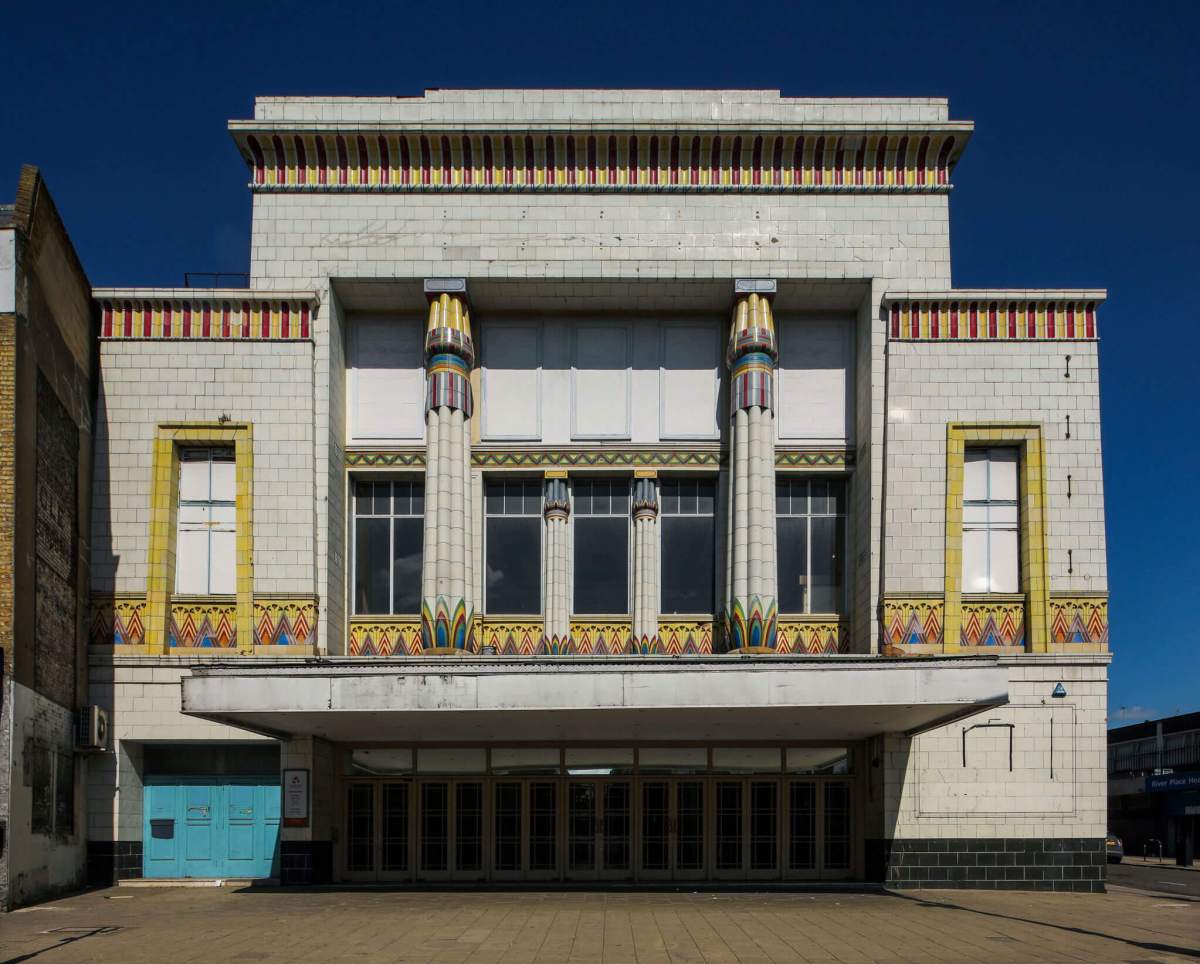
    Egyptian themed facade at the Gracepoint Church (former Carlton Cinema), Islington London; designed in 1930 by George Coles. © Sirj Photography

    Cinemas in decline

    Sadly, the golden age of cinema construction was short-lived. From the 1950s, the popularity of television led to a decline in cinema-going, and by 1963, the number of operational cinemas had more than halved to 2,181.

    From the 1980s, the advent of home videos accelerated the decline and this, combined with the shift to functional multiplexes, saw the closure of scores of 20th-century cinemas. By 2022 there were just 1,087 cinemas in operation in Britain.

    Archive black and white photograph of a staircase within a cinema.
    A 1930s image of the Grand staircase at the Woolwich Granada Cinema., Woolwich. Courtesy of Cinema Theatre Association Archive.

    Many cinema buildings were saved through reuse as nightclubs and bingo halls, but this frequently required destructive alterations such as the removal of fixed seating and raked flooring.

    By the 1980s, amenity societies such as the Cinema Theatre Association began to champion the cause of these buildings, resulting in the listing of many important examples.

    In the 21st century, former cinemas faced yet another threat, as the indoor smoking ban in 2007 led to the widespread closure of bingo halls. For the numerous empty cinemas, even listing couldn’t guarantee protection against neglect, vandalism and demolition.

    The facade of a former cinema converted into a church, the frieze at the top of the facade is in a moorish style.
    ‘Moorish’ style facade at the Ealing Christian Centre, (former Avenue Cinema), Ealing London. Designed by Cecil Masey, 1932. © Sirj Photography

    Cinemas as places of worship

    In recent years, many of these buildings have found new life as places of worship, with religious communities restoring the buildings to their former glory.

    While former cinemas may seem an unusual venue for a church, mosque, gurdwara or temple, they are often ideally suited to worship.

    The interior of a cinema converted to a temple, with a shrine on a dias.
    Interior of the Nanaksar Gurdwara Gursikh temple (former Redesdale Cinema, Coventry). © Sirj Photography.

    The spatial organisation of cinemas lends itself well to the performative style of worship in Pentecostal churches, where the stage provides a platform for musical services. In mosques, expansive auditoria can accommodate large numbers of worshippers for Friday prayers.

    In Hindu temples, the open spaces can accommodate free-standing shrines that worshippers process around. In gurdwaras, large rooms are often converted into dining halls and langar kitchens, which serve free food to the religious and local community.

    A group of ornate canopied shrines within a temple.
    Ornate shrines in the Kent Shri Shwarna Dhurgai Amman (former King’s Theatre, Ramsagate. © Sirj Photography.

    The Christ Faith Tabernacle, Woolwich, London (formerly Granada Theatre)

    The Christ Faith Tabernacle Cathedral now occupies the building that was once the Granada Theatre in Woolwich, London. The building was completed in 1937 to designs by the renowned cinema architect Cecil Masey, with the Art Deco façade by Reginald H. Uren. 

    A black and white 1930s illustration of an art-deco cinema.
    1930s illustration of the former Grenada Cinema, Woolwich. Courtesy of Cinema Theatre Association Archive.

    The former Granada was acquired by the Christ Faith Tabernacle community in 2011, who have since undertaken a painstaking restoration, which included reinstating the rake, organ and fixed seating.

    Photograph of the exterior of  an art deco style brick cinema converted to a church.
    The exterior of the former Grenada Cinema, Woolwich., after conversion to the Christ Faith Tabernacle© Sirj Photography.

    The building is noted for its dramatic Gothic interior, which was created by Russian set designer Theodore Komisarjevsky. The design was intended to be church-like, with Komisarjevsky writing that he had purposely chosen the Italian Gothic style at the Granada, because it was used “mostly in churches…which were designed for ‘religious shows’ which have the same origin as the shows of Secular theatre.”

    Christ Faith Tabernacle, interior. © Sirj Photography.

    The Bath Forum, Bath, Somerset (former Forum Cinema)

    The Bath Forum is a church and venue operating in the former Forum Cinema in Bath, Somerset. This striking Grade II* listed ‘super cinema’ was completed in 1934 to designs by A.S Gray. The cinema closed in 1969 and, following a period as a bingo hall, it was acquired in 1988 by the Bath Christian Trust, for use as a place of worship, theatre and concert venue.

    The Trust invested in a sensitive renovation of the building and its opulent Art Deco interior.

    Portsmouth Jami Mosque and Islamic Centre, Southsea, Hampshire (former Gaumont)

    The Portsmouth Jami Mosque and Islamic Centre in Southsea, occupies the former Gaumont (originally Plaza Cinema), which was designed by Henry J. Dyer and Son and opened in 1928. The interior was decorated in the ‘Atmospheric’ style, which featured inventive lighting effects to simulate sunlight, moonlight, and cloud effects on the ceiling.

    The entrance to a former cinema accessed by steps.
    The exteror of the Portsmouth Jami Mosque. © Sirj Photography.

    The cinema closed in 1965 and was subsequently converted into a bingo club, which operated until 1997. In 1999, an arson attack on the empty building left it badly damaged. The building was purchased in 2002 for use as a Mosque and community centre. Since acquiring the former Gaumont, the community has undertaken a meticulous refurbishment of the building.

    the interior of a former historic cinema, with  a curved ceiling.
    Interior of the Portsmouth Jami Mosque. © Sirj Photography.

    Jehovah’s Witnesses Assembly Hall, Wythenshaw, Manchester, Greater Manchester (former ABC)

    This Jehovah’s Witnesses Assembly Hall is housed in the former ABC cinema in Wythenshaw, Manchester, which was designed in the ‘Jazz Modern’ style. The building features a unique colourful interior with decorative plasterwork that resembles a church organ.

    A view of a colourful historic cinema interior looking towards the stage/screen area.
    The interior of the Jehova’s Witnesses Assembly Hall, Wythenshaw. © Sirj Photography.

    The ABC opened in 1934 and was originally operated by the Independent Forum Cinema Company, but was taken over in 1936 by Associated British Cinemas and renamed ABC in 1964. The cinema closed in 1974 and was used as a live theatre until the Jehovah’s Witnesses acquired it for use as an assembly hall.

    A similar Jehovah’s Witness Kingdom Hall was established in the unlisted former ABC cinema in Southgate London. The communities have restored both to a high standard.

    The exterior of a converted historic cinema built of brick with a rendered entrance bay.
    The exterior of the Jehova’s Witnesses Assembly Hall, Wythenshaw. © Sirj Photography.

    Ruach City Church, Kilburn, London (former Gaumont State ) Grade II*

    The former Gaumont State, the largest cinema ever built in England, was completed in 1937 to designs by the celebrated cinema architect George Coles. The Art Deco exterior was inspired by the Empire State Building in New York, which had recently been completed, but the interior employed a more traditional classical style.

    The exterior of a former art deco style cinema and adjacent parade of shops.
    The exterior of the former Gaumont State Cinema, Kilburn, London. © Sirj Photography.

    In 1981, the cinema closed and was converted into a bingo hall. After the closure of the bingo hall, the Gaumont was acquired by the Ruach City Church in 2008 and opened for worship in 2010.

    The building was painstakingly restored and retains its original organ. The former cinema is ideally suited to the community’s lively, performative worship.

    View of a historic cinema interior with an ornate ceiling.
    Interior of the former Gaumont State Cinema, Kilburn. © Sirj Photography.

    The Zoroastrian Centre, Harrow, London (formerly Ace Cinema, originally Grosvenor Cinema) Grade II*.

    The Zoroastrian Centre occupies the former Ace Cinema, which was completed in 1936 to designs by F.E. Bromige. The distinctive cinema was listed in 1981 at Grade II and subsequently upgraded to Grade II* in 1984 in recognition of its unique sweeping Art Deco façade and interior.

    The exterior of a former historic cinema with a sweeping art deco design.
    The exterior of the Zoroastrian Centre, Harrow, London. © Sirj Photography.

    The Ace Cinema closed in 1986 and was used as a bingo hall until 1999, when it was acquired by the Zoroastrian Trust Funds of Europe, who undertook a costly restoration of the building. As a result of the work undertaken by the Zoroastrians, the cinema was removed from the Heritage at Risk Register in 2005.

    The building is now used for religious ceremonies and community events, with the former projection room housing the Zoroastrian sacred fire.

    The interior of a converted historic cinema, looking towards the stage/screen area, at the top of which are Zoroastrian symbols.
    The exterior of the Zoroastrian Centre, Harrow, London. © Sirj Photography.

    The future of cinema buildings in England

    Repurposed cinema buildings are once again facing threats, as the nighttime economy struggles and pubs, restaurants and bars have closed.

    In contrast, many cinemas that have been converted into churches, mosques, and temples have remained in use and continue to flourish.

    These buildings are surprisingly well-suited to worship and have become cherished landmarks for the religious communities that have given them a new life.

    Further reading

    Cinema Treasures Website

  • historic pubs with a festive theme

    historic pubs with a festive theme

    In this blog post we’ll explore the hidden histories of listed pubs with a festive theme, selected by Amy and Caroline from Historic England’s Listing Policy Team.

    Pubs are often part of our festive celebrations, whether that’s a warming mulled wine after a busy day of gift shopping, or a work celebration with Christmas crackers and paper party hats.

    There are over 12,000 listed pubs and inns in England, making up around 3.2% of all listed buildings. Many have fascinating stories to tell, whether through the people who lived, worked and drank there, the signs and symbols used to identify them or the traditions that developed there. Some have traditions of connections to important parts of our national story, such as the English Civil War, others have connections to famous figures, and some may even have tales of residents of a more supernatural kind.

    1 .Ye Olde Reine Deer Inn, Banbury, Oxfordshire

    Dating from the 16th century, Banbury’s Ye Olde Reine Deer Inn has a storied past as one of the town’s oldest pubs. The inn’s 17th century Globe Room made it a venue of the highest quality, with wood panelling, a richly carved and painted ceiling and a large stone fireplace. Local legend links the room to Oliver Cromwell, who supposedly used it as a base for his part in the nearby Battle of Edgehill.

    Street view showing the Ye Olde Reine Deer Inn, Parsons Street, Banbury. Contributed to the Missing Pieces Project by Brian Mawdsley. View list entry 1369571.

    The Globe Room became well known and a popular local attraction in the 19th century, after the Architectural Association included a description, diagrams and photographs of the room in their journal. In 1899, plaster casts of the ceiling were made by the Victoria and Albert Museum. These are still on display today in the Cast Courts at the museum’s South Kensington site. The design of the ceiling became so popular that it was copied elsewhere, including at Knowsley Hall in Liverpool, and in the Houses of Parliament.

    The room’s panelling was sold off in 1912 but was later returned to the pub in the 1960s, although the ceiling was lost. You can still enjoy a pint in the historic surroundings of The Globe Room today, drinking in the atmosphere of centuries past.

    A black and white archive image of the interior of a wood panelled room with an ornate moulded ceiling.
    Interior view of the Globe Room at The Reindeer Inn, showing the fireplace, tables and chairs, and the moulded ceiling, 1878. Source Historic England Archive.

    2. The Angel, Andover, Hampshire

    Like Ye Olde Reine Deer Inn, The Angel has traditions about some celebrated guests. At least ‘three kings’ have stayed or dined here, according to information on display in the pub. Notable royal guests have reportedly included Henry VII, Catherine of Aragon, Prince George of Denmark, and James II.

    The exterior of a brick public house with a carriage entrance through to a courtyard.
    The Angel Inn, Andover, Hampshire. Contributed to the Missing Pieces Project by Brian Mawdsley. View list entry 1093460

    3. The Star Inn, Alfriston, East Sussex (previously known as The Star of Bethlehem)

    The 15th century Star Inn at Alfriston was previously known as The Star of Bethlehem, perhaps because it offered sanctuary to weary pilgrims on route to the Shrine of St Richard, previously located at Chichester Cathedral. Managed as a hostel by the monks of nearby Battle Abbey, the inn’s exterior features carvings with religious themes, including St George and the Dragon.

    With such a long history, it is perhaps unsurprising that the pub is reported to be haunted, including by a lady dressed in grey and a ghostly monk, whose presence it is said, can be detected by the smell of wafting incense.

    The inn’s dark past isn’t limited to its ghostly inhabitants: on the front of the building stands a carved lion, said to be formerly a ship’s figurehead. Tradition has it that it came from a Dutch warship which sank in the English Channel and washed up at nearby Cuckmere Haven. A gang of local smugglers supposedly brought the figurehead to the pub, where it adds to the quirky exterior.

    A black and white archive image of the exterior of a timber framed public house.
    The Star Inn, High Street, Alfriston, East Sussex. The lion figurehead is visible in the bottom left hand corner. Taken between 1940 and 1949. © Historic England Archive BB57/00149

    4. Ye Olde Trip to Jerusalem, Nottingham

    Is Ye Olde Trip to Jerusalem the oldest inn in England? That claim is disputed, and you can read more about it elsewhere on our blog. Our list entry dates it to the 1600s, although some parts of the building, like the caves you can see below, are older. Regardless of its age, there are plenty of legendary tales associated with Ye Olde Trip to Jerusalem.

    Supposedly, the pub’s name comes from King Richard the Lionheart stopping there before journeying to Jerusalem in 1189. It’s had various names over the years, though. At one time, it was The Pilgrim (for which there is a record in 1760) and four decades later, it was called The Trip (there is a record dating to 1799). It’s also said that the pub was a local hideout for Robin Hood himself (another icon who inspired a host of pub names).

    If you’re driving home for Christmas and pass Ye Olde Trip to Jerusalem, stop by – but make sure you think twice before sitting in the ‘pregnancy chair’ (in the fireplace below), which is said to increase your chances of becoming pregnant!

    The interior of pub built inside a cave.
    Ye Olde Trip to Jerusalem Public House. I Brewhouse Yard, Nottingham. Nottinghamshire. First floor, Ship Bar. © Historic England Archive DP046289

    5. The Christmas Steps, Bristol

    Bristol folk know: the cosiest place to be is The Christmas Steps in December. Plenty of nooks, a roaring hearth, and a sensitively styled interior that nods to its 425-year history. It is possible that it was first named The Horse’s Head, as there are 1613 burial records of a Black serving maid named Katherine working at an inn called The Horse’s Head which appears to have stood at the same location.

    Over the years, it has been known as The Gaiety (also rather festive!), The Three Sugar Loaves, and much more. Nothing has suited it quite like The Christmas Steps, though.

    A rendered pub with a set of steps leading to it in the background.
    The Christmas Steps pub, Bristol. Contributed to the Missing Pieces project by Amy Burnett. View List entry.

    6. The Shepherd and Shepherdess Public House, Beamish, County Durham

    Rather than watching their flock by night, the life-sized lead statues at The Shepherd and Shepherdess Public House, Beamish, County Durham watch over regulars and visitors to this 18th century village pub.

    According to the pub’s website, the statues have a rather surprising history. The story goes that the figures were imported from France during the Napoleonic wars, when the French imposed a blockade on lead to prevent the English from producing munitions. The lead was disguised as a set of decorative statues to avoid the blockade. Rather than being melted down as planned, they were purchased by the squire of nearby Beamish Hall, who erected them above the entrance to his home.

    Following a storm, the figures were relocated to a lawn, but after a frightening encounter with them on a dark night the squire gave them away to the pub, where they have graced the entrance ever since. Located close to Beamish Museum, the colourful, classically inspired lead statues are an eye-catching advertisement for the pub.

    A black and white archive image of a public house, over the entrance are two life-size statues.
    The Shepherd and Shepherdess Public House, Beamish, County Durham. Ursula Clark © Historic England Archive UXC01/01/01/1164/34.

    7. The Holly Bush, Hampstead, London 

    ‘The Holly Bush’ is a popular name for English pubs, and not just for the festive inn signs it can inspire, such as that at Hampstead’s The Holly Bush. When medieval women brewed ale and had some excess to sell, they would put a temporary sign outside their houses to let people know they had drink for sale. This sign could be something like a wreath or small bush hung above a doorway, often a holly bush.  

    Black and white street scene showing hanging sign for The Holly Bush.
    The Holly Bush, Hampstead, London. John Gay, taken between 1957 and 1965. © Historic England Archive aa072438

    As time went on, there were more and more ‘permanent’ establishments with painted wooden signs; but innkeepers and alehouse keepers continued the tradition by adorning their doorways with bushes and wreaths. Even today, publicans at The Holly Bush hang flora outside to welcome guests inside. 

    When you’re hanging a wreath on your door this Christmas, remember: this is a tradition that’s always been about providing a warm welcome… and a glass of something delicious! 

     Exterior photograph of a pub painted white with hanging baskets and the name The Holly Bush painted on the front.
    The Holly Bush, Hampstead, London. Contributed to the Missing Pieces Project by David Lovell. View list entry 1379102

    8. ‘The three kings’: The King’s Head, Laxfield, Suffolk, The King’s Head Inn, Aylesbury, Buckinghamshire and The King’s Head and Bell, Abingdon, Oxfordshire

    Pubs with the name ‘king’ in the title are common: there are more than 60 listed pubs and inns called The King’s Arms or The King’s Head, and both names are in the top 20 most common names for listed pubs. Here are three historic King’s Head pubs from across the country to explore – you might not find the gifts of gold, frankincense and myrrh, but you will find real ale, traditional character and bags of history.

    The courtyard of a public house at dusk, with tables and benches, lit by strings of lanterns.
    Courtyard of The King’s Head, Aylesbury, Buckinghamshire. © Historic England Archive DP528213.

    Managed by The National Trust, The King’s Head, Aylesbury dates back to at least the 15th century and although it has been altered throughout the years, many historic features remain. This includes the stables and mounting block from when it was used as a coaching inn, and rare stained glass windows in what was once The Great Hall, originally constructed as guest accommodation for nearby Claydon House.

    The interior of a room within a historic pub showing timber construction and  window with heraldic designs.
    The Great Hall with stained glass windows at The King’s Head, Aylesbury, Buckinghamshire. © Historic England Archive DP528221.

    The inn also houses an Act of Parliament clock. These clocks (also known as tavern clocks) were installed in pubs and other public spaces to allow travellers to tell the time, during a brief period of heavy taxation on clocks.

    Photograph of a wooden tavern clock, with gold detailing, gold hands and roman numerals.
    Tavern Clock at The King’s Head, Aylesbury, Buckinghamshire. © Historic England Archive DP528225.

    The ‘King’ in question in the pub’s name may have been King Richard II, after an earlier 14th century inn on the site (called the ‘Kyngshede’), or King Henry VI, who reigned when the 15th century inn was built.

    Like at Aylesbury, The King’s Head and Bell, Abingdon also offered stabling for horses, and the courtyard and coach entrance are still visible. Much of this historic pub dates back to the 18th century, with some 17th century elements, although there has been an inn on the same site from at least the mid-16th century. Originally named ‘The Bell’, The King’s Head may have been added later to give weight to a connection with Charles I, who is alleged to have stayed here and to have held at least one council of war at the inn.

    Alt text: A black and white photograph of the corner of a street showing a pub with a carriage entrance and tall chimneys.
    The King’s Head and Bell, Abingdon, Oxfordshire. Eric de Maré. © Historic England Archive AA98/05885.

    The charming, thatched King’s Head at Laxfield may have begun as a traditional Suffolk longhouse, probably dating to the 16th century. Its use as a pub began in at least the late 18th century, and its interior includes many unaltered historic features. Unusually the pub has no bar, and beers are served from casks in the tap room. Only around 7 pubs in England still have this arrangement. It also features wooden settles – high backed benches – which help to create a cosy feel.

    A room containing casks of ale on wooden benches and a chalkboard listing current beers for sale.
    Tap room at The King’s Head (The Low House), Laxfield, Suffolk. © Historic England Archive DP312541.

    In the early 1990s The King’s Head was purchased by a consortium of locals. This happened again in 2018, when it was purchased from the brewery by a Community Interest Company (CIC) made up of locals who wanted to ensure the long term future of their village pub, which is also known locally as The Low House.

    Historically, taverns offered a range of functions alongside accommodation and hospitality, and the three ‘Kings Head’ pubs mentioned here are no exception. The pub at Aylesbury provided postal services, the Abingdon inn offered stabling for the horses used by the volunteer fire brigade and the inn at Laxfield was used for inquests and legal proceedings, as well as providing workshop space for a carpenter, wheelwright and shoemaker.

     A cream coloured, thatched roof pub with some tables and benches outside.
    The King’s Head (The Low House), Laxfield, Suffolk. © Historic England Archive DP312519.

    9. “Rocking around the Christmas tree” at the Bell Inn, Bath

    Like The King’s Head at Laxfield, Bath’s The Bell Inn is a great example of a community-owned pub. Since 2013, it has been owned by over 650 customers. At the time, it was the largest pub buyout project in the country.  The Bell Inn is also a flourishing live music venue and has been since at least the 1970s. The community buyout scheme was even backed by big names in music, including Robert Plant and Peter Gabriel. The pub has existed since at least the middle of the 18th century as evidenced by historic council meeting documents.

    The exterior of a stone public house with a bell hanging from a bracket above the entrance.
    The Bell public house, photographed in 2024. Contributed to the Missing Pieces Project by Simon Jones.

    10. St. Nicholas Arms, Carlisle

    What’s a Christmas blogpost without a nod to St. Nick?

    Continuing a long tradition of homes that became public drinking houses, the lovely St Nicholas Arms maintains a homely feel in its cosy nooks. The Georgian home appears on an 1842 map of Carlisle, albeit as a private residence called St. Nicholas’ View.

    In 1921, it was proposed as a pub by the Carlisle and District State Management Scheme. This was part of an effort to reduce overcrowding in the pubs at the lower end of Botchergate, but it wasn’t especially popular. Despite 900 residents objecting to the plans, the St. Nicholas Arms opened in 1921 and has been serving pints for over a century.

    A brick pub with a red door, and red hanging sign.
    St Nicholas Arms, Carlisle, Cumberland. Photograph taken in 2002 for the Images of England project. © Mr Dennis Balmer. Source: Historic England Archive

    11. and 12. The Partridge Inn, Singleton, West Sussex and The Pear Tree Inn, Melksham, Wiltshire

    To round out the 12 pubs of Christmas, we have a pair that simply had to be combined: The Partridge Inn and the Pear Tree Inn.

    Both these names are traditional. The painted wooden inn signs mentioned in The Holly Bush entry were widely used before full literacy was common. A name like Ye Olde Trip to Jerusalem wouldn’t have caught on unless people could read a name like that; whereas a sign that had, for instance, a pear tree painted on it would have become known as The Pear Tree. “She was drinking at the sign of the Pear Tree” people might have said.

    Any establishment with either of these names will certainly hear The Twelve Days of Christmas a lot this December!

    A cream coloured pub with a hanging sign showing a partridge.
    The Patridge Inn, Singleton, Chichester, West Sussex. Contributed to the Missing Pieces Project by David Dunford. View list entry 1026203.

    ‘Inn-terested’ in historic pubs? Visit our ‘Pubs Hub’ to find out more about our research, listing work and more. You’ll also find links to historic pub walks, and advice on protecting your local historic pub.

    We are also inviting you to add more images of historic pubs through the Missing pieces project: to find out more see our ‘Winter Warmers’ page.

    Our heritage pubs feel extra special at Christmastime: the names, the signs, the interiors, and the warm welcome all carry some extra festive magic at this time of year. Know another pub with a festive name or connection? Let us know in the comments.

    Further reading

  • Alsatian conscription evaders in Switzerland – Swiss National Museum

    Alsatian conscription evaders in Switzerland – Swiss National Museum

    On the evening of 12 February 1943, the group congregated in the Alsatian town of Ballersdorf, before setting off on foot into the darkness at around 10 pm. Their aim was to cross the Swiss border – around 15 kilometres to the south as the crow flies – to avoid being forcibly conscripted to fight in the Wehrmacht.

    The men, aged between 18 and 33, were mainly farmers and students. They hailed from Ballersdorf and from surrounding towns and villages. Carrying a small number of firearms, they were intent on making their way to Switzerland, as other groups of conscription evaders had done in previous days. This had led to a crackdown on escape attempts by the German authorities, with border guards quite prepared to shoot anyone trying to cross the border illegally.

    Guided only by the light of the moon, the men cut across fields, avoiding main roads and villages. Around midnight, they arrived close to Seppois-le-Bas, just four kilometres from the border. Suddenly, there were screams. The group had been discovered by a patrol of German border guards. Shooting ensued, killing three of the Alsatians, and seriously wounding a German, who succumbed to his injuries the next day.

    What led this group of young Alsatian men to try and flee? In 1940, during the Western Campaign, the Wehrmacht overwhelmed France within the space of a few weeks. On 22 June of that year, France signed a momentous armistice with Nazi Germany in Compiègne. From then on, 60 per cent of France was occupied by the Wehrmacht, while the free zone (zone libre) was governed by the Vichy Regime, which was closely aligned with Germany. Shortly afterwards, the German Reich annexed Alsace-Lorraine, which comprised the current French departments of Moselle, Bas-Rhin and Haut-Rhin. The people living in Alsace-Lorraine were seen by the Nazis as ethnically German and were therefore subject to the same obligations as the German people.

    A phase of Germanisation and Nazification ensued in the annexed areas: German was made the official language, teachers were ‘re-educated’ or replaced by German staff, and all traces of France, from monuments to street names and family names, were erased.

    The transits to Annemasse ended in November 1942 when the free zone was occupied by German and Italian troops following the Allied landings in North Africa. By late 1942, the Swiss authorities had put in place a centralised system for the reception, accommodation and internment of escapees, and significantly expanded intake capacity.

    The Alsatians who entered Switzerland on the north-west border were first taken to reception and transit camps, particularly those in militarily-controlled Büren an der Aare (canton of Bern) and Büsserach (canton of Solothurn), where they underwent medical examinations and were questioned by police. They were then notified of the official decision regarding admission and internment in Switzerland, before being placed in labour camps, on farms or with relatives depending on their physical state and financial means. The work in the camps involved tasks such as clearing fallow land, extracting peat (like in Tramelan in the Bernese Jura), building roads, and carrying out groundwork along the Rhône (as in Visp). Under the Hague Convention, deserters from the Wehrmacht were interned in military camps.

    A labour camp was set up in Cossonay (canton of Vaud) for academics, with 120 French internees – half of whom were from Alsace. The idea for this camp had been proposed by Father Keller, the chaplain in the internment camps. Between July 1943 and July 1944, escapees with a secondary school leaving certificate and those who were already attending university, could continue their studies there. In the mornings they helped with land-clearance and drainage work on sites in the north of the town. The afternoons were dedicated to study, which was led by a number of internees, occasionally supported by renowned professors from the University of Lausanne. The camp was officially closed on 14 July 1944 due to many internees attempting escape to Savoie with a view to France’s liberation following the Normandy landings. The internees were then transferred to the Zweidlen camp (canton of Zurich), just one kilometre from the German border: a radical measure, but one which failed to put a stop to the escape attempts.

    In early 1942, the Alsatian resistance movement Réseau Martial decided to set up secret units. Three Groupes mobiles d’Alsace (GMA) were established: GMA Sud in the southern part of France, GMA Vosges, and GMA Suisse. GMA Suisse was headed by Commandant Georges, who had crossed the Swiss border in October 1943. He was supported by chaplain Father Keller, by staff from the French consulate in Basel and from the Aide fraternelle aux réfugiés français, an association led by Pierre de Leusse, a representative of General De Gaulle’s provisional government. The ‘Free France’ committee in London financed GMA Suisse through Allen Dulles, the head of the US intelligence service OSS in Bern.

    The D-Day landings on 6 June 1944 gave the GMA an additional boost. Commandant Georges and his secret general staff in Switzerland managed to recruit between 1,800 and 2,000 men, including 200 Wehrmacht deserters. These soldiers were found with the aid of lists, mainly compiled by Father Keller. As camp chaplain, Keller was able to move around freely and had decided of his own accord to collect information, which was used to locate men in 86 camps and in the homes of many individuals throughout Switzerland.

    The recruitment of troops and their potential repatriation were negotiated with the Swiss authorities. Throughout the war, Switzerland was careful to maintain relations with the French authorities, while avoiding any action that could be construed as provocation by Nazi Germany. When it became clear that the Nazis were going to lose the war, the Swiss authorities adopted a pragmatic policy towards free France.

    The original goal of GMA Suisse was to support the Allies by intervening behind the enemy line between the Vosges and the Swiss border. However, the difficulties encountered in the weapons and equipment airdrops in the Vosges, and the significance of the region to the German military authorities meant its mission had to be modified. GMA Suisse was integrated into the French 1st Army under General de Lattre de Tassigny, whose units had landed in Provence and were marching up the Rhône Valley.

    In early September 1944, the GMA Suisse recruits received their mission order. The French consulate in Basel provided them with a sack of supplies, equipment and a transportation certificate, which they could use to reach a meeting point on the Swiss Federal Railway. An agreement was made with the Swiss authorities that they would accept voluntary repatriation requests from French internees and would initiate the administrative procedure for their departures.

    The first transfer took place on 21 September, with 200 recruits transported to a camp at Col-des-Roches close to Le Locle (canton of Neuchâtel) by the Swiss Army. From there, they were taken in a French military truck to Ornans in the French department of Doubs and then on to the Valdahon Camp, where they were trained and equipped.

    Within the 1st Army, the battalions of GMA Suisse took part in fighting in November 1944 along the Swiss border, a region from which many of them originally hailed. Among them was René Grienenberger, the only survivor from the group who had tried to escape from Ballersdorf.

  • Sabina Spielrein – a rediscovered voice of psychoanalysis – Swiss National Museum

    Sabina Spielrein – a rediscovered voice of psychoanalysis – Swiss National Museum

    Landscapes of the Soul. C.G. Jung and the exploration of the human psyche in Switzerland

    Switzerland has been home to a number of soul searchers over the years, such as Jean-Jacques Rousseau, Friedrich Nietzsche and Carl Gustav Jung. Their work had a major impact on the development of psychiatry and psychoanalysis. To mark the 150th birthday of C. G. Jung, the exhibition presents the history of psychoanalysis in Switzerland. The main exhibit is Jung’s ‘Red Book’, supplemented by contributions from Johann Heinrich Füssli, Louise Bourgeois, Rudolf Steiner, Meret Oppenheim, Thomas Hirschhorn, Heidi Bucher and many more.

  • The right to privacy, except during wartime – Swiss National Museum

    The right to privacy, except during wartime – Swiss National Museum

    During times of political unrest – especially during the two world wars – state censors monitored private as well as military correspondence. They made no attempt to hide their actions.

    Nadja Ackermann

    Nadja Ackermann is a scientific archivist responsible for company archives in the Burgerbibliothek Bern.

  • The bombing of the Sihl plain – Swiss National Museum

    The bombing of the Sihl plain – Swiss National Museum

    The first attempts involved buried bombs before dropping the high-explosive and finally firebombs. An illustrated report in weekly newspaper Zürcher Illustrierte contained a number of striking photographs demonstrating the effect of a high-explosive bomb, which fell about a metre from the building. The article said: “The detonation could be heard over 10 km away. It left an 8-metre wide and 2.5-metre deep crater. Stones, clods of earth, roof tiles, boards and other parts of the house were sent flying up to 80 metres in the air. Part of the building collapsed sideways and almost entirely disappeared into the crater.” One of the pictures is very blurred. That was due to the ground shaking from the bombs as apologetically explained in the article. The photographer was 500 metres from the house, which was how far the bomb fragments reached. One of the fragments, about eight centimetres long, is shown in the report.

    Next up was the second house in the direction of the hamlet ‘Birchli’. The slopes were “full of spectators” by then according to a report in the Neue Zürcher Nachrichten (NZN). The people followed the dive and dropping of the bombs “with bated breath”. “Aerial bombardment in the Lake Sihl basin” was the headline in Der Sonntag magazine. The NZN concluded its report thus: “The people experienced a sensation and a rare, remorselessly destructive spectacle. Something we hope never to see for real.”

    Just under seven years after the bombing, Einsiedeln was to receive a taste of real war. An English bomber that had been involved in the RAF’s disastrous raid on Augsburg had been so hard hit by German anti-aircraft fire that it diverted to Switzerland and exploded in a big fireball over Lake Sihl. The Einsiedler Anzeiger reported that the explosion had been so powerful that “people were thrown around in their beds while the furniture shook and entire houses vibrated.” The aircrew had managed to vacate the airplane shortly before the explosion, only one crew member who had already been injured died after his parachute jump. The frozen Lake Sihl, however, resembled a giant field of debris; only the heaviest pieces of debris penetrated the ice.

    These days, Lake Sihl looks like it’s been there forever. No trace remains of the natural and cultivated landscape from the 1930s, which now lies almost 20 metres under the water.

  • An extraordinarily successful couple – Swiss National Museum

    An extraordinarily successful couple – Swiss National Museum

    Hans Peter Tschudi was proud of his wife, whom he had married in spring 1952, and of her success as a scientist: “Towards the end of my time at the Trade Inspectorate, I had the good fortune to meet Irma Steiner, Dr. med. et phil. nat., a qualified lecturer and assistant at the pharmaceutical institute at the university.” He valued her certainty in factual and personal matters. As head of the Department of Home Affairs, her medical and scientific knowledge were especially valuable to him in managing the Federal Office of Public Health.

    Irma Tschudi-Steiner not only stood out in terms of her career. She enjoyed smoking cigars and driving special sports cars. Her husband, on the other hand, didn’t even have a driving licence in spite of his portfolio including the national motorway network as head of the Department of Home Affairs.

    Hans Peter Tschudi gained great popularity when he wrote a book on Swiss employee protection law for the Swiss Federation of Trade Unions (SGB) following his retirement. Irma Tschudi offered her services as a lecturer to the third-age universities in Basel and Bern and successfully covered topics of interest to senior citizens.

  • The ‘glacier pastor’ – Swiss National Museum

    The ‘glacier pastor’ – Swiss National Museum

    Gottfried Strasser was born on 12 March 1854 in Lauenen near Gstaad. His father Johannes, a clergyman, was married to Emilie Katharina Ludwig, whose father Emanuel had been a pastor at Bern Minster. The family moved to Langnau in the Emmental region in 1855. Gottfried grew up there, in a lively household of two sisters and five brothers, during an era of great change. At the age of ten he witnessed the opening of the railway line between Bern and Langnau, when horse-drawn coaches gave way to the ‘iron horse’. And the billeting in the town of around 500 soldiers from Bourbaki’s army in 1871 left a lasting impression on the young lad.

    Strasser’s penchant for poetry began to shine through at an early age. He penned sundry, mainly humorous texts in the pages of his friendship book while still at secondary school. He then went on to study theology in Bern from 1873, making additional study trips to Germany. He was put forward for the position of pastor in Grindelwald without actually applying and unanimously chosen by the congregation on 23 February 1879.

    The colossal glaciers close by had earned this parish in the Bernese Oberland the nickname of ‘glacier village’. Strasser quickly settled in and soon came to be known far and wide as the ‘glacier pastor’. Himself a keen mountaineer, he made the most of the surrounding Alpine landscape to venture forth on a number of hiking tours, often accompanied by local mountain guides. His passion for the mountains led him to join the board of the Swiss Alpine Club (SAC), where he would later become secretary of the Grindelwald section and chair of the examination committee for mountain guide courses. It was at an official SAC event that he first met Elise Anna Rüegg from the Zurich Oberland area. The couple would marry in 1881 and have eight children together: four girls and four boys.

  • Defending Switzerland against attacks that never happened – Swiss National Museum

    Defending Switzerland against attacks that never happened – Swiss National Museum

    In the early 19th century, Switzerland was traumatised by the French invasion of 1798 and there were fears that France would attack again. In Switzerland’s defence planning, Aarberg was a strategic military location as French armies could potentially cross the River Aare there. An obstacle was therefore needed.

    Juri Jaquemet

    Dr. phil., Curator of the Information and Communication Technology Collection, Museum of Communication, Berne

  • Where was Jesus born? – Swiss National Museum

    Where was Jesus born? – Swiss National Museum

    The setting in which Jesus actually came into the world remains a mystery – but the way it has been imagined has shaped Christian Christmas culture for centuries. In art and crib building, the nativity scene has been depicted in various locations, including a stable, a cave, a ruin, and a house, in each case reflecting the values and ways of life of the respective periods.

    Alexander Rechsteiner

    Alexander Rechsteiner holds an M A in modern English literature and political science and is Head of Marketing & Communication at the National Museum Zurich.